For other versions of this work, see Chiushingura.
Chiushingura;
Or,
The Loyal League.
A Japanese Romance
Translated by
Frederick V. Dickins, Sc.B.,
of the Middle Temple, Barrister-at-Law.
With Notes and an Appendix Containing a Metrical Version of the Ballad of Takasago.
and a
Specimen of the Original Text in the Japanese Characters.
Illustrated by Numerous Engravings on Wood, Drawn and Executed by Japanese Artists, and Printed on Japanese Paper.
“Est hic, est animus lucis contemptor, et… Qui vita bene credat emi … honorem.”
Virg.
New Edition.
London: Allen & Co., Waterloo Place.
MDCCCLXXX.
Errata and Addenda.
Appendix, p. 157.—“Meiji,” translated “illustrious rule,” is better rendered “enlightened rule.”
Appendix, p. 164.—“We shall climb together the Shide Hill.” The note here is erroneous. Mr. Chamberlain (Trans. As. Soc. of Japan, vol. vii., pt. iv., p. 293, n. 24) says: “Souls on their way to hell have to cross the river Sandzugawa, containing the waters of Avarice, Cruelty, and Envy, where a crone named Datsuiba despoils them of their raiment, which she hangs upon the branches of a willow tree.”
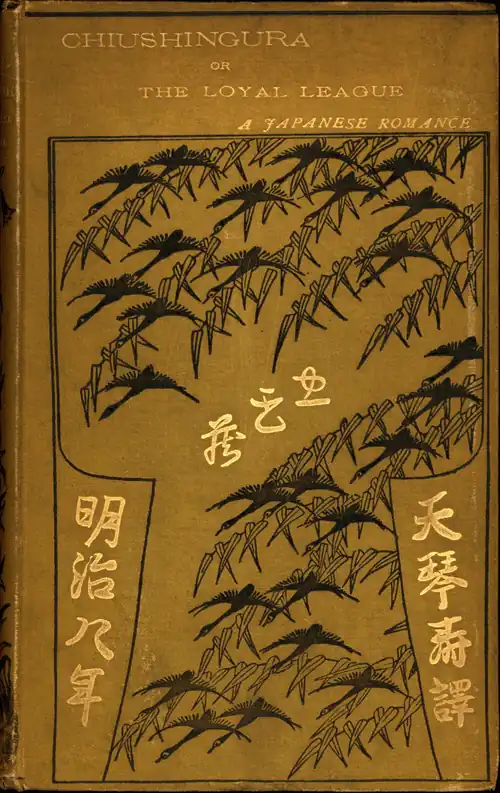
For the preparation of the design on the cover, taken from a Japanese album of decorative art some two hundred years old, in the possession of the translator, he is indebted to his friend, Mr. T. W. Cutler, of Queen’s Square, Bloomsbury.
(The Spirit of Takasago, the Spirit of Sumiyoshi, a Crane, and a Hairy Tortoise, with the Pine Tree, emblems of longevity.)
List of Principal Personages.
N.B.—Pronunciation. Vowels as in Italian, save “u” as in English “put,” “full,” “bull,” &c. Consonants as in English, h being well aspirated.
Bánnai (Ságisáka), retainer of Moronaho.
Gihéi (Amagawa), agent of Yenya.
Goyémon (Hara), retainer of Yenya.
Heiyémon (Teraoka), a common soldier, retainer of Yenya.
Hónzô (Kakogawa), chief councillor of Wakasanosuke.
Íshi (or O Ishi), wife of Yuranosuke.
Íshido (Umanojô), one of the commissioners present at the seppuku of Yenya.
Kámpei (Háyano), a retainer of Yenya, husband of Karu.
Káru (or O Karu), wife of Kampei (Hayano), daughter of Yoichibei, sold on his account to the teahouse in the Gion Street.
Kawóyo, wife of Yenya, beloved by Moronaho.
Konámi, daughter of Honzô, affianced to Rikiya.
Kitaháchi (Tákemóri), a retainer of Yenya.
Kudáiu (Ono), a disloyal retainer of Yenya.
Moronáho (Kô no), Lord of Musashi, superior and enemy of Yenya.
Náhoyóshi, deputy of the Shôgun.
Ríkiya, son of Yuranosuke, affianced to Konami.
Sadákuro (Ono), disloyal retainer of Yenya, son of Kudaiu and murderer of Yôichibei.
Tonáse, wife of Honzô.
Wákasanósuke Yasuchika, officer under Moronaho.
Yágoro (Sénzaki), retainer of Yenya.
Yákushìji (Jirôzáyemon), one of the commissioners present at the seppuku Yenya.
Yazáma Jiútarô, a retainer of Yenya.
Yénya Hánguwan Tákasáda, officer under Moronaho, husband of Kawayo.
Yôichibéi, a farmer, father of Karu, murdered by Sadakuro.
Yúranósuke (Òhobóshi), hero of the tale, chief retainer of Yenya.
Chiushingura;
or,
The Loyal League.
Translator’s Note.
he “Chiushingura” is, or at least was, one of the most popular and best-known romances in Japan. It is easy to understand why such should be the case, the main object of the tale being to glorify “chiushin” or loyal-heartedness, the supreme virtue of the Bushi class under the old order of things that passed away with the year 1868. The story is, as a mere story, not unskilfully constructed, and the variety of its incidents is sufficient to interest even the reader of the sensation novels of the period; while to those who still preserve some lingering affection for the quaint and picturesque national life that ended with the last decade, to be replaced by the vulgar and commonplace existence of the day, the following pages, as descriptive of old-world manners and already obsolete sentiments, a portion of a curious mediæval system that has lasted down to our own times, will not, it is hoped, be altogether unpleasing.
The title “Chiushingura” is hardly translatable, and is a notable example of the Japanese love of a play upon words. “Chiushin” may mean either “loyal-heartedness” or “loyal followers;” and “kura” (gura) signifies a treasury or storehouse, while it is also the first half of the name of the popular hero, Kuranosuke, of the historical episode of the “Forty-seven Rônin,” upon which the romance is founded, and which has been so pleasantly told by Mr. Mitford in his admirable “Tales of Old Japan.” The translator, therefore, without attempting to render the native title, has chosen that of the “Loyal League,” as fairly indicating the nature of the story, and preserving as much of the spirit of the original title as could be preserved in a single expression.
The translation, it should be premised, was made long since, in Europe, without the possibility of assistance; and although it has been revised with as much care as the limited leisure and still more limited scholarship of its author have permitted, there are, doubtless, numerous inaccuracies to be detected in it by those better versed in the language and literature of Japan than himself; for which an indulgent consideration is claimed.
The translation is made partly from the text of the abbreviated form in which the story is more commonly met with, but mainly from that of the “jôruri” (or musical romance) in which the tale is amplified and adapted for theatrical recitation.
A few explanatory additions, necessary to make the story plain to the English reader, have been incorporated with the translation, which is throughout, and purposely, a free one; and in some instances it has been found advisable to leave untranslated, or to translate shortly, portions of the original.
Note to the Present Edition.
The whole translation has been revised, and much of it rewritten. Errors in the earlier edition have been corrected, and the present version is, on the whole, a closer rendering of the text now followed than the former one. But it has not been the translator’s aim to assist in any way the student of Japanese, and amplification, condensation, and, to some extent, combination and alteration have been practised where judged advisable to meet the exigencies of English readers.
It should be added that the revision has been made in England, without the advantage of the usual native assistance in its preparation.
The text employed differs to some extent from that which served for the previous edition. New notes have been added, and the former notes have been rectified and enlarged. The Appendix has been but little altered.
f you don’t eat of a dish, however savoury, you can’t enjoy its flavour, they say; and so, in piping times of peace, the loyalty and bravery of valiant samurahi remain unnoticed, like as the light of the stars, unseen in the day-time, becomes visible only in the darkness and confusion of night; whereof an example will be found in the following syllabary written pages.
↑In the text the whole of the First Book is dignified by the name of “daijo” or “preface”; but the introductory sentence here translated alone deserves that title, the rest of the book being, in reality, a portion of the narrative.
This work is a translation and has a separate copyright status to the applicable copyright protections of the original content.
Original:
This work was published before January 1, 1930, and is in the public domain worldwide because the author died at least 100 years ago.
Public domainPublic domainfalsefalse
Translation:
This work was published before January 1, 1930, and is in the public domain worldwide because the author died at least 100 years ago.
















 he “Chiushingura” is, or at least was, one of the most popular and best-known romances in Japan. It is easy to understand why such should be the case, the main object of the tale being to glorify “chiushin” or loyal-heartedness, the supreme virtue of the Bushi class under the old order of things that passed away with the year 1868. The story is, as a mere story, not unskilfully constructed, and the variety of its incidents is sufficient to interest even the reader of the sensation novels of the period; while to those who still preserve some lingering affection for the quaint and picturesque national life that ended with the last decade, to be replaced by the vulgar and commonplace existence of the day, the following pages, as descriptive of old-world manners and already obsolete sentiments, a portion of a curious mediæval system that has lasted down to our own times, will not, it is hoped, be altogether unpleasing.



 f you don’t eat of a dish, however savoury, you can’t enjoy its flavour, they say; and so, in piping times of peace, the loyalty and bravery of valiant samurahi remain unnoticed, like as the light of the stars, unseen in the day-time, becomes visible only in the darkness and confusion of night; whereof an example will be found in the following syllabary written pages.



 This work is a translation and has a separate copyright status to the applicable copyright protections of the original content.