Chiushingura (1880)/Book 5
Book the Fifth.
The Night Adventure of Kampei.
 ot unmindful of the example set by the falcon, that even in the last extremity of hunger, will not peck at a single ear of grain, Hayano Kampei, as the dark nights and the bright days passed by, continued to dwell in poverty and seclusion near the village of Yamazaki, mourning over his youthful error, and gaining his livelihood by tracking the monkey and the wild boar along the narrow mountain paths—narrow as were his means of existence.[1]
One night he was out among the hills a-hunting, when the thunder began to roar, and the lightning to flash, and the ground to tremble with the storm—a veritable July tempest,—and his sleeves were soon wet through with the pouring rain.
He sought shelter under a pine-tree, holding his matchlock in readiness, until the storm should be over; but hardly had he got there when he saw the glimmer of a light coming towards him through the darkness.
It proceeded from a small paper lantern, carried by a man, who seemed to be a samurahi, and who held it by its bow-shaped handle under the folds of his dress, which, partly to shelter himself from the tempest, partly to prevent the light from being blown out by the wind, he had drawn close round his person.
“Iya! there,” cried Kampei. “Pardon me for stopping you, but will you be good enough to give me a light?” With these words he approached the wayfarer, who, as soon as he saw him, assumed a posture of defence, exclaiming:
“I know the risk of journeying alone on this road, but you must not fancy I have any fear of you, highwayman though you look like; you will get nothing out of me—try your tricks elsewhere.” And suddenly turning towards his questioner, the traveller scanned him narrowly.
“What!” said Kampei, “you take me for a robber, your eyes deceive you, but I can excuse your mistake. I am a hunter of the neighbourhood, and the rain has so damped my match that I can make no use of it. You can understand my plight. See, I will give the gun into your own hands, while you can light the match for me yourself.”
The hunter spoke in an honest accent enough, and the traveller once more regarded him attentively. After a slight pause, he exclaimed suddenly:
“Why, you are Kampei, Hayano Kampei, are you not?”
“I am; and you? You must be Senzaki Yagorô.”
The two friends greeted each other cordially after their long separation, and clenched their fists firmly as the memory of the ruin of their lord’s house again stirred their hearts in the undying hatred of his enemy. Kampei, letting his head fall mournfully on his breast, could not for some time utter a word. At last he found speech, exclaiming:
“Yeh! I am so stricken with shame—my honour as a Bushi is
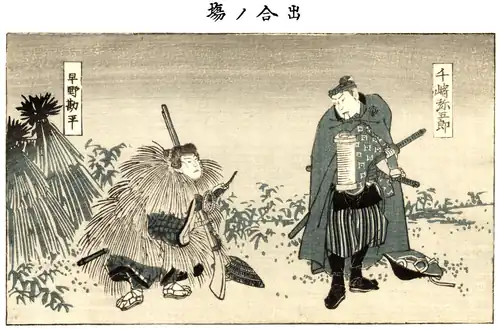
The Rencontre of Kampei and Senzaki.
so entirely gone—that I hardly dare show my face even to so old a comrade as yourself. I ought to have been at my lord’s side when the event that resulted so cruelly for our master’s house took place; but my ill-fortune was such that I was not where my duty called me, nor was it possible for me to return to the castle. While waiting for a favourable moment for begging that my fault might be overlooked, I was overwhelmed by the news of our master’s self-dispatch. Namusambô! that fellow Moronaho is the cause of all this; and thinking that at least I could accompany my lord on the dark path, I laid hand upon my sword, when I was arrested by the reflection that my lord would ask me what high deed I had done to entitle me to follow him, and that I could do nothing but hang my head with shame in reply. Heartbroken, I gave up the idea of self-dispatch; and it coming to my ears that it was intended to avenge the death of our master, the design originating with the Ohoboshis, father and son, and Sir Goyemon, and as I have never been formally thrust out from the clan, I thought that if means could be found of getting me a favourable hearing from Yuranosuke, I might be permitted to add my name to the list of conspirators, and should then never fear to face the world as long as I lived, while my name would remain bright for ages after my death. In our chance meeting to-day, I am as fortunate as if I were to come upon the Udonge[2] in bloom. I adjure you, as an old comrade, as a fellow-samurahi, give me your aid, and help me to regain the honourable position I have lost.” So saying, Kampei prostrated himself, full of remorse for his disloyalty, and burst into tears. Truly pitiable it is to see a man weep. Senzaki felt that his friend’s repentance was sincere, but thought it right not to reveal the whole plot, seeing how important a matter it was.
“Come, come, Kampei,” he said, after a pause; “you are speaking at random. Your talk about a list of conspirators is all moonshine; as far as I know, no one has dreamt of any such scheme as you refer to. I am on my way from Yuranosuke to Goyemon with a message about erecting a monument over our lord’s grave. True, we are all mere rônin now; yet we wish to put up a monument that will last for ever, so that his memory may not be lost, and are trying to collect the money necessary for the purpose among those who do not forget the benefits they have received from our dead master; whose disposition, however, we ascertain before we unfold our scheme to them. You, of course, are among those who keep a grateful memory of our lord.”
The story about the monument was a fiction; Senzaki, who was moved by his friend’s distress, meant to hint what Yuranosuke’s real design was.
“You are very good, Senzaki. A rumour had reached me of your intention to get funds for a monument. I understand you perfectly. I shall move heaven and earth to get money somehow, so that I may join in the subscription. Senzaki, what a shameful position I am in; fit punishment for my disloyalty to our master. There is not a single soul to whom I can apply for aid. However, my father-in-law, Yoichibei, is a good-natured old man, a farmer of these parts. My wife is as much grieved as I am at the remembrance of my fault, and the old people are full of compassionate desire to see me restored to my former rank by some means or other. I shall tell them of my fortunate meeting with you to-night; and, if I let them know of this chance of my regaining my position, they will, for the sake of their daughter, sell some of their land. I know they will not refuse to do so, and I would beg of you to take the money for me to Goyemon.”
Senzaki could not resist Kampei’s pleading tone, and replied, “Well, I will tell Goyemon all that you have said, and will see what can be done by petitioning Yuranosuke on your behalf. The day after to-morrow you shall hear from me without fail. And here, by-the-bye, is Goyemon’s itinerary,” handing over a paper, as he spoke, to Kampei, who lifted it respectfully to his forehead.
“A thousand, thousand thanks; no danger of my being behind-hand with the money. The day after to-morrow I hope to see you. If you should want to look me up you must go to the ferry at Yamazaki; turn to the left, and then inquire for the house of one Yôichibei; you will have no difficulty in finding it. And now, ere it gets too late, I think you had better continue your journey. Remember that the road you will have to travel over is somewhat dangerous, and therefore do not cease to be on your guard.”
“Good, I understand. Until the monument to our dead lord has been erected, no flea shall taste this body of mine; and be of good cheer, you will get the money, I make no doubt. Fare you well, fare you well.”
Kampei and Senzaki then took leave of each other.
The rain continued to patter down, amid the sound of which the clatter of wooden pattens betokened the approach of some wayfarer. Presently, Yôichibei, not fearing the darkness, for he knew the paths well, came tottering by, leaning on his staff, honest stouthearted father, only fearing for his child, Karu, whose surviving parent he was.[3] As the old man struggled forward through the storm, he was startled by some one behind him shouting, “Oi, oi, old gentleman, let’s travel together.”
This was no other than the son of Kudaiu, Sadakuro, whose home was no more fixed than the white crest of a wave, and who had betaken himself to night work on the highways, a heavy sword hanging by his hip.[4]
“How, old fellow, art deaf?” cried Sadakuro; “I’ve been shouting after you for some time. Perilous task for an old man like you to travel alone, and by night, along a dangerous road like this. Come, I’ll keep you company.” So saying, he got in front of Yôichibei, and stared at him rudely. The latter started, but with the craft of old age, replied:
“Well, well; you don’t look young, and so I suppose I need not fear you.[5] True, indeed, it is perilous for an old man like me to be out on such a night, and all alone; but there is no help for it. Money, you know, is what people are always in want of, everywhere; and as I am behind with my taxes, I have been round among my relations to ask assistance, but without getting a cash from one of them; and so, as none of them seem inclined to help me, I did not trouble them with a long visit, and am now on my way home again.”
Sadakuro broke in rudely: “Yai! don’t try to fool me with your nonsense about being behind with your taxes. Just listen to what I’ve got to say to you. That bag in your bosom there, to judge by its bulk, must contain some forty or fifty riyô. I caught a sight of it just now, a striped bag—hand it over. What! must I ask it with clasped hands? Of course, you will howl about your poverty, and the money being for your family. I care nothing about all that; you can’t help yourself, that’s clear, so let me have it if you please, and at once.”
And with a sudden movement he snatched the bag out of the old man’s bosom.
“Ah! sir,” cried the old man, “I implore you, that bag”
“That bag, that bag Well, it seems I was right as to its contents.”
And the robber grasped the bag more firmly as he spoke.
“No, no; it only contains some cash left after buying a pair of straw shoes at the last village, together with the remains of some rice balls I had for my dinner, and some emollient physic and stimulant lozenges my daughter gave me before leaving home, to use in case of an attack of flux. Pray let me have it back.”
And with a quick movement the old man repossessed himself of the bag and made off with it. Sadakuro, however, soon overtook him.
“Yeh! you will be a fool then. I did not want to hew you in pieces, but gentle means, it seems, only make you harder to deal with. Hand that to me without more ado, or I’ll have at you.”
So saying, he drew his long sword and raised it high above his head, and ere one had time to cry mercy he aimed a blow at the old man, sweeping down with his sword as if it was only a bamboo he was splitting. But Yôichibei, whom some swerve of arm or weapon saved for the moment, convulsively seized the naked blade with both hands, crying:
“What, would you murder me?”
“Ah! I knew I was right,” exclaimed the robber, “I felt sure you had money about you. It is your money kills you. Come, no more nonsense, but die and make no noise about it.”
And the villain pressed the old man with the point of his sword as he spoke.
“Ma, Ma! I pray you a little patience. Alas! is there no escape for me! true, aye, true! I have money on me, but this money belongs to my only daughter. She has a lover, dearer to her than life itself, and the money is for him. For certain reasons he became a rônin. My daughter told me he had become a rônin through her fault, and begged us—her mother and me—that she might be allowed to help him to get back his lost rank. Night after night she begged this. But we are very poor bodies, and could hit upon no plan of bringing about what she wanted. At last, however, her mother and I, after talking over the matter, agreed upon a means of aiding her, and got her to consent to it. We took good care, however, that her lover should know nothing of our plan, and told her to be careful to say nothing about it to him. Oh, this money has cost tears of blood to us—my only daughter, her mother and myself. What shall we do if you take it from us? O, sir; I ask you, with clasped hands, to be merciful to us. You, too, sir, look like one who has been a samarahi and will sympathize with us. Without this money my daughter and her lover will never be able to hold up their heads again. He is affianced to my only daughter; how pitiable, how cruel to separate them. Oh, sir, consider their hard case. I beg of you to afford us your merciful help. Yê, yê, you are young yet, sir; you have no children. Bye-and-bye you will have children, and then you will understand why I plead with you so earnestly. You cannot refuse to help us in our miserable lot. My home is but one league farther on; let only the money be given to my daughter’s lover, and do your will with me. Let me but see my daughter’s face happy, and I will gladly die. Have pity! have pity!”
But loud as the old man’s entreaties were, the far-off echoes of the hills alone responded to his cries.
“O pity, pity,” sneered the robber; “what stuff you talk; your doing a kindness to me will not harm your son, nothing evil can come out of doing a kindness.”
“Have mercy on me,” groaned the victim as, pierced by Sadakuro’s sword, he fell down and rolled in his death agony on the ground. The murderer, kicking the body aside, exclaimed coolly, Wretched piece of work! Well, I am sorry for it; I didn’t do it out of any malice; but, you see, you had money. That killed you. No money and you’d be alive now. Your money was your enemy. I can’t help pitying you, too. Which prayer are you for? Namu-amida butsu or Namu miyôhô renge kiyô?[6] Choose one, and let all end.” And he buried his sword still deeper in the quivering form. The blades of grass were red with dewlike drops of blood, and the feeble breath passed away from the old man full of years and misery. His murderer immediately possessed himself of the bag of money, and tried to estimate its contents in the dark by feeling it with his hand.
“Capital,” he cried, after a pause; “fifty riyô here; it’s a long time since such a sum and I have been face to face. I am much obliged to you.” Casting a glance towards his victim, he then hung the bag round his own neck and threw the corpse to the bottom of a neighbouring ravine, little thinking of the retribution that was awaiting him.

The Murder of Yôichibei.
He had not gone far on his way when a wounded boar came dashing up behind him. He stood aside to let the animal pass, that rushed straight on, heedless of roots and stones. At the moment Sadakuro stood back, startled, out of the animal’s way, just as the boar was flying past him through the mud and bushes, he was struck by a double shot, which passed from his backbone through the side of his chest, and rolled him over dead before he could even utter a groan—a fit end for the villain.
Kampei meanwhile, for it was from him that the fatal shot proceeded, thinking he had hit the boar, came towards the spot, holding his gun muzzle downwards, and searched for the animal’s carcase. Seeing something on the ground, he raised it up, and found to his horror and astonishment that it was a human corpse.
“Yai, Yai! ’Tis a man. Namu sambo, what an unlucky shot!”
It was so dark it was impossible to tell who the man might be, but Kampei put his hand inside the breast to see if his victim’s heart still beat. In doing this, his hand came upon the purse of money, which seemed by its bulk to contain some forty or fifty riyô. Overjoyed at his luck, he lifted the bag gratefully to his head, and made off with the speed of a bird, distancing the boar itself.[7]
End of Book Five.

- ↑ Such is the sense of a play upon words occurring here in the original text, and incapable of anything like a literal rendering.
- ↑ Udonge. Vide Appendix, and below.
- ↑ This portion of the text is stuffed with puns, of which a full rendering is impossible.
- ↑ That is, not stuck in his girdle, as was usual, but pendent by his side, so as to be readier for use.
- ↑ For the young, so think the Japanese, not without justice, are commonly more cruel and violent than the old.
- ↑ Vide Appendix.
- ↑ “Shishi yori saki he Issan ni tobu no Gotoku ni isogikeru.”