The New International Encyclopædia/Japan
COPYRIGHT, 1903, BY DODD, MEAD & COMPANY.
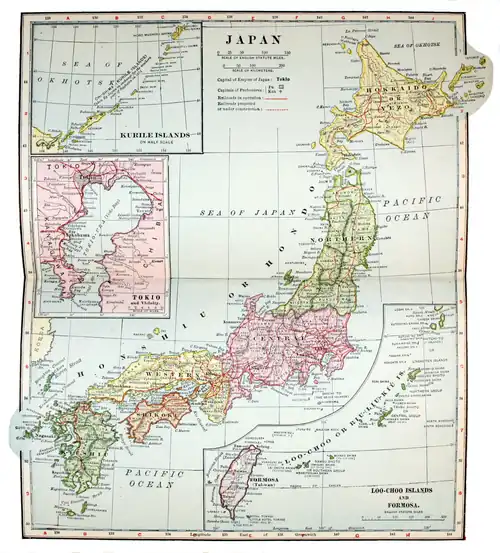
JAPAN, in Japanese NIPPON, or NIHON. An empire consisting of a chain of islands lying along the eastern coast of Asia, and extending from latitude 21° 48′ to 50° 56′ N., and from longitude 119° 20′ to 156° 32′ E. It is separated from the most northern islands of the Philippine group by the Bashi Channel; from China by the Formosa Channel, 70 to 100 miles wide; from Korea by Broughton Channel, less than 25 miles in width; from the Russian island of Saghalin by La Perouse Strait, 25 miles wide, and from Kamtchatka by the Kurile Strait; while the wide, somewhat secluded Sea of Japan lies in the embrace of the main island and Yezo, on the south and east, and of the east coast of Korea and the maritime province of Siberian Manchuria on the west and north.
Japan is the name by which the country is known to foreigners, but in Japan itself Nippon or Nihon is used, sometimes with the syllable Dai (‘Great’) prefixed to it, and occasionally also Te Kokū (‘Empire’ or ‘Imperial’), so that in its most expanded form the name is Te Kokū Dai Nippon (or Nihon), that is, ‘The Empire of Great Japan.’ The name Nihon seems to have been adopted about the year 670. Down to that time Yamato was the name, from the province adjoining Kioto, in which Jimmu Tenno (B.C. 660) and the early mikados ruled. The Chinese have long known the country as Jih-pun-Kwoh, or ‘Sun-origin Kingdom.’
The islands of which the Empire is composed are said to number nearly 4000, but of these only about 500 are inhabited or have a coast-line of over one ri, or about 2.44 miles. The remaining islands are mere rocks, sometimes covered with vegetation, as for example the 808 tiny islets of the Bay of Sendai, collectively known as Matsushima, or ‘Pine Islands.’ The chief islands are five in number: (1) The Hondo, or ‘Main Island,’ sometimes also designated as Honshiu, or ‘the Mainland,’ and formerly but incorrectly named Nippon, a name which can be applied only to the whole country. It has an area of 14,492 square ri (the square ri being equal to 5.955 square miles). In shape it is an irregular crescent, its concave side forming the southeastern boundary of the Sea of Japan. Its greatest breadth is less than 200 miles. It is separated from Yezo, on the north, by Tsugaru Strait, 10 miles in width (through which runs a strong current from the Sea of Japan), and from the eastern part of Shikoku, on the southwest, by Kii Channel. (2) Shikoku, with an area of 1151 square ri, lying south of the western part of Hondo, and separated from it by the beautiful land-locked but shallow channel, studded with islets, known to foreigners as the ‘Inland Sea,’ but to the Japanese by different names in different parts of its length. (3) Kiushiu, with an area of 2311 square ri, separated by the narrow Strait of Shimonoseki from the western point of Hondo, and lying to the west of Shikoku, from which it is divided by Bungo Channel. (4) Yezo, an irregular four-cornered island, with an area of 5056 square ri, lying north of the main island, with one long arm or corner stretching north to Siberia, and one reaching northeast to the Kurile Islands. (5) Formosa (q.v.), with an area of 2253 square ri, lying off the coast of China. The other considerable islands or groups of islands are Sado and Oki, in the Sea of Japan, with a combined area of 75 square ri; the island of Awaji, lying off the mouth of Osaka Bay and between the main island and Shikoku, area 36.69 square ri; and Iki and Tsushima, lying between Kiushiu and Korea, and having an area of 52.50 square ri, or with their six adjacent islands, 53.25 square ri; lastly, the ‘Seven Islands,’ which are found off the promontory of Idzu.
The first three of the large islands, viz. Hondo, Shikoku, and Kiushiu, with their adjacent islands, together with Sado, Oki, Awaji, Iki, and Tsushima, with their adjacent islands, constitute Oyashima, or ‘Old Japan.’ With the 55 islands of the Loo-choo group and the 20 of the Bonin group added, there is formed Japan proper—Yezo, with its 12 adjacent islands, the 32 islands of the Kurile group, and Formosa and the Pescadores, with their numerous adjacent islands being regarded merely as colonial possessions.
The following table shows the different constituent members of the Empire—the chief islands with the number of adjacent islands, the length of coast-line of the various groups, and their area in square miles:
Chief Islands, Coast-Line, and Area of the Japanese Empire
| Chief Islands | Adjacent islands |
Coast-line in miles |
Area in sq. miles | ||
|
165½ | 5,930.12 | 87,771.01 | ||
|
74½ | 1,628.29 | 7,039.90 | ||
|
150 | 4,506.33 | 15,587.45 | ||
|
.... | 130.05 | 336.44 | ||
|
1 | 185.36 | 130.35 | ||
|
1 | 89.76 | 218.48 | ||
|
1 | 90.89 | 51.39 | ||
|
5 | 503.17 | 266.30 | ||
|
.... | 13,063.97 | 111,392.32 | ||
|
.... | 768.74 | 934.40 | ||
|
.... | 174.65 | 26.79 | ||
|
.... | 14,007.36 | 112,353.51 | ||
|
12 | 1,533.56 | 30,143.61 | ||
|
.... | 1,496.23 | 6,153.25 | ||
|
29 | 859.63 | 13,418.04 | ||
|
47 | 98.67 | 85.33 | ||
|
.... | 17,995.45 | 162,153.74 | ||
Topography. Japan is a land of high mountains and deep valleys, with few plains of any extent. Its scenery is, in the main, pleasing rather than grand or sublime, rounded heights clad with forests, or with the verdure of a remarkably luxuriant vegetation predominating, though a large number of lofty, more or less shattered and craggy volcanic peaks are found.
The level land lies chiefly along the lower courses of the principal rivers, or consists of stretches by the seashore, or of plateaus and gentle slopes along the feet of the mountain ranges. The most extensive plains are those which border the Ishikari and Tokachi rivers in Yezo, or stretch along the seashore at Kushiro and Nemuro. In the northeast section of Hondo is the Oshiu plateau, watered by the swift-flowing Kitagami, and extending over portions of four provinces. In the central region is that of the Tonegawa, or plain of the Kwanto, which spreads into the provinces of Musashi, Kodzuke, Hitachi, and Shimosa. Next comes the Kisogawa, which forms part of Mino and Owari. The most extensive of the littoral plains is found in Etchigo, along the lower waters of the Shinano River. In the Five Home Provinces are several comparatively wide plains along the Yodo and Yamato Rivers and their feeders, while in Shikoku flat lands lie along the Yoshino River and in Kiushiu along the Chikugo. In Formosa a plain 20 miles wide, expanding toward the south, lies between the mountains and the western coast.
The general trend of the mountain systems is along the longer extension of the islands—that is, from southwest to northeast, or from south-southwest to north-northeast—but in several places the main chains are intersected by other lofty ridges, running in a general way from north to south, as in Kiushiu, Central Hondo, and Yezo. It is at these points that the greatest mountain masses and the most imposing scenery are found. In Formosa, also, the great backbone of the island extends from north to south, several of its peaks exceeding in height those of Japan proper. Beginning with the volcanic elevations of the Kurile group, which form a line of 32 stepping-stones from Kamtchatka to the island of Yezo, a range of trachytic and basaltic rocks is intersected near the centre of Yezo by a loftier and more massive chain composed of granite and old schists, from Cape Soya on the north (a continuation of the Saghalin system), the highest peak of which is the Tokachi, with an elevation of 8200 feet. Farther on toward the southwest this volcanic Kurilian range merges into the west coast range from Cape Soya, and is marked by some remarkable volcanoes, the most noted though not the highest of which is Komagatake, or ‘Foal Mountain’ (a name of common occurrence in Japan), with a height of nearly 4000 feet. Branching into two lines after the long western arm of the island rounds Volcano Bay, these mountains reappear on the main island in two parallel chains. One, the Northern Schist range, separates the valley of the Kitagami River from the Pacific; the other, the main chain, continues toward the southwest, forms the backbone of the island until it meets the great complex of massive intersecting ridges which inclose the plateau of Shinano (2550 feet above the sea), and occupies the central portion of the main island where it is widest. It sends out important branches and continuations southeast through the Hakone range into Idzu; southwest through Yamato and Shikoku to Kiushiu; and westerly through the centre of Chiugoku to Shimonoseki, forming in its course the dividing line between the group of provinces known as San-yodo and that called San-in-do.
In this central mountain mass, which covers the provinces of Kaga, Etchiu, Hida, Shinshiu, Koshiu, and part of Kodzuke are found the loftiest peaks of Japan proper (next after Fujiyama ‘the Peerless,’ with its elevation of 12,365 feet, which soars near the southeast coast, not very far from Tokio). They also offer the grandest scenery, and hence are frequently called the ‘Japanese Alps.’ The principal summits are: Haku-san in Kaga, an extinct volcano, with a height of 8920 feet; Yariga-take, 10,000 feet, in Hida; Gohonsha, the highest peak of the Tate-yama range, 9500 feet; Ko-ma-ga-take, 10,384 feet; and scores of others. Farther north in the Nikko range of Shimotsuke is Shirane-san, 8580 feet; Nantai-san, 8150 feet; and farther north still, on the shores of Lake Inawashiro, is Bandai-san, 6280 feet. Thence northward are Gwassan, 6200 feet; Gan-ju-san, or the Nambu-Fuji, 6500 feet; and southward along the west coast from Iwaki-san or Tsusaru-Fuji (4500 feet), are Cho-kai-san, 7800 feet, Haguro-san, and others, each as a rule sacred to some deity and consequently much visited by pilgrims. Snow covers most of them in winter, but, except in a few cases, as, for example, Haku-san and the peaks of the great mountain masses of Shinano and Hida, it disappears before the end of summer. Even on Fujiyama only patches of snow remain from year to year. The toge or passes by which these mountains are crossed are comparatively low, due to the fact, as Rein points out, that (1) the mountain masses of primitive crystalline rocks and schists do not rise very high, and that (2) the volcanic formations, which have in so many places burst through and overlain them, seldom form long or very high ridges.
It is said that there are in Japan, which is of volcanic origin, 170 volcanoes, most of them, however, regarded as extinct, some merely quiescent, but scores still active, sending forth smoke and steam, or serving as landmarks at night by their fiery glow. Among the more famous volcanoes still reckoned as active are Asama-yama, in Shinano; Komaga-take and several others, in Yezo; Chacha-take, in one of the Kuriles; Shirane-yama, in the Nikko range; Mihara-yama, on Oshima or ‘Vries Island,’ one of the ‘Seven Islands,’ lying off the promontory of Idzu; and Suwa-shima, in Loo-choo. As late as 1888 Bandai-san (q.v.) was in a state of violent eruption. Earthquakes are of frequent occurrence, and even in comparatively recent times some have been very disastrous. The line of greatest seismic disturbance extends from Loo-choo through Kiushiu to the northeast. On October 28, 1891, occurred an earthquake, felt in six provinces; 7279 persons lost their lives, 17,393 were injured, and 197,947 buildings were utterly destroyed.
Thermal springs and solfataras are exceedingly numerous. In Japan proper, the former, chiefly sulphur, are said to occur in 388 different localities, and almost all are much patronized by the natives. The chief are Kusatsu and Ikao, in Kodzuke; Yumoto, at the foot of Shirane-yama, in the Nikko range; and Enoyu on Kirishima-yama, in Kiushiu. Chalybeate springs, both hot and cold, are also found. The solfataras are well exemplified by the Ojigoku and Ko-jigoku, or ‘Great and Little Hells,’ of the Hakone range.
Hydrography. Owing to the mountainous character of the country, and the narrowness of the islands, Japan cannot boast of long rivers, no part being farther distant from the sea than about 100 miles. Yet the country is well watered. Every valley has its stream or its streamlet, and one of the chief charms of the scenery is the rush of the numerous waters, and the beauty of its waterfalls, while the swiftness and torrential character of many of the streams present grave problems to the engineer engaged in railway construction or bridge-building. The largest river in the Empire is the Ishikari, in Yezo, which flows into the Sea of Japan, after a course of 407 miles. On the main island, the three great kawa, or rivers, are the Shinanogawa, the Tonegawa, and the Kisogawa. The Shinano rises in the province of that name, has a course of 320 miles, and flows northwest into the Sea of Japan. The Kitagami, in the northeast, has a course of 122 miles, and flows southeast into the Bay of Sendai. The Tonegawa rises in Kodzuke, traverses the plain of Kwanto, and enters the Pacific near Tokio, after a course of 170 miles. The third great river is the Kisogawa, which pursues a devious course from Shinano, and falls into the Pacific. Another important river is the Ten-riu, which rises in Lake Suwa and flows south for 135 miles to the Pacific. Other rivers are the Sumida, flowing through Tokio into the Gulf of Yedo, and the Yodogawa, the outlet of Lake Biwa, which enters Osaka Bay. They are all swift, and spread out greatly when they leave the mountains.
Japan has few lakes of any great extent. Several shallow sheets of water are found in Yezo, and along both the east and the west sides of Hondo or Main Island, but they are of little consequence as lakes, and have little beauty. The largest and most noted is Lake Omi, better known as Biwa-ko (Ko-lake) from a fancied resemblance in shape to the Chinese guitar (p’i-pa). It lies in the centre of the Province of Omi, at no great distance from Kioto (q.v.), and is much visited by tourists on account of its ‘Eight Beauties.’ It is 37 miles long and 12 miles wide at the widest part, and has an area nearly equal to that of Lake Geneva in Switzerland. Northeast of this, in the Province of Shinano, is Suwa Lake, the source of the Ten-riu-gawa, 2600 feet above the level of the sea. In winter it is covered with ice more than a foot thick. Farther north, in the Nikko Mountains, is the beautiful Chiuzen-ji, at the foot of Nantai-san, with an area of nearly 18 square miles, and situated 4375 feet above sea-level. It is of great depth, and contains no fish. Farther north still is Inawashiro, near Bandai-san, with an area of perhaps 90 square miles, and situated about 1840 feet above sea-level. It abounds in fish and is said never to be frozen over. Its outlet is the Ikano-gawa, which falls into the Sea of Japan near Niigata. Another well-known lake is that of Hakone, about 50 miles west of Yokohama. It is said to fill the crater of an ancient volcano, at an elevation of 2300 feet above sea-level. It is about 10 miles long, and is of unknown depth. Its outlet is the Haya-gawa, and by a tunnel at one end it supplies water for irrigating the rice-fields of 17 villages on the plain to the west.
Climate. Stretching as the Empire does through nearly 30 degrees of latitude, climatic conditions vary widely in different parts. In the Loo-choo group subtropical conditions prevail; the heat is great, and snow and ice are never seen. In the Kurile Islands, on the other hand, snow and ice never entirely disappear, the sea freezes over in winter, and it is sometimes possible to pass from one island to the other on the ice. Omitting Loo-choo, the Bonin Islands, and Formosa, there is scarcely a part of the country that is entirely free from snow in winter. It is heaviest in Yezo, and along that part of the main island which lies between the great mountains (which form its backbone) and the Sea of Japan; and so deeply does it cover the country that in many places, especially north of the Shinano, Hida range, the inhabitants have recourse to continuous porticoes or snow-sheds along the streets to afford passageway. To the south and east of this region the snow is somewhat less heavy, and the winter is milder, owing to the influence of the warm current known as the Kuro Shiwo (q.v.). Seldom does more than a few inches of snow fall in Tokio and Yokohama, though Fujiyama, only 60 miles distant, is covered to its base. The winter temperature hardly ever goes below 22 degrees Fahrenheit, and there are not more than three or four frosty days during the whole winter. Kiushiu, Shikoku, San-yo-do, and Tokaido are warm, and snow seldom lies except on the higher mountains. The wind is northerly and dry and the air bracing. The exceptional conditions which prevail in Yezo are due largely to the cold current—the Oyashiwo—and to the strong northeast winds which sweep down upon it from the ice-fields of Siberia.
The southwest monsoon brings with it a hot, moist summer. The rainfall is great, and the heat is considerable, much greater than in corresponding latitudes in Europe and America. The rainfall is heaviest in June and September. The annual fall in Yokohama is about 70 inches; in Nagasaki, 71½; in Tokio, 65.4; in Hakodate it is only 57.2. It is the great humidity which some of these figures imply, coupled with a temperature which may rise in summer to 95 degrees or 96 degrees Fahrenheit, as in Tokio and Yokohama, that causes so much discomfort, and sends to the mountain all who can get away. Yet, as compared with many places on the mainland of China, Japan is a very pleasant summering place. There is a well-equipped and well-managed Weather Bureau, with 74 meteorological stations.
Flora. The flora of Japan is exceedingly rich in variety, and its luxuriance is in keeping with the warmth and the moisture of the Japanese summer. In 1876 Franchet and Savatier enumerated no fewer than 2743 species of phanerogamous and the higher cryptogamous plants, distributed among 1035 genera. Since then the number has been increased to over 3000. The ferns are represented by 43 species, the sedge family by 168, and the Ericaceæ by 76. In the plains one meets with pimpernel, the lily of the valley, blue-bells, eye-bright, various kinds of violets, the gladiolus or sword-lily, and many species of iris, hemerocallis, etc., as well as the characteristically Japanese Lespedeza striata, or ‘Japan clover,’ with its minute purple flower, now well known throughout the Southern United States, having been introduced accidentally about 1840, perhaps in tea-chests. In April the hillsides of Japan are ablaze with azaleas.
Among trees, evergreens, of which there are said to be 150 varieties, predominate. Savatier enumerates 41 species of Coniferæ alone. One of the most characteristic of Japanese trees is the sugi, or ‘Japanese cedar’ (Cryptomeria japonica), which sometimes attains a height of 150 feet. It is a favorite in temple grounds, and is frequently seen lining the highways, but more particularly the approaches to some sacred place, as along the great avenue (nearly 50 miles in length) leading to the tomb of Iyeyasu at Nikko (q.v.). Another beautiful temple-tree is the Icho (Salisburia adiantfolia) or ‘maiden-hair’ tree. A fine specimen, said to be 1000 years old, stands near the entrance to the Temple of Hachiman at Kamakura.
The cypress and the yew, firs of different kinds, the box, the holly, and the myrtle abound. The mulberry-tree, the tea-plant, the lacquer-tree (Rhus vernicifera), the camphor-tree, and many species of bamboo not only add to the beauty of the landscape, but are of great economic value. Among deciduous trees are the oak (20 species), the maple (24 species), beeches, alders, the ash, the horse-chestnut, the birch, and 17 species of willow. The hinoki, or ‘fire-cypress,’ is much prized in the making of lacquer-ware: the heyaki, or Japanese elm (Planera japonica), in cabinet-work; and the box for combs. The hajimo-ki, or wax-tree, grows profusely on the hillsides and round the edges of the cultivated fields in Kiushiu, and the cocoa-tree, the banyan-tree, and the banana flourish in Loo-choo and the Bonins. The bud and leaves of the ornamental kiri, or Paulownia imperialis, form the badge of the Mikado. Among the climbing and twining plants are the Hydrangea cordifolia, several species of climbing magnolia, whose coils run from right to left, the Akebia quinata, the Clematis japonica, and the wistaria, which blossom in June. The plum blossoms in February; the cherry in April. The tree-peony flowers about the first of May, lotuses fill the castle moats and canals in August, and in November the chrysanthemum is the occasion of perhaps the greatest of the Japanese flower festivals. Of the fruits the grape is the best, and those from the Province of Kai are most esteemed. (See Kofu.) The kaki, or persimmon, comes later in the year, and is a very luscious fruit; the oranges grown in Kiushiu are also good. The pear is woody and worthless. All attempts at introducing English and other pears have invariably proved unsuccessful. But the apple is now cultivated with good results in Yezo. The strawberry has been successfully introduced. The loquat conmes in April.
Fauna. This is not as rich as the flora, yet the country can boast of at least 150 species of mammals, 359 of birds, 300 of reptiles and batrachians, a great number of kinds of fishes, of which 358 species were described by Siebold. Also over 1200 species of mollusca are mentioned in the books; and, according to the best authorities, 26 kinds of sea-urchins, and 12 species of star-fishes are found. At the head of the mammals stands the red-cheeked saru or monkey (Inuus speciosus), which lends its name as a qualifier to the name of many a place and plant, and whose flesh is esteemed a delicacy. The saru is sometimes found as far north as the forty-first parallel of latitude, where in winter snow often lies 15 to 20 feet deep, and the thermometer registers many degrees below zero. Among the 10 species of cheiroptera peculiar to the country are several bats, and of the insect-eaters are the mugura, or Japanese mole, and several kinds of shrew-mouse. The hedgehog is unknown. The carnivora include three species of bear—the common black bear (Ursus japonicus), the ‘red bear,’ also called the great bear (Ursus ferox), much reverenced by the Ainos, and the ice-bear (Ursus maritimus), an involuntary visitor brought to Yezo and the Kuriles by the Arctic current. The tanuki, or badger, sometimes called the ‘bamboo bear,’ whose flesh is eaten, occurs everywhere. The tiger is known only from Chinese literature and art, while the wolf of the country, known as Yama-inu, or ‘mountain dog,’ is not numerous. The fox is found everywhere and, like the monkey and the badger, plays a very important part in folk-lore and the superstitions of the country. (See Fox.) Among the fur-bearing animals are the martin, the fish-otter, the sea-otter, and the itachi, or weasel. Rodents are numerous and include two species of ki-nedzumi (‘tree-rats’) or squirrels, two flying squirrels, and rats, which are so numerous and so much of a pest that the Japanese Government has offered rewards for their extermination. The common house-mouse is unknown. Hares exist everywhere. Two species of deer are found.
The avifauna includes many species which are familiar in the Old World, showing very slight differences in color and size, as for instance the robin, the cuckoo, the woodpecker, the ice-bird, the hoopoo, and the jay. The cuckoo, however, is not very common. The sparrow, the house-swallow, and the thrush are the commonest and most numerous. Eagles, falcons, and kites are seen, as well as the wood-chat, the magpie, and the Korean raven. There are several species of singing birds, but the uguisu, or Japanese nightingale, is the most conspicuous. Blackbirds and the singing thrushes are absent. There are two species of kiji, or pheasant: the Phasianus versicolor, called yama dori, or ‘mountain-bird,’ by the Japanese, and the copper pheasant, or Phasianus sœmmering. Wild pigeons abound and quail and snipe are fairly abundant. The wild duck and geese also furnish many a shot for the sportsman. The crane and the silver heron are the most popular of the waders. The former, the symbol of longevity, has a prominent place in Japanese art. The latter faithfully keeps company with the peasant in the rice-fields all summer.
The mamushi (Trigonocephalus blomhofi) is the only poisonous snake of the eight species found in Japan proper. Another, called the habu, exists in Loo-choo. The mamushi, skinned and cooked, is used as a ‘nerve-strengthening’ food. Four sea-snakes make their way to the southern islands in summer. Of the three species of lizard one, the ya-mori, or ‘house-warden,’ frequents dwellings and is an expert fly-catcher. Marine turtles, of which there are three species, are most numerous in the Bonin Islands. The kame, a river tortoise, another symbol of longevity, is one of the four supernatural creatures of Chinese and Japanese mythology. It is found as far north as Yezo, but is not common. There are several species of frogs and toads, but they differ little from those found in Europe and America. The mountain newt (Lacerta japonica), when boiled and dried, enriches the Japanese pharmacopœia as a vermifuge. The most remarkable of this class is the ‘giant salamander,’ extinct elsewhere, but still found in the rivers. It is sometimes captured for the sake of its flesh.
Insects are exceedingly numerous, both in species and individuals, and include many beautiful beetles, 137 species of butterflies, and over 100 species of moths. There are several large silk-moths, but only two are used in the silk industry. Except in the mountains the mosquito is very troublesome, and rivals the flea in persistency, but not in numbers. Flies are found everywhere, but are most numerous in the silkworm-breeding localities. Ants are numerous and troublesome, and crickets, grasshoppers, and cicadas abound. Scorpions exist, but are said to he non-poisonous.
Geology and Mineral Resources. Soon after the opening of the country the Government seems to have realized the desirability of exploiting its mineral resources, which were supposed to be very extensive and of great value. To this end geologists and mining engineers were engaged abroad, and to them—Pumpelly, Lyman, and others—as well as to the explorations and observations of later geologists and travelers—Richthofen, Milne, Naumann, Rein, and Wada—the world is indebted for its still very imperfect knowledge of the geology of Japan.
The backbone of the country consists of metamorphic rocks—gneiss, crystalline schists, serpentine, and marble—which are discovered everywhere in great masses, but are best studied in Shikoku. Overlying these are thick Paleozoic strata—probably of the Silurian or Devonian formation—consisting of clay-slate, graywacke, quartzite, and limestone. The Carboniferous formation is represented by limestone, and by the coal-measures of Yezo. The Permian seems to be entirely unrepresented in Yezo, but Rein seems to have found indications of the occurrence of the lower New Red Sandstones on the main island. Mesozoic strata of the Jurassic formation exist in Kaga, while the Cretaceous formation is exemplified by the coal-measures of Takashima, by the gray-white granular and micaceous sandstones of that vicinity, and in Yezo by certain Cretaceous clays. Tertiary and Post-Tertiary conglomerates, sandstone, clay-slate, peat, stratified volcanic tuffs rich in coal, lignite, and fossil plants, fringe the country in many places. The oldest eruptions were of granite, which is very widespread.
Japan is not specially rich in minerals, contrary to the views expressed by early geologists. Iron and coal are the most plentiful: next come copper and antimony, gold, silver, lead, tin, zinc, graphite, and petroleum. The Japanese seem to have been entirely unacquainted with the useful or even the precious metals until after contact with the Chinese and the incoming of the arts, sciences, letters, and religion from China. Silver was first discovered and worked in the year 674, copper in 698, and ten years later, in imitation of the Chinese ‘cash,’ a copper coinage was introduced, a fact commemorated in the name of the reign in which this occurred—Wa-dō (‘Japanese Copper’) (708–714). Gold was discovered in 749. The lodestone had become known somewhat earlier—in 713.
Coal is found in many places, from Formosa to Yezo. The best is that of Takashima (where the seams are 14 feet thick and extend under the sea). Karatsu, Miike, and other places in the island of Kiushiu; at Kelung (q.v.) in Formosa; and at Poronai in Yezo. In 1899 the output (exclusive of that of Formosa) was 6,721,798 tons. As already indicated, most of it belongs to the Tertiary formations. Iron is found chiefly as magnetic iron ore, the chief ore of the Japanese iron industry, and, as iron-sand, exists in nearly all the provinces. In 1899 the production amounted to 50,930,553 pounds. Copper seems to have been plentiful from the very first. It is said that from 1609 to 1858 no less than 533,332,000 pounds were exported by the Dutch. The product in 1899 amounted to 53,601,019 pounds. Three silver ores are found, besides galena. The first discovery of silver was on the island of Tsushima, half-way between Kiushiu and Korea. It is now worked in many places in Shikoku, and in Hondo from Settsu to Mutsu in the north. In 1899 the product amounted to 1,808,944 ounces.
Gold exists chiefly (1) in the alluvial sands and gravels of Osumi, in Kiushiu, and at several places in Yezo; and (2) in auriferous quartz in Satsuma, Koshin, Rikuchiu in Hondo, and at Aikawa, on the island of Sado, in the Sea of Japan. In 1889 the total product was 53,951 ounces. Several gold-mines are also worked near Kelung, in Formosa. The other mineral products are, per annum: Lead, 1023 tons; antimony, 1097 tons; tin, 63 tons; manganese, 10,561 tons; arsenic, 34,770 pounds: mercury, 7140 pounds; sulphur, 22,603,986 pounds; iron pyrites, 18,493,678 pounds; and graphite, 520 tons. The sulphur supply is practically inexhaustible. Petroleum is obtained at Nagaoka and many other places, but the output is far from being enough to supply the needs of the country. In 1899 it amounted to 18,844,239 gallons. It is interesting to note that petroleum was discovered by the Japanese in the Province of Etchigo as early as 668. Marble, granite, and other building-stones exist in different parts of the country, but are at present little used in building.
Fisheries. The Japanese depend on the farmer and the fisherman for their food-supplies. The former provides them with the indispensable rice, and the latter with the fish which invariably goes with it. The waters, both fresh and salt, teem with fish of every kind, from the whitebait to the bonito and the sturgeon. There is probably no country in the world where the markets are supplied with a greater abundance or variety. The mackerel family is perhaps the largest, both in species and catch: the tai, or golden bream, is perhaps the most prized. The salmon abounds, especially in Yezo, where there are many salmon-curing establishments. The flounder, sole, turbot, trout, haddock, perch, pike, shad, and halibut are all plentiful, and the taking of them gives employment to tens of thousands of men. In 1899 the total catch of fresh fish was valued at $20,023,911. There are several establishments in different parts of the country for the hatching and rearing of fish, each with a capacity of 30,000. Various kinds of fish oil are made. On the coasts of Yezo immense numbers of a kind of herring or sardine are caught, and the residue, after expressing the oil, is packed and shipped south to the other islands as manure. The value of the salt fish, fish-oil, seaweed, etc., in 1899 was nearly $16,000,000. The salt used in fish-curing and in Japan generally is made by evaporating sea-water and then leaching and boiling. The area of these beds in 1899 was 18,718 acres, and the value of the salt produced was $3,771,471.
Agriculture. In Japan, as in China, the farming class has always held an honorable position in the community, ranking next after the barons and their military retainers, who were the scholars of the country, and taking precedence of the mechanic and the merchant. Nearly half the population is directly engaged in agriculture.
The soil is largely the product of old shales, granite and trachytic eruptions decomposed by the action of the weather, and is not naturally fertile. It is only by the most careful manuring that it can be made productive, a result to which also the warmth and moisture of the climate contribute largely. As already indicated, the greater portion of the country is occupied by mountains, largely covered with forests or tall, rank grass, leaving only certain narrow river stretches and plateaus, and more or less circumscribed plains for cultivation. It is therefore not surprising to learn from official statistics that the portion devoted to agriculture is only 12 per cent. of the total area of the country. The forests cover 20,062 square miles, and the hara, or prairie, 2895 square miles. Rice (of which there are 217 varieties) is the staple food of the people, and is therefore the most important crop. Rice land is the most valuable, 2.45 acres of rice or ‘wet’ land being equal to 6.37 acres of other arable land. For its cultivation irrigation is needed for flooding the fields, and even the hillsides and gullies are terraced, the water being ingeniously conducted from one terraced plat to the other. It is sown in May and reaped in November, and the average yield is said to be about 30 bushels an acre. In 1900 2,828,349 chō (6,929,455 acres) of rice land were under cultivation, and yielded 205,667,080 bushels. Much of this is consumed in the manufacture of saké, the beverage of the country, the excise duty on which returns a large revenue to the Government. In 1900 over 173,051,000 gallons were produced by 27,789 establishments. The crops next in importance are barley, rye, and wheat, the area and the product of which in 1900 were as follows: barley, 1,579,096 acres, yielding 42,951,056 bushels; rye, 1,697,850 acres, yielding 37,176,867 bushels; and wheat, 1,147,747 acres, yielding 21,005,776 bushels. The other products are pulse, millet, corn, buckwheat, potatoes of various kinds, all sorts of vegetables, and the soybean, which is said to approach more nearly in its proximate chemical composition to animal food than any other known vegetable; one-fifth of its weight is fat and nearly two-fifths nitrogenous matter. In 1900, 73,641,157 gallons of the condiment prepared from it were produced. In addition to this, tobacco (introduced by the Portuguese some time before 1612, for in that year its production and use were forbidden), cotton (known to the Japanese 150 years before the Chinese), sugar, hemp, and indigo are grown, and great attention is given to silk and tea. In 1900 the land devoted to silk culture was 736,933 acres. The tea plantations in 1900 covered 120,702 acres, produced 63,210,099 pounds of tea, and employed 568,147 households.
Since the abolition of the feudal system, the soil has been for the most part held by those who work it, the average holding being about an acre, and the average price per acre of rice land being 180 yen, and for other tilled land 55. The land tax is 2½ per cent., and in 1901–02 it brought into the treasury $23,500,000, or more than three times the amount derived from customs. The agricultural implements in Japan are very simple.
Until recent years the rearing of flocks and herds has had no place in Japanese agriculture, such cattle as were found being used merely as beasts of burden. Milk, butter, and cheese were unknown, and beef was never eaten. This was due partly to the influence of Buddhist teaching, which forbids the taking of life, and partly to the fact that the grasses of Japan, except perhaps in Yezo, are not adapted for grazing. Since the Restoration (see paragraph on History), however, much attention has been given by the Government to the subject. Experimental farms have been established everywhere, under skilled foreign superintendence, including the breeding of horses and cattle and the rearing of sheep, etc. These efforts have been only partially successful, the soil proving unsuitable both for the grasses and the sheep. The use of animal food is now extending, however, and dairying has been introduced. In 1899 there were in the country 1,451,530 head of cattle and 1,547,160 horses.
Manufactures. China is the original home of the highly perfected arts of lacquer-work, fine ceramics, chasing and inlaid work, ivory, bone, stone, and wood carving, in most of which Japan now excels its ancient tutor. The most authoritative writers on the industries of Japan agree that the Japanese have regarded China as their model in all these departments for many centuries. They have developed great aptitude for imitating these art products, and but very little independent creative power. The fact that Japan now far surpasses its old master in the most extended branches of art-handicraft is to be attributed to this very gift of imitation, and most of all to the awakened sense of beauty in nature and art that has been applied to worthy and useful ideas as models which originated on foreign soil.
In the latest development of the industries of Japan the same limitations are observed. It has been shown thus far that while the Japanese artisan has great manipulative skill and can turn out indifferent sewing machines, typewriters, and many other foreign mechanisms with an imitative art in superficialities that amounts almost to genius, still for the fundamental elements of his industry he must yet depend on the assistance of foreigners. The national character in its recent approximation to Western civilization is what it always has been, imitative, not originative; and is almost wholly devoid of that rude energy of initiative which constitutes such a marked difference between the inhabitants of the East and the West. This detracts nothing from the merit and value of the industries for which the Japanese are famous. In wood-work their buildings lack much in solidity, adaptation, and elegance. It is not as carpenters and architects that they are distinguished, but as joiners, turners, and wood-carvers. The frames of their window-panes, the wainscoting of the walls of many of their temples, and numerous other works, are samples of fine and careful joinery. They make many small wooden wares, excellent in design and utility. Comb-cutting is a large house industry, small-tooth combs of the thick, heavy wood of several evergreen trees being used in the native toilet.
Lacquer-work takes the first place among the Japanese art industries. In no other branch of art have the Japanese so completely disengaged themselves from their Chinese masters, displayed so much fancy and taste, and won such eminence among all civilized peoples. The lacquer tree is grown chiefly in Hondo or the main island, between the parallels of latitude 35° and 40° north. Its sap is distinguished from all other varnishes by its greater hardness, its high lustre preserved for centuries, and its resistance to agencies that destroy other resinous varnishes. The lacquer varnish is applied to wooden or metal articles. Every layer must be thoroughly dried and polished before another is placed. A fine piece of work, with twenty to thirty coats of lacquer, may be many months in making. The antiquity of the industry is attested by some lacquer boxes in one of the temples where they have been kept, it is said, in a state of perfect preservation for seventeen centuries. Among the choicest exhibits of the museums in the Occident are Japanese lacquers fixed on copper, or more frequently on the wood of the Pinus retinospora, and ornamented with gold, silver, or mother-of-pearl. The best specimens have a metallic lustre, can scarcely be scratched, and are almost indestructible. In 1899, 20,373 persons were engaged in the lacquer industry in 4147 establishments. The value of their output is given as $2,820,114.
Much broken pottery has been discovered in mounds in Japan dating from prehistoric times, but it was only after contact with China through Korea, and the introduction of Korean potters, that Japan began to progress in an art which has made it renowned. The most famous of the pottery wares are the choice imitation porcelains known as ‘Old Satsuma,’ which have become extremely rare. All Japanese pottery, however, is traced back to Seto in Owari, and from this circumstance Setomono has become the general name for all Japanese ceramic ware. The number of ceramic works was never greater than at present. The art has spread into many districts where it has been hitherto unknown. Wares serving the humblest utilities or expensive products for collecting connoisseurs are produced, many of them being remarkable for richness of color and originality of floral and animal designs. Many of the potters’ villages are famous, though they do not differ in appearance from ordinary hamlets. Each workshop comprises the members of a single family, every member watching in his turn over the baking of the materials in the public oven of the commune. Japanese porcelain is one of the important articles of export to Occidental countries. The chief manufactories for the finest porcelain ware are at Arita in the Province of Hizen, in Kiushiu, where the best clays are found in abundance. It was here that Gorodayu Shonsui set up his first kiln on his return in 1520 from China, where he had learned the art of porcelain-making. In 1899 the number of establishments engaged in pottery and porcelain making was 4604, the number of persons employed 19,454, and the value of the product $2,933,916.
In the making of works of art in bronze, a single artist casts the metal, does the chasing, colors with oxides, encrusts the bronze with precious metals, coral, or pearls, and produces the work from start to finish. The Japanese do not share the predilection of the Indian people for brass utensils, though the few they make are ornamented with great skill and care; but they excel in bronze manufactures. In 1899 the bronze and copper workers in Japan numbered 5395, and the finished product was valued at $691,875.
The Japanese excel in the manufacture of some kinds of paper, of which they use a larger quantity in proportion to population than most other nations. It is made from various species of plants, including the pulp of the paper-mulberry, and is used not only for printing and painting, but for many other purposes. Their handkerchiefs, table napkins, window-panes, the panels forming the movable partitions of their houses, are made of paper. They cover with paper the cushioned stools used as pillows, and paper garments coated with vegetable wax are worn in rainy weather. The papers of Japan always show a yellowish tint when made of the purely native materials, and in the purely native way, and in this respect are inferior to the pure white products of the West; but printing paper as white as any made in the United States or Europe is produced in quantity. All attempts to imitate some of the Japanese native papers have failed. In 1899 paper was manufactured in 65,514 establishments, yielding an output valued at $8,272,754.
The Japanese also excel in wickerwork, and in a great variety of straw objects, such as straw toys and mosaics. Ivory is fashioned into curious boxes and cabinets, and embellished with carved reliefs involving microscopic work. Ivory carvings, large and small, distinguished for technical skill and inspiration, are sold in all Western countries. The artistic skill of many of the natives, however, has been impaired by the production of great quantities of cheap articles to meet the foreign demand for the artistically worthless articles sold under the name of ‘Japanese-china’ and other cheap products.
Spinning and weaving have for centuries been the most important native industries. The art of weaving heavy linens and silken fabrics and their brocades, interwoven with gold and silver thread, was long ago developed to a high degree; their products still form admirable hangings and festive robes. But the modern brocades are often colored with imported aniline dyes, and have neither the brilliancy nor the quality of the old fabrics. Spinning and weaving for every-day utility have always employed most of the textile workers. The returns for 1895 showed that there were then over 1,000,000 weavers, and in nearly every house in rural Japan the spinning-wheel and loom were kept going from morning till night. A great revolution, however, was already far advanced. About 1880 an enormous impetus was given to the erection of cotton spinneries, with all modern appliances, and to-day home-spun yarn is almost unknown in the Japanese markets. Osaka is the great centre of manufacture both of yarns and cotton goods. It has been compared to Manchester on account of the many spinning-mills and other large textile interests centred there. In 1890 the amount of raw cotton imported into Japan was 34,779,000 pounds. Since then the imports have increased six-fold. In 1900 79 cotton-spinning mills, with 1,135,111 spindles, employed on the average 12,170 men and 43,375 women; but since 1898 the industry has suffered much from overproduction and from the great advance in the wages of skilled labor. Generally speaking, Japanese industry on modern lines has suffered much since the war with China on account of lack of capital and the temporary loss of the trade with China. The native capital invested in numerous factory industries, amounting to $31,000,000 in 1893, has been more than trebled since that time. The following table, giving the value for a series of years of the silk, cotton, and other textile manufactures, shows the rapid progress of these industries:
| 1886 $14,240,000 |
1896 $55,492,100 |
1897 $60,955,200 |
1898 $71,562,600 |
1899 $85,456,800 |
The amount of cotton yarn produced in 1899 was 277,380,000 pounds. Silk is also manufactured to a great extent by modern machinery. About half the raw silk is retained at home for the manufacture of the characteristic silk fabrics worn in the country. Large quantities of the exported silk fabrics are now dyed in France and the United States before being placed on the market. Reeled silk, however, is the chief silk export. Silkworm-eggs on cards are also exported to Italy.
The policy of Japan has long been to build up a strong navy and a large merchant marine, without dependence on foreign yards. Shipbuilding is therefore a large industry, especially at Nagasaki, the open port of Kiushiu, where vessels of from 1000 to 8000 tons’ burden are turned out. There are also large yards at Kawasaki, Osaka, Ishikawajima, and Uraga. They are all equipped with the best appliances for the building of steel and iron ships, and have fully demonstrated their ability to turn out ocean-going craft and river steamers of the highest standard. A number of steamers on the Yangtse River were built in Japan. In many directions Japan is striving to increase her manufactures of iron and steel goods. This necessitates considerable imports of metal, as the local iron-mining industry is not yet adequately developed.
For some years the Japanese have been carrying on the manufacture of many European and American articles that were not even known in their country when it was opened to foreigners. They manufacture enormous quantities of matches, which they sell in China, Hong Kong, India, Singapore, Siam, Australia, and other markets. About 30,000 clocks are made in Kioto, Osaka, and Nagoya every month, and sold at very low prices. The manufacture of felt hats like those worn in Western countries was begun in 1889, and the output in 1902 was nearly 50,000 dozen. Saddlery, glassware, umbrellas, brushes, boots and shoes, rugs, mathematical and surgical instruments, patent medicines, watches, canned fruits, vegetables, and condensed milk are among the articles they are producing with the aid of Western ideas and processes. Many of these imitations are as yet of very inferior quality. Japan cannot seriously compete with the Western nations for the control even of the Oriental markets so long as its manufactures do not favorably compare in quality and price with those of America and Europe. The wages of the labor employed in these numerous industries are advancing, and, judged by the quantity and quality of the product, are about as high as those paid in the Western world.
Commerce. The domestic trade has been greatly stimulated by the rapid growth of railways, which render it easy and cheap to distribute the products of the factories throughout the country and particularly in the main island. This fact is causing some decline in the home industries, which, however, still supply a very large part of the common needs of the people. In the foreign trade the imports have regularly exceeded the exports since 1895, owing to the large railway equipment and other material which Japan has purchased abroad in the development of its many enterprises. About one-third of the imports come from other parts of Asia and two-thirds from Occidental lands. Asiatic countries buy from Japan about one-third of the exports, the remainder being sent to Western countries. The following table, showing the total foreign trade for a series of years, will give an idea of the rapid development of foreign commerce:
| 1896 | 1897 | 1898 | 1899 | 1900 | |||
|
$95,220,000 | $130,177,200 | $161,700,600 | $114,042,000 | $156,023,400 | ||
|
62,422,000 | 81,472,800 | 82,767,600 | 108,763,200 | 104,380,800 | ||
The value of the foreign trade has increased five-fold in twenty years. In 1901 the total value of Japan’s imports and exports was $272,406,000. The value of the imports from the leading countries in 1899 and 1900 was as follows:
| 1899 | 1900 | |||
|
$22,310,400 | $35,656,800 | ||
|
21,812,400 | 11,703,600 | ||
|
19,023,600 | 31,224,600 | ||
|
14,292,600 | 14,890,200 | ||
|
8,764,800 | 14,491,800 | ||
|
3,635,400 | 5,278,800 | ||
|
2,689,200 | 3,934,200 | ||
|
2,888,400 | 4,033,800 | ||
|
2,241,000 | 2,838,600 | ||
The value of the exports to the leading countries in 1899 and 1900 was as follows:
| 1899 | 1900 | |||
|
$31,822,200 | $26,145,000 | ||
|
20,019,600 | 15,886,200 | ||
|
17,081,400 | 19,521,600 | ||
|
14,541,600 | 9,521,600 | ||
|
5,627,400 | 5,577,600 | ||
|
3,486,000 | 4,930,600 | ||
|
3,037,800 | 4,332,600 | ||
|
1,992,000 | 1,743,000 | ||
|
1,792,800 | 3,535,800 | ||
The value of the chief articles of Japan’s special import and export trade in 1899 and 1900 was as follows: The value of the exports to the leading countries in 1899 and 1900 was as follows:
| Imports | 1899 | 1900 | Exports | 1899 | 1900 | ||||
|
$30,975,600 | $29,581,200 |
|
$33,216,600 | $24,302,400 | ||||
|
8,764,800 | 13,296,600 |
|
14,193,000 | 10,209,000 | ||||
|
7,719,000 | 15,786,600 |
|
10,756,800 | 11,703,000 | ||||
|
7,171,200 | 12,798,600 |
|
7,519,800 | 9,960,000 | ||||
|
6,972,000 | 11,703,000 |
|
5,727,000 | 6,374,400 | ||||
|
4,631,400 | 6,822,600 |
|
5,129,400 | 1,792,800 | ||||
|
4,382,400 | 2,390,400 |
|
4,233,000 | 4,482,000 | ||||
|
3,934,200 | 7,021,800 |
|
2,838,600 | 3,286,800 | ||||
|
3,585,600 | 4,033,800 |
|
2,888,400 | 2,838,600 | ||||
|
2,988,000 | 298,800 |
|
1,942,200 | 2,639,400 | ||||
The principal imports into Japan from the United States are raw ginned cotton and kerosene oil (more than half the value of the whole); also engines, locomotives, electrical apparatus, and other kinds of machinery. Nearly all the kerosene oil and most of the lubricating oil and paraffin wax come from the United States. The larger part of the raw cotton is obtained from British India, the price of whose short staple is usually about 11 per cent. lower than that of American cotton. Raw cotton, however, is largely imported from the United States, and the shipments of 1892 were nearly double those of 1891. The United States supplies nearly all the flour, but Australia competes in supplying wheat. The United States leads in shipments of alcohol, leather, telephones, lumber, and steel and iron materials for bridges and buildings. Hong Kong and Germany supply nearly half the sugar imported, the remainder coming chiefly from other Asiatic countries. The United States buys more than three-fourths of the tea exports, and is the heaviest purchaser of raw silk, which in 1901 was in value three-sevenths of the entire exports of Japan. Japan’s cotton yarn and tissues are sold in neighboring countries of Asia. The exports of coal, principally to China and Hong Kong, are important.
Communications. Japan has been exerting every energy for many years to improve transportation facilities throughout the country and to foreign lands. The Government is not unmindful of the necessity of supplying good harbors. Yokohama, the most northerly port of first-class importance, has a naturally fine harbor that has been greatly improved by dredging. There are large dock facilities and a substantial breakwater. Yokohama transacts a very large part of the foreign business of the country. It is the centre of the silk trade. The second port in importance is Kobe, one of the centres of the tea trade and other commerce of Central Japan. The ports open by treaty to foreign trade are Yokohama, Kobe, Osaka, Nagasaki, Hakodate, Niigata, and a few minor ones. In 1900 Japan had in its merchant marine 1321 steamers of the Western type (543,258 tons) and 3850 sailing vessels of the Western type (320,572 tons), besides a large number of sailing vessels of the native type. There are regular lines of Japanese steamers to Europe, America, Australia, British India, China, and Korea. Forty-eight steamships, including those of the United States and Canada, ply regularly between the Pacific Coast ports of America and the seaports of Japan, some of them going on to Hong Kong and Shanghai. Nine steamship companies have vessels in this trade, and they ply between Yokohama, San Francisco, Puget Sound ports, and Vancouver. About half of the total foreign commerce is carried under the British flag.
At the end of 1901 the length of the Japanese railways in operation was 4026 miles, of which the Government owned 1059 miles. Nearly 2000 miles are building. The first railway, 18 miles in length, between Tokio and Yokohama, was opened in 1872, and now there is direct communication by rail from Awomori at one end of the main island to Shimonoseki at the other, a distance of 1132 miles, and from Moji in Kiushiu, less than a mile distant, the lines run south to Kumamoto, 121 miles, and beyond. There are many branch lines, and there is a line of some length in Yezo. There are also 14 tramway companies, with 227 miles of track, and on March 31, 1901, 205,390 jinrikishas were in use. More than 500 locomotives built in the United States are in daily use in Japan. The post-office system is extended all over the Empire, and the telegraph and telephone have been very widely introduced.
Banks. The banking business of the country is carried on by six great banks (one of them with 46 branch establishments) and 1802 ordinary banks, not including the foreign banks at the open ports. The Bank of Japan is a Government institution founded in 1882, and authorized to issue convertible notes, the paper currency of the country down to that time having been ‘fiat’ money. There are also 681 savings banks with deposits in 1900 of $139,534,330, in addition to the post-office savings banks. Japan adopted a gold standard in 1897, and the yen, in which accounts are kept, is nominally equal to the United States dollar.
Money, Weights, and Measures. The yen is divided into 100 sen. The subsidiary silver coins are 5, 10, 20, and 50-sen pieces, and there are 5-sen nickel pieces, and 2 sen, 1 sen, and ½ sen of copper. For small sums copper ‘cash’ are in use (1000=1 yen), and the old-fashioned tempo is now seldom met with. The unit of weight is the kin, equal to 1⅓ English pounds, or more exactly 1.325 pounds avoirdupois. Above that is the kwan (or kwamme) equal to 8.28 pounds avoirdupois, or 16 kwan to 100 kin. The lineal foot is divided into 10 inches, and is equal to 0.9942119 English foot. For distances, 36 chō equal 1 ri, which equals 2.44034 English miles. For land measures the square chō equals 2.45 acres, and the square ri equals 5.955 square miles. For measures of capacity 10 go=1 shō=108.5 cubic inches, or a little more than 1½ quarts. The kokŭ is equivalent to 39.7033 gallons, or 4.9629141 bushels. The English pound and the ton of 2240 pounds are also coming into commercial use. The picul—100 kin, or 132½ pounds avoirdupois—has long been in use in the foreign trade.
Government. The government may be described as a constitutional monarchy with representative institutions based largely on German rather than on British or American models. The Constitution on which it rests was promulgated by the Mikado in 1889 in accordance with his oath in 1868, to give the people representative government. In that year the dual government which had existed for centuries reached its end, and the Mikado became the de facto as well as the de jure ruler. The instrument consists of 76 articles, 17 devoted to the Emperor, 15 to the rights and duties of subjects, 22 to the Imperial Diet, 2 to the Ministers of State and the Privy Council, 5 to the Judiciary, 12 to Finance, and 4 to supplementary rules. The Premier, or Minister President of State, presides over the Imperial Cabinet. The central Government consists of the Imperial Cabinet, Privy Council, and the nine ministries—Foreign, Home, Finance, War, Navy, Justice, Education, Agriculture and Commerce, and Communications. There are also a court of accounts, a tribunal of administration, and the administrative bureaus for the Upper and Lower Houses. In the Provincial Governments division, there are the prefecture of the police of Tokio, the Department of Colonization of Yezo, the fu and ken (the three cities and 43 prefectures into which Japan proper is divided), and the Government of Formosa. Functionaries are in three grades (choku, so and hin), besides many salaried agents, there having been a grand total in 1900 of 92,571 persons, receiving salaries amounting to $12,653,267.
The Parliament or Diet meets annually and has control over the policy and expenditures not fixed by the Constitution. It consists of an Upper and a Lower House. The composition of the Upper House is peculiar, its membership being made up of five classes: (1) Princes of the Imperial family who are twenty-five years of age or over—they become members for life; (2) princes and marquises of twenty-five years of age and over—also members for life; (3) a certain number of each of the other classes of peers—counts, viscounts, and barons—over twenty-five years of age, elected by their own order to serve for seven years; (4) persons who are not peers, nominated by the Emperor for meritorious services to the State, or noted for scholarship—they are members for life; (5) persons over thirty years of age in each fu and ken who are among the fifteen largest taxpayers, elected by the fifteen, and appointed by the Emperor for life. The Upper House contains 300 members; the Lower 369, or one for every 118,600 of the population.
The national trend is toward democracy, and the struggle is to secure party government and to make the Ministers responsible to the Diet and not to the Emperor, as they now are. In the fu (first-class cities), Tokio, Osaka, and Kioto, and the ken, or prefectures, there are local legislatures, which have general supervision over local affairs, besides paying their own officers, who in 1900 numbered 8604, receiving in salaries $904,396. Male subjects who are twenty-five years old, have lived a year in the voting district, and pay $7.50 of direct taxes, are allowed to vote for members of the Lower House. Of 555,538 such taxpayers in 1898, 501,459, or 11.8 to every thousand inhabitants, had the right to vote. The inhabitants of the Colony of Yezo and the inhabitants of the Loo-choo Islands have as yet no part in the Parliamentary representation. The franchise is also withheld from functionaries of the Imperial household, ecclesiastics, police, soldiers, sailors, bankrupts, and outlaws. Deputies must be at least thirty years of age, and Japanese subjects.
Administration of Justice. In preparation for the abolition of the extraterritoriality clause in all the treaties, a new criminal code, based on the Code Napoléon, was put in operation in 1882, with modifications suggested by the old criminal law of Japan. The code of criminal procedure was in 1890 made uniform with the code of civil procedure, according to the provisions of the law of the organization of judicial courts. The civil code, code of civil procedure, and commercial code, published in 1890, went into effect after 1893. The law of the Imperial House, Diet, and Finance, laws for the exercise of local self-government, and various miscellaneous subjects, such as the statutes relating to banking and the mechanism of exchange, may also be called codes. Three kinds of crime are classified: (1) Crimes against the State, or to public detriment; (2) crimes against personal property; and (3) police offenses. Punishments for major crimes are death by hanging; deportation, with or without hard labor, for life or a term of years; imprisonment, with or without hard labor, for life or a term of years. Instead of the 250 crimes calling for the death penalty under the old system, there are but few mentioned which are punishable with death. The principal courts are the high court of cassation (1), courts of appeal (7), and tribunals of the first instance (49).
The policing of the country is excellent. In 1899 it consisted of 34,480 men, with 2509 inspectors and commissioners, or one man to every 1270 of the population.
Finance. The revenue of the Imperial Govrnment is derived chiefly from the land tax (which since 1877 has been 2½ per cent. of the market value of the land); the taxes on saké and other liquors (about $30,000,000); customs dues, the leaf-tobacco monopoly, stamp duties; income tax ($2,750,000); and the profits derived from Government enterprises—railways, mining, postal and telegraph services, etc. The chief items of expenditure are: The army ($19,000,000), navy ($10,000,000), administration of justice ($5,000,000), education, pensions, the prefectural governments ($3,125,000), and the expenses of Parliament, the different executive departments, and the civil list ($1,500,000). In 1901–02 the total revenue—ordinary and extraordinary—was estimated at $138,748,500, and the expenditure, $137,943,712. The public debt now stands at $255,099,500.
In local matters the fu and ken revenue in 1900 was $28,135,638, expenditure $24,238,995, the grants from the Imperial Treasury being $2,752,045. The revenue of the smaller communes amounted in 1900 to $30,026,282, and the expenditure to $31,716,612.
Prior to 1884 the country was flooded with ‘fiat’ paper money, which had depreciated nearly 100 per cent. In that year the Bank of Japan, a Government institution, issued convertible notes in exchange for this depreciated currency, and by 1885 the difference in value between silver and paper had almost disappeared. The following year specie payments were resumed. In 1897 the gold standard was adopted, 74,455,735 yen in gold were coined, the silver dollars were redeemed as far as received. The currency is now nominally on a gold basis. In 1900 12,015,549 gold yen were put into circulation, as well as 1,000,000 silver yen, and 300,000 yen in nickel pieces; total, 13,915,549. The notes in circulation were 1,724,883 yen in Treasury notes, 470,231 yen in national bank notes, and 180,089,658 yen in gold and silver notes issued by the Bank of Japan. Total, 188,284,772 yen.
For Army and Navy, see Armies and Navies.
Political Divisions. Omitting Formosa (q.v.), it may be stated that Japan is divided: (1) Into 84 ‘provinces,’ separated the one from the other by natural boundaries; and (2) for administrative purposes into fu and ken or ‘prefectures.’ The former is the older division, and dates back many centuries, though the number has not always been the same. Their names are in more general every-day use than those of the newer divisions. With only one or two exceptions each has both a Japanese and a Chinese name; thus Yamashiro is also called Joshiu, and so on, those ending in -shiu (which may be translated ‘province’) being of Chinese origin. Of these 84 provinces two are separate islands (Iki and Tsushima, which lie between the island of Kiushiu and Korea). The others are grouped into nine regions, of which eight are named do or ‘circuits.’ The other is the Go-kinai or Five Home Provinces, which surround the old capital, Kioto (q.v.). Taken in order from east to west, the eight circuits are as follows: (1) Hokkaido or ‘North Sea Circuit,’ comprising the 10 provinces of Yezo (q.v.), and an eleventh added in 1875, made up of the Kurile Islands; (2) Tozando or ‘Eastern Mountain Circuit,’ comprising 13 provinces, the most easterly of which lie toward Yezo; (3) Tokaido or ‘Eastern Sea Circuit,’ comprising 15 provinces, and stretching along the Pacific from Sendai Bay toward the Five Home Provinces (Fuji-san, Tokio, Yokohama, and other important or well-known places are in this do); (4) Hokuroku-do (or riku-do), the ‘Northern-land Circuit,’ lies along the Sea of Japan, and comprises seven provinces; (5) San-in-do, or ‘Mountain-shade Circuit,’ comprises eight provinces which border the Sea of Japan; (6) San-yo-do or ‘Mountain-sun Circuit,’ lying along the south or ‘sunny’ side of the mountains (the last two circuits are frequently spoken of as Chiugoku or the ‘central provinces’); (7) Nan-kai-do or the ‘South-sea Circuit,’ comprising the four provinces of Shikoku, the island of Awji, and Kishiu on the main island, six in all; (8) Saikai-do or the ‘West-sea Circuit,’ comprising the nine provinces of Kiushiu. The subdivisions of the provinces are called kori.
For administrative purposes the Empire—excluding Hokkaido (Yezo and the Kurile Islands) and Formosa, is divided into three fu (Tokio, Kioto, Osaka), and 43 ken or prefectures, one of which comprises the Loo-choo Islands, annexed in 1878–79, and is grouped with Kiushiu as Okinawa Ken. They are here given with their area and the population at the census of 1898:
| Prefectures | Area in square miles |
Population 1898 | ||
| | ||||
| Main Island (central): | ||||
|
749.76 | 1,507,011 | ||
|
927.79 | 776,685 | ||
|
1,585.30 | 1,174,094 | ||
|
1,943.85 | 1,273,389 | ||
|
2,235.67 | 1,131,556 | ||
|
2,854.14 | 788,324 | ||
|
2,427.21 | 774,604 | ||
|
5,088.41 | 1,237,627 | ||
|
1,727.50 | 489,539 | ||
|
3,002.76 | 1,199,805 | ||
|
1,864.17 | 1,591,356 | ||
|
2,196.56 | 996,411 | ||
|
4,001.84 | 996,062 | ||
|
1,540.30 | 712,024 | ||
|
1,621.50 | 633,840 | ||
|
1,611.50 | 781,784 | ||
|
1,587.80 | 785,554 | ||
| Main Island (northern): | ||||
|
4,914.55 | 1,812,272 | ||
|
5,042.57 | 1,057,971 | ||
|
3,223.11 | 835,830 | ||
|
3,576.89 | 829,210 | ||
|
4,493.84 | 776,077 | ||
|
5,359.17 | 720,386 | ||
|
3,617.89 | 612,171 | ||
| Main Island (western): | ||||
|
1,767.43 | 931,560 | ||
|
689.69 | 1,311,909 | ||
|
1,200.46 | 538,507 | ||
|
1,851.29 | 681,572 | ||
|
3,318.31 | 1,677,226 | ||
|
2,509.04 | 1,132,000 | ||
|
3,103.84 | 1,436,410 | ||
|
1,324.34 | 986,161 | ||
|
2,597.48 | 721,448 | ||
|
1,335.99 | 418,929 | ||
|
86,891.95 | 33,329,304 | ||
| Shikoku: | ||||
|
1,616.82 | 699,398 | ||
|
676.46 | 700,402 | ||
|
2,033.57 | 997,468 | ||
|
2,720.13 | 616,549 | ||
| Kiushiu: | ||||
|
1,401.82 | 821,823 | ||
|
984.07 | 621,011 | ||
|
1,894.14 | 1,362,777 | ||
|
2,774.20 | 1,151,401 | ||
|
2,400.27 | 839,485 | ||
|
2,904.54 | 454,730 | ||
|
3,589.76 | 1,106,969 | ||
|
935.18 | 410,881 | ||
|
110,822.58 | 43,112,198 | ||
These prefectures are further divided into 557 gun, 52 shi, or independent towns with a population of more than 20,000, and 13,949 villages ranked as cho and son. Yezo is similarly subdivided into 88 gun, 3 shi, and 753 villages. The capital of the country is Tokio (q.v.). The pre-Restoration capital was Kioto.
Population. The first really reliable census of the whole country was taken in 1872. This showed 7,107,841 houses, and a total population of 33,110,825—very nearly that of the main island at the present time. At the end of 1898 the number of houses (including a slight gain through the annexation of the Loo-choo Islands in 1879) had increased to 8,281,708, and the population to 43,763,153, of whom 22,073,896 were males and 21,689,357 females. Of this total number the Imperial family claim 53, the nobility 4551, the gentry 2,105,696, and the common people 41,050,568. In these figures (which do not comprise Formosa, with nearly 3,000,000 inhabitants) are also included 17,573 Aino dwellers of Hokkaido, 70,801 Japanese residing abroad, and 12,664 foreigners from 29 different countries—the diplomatic and consular service claiming 128. The population of the whole Japanese Empire (including Formosa, acquired in 1895) at the present day does not fall far short of 50,000,000. As will be seen from the table of fu and ken given higher up, Hondo, the main island, with 381 to the square mile, is the most densely populated part of the Empire, especially in its southwestern portion, having there 475 to the square mile, as compared with 220 in the northern third.
Since the centralization of modern industries there has been a large concentration of population in the cities and towns. In 1898 there were 78 towns with a population of 20,000 and over.
Education. Since Japan was opened to foreigners much attention has been given to education, and for a time foreign teachers and advisers were in demand, both by the Government and by private persons. The present Department of Education was established in 1871, but much organizing had been done before that time. The advisers were mostly from the United Slates, and as regards the public school system which the Government had determined to establish, United States models were largely followed. Later German influences prevailed, and the system now in vogue is largely patterned after German models. It includes the following grades:
(1) Kindergarten work or infant schools, which originated first in 1876 in connection with the normal school, but has since been extended. The age is from three to six. In 1899 there were 230 such schools, employing 618 women, with 21,861 infants in attendance, of whom 11,764 were boys, and 10,097 girls.
(2) Elementary schools, attendance at which is compulsory, as far as the lower division called ‘ordinary schools’ is concerned. It is for children from six years to ten; the school year is 32 weeks long, and the children are taught morals, reading, writing, composition, arithmetic, and sometimes gymnastics, drawing, and music are provided. The higher grade is optional for children between ten and fourteen. The course of instruction includes geography, history, English, agriculture, and commerce.
(3) Middle schools, in two grades, ordinary and higher. The ordinary covers a course of five years, and includes ethics, Japanese language, English (then French or German), agriculture, geography, history, mathematics, natural history, physics, chemistry, etc. In the higher grade the course covers two years of Latin, zoology, botany, geology, mineralogy, dynamics, surveying, philosophy, etc.
(4) The university crowns the whole. Besides these there are normal schools and special schools.
Instruction is not gratuitous, and the local school boards, which are elected by the people, have to provide for those too poor to pay. The school age is from six to fourteen. In 1898 the number of children of school age was 7,709,424. In 1899 the public and private primary schools numbered 26,997, with 88,660 teachers, and 4,302,623 pupils in attendance (2,672,372 boys, and 1,630,251 girls), or an average of 48.53 to every teacher. These figures do not include Formosa, whore there is a special educational system. In that year public school property was valued at $25,060,960, including land, buildings, books, instruments, etc.
In 1899 there were 190 middle schools, with 3083 instructors, and 68,885 pupils; 40 normal schools, with 839 instructors, and 12,829 students; 275 special and technical schools, with 1970 teachers, and 34,969 students; 30 superior schools for girls, with 430 teachers, and 8474 pupils; 2686 miscellaneous schools, with 5733 teachers, and 109,209 pupils (30 of which with 1441 pupils were in Hokkaido, and 1523 with 35,835 pupils were in Formosa).
There are 42 schools of law, medicine, political economy, literature, and science, with 782 professors (some of whom are foreigners), and 11,627 students; 120 schools of arts, manufactures, agriculture, commerce, etc., with 1033 professors (some foreign) and 15,772 students. The preparatory schools number 107, have 202 teachers, and 7324 pupils. Lastly, there are six schools for deaf mutes. One hundred students were also maintained abroad. The 38 libraries had 484,225 Chinese and Japanese books, and 63,332 in European languages. The total expenditure was $13,952,581. The Imperial University at Tokio was founded in 1869 by the consolidation of two schools—the Kai-sei-gakko and the Sho-heiko, which had come into existence in the Shogun’s time, and later other colleges were added. In 1900 it had 15 foreign and 211 Japanese professors and instructors, and 2880 students. The University of Kioto was opened in 1899 with one foreign and 69 native professors, and 300 students. It has a University Hall and four colleges. In the same year the number of books published was 21,235, of which 4453 related to law and administrative organization; 1237 to agriculture; 1058 religion; 118 painting; dictionaries, 77; history, 206; and geography, 474; and 464,458,141 copies of 978 periodicals were issued.
Religion. It is customary to speak of the two religions of Japan—Shinto and Buddhism (qq.v.)—but to these may now be added Christianity, for the old prohibitions have been removed, and under the new Constitution of 1889 absolute freedom of speech and freedom of religious opinion and belief are guaranteed. The first-mentioned of the three, Shinto, ‘the way of the gods,’ is a purely native cult. It has no creed, no doctrinal system, no moral code, no priests, and no images in its 191,962 temples and shrines, though it has nearly 14,000 gods, before whom, or some of whom, certain offerings are made from time to time; to whom certain prayers are addressed on such occasions, and before whom certain ceremonious dances are performed in a very punctilious and decorous way. It appears to be a mild kind of ancestor and hero worship which has come down from primitive times. The chief deity is Amaterasu, the ‘sun-goddess,’ from whom the mikados are descended. It exerts no particular influence for good on the people, though it does them no harm. From the ninth century onward it became much tinged and corrupted with Buddhism, indeed was practically absorbed by it, Kobo Daishi (q.v.) having apparently convinced everybody that the Shinto gods were merely manifestations or transmigrations of Buddhist deities. It is stated that 12 sects of Shinto now exist.
Buddhism entered Japan by way of Korea in 552 along with the arts, sciences, and letters of China. Its gilded images and its gorgeous temples and ritual appealed to the Japanese mind, and the new religion became popular. It gained both the favor and the patronage of the Imperial Court, and in 621 it was by edict proclaimed to be the established religion. Priests went to China, or were sent there by the Government to study, and these on their return brought with them new scriptures, new sects, and new ideas which soon began to blossom out into other new sects in Japan. Kobo Daishi in 816 founded the Shingon (q.v.) or the sect with the form of ‘true words;’ the Zen or ‘contemplative’ sect was introduced in 1202; the Jodo or ‘pure-land’ sect (see Ts’ing-tu and Sukhavati) in 1211; the Shin-shiu or ‘new sect,’ an offshoot of the preceding, in 1262; the Nichiren in 1282; and many others. Now there are 70 sects and sub-sects, all based on or developments of the Mahayana or ‘Northern School’ of Buddhism in which Sakyamuni, the historical Buddha, has little or no place. The most important of these as far as influencing the people is concerned are the Jodo, which finds Nirvana too hard to attain to, and provides instead a ‘Paradise in the West,’ presided over by Amida Buddha, where the faithful may enjoy a blissful existence through untold ages, and whence, if they have to be reborn, it will be easy to reach the Nirvana state. The Shin-shiu, an offshoot from Jodo, has been called the ‘Protestantism of Japan.’ It teaches that salvation may be obtained merely by faith in the mercy of Amida—the chief of the Buddhas—and his ability to save, without works of any kind. No change of heart or conduct is necessary and nothing is required beyond loving one another, keeping orderly, and observing the laws of the Government. Its priests may marry, and they are free to eat both flesh and fish. This is the most powerful of the Japanese sects; its temples are large and magnificent, are found in the most crowded parts of the cities, and are thronged day and night with silent worshipers. In 1899 its temples numbered 19,213. Buddhism was disestablished in 1871, and disendowed in 1874, and there is now no State religion. The great majority of the people arc Buddhists, but there are no organized bodies of church members as there are in Christendom. Among the upper classes agnosticism prevails.
If Shinto can be called a religion, then Christianity comes third. All its churches are enrolled by the Government, and are protected by law. In 1900 there were 723 Protestant missionaries in the country, 570 native preachers and helpers, 416 churches, 42,273 enrolled members, and 14 theological and other schools, with 5011 students and pupils. The Roman Catholics had 106 European missionaries, 117 church edifices, 251 congregations, and 54,602 adherents. The Greek Church had 438 native workers, 297 churches, 25,698 followers, and schools with 19,055 pupils.
In 1899 there were 71,977 Buddhist temples and monasteries, with 54,635 priests, 10,983 students, and 59,943 preachers. The Shinto temples numbered 191,962, in charge of kannushi or temple-keepers, not priests as they are sometimes miscalled.
Ethnology. The modern Japanese are a very mixed people. The largest factor in the production of the Japanese is to be traced back to the Mongolian race of the adjacent continent, a view confirmed by the physical characteristics of a considerable portion of the population at the present time. Some, indeed, group Japanese and Koreans together as being ancestrally very closely akin, by physical characters as well as by speech. But among the Japanese, as among the Koreans, and in certain parts of China, there are recognizable three physical types—an Aino type, chiefly characteristic of Northern Japan; a Manchu-Korean, in the regions nearest Korea; and a Malayo-Mongolic, in the centre and east. The Korean-Manchu type seems to go back, like the primitive Chinese, to a Mongolian ancestry with a strain of proto-Caucasian blood, while the Ainos (see Aino) are perhaps allied to the most primitive Caucasians; but such opinions must be accepted with caution. The best authorities agree in distinguishing a ‘fine’ and a ‘coarse’ type among the modern Japanese. The former is taller, more slenderly and gracefully built, longer faced and longer headed, with better-shaped nose, and, generally, less distinctively Mongolic in form and features, with lighter skin, etc. This is the dominant type of the aristocracy and upper classes, and is found in those parts of the Empire nearest Korea, whence the original representatives of this type probably immigrated into Japan. The ‘finer’ type may be considered to he the descendants of the Japanese immigrants from the continent, who conquered and intermingled with the original inhabitants, or Ainos. This ‘fine’ type has now become the Japanese ideal. The ‘coarse’ type is characterized by shorter stature and thick-set body, broader skull and face, more prominent cheek-bones, somewhat oblique eyes, large lips, wide mouth, more powerful jaw, flatfish nose and wide nostrils, darker skin, and generally more of the Mongolian in form and feature. Many of the women of the upper classes seem to belong more to the ‘coarse’ type, which may be accounted for by the process of conquest and the practice of polygamy. Both the ‘fine’ and the ‘coarse’ types are mixed, and in the north, from intermingling with the Ainos, another mixed type has been and is still being produced.
The population of Japan may thus be considered to consist of a prehistoric proto-Aino and later historic Aino element, upon which the Sibiric ancestors of the Japanese proper imposed themselves by slow degrees until they ultimately became the dominant factor. There has been added, perhaps at several different periods, a Malay or Polynesian element, which is noticeable in Central and Eastern Japan, where it is thought to have modified considerably both physical and social characters. Traces of ancient Negrito influence have been seen in Japan by some authorities, but others attach no importance to these alleged proofs of the former existence of a black race in Japan.
Physically the Japanese are not a strongly developed people, but they are capable of great exertion and endurance. A number of somatic peculiarities have been noted in the Japanese, such as the divided molar bone (os japonicum), the low, broad upper jaw, without canine fossa, and the so-called ‘Japanese knee’ (due to the practice of sitting so much). In their general physical conformation many of the Japanese males of the better classes have a decidedly feminine, or even child-like, cast, a character thought by some authorities to belong more or less to the Mongolian race in general.
Intellectually the Japanese have shown a capacity equal to that of any other known people, and their native power is revealed by the fact that while their manners, customs, and certain institutions were modified in ancient times by Chinese culture, and in recent times by European and American civilization, the fundamental traits of their character have not been altered. The mental and moral characters of the Japanese may be summed up as patience and persistence, combined with cheerfulness, a certain versatility and quick-wittedness, enterprise and originality, together with unexcelled powers of imitation, as well as progressiveness, industry, artistic sense, humor, cleanliness, politeness, honor, bravery, kindness, calmness, and ability to conceal the emotions. From the Chinese and some other Mongolian peoples the Japanese differ in the freedom accorded to women from the remotest times down to the present day, their less altruistic ethical system, their high estimation of the warrior and their appreciation of war as a means of national advancement, their national virility, and their power to respond to and accept facts of modern social and historical evolution. The social and moral life of the Japanese offers much that is interesting in the way of evolution. In sexual relations they range from polygamy and concubinage to monogamy.
As compared with China, and perhaps with Korea, the civilization of Japan is comparatively modern, for the coming of the continental Mongoloid ancestors of the Japanese to the island may be fixed at B.C. 2000–1500. Their conquest of the various islands of the great archipelago was slow and apparently difficult, as the Japanese annals themselves record, for the Aino and proto-Aino population was well distributed throughout the group. Relics of Aino origin are found almost everywhere, but naturally in more abundance toward the north. The amount of Aino blood in the modern Japanese is considerably more than hitherto supposed, and the liberal policy of the present authorities toward the Ainos of the extreme north is leading to a recognition of the abilities and intellectuality of this ancient and primitive people, pointing to their ultimate disappearance, not by dying out or extermination, but by absorption into the general population. The question of the Malayan or Polynesian element in Japan is more difficult to elucidate. Twice at least in Japanese annals there is mention of swarthy foreigners from the south who made irruptions into Eastern and Central Japan. These, according to several authorities, were Malayan or Malayoid tribes, who came by way of Formosa and the Loo-choo Islands, and the physical characteristics of this section of Japan bear testimony to their presence and their numbers. Other evidence of a Malayan influence exists, according to some ethnologists, in the structure of the house, the practice of massage, certain dances, luxury, and love of weapons. Some of these resemblances are too general, however, and others too dearly the product of the Japanese environment, to be conclusive evidence. The introduction of Chinese and Korean civilization into Japan dates back for its beginnings to about the first Christian century, and this influence was strengthened after the transference of Buddhism in the sixth century.
Manners, Customs, etc. The Japanese are a cheerful, contented people, lovers of nature, and always ready for a holiday. Responsibility rests lightly on their shoulders, and employers have always to reckon on absences from time to time on account of ‘sickness’ when apparently there is none; and a contract is not always sacred. Opium-growing and the importation of it are forbidden, and Government supplies the needs of the medical profession. Courteousness is a distinguishing trait, and their ceremonious politeness is oftentimes most embarrassing to the foreigner, who is not usually given to self-depreciatory remarks, and whose stock of honorifics is small and not always instantly at command. Handshaking is not a Japanese custom, and the lowness of the obeisance varies with the rank of the individual, women and the lower classes usually getting down on their knees. Children dress exactly like their elders, and though their foot-gear is clogs held on by a band passing between the big toe and the next one, they romp and run as much and as fast as European or American children. Their socks—when they wear them—have a separate compartment for the big toe. Their toys and indoor amusements are innumerable. In dress the Japanese are not burdened with much underclothing. Their chief outer garment is the loose-sleeved gown known as the kimono, open in front but bound round the waist with a sash. That of the women is a little longer, differs somewhat in the sleeves, and the sash or obi is wide and formed into a bow at the back which varies in style according to age, etc. Married women shave off their eyebrows, and blacken their teeth with the juice of the persimmon-tree. The coffure is an elaborate construction with ‘waterfalls,’ plastered down with bandolin and decked with stick-pins.
Japanese houses are usually of one story. There are no cellars. The floor is about 2½ or 3 feet from the ground, and is formed of soft, thickly padded mats measuring 6 feet by 3, and on these the family sit (or rather squat on their heels), eat, and sleep. There are no tables, chairs, or bedsteads, thick wadded quilts serving as mattress and blankets. Heat when wanted is provided by a hihachi or brazier filled with burning charcoal. The pillow is a little paper-covered cylindrical cushion strapped on a narrow stool, which is placed under the neck so as not to disturb the hair. Foot-gear is left in the porch before stepping on the verandah. A single picture, changed with the season, and a small wall vase containing a single sprig, form the only decoration, apart from that of the shōji or sliding paper screens which serve as partitions. Passers-by may get a glimpse through the open screens of a tiny garden at the back, with a miniature rivulet, a stone thrown across it as a bridge, a miniature hillock crowned with a dwarfed pine, and a flowering shrub or two, and perhaps a stone-pillar lantern. A neccssary feature of every house is the ‘god-shelf,’ or family altar, where is the little shrine—Shinto or Buddhist—before which the offerings are placed. Cleanliness is next to godliness, and the bathtub at the back, with its little furnace in one end for boiling the water, is patronized by every member of the family in succession, the water being invariably hot (100° to 115° F.).
Food is served on little lacquered stands about a foot high, and is eaten with chop-sticks (both of the same material). Rice, with soup of seaweed, beans, vegetables, or hard-boiled egg cut up into pieces, with a little fish with soy, and the like, daintily served, make the meal, saké (their fermented beverage) when used being heated and served in the tiniest of porcelain cups. Tea is the usual beverage. But there is no meal called ‘tea.’ Pickled daikon (or radish) is their chief relish.
Married life is usually happy. Of 8537 suicides in 1899, only 212 were due to family quarrels, and 600 were attributable to ‘love.’ Ceremonial uncleanness arises from contact with the dead in any way, and mourners are ‘unclean.’ Those returning from a funeral are sprinkled with salt before reëntering the house. Those who favor the Shinto cult bury their dead in coffins. Cremation was introduced by the Buddhists about A.D. 700. After the Restoration it was forbidden, but a custom of such long standing could not be wiped out with the stroke of a pen. The people, and especially the women, are very superstitious, and are believers in ghosts, demons, fairies, and witchcraft. A handful of green peas thrown at a suspected demon will cause him to scamper off, and when the fox (q.v.) or the badger is suspected by the careful mother with daughters of being around, a flash from her metallic magic mirror will strip Mr. Fox or Mr. Badger of his disguise; and it is a curious fact that the presence or proximity of a serpent should never be pointed out to a woman or mentioned to her. Everybody wears a charm or charms.
History.
The Japanese begin their history with a year which corresponds to B.C. 660, when Jimmu Tenno (q.v.), the leader of a band of invaders, settled in Yamato after having conquered several of the tribes who opposed him. Our only source of information in regard to the early history of the dynasty which was founded by him, and which exists to the present day, is found in the Kojiki, the oldest extant book of Japan, in which are found the myths and legends written down in Chinese characters in the years 711–712 by one Yasumaro, from the lips of a person named Hiyeda-no-Are, who possessed a most wonderful memory! These myths and legends, under close analysis, show three streams of legends—the Tsukushi or Kiushiu cycle; the Idznmo legendary cycle, which covers Central and Western Japan; and the Yamato cycle, which covers the central and eastern parts of the main island. The northern and eastern part of the main island was inhabited by the Emishi savages, or Ainos, who had retired thither before the advancing invaders, leaving their names on rivers, mountains, streams, and other natural landmarks. In the south dwelt aboriginal people, perhaps from the Malay regions. The invaders of the archipelago, whether coming from Tartary or Korea, were without letters or writings, but possessed superior arms, valor, and discipline. They came as immigrants, at various times and to various places, finding people already on the soil, whom they proceeded to put under their control.
There are thus early discerned with clearness, in the morning of the history of Japan, race struggles among various tribes of differing customs and languages, and two types of men, whom we now call Japanese and Ainos, the former living south, the latter north of the thirty-eighth parallel. Gradually the Tsukushi and the Idzumo people became subordinate to the Yamato house or tribe. The conquerors intermarried with the subjugated, and the pacified chiefs were awarded rank and honor, while the power of the Mikado or Yamato chief was consolidated by making the primitive cult, now called Shinto, or Kami-no-michi, a political engine. The whole country was put under a rude feudal system, the conquered or subordinated holding their lands in loyalty to the Yamato chieftain or Mikado. Civilization gradually drifted in from Korea, through teachers, artificers, and men of learning. There are indications that a century or two before the great flood of civilizing influences was borne on the waves of Buddhism, considerable knowledge of Chinese letters, writing, and ethical notions had penetrated to the Yamato Court, and among some of the chiefs of the southwest. The Nihongi (another historical work compiled in A.D. 720) states that in the year 405 a Korean scholar was appointed tutor in China to one of the Imperial princes, and that about the year 430 ‘historiographers were appointed.’ As yet, however, there was no such thing as a settled capital, the Mikado and his household moving from place to place in Central Japan. After the death of the Mikado-chief, his successor, with a horror of the place of the dead, moved on and built a new palace. There have been thus no fewer than sixty capitals. To-day the provinces of Yamato, Yamashiro, Kawachi, and Settsu “are dotted with places, now mere villages, sometimes indeed empty names, but once in the proud position of capitals of the Empire.”
The line between legend and true history is made clear upon the arrival in A.D. 552 of Buddhist missionaries from Korea, who brought with them not only the sutras and images of their cult—the Mahayana northern form of Buddhism—but also letters, writing, calendars, and methods of keeping time. Buddhism took root, and became so popular with both Court and people that in 621 it was proclaimed by edict to he the established religion of the land. From this time forth we have something like a coherent account of things, and can trace with some clearness, through many rebellions and oppositions, the rise to paramountcy of the Yamato House. Nara, in Yamato. became the fixed capital, and remained so for seven reigns between the years 709 and 784. One decade later Kioto was made the Imperial residence, and, with few interruptions, continued to be so until 1868. At the opening of the seventh century Chinese civilization had so far been accepted that in 603 the form of government was changed from feudalism to monarchy; eight boards or departments of State were established, in imitation of the Chinese system, and a new order of nobility, in nine ranks, was created. A great council, called the Dai-jo-Kwan, which had also been established, superintended the eight boards, and ruled the Empire by means of local governors appointed and sent out from the capital.
The practical enforcement of this new centralized system of rule from Kioto was not acceptable, and was in many places long and stoutly resisted. Gradually a military class was formed, which became separate from the agricultural, the latter comprising the farmers and those who permanently tilled the soil. By parallel development the men at arms became professional soldiers. Other great lines of movement may be summarized in the increasing centralization of government, and the withdrawal of the Mikado from active service in the field, or even in the affairs of government, and his comparative seclusion. Under the pretext of religion, or a desire to lay aside the cares of government, committing the actual work of administration to his subordinates in order to seek retirement, he became in the national life rather an abstraction than a person.
By means of the superior valor, force, and skill of its soldiers, the Empire was extended north, south, east, and west until all Kiushiu and Shikoku were subdued and the arms of Japan extended to the far east and north. Meantime, in the capital and palace, the Fujiwara family, who had come into position and power about the year 670, had developed a bureaucracy, so that they gradually monopolized most of the offices in and about the Court and the administrative boards. In other civilian families, the particular administration of sacred rites or the cultivation of learning became the specialty or monopoly. The military commands were always given to the rival clans of the Taira and Minamoto. The Taira warriors, fighting under the white crest or banner, gained renown and power in the southwest. The Minamoto, under the red banner or crest, won victory and held power in the east and north; but when once the activities of the field were comparatively things of the past, both clans lusted for power nearer the throne. Then began a struggle in the capital. The Fujiwara, who had formed a ring around the Emperor, and by their own henchmen blocked most of the ways of approach by nepotism, were ousted by the Taira, whose star was now in the ascendent. This naturally excited the jealousy of the Minamoto, and in the year 1159 the two rival military clans came to blows. Then began that famous period of the wars of ‘Genji and Heiké,’ which have since colored all Japanese history, literature, and art, and which in later times, even to this day, have given the standard and motives for games of skill and chance. Kiyomori, the Taira chief, became Premier in 1167. He not only redistributed the offices, civil and military, among his own clansmen, but by marrying his daughter to the Emperor controlled the throne itself. The Minamoto men, their leaders beheaded or banished, were scattered, one line becoming rulers of far-off Loo-choo. In 1181, after Kiyomori’s death, Yoritomo led the Minamoto in an uprising, and under the generalship of Yoshitsuné, his brother, the Taira men were driven out of the capital and from their palaces. After several land battles and a great naval conflict near Shimonoseki, the Taira were annihilated. The divisive evolution between military and civil power had so far proceeded that, leaving Kioto to be the centre of honor and tradition, and of that outward form which in Japan, as in China, saves the ‘face’ of a thing, Yoritomo fixed his seat of authority, in the name of the Emperor, at Kamakura, in the far east, on the bay of Yedo. He had himself appointed Shogun, or general, and was hailed as the great peace-bringer. Although his line came to an end in 1219, yet the system which he inaugurated was carried out by the Hojo family of regents, who held power until 1333. Obtaining from Kioto, in the name of the Emperor, nobles who were mere children and puppets, to whom the title of Shogun was given, while they held the power themselves, the Hojo ruled the Empire. It was during their rule at Kamakura that the armada of the Mongol Tatars was destroyed by storms and the valor of the Japanese. Several of the Hojo regents were men of great ability, and ruled with justice and vigor.
From the moment of Yoritomo’s success feudalism entered upon a new stage of development. Under the Imperial system, from 603 to 1182, the governors sent out from Kioto to the different provinces under a four years’ tenure of office had charge both of the collection of revenue and the repression of crime. Yoritomo had no sooner got control of the east than he obtained from the Emperor a civil title equivalent to that of ‘high constable of the realm,’ by which means he had the two departments of revenue and the maintenance of order divided, leaving the Emperor’s officers to collect the revenue, while he repressed crime and maintained order. This system of appointing military magistrates seemed to be so excellent that it was gradually extended all over the country. Yet all the time Yoritomo cloaked his military ambition under the guise of his civil title, so that when, in 1192, he was made Shogun, and was thus military commander-in-chief, he was already the virtual ruler of the country. Seeing this, the Imperial officers in charge of the revenue left Kioto for Kamakura, and the Shogun thus possessed both purse and sword, leaving Emperor and Court, in honor and poverty, dependent on him. Henceforth the functions of government were separated into that of throne and camp—the former the centre of mystery and the fountain of honor, the latter being the actual Government. The Hojo were overthrown by the brave warrior Nitta in 1333. Then followed for a while, but for two years only, what may he called the temporary mikadoate, when there was no shogun and theoretically no feudalism.
That the mikados had not yet, however, vigor enough to enter upon personal rule was shown in the fact that when the adherents of rival nominees to the throne went to war over the division of spoils, the Mikado could not restrain them. Civil war broke out, lasting fifty-six years, when two rival lines of mikados held the shadow of power, in the period 1336–92, and there were two capitals, though the real rulers were the shoguns of the Ashikaga family. In 1392 one of their envoys persuaded the Mikado, who had the three Imperial regalia—mirror, crystal ball, and sword—to come to Kioto and hand over the sacred emblems, and the feud was healed. Now that the Ashikagas had their nominee on the Imperial throne, the second great step in feudalism was taken by them, when they made the military magistracies, established by Yoritomo, hereditary in the families of their own nominees. Thus arose the class of daimios (q.v.). The Ashikaga power lasted until 1573, during which time the Portuguese came to Japan. Mendez Pinto (q.v.) landing in 1539 and Xavier in 1542, beginning a period of intercourse with Europeans which continued until about 1620, during which Christianity and firearms were introduced. In general the period of the Ashikaga rule was one of great refinement of manners, of high art and literary culture, along with the missionary expansion of Buddhism and a remarkable phase of doctrinal evolution. On its political side Buddhism reached a point of wealth, luxury, and menacing military power which made it one of the great forces in the State, calling for some powerful hand to put it down. As the Ashikaga became weaker in their later years, anarchy grew to be more general. The Buddhist abbots and their monks, in arms and armor, possessing closer organization and with fortified monasteries, often turned the scale of power. From 1573 to 1604 was the period of the three famous men Nobunaga (q.v.) (1533–82), Hideyoshi (q.v.) (1536–98), and Iyeyasu (q.v.) (1542–1616). The first humbled the Buddhists, the second reduced the daimios to submission, and the third consolidated results. The third decisive step in the development of feudalism was taken by Hidéyoshi when he rearranged the feudal map of the Empire, marking out the boundaries of the fiefs and appointing to them the daimios as his own nominees, giving them titles in his own name without reference to the Emperor. During Hidéyoshi’s time Korea was invaded (1592–98) by his hosts of warriors, who on the return of peace in Japan had been left without occupation. Iyéyasu, his successor, making Yedo his capital, carried out Hidéyoshi’s plans, so enlarging them that he and his grandson, Iyémitsu, gave the final form to Japanese feudalism, which early in the middle of the seventeenth century had become settled in routine. It is noteworthy that alongside of elaborate feudal institutions grew up a commercial and industrial system like that contemporaneous with late feudalism in Europe. Yedo, from a village, became the greatest city in the Empire. The Tokugawa family furnished, from 1603 to 1868, fifteen shoguns. Christianity was, as was thought, rooted out. Then began a great development in art, literature, the study of ancient history and the native language, and the revival of pure Shinto (q.v.). The policy followed was that of the exclusion of foreigners and the inclusion of the people of Japan within their island walls, while their intellect was kept within fixed bounds.
The shipwrecks and the casting away of seamen gave the United States Government its opportunity to seek a treaty of friendship, and, if possible, of commerce, and Commodore Perry, to whom the task was intrusted, succeeded in 1854. Four years later other treaties opened several ports to foreign residence and trade. In 1860 a Japanese embassy visited the United States, and in the following year an embassy was sent to the European courts. Narrow-minded patriots protested: but the great clans of the southwest, always detesting the northern rule of Yedo, gradually gathered around the Court. In 1867 the Shogun was compelled to resign, and when in 1868 he sought to regain power by force of arms, he was driven from the field. Men with new ideas and determined purpose obtained control of the Emperor and the Government, moved the capital to Yedo, had the sovereign swear to rule according to ‘the right way between heaven and earth’ (in deference to public opinion), and to order the abolition of feudalism. It was virtually a committee of four men, Iwakura, Okubo, Kido, and Saigo, with their far-seeing fellows and helpers, that led the samurai who were able to swing the nation out of ancient routine and, with political motives wholly, made the new Japan. They invited educators from the United States to reorganize their educational system, French officers to remodel their army, British seamen to reorganize their navy, and Dutch and other engineers to make internal improvements. These tremendous changes were not accomplished without protest. In 1887 Saigo quarreled with his old friends, led an army ‘against the Emperor’s evil advisers,’ and the Satsuma Rebellion cost Japan 20,000 lives and $50,000,000. In 1879 Loo-choo was made an integral part of the Empire, and Sho Tai, the King, brought to Tokio and made marquis. Western laws were introduced and codified. In pursuance of the Imperial oath, a Parliament was promised. In 1884 the nobility was reorganized on the European idea, and the able men of the Restoration honored also with titles. In 1889 the Constitution was proclaimed, and the Diet met in 1891. With many an ebb and flow the great tide of progress has kept on. In 1894 war with China broke out in regard to Korea; this resulted in the utter defeat of China, the cession in 1895 of Formosa to Japan, the payment of a large indemnity, and the independence of Korea. Japan took a prominent part among the Powers in the military events resulting from the Boxer movement in China in 1900. See Chinese Empire.
Amid all changes, even those in the last half of the nineteenth century, it has been shown that the deepest and strongest force in Japanese history is the universal loyalty to the Mikado. The one now on the throne is the one hundred and twenty-third. See Political Parties, section on Japan.
Bibliography. General; Descriptive: Siebold, Nippon, Archiv zur Beschreibung von Japan (Leyden, 1832–51; 2d ed., Würzburg, 1897 et seq.), and Alcock, Capital of the Tycoon (London, 1853), although old, are still valuable. A comprehensive work is Rein, Japan nach Reisen und Studien (Leipzig, 1881–86), the first volume of which, translated and enlarged, appeared as Travels and Researches Undertaken at the Cost of the Prussian Government (2d ed., London, 1889), and the second volume as The Industries of Japan (London, 1883; New York, 1889). Especially noteworthy are: Griffis, The Mikado’s Empire (2d ed., New York, 1883); Chamberlain, Things Japanese (London, 1898), which has an excellent bibliography; Brinkley, Japan, Its History, Arts, and Literature (8 vols., Boston, 1901–02); and, for an understanding of the inner life of the Japanese, Hearn, Glimpses of Unfamiliar Japan (Boston, 1894); id., Out of the East: Reveries and Studies in New Japan (Boston, 1895); id., In Ghostly Japan (ib., 1899); id., A Japanese Miscellany (ib., 1901). Consult also: The Transactions of the Asiatic Society of Japan (Yokohama, 1874–95); the Transactions and Proceedings of the Japan Society (London, 1893 et seq.); and the Mittheilungen der deutschen Gesellschaft für Natur- und Völkerkunde Ostasiens, which contain exhaustive information on all topics connected with the country; Bishop, Unbeaten Tracks in Japan (London, 1880); Metchnikoff, L’empire japonais (Geneva, 1881); Reed, Japan: Its History, Traditions, and Religions (London, 1880); Dickson, The Land of the Morning: An Account of Japan and Its People (London, 1883); Eggermont, Le Japon, histoire et religion (Paris, 1885); Lamairesse, Le Japon, histoire, religion, civilisation (Paris, 1892); for domestic and social life, etc., Faulds, Nine Years in Nippon (London, 1885); Netto, Papierschmetterlinge aus Japan (Leipzig, 1888); Morse, Japanese Homes and Their Surroundings (New York, 1889); Bacon, Japanese Girls and Women (Boston, 1892); Sladen, The Japs at Home (London, 1892); Arnold, Japonica (London, 1892); and Munzinger, Die Japaner (Berlin, 1898); for development, progress, etc., Norman, The Real Japan (London, 1892); Morris, Advance Japan: A Nation Thoroughly in Earnest (London, 1895); Curtis, The Yankees of the East (Chicago, 1896); Eastlake, Heroic Japan (London, 1896); Japan Described and Illustrated by the Japanese, edited by Brinkley (Boston, 1897); Hesse-Wartegg, China und Japan (2d ed., Leipzig, 1900); Königsmarck, Japan und die Japaner (Leipzig, 1900); Hitomi, Le Japon (Paris, 1900); Eggermont, Voyage autour du globe. Japon (Paris, 1901); Hartshorn, Japan and Her People (Philadelphia, 1902); and for bibliography, Wenckstern, A Bibliography of the Japanese Empire (Leyden, 1895); New York State Library Bulletin, Bibliography No. 6 (Albany, 1898); and Chamberlain’s book above mentioned.
Commerce; Industries: The most important work is Rein, The Industries of Japan (trans., New York, 1889), the statistics of which, however, are not up to date. Numerous articles are to be found in the Transactions and Proceedings of the Japan Society (above mentioned), and in the Journal of the Society of Arts in London (London, 1852 et seq.). On the art industries, consult: Alcock, Art and Industries of Japan (London, 1878); Dresser, Japan: Its Architecture, Art, and Art Manufactures (New York, 1882); Riganey, Japan in Art and Industry, translated by Sheldon (New York, 1893), which has a bibliography; Anderson, The Pictorial Arts of Japan (Boston, 1894); and authorities referred to under Japanese Art; on the silkworm industry, Sira Kawa, Traité de l’éducation de vers à soie au Japon, translated by De Rosney (2d ed., Paris, 1869); Wallace, Japanese Silkworm Culture (Colchester, 1869); Adams, “Report on the Silk Districts of Japan,” in Journal of the Royal Geographical Society, vol. xi. (London, 1840); Bolle, Der Seidenbau in Japan (Vienna, 1898); on the fisheries, Narinori Okoshi, Sketches of Fisheries in Japan (London, 1883); and in general, Ono, “The Industrial Transition in Japan,” in American Economic Association Publications, vol. v. (Baltimore, 1886); Porter, Commerce and Industries of Japan (Philadelphia, 1896); Morris, Japan and Its Trade (London, 1902); Goto, Die japanische Seeschiffahrt (Berlin, 1902); and the Reports of the Japan Bureau of Commerce and Industry.
Government; Politics: Le Gendre, Progressive Japan: A Study of the Political and Social Needs of the Empire (San Francisco, 1878); Kussaka, Das japanische Geldwesen (Berlin, 1890); Rathgen, Japans Volkswirtschaft und Staatshaushalt (Leipzig, 1891); Iyenaga, “Constitutional Development of Japan,” in Johns Hopkins University Studies (Baltimore, 1891); Layrle, La restauration impériale au Japon (Paris, 1893); Curzon, Problems of the Far East (London, 1894); Diosy, The New Far East (New York, 1899); Vladimir, The China-Japan War (New York, 1895); Ransome, Japan in Transition (London, 1899); Tanaka Yudourou, La constitution de l’empire de Japon (Paris, 1900); Norman, The People and Politics of the Far East (2d ed., London, 1900).
Religion. Humio Nanjo, Short History of the Twelve Japanese Buddhist Sects (Tokio, 1887); Fujishima, Le bouddhisme japanais (Paris, 1889); Cobbold, Religion in Japan: Buddhism, Shintoism, Christianity (London, 1894); Lloyd, Developments of Japanese Buddhism (London, 1894); Griffis, Religions of Japan (New York, 1895); Lowell, The Soul of the East (Boston, 1888); id., Occult Japan (Boston, 1895); id., “Esoteric Shinto,” in the Transactions of the Asiatic Society of Japan, vol. xxi. (Tokio, 1843); Florenz, Japanische Mythologie (Tokio, 1901); and in general, Adams, History of Japan (London, 1874); Thorpe, History of Japan (London, 1885); Appert, Ancien Japon (Tokio, 1888); Knapp, Feudal and Modern Japan (London, 1897); Mazelière, Essai sur l’histoire de Japon (Paris, 1899); and the general works referred to in this bibliography under General; Descriptive.
Other works on various subjects relating to Japan are: Naumann, Ueber den Bau und die Entstehung der japanischen Inseln (Berlin, 1885); Dana, Characteristics of Volcanoes (New York, 1890); Hull, Volcanoes Past and Present (New York, 1892); the Reports of the Imperial Geological Survey of Japan, and the Transactions of the Seismological Society of Japan; Seebohm, Birds of the Japanese Empire (London, 1890); Fesca, Beiträge zur Kenntnis der japanischen Landwirtschaft (Berlin, 1890–93); Piggott, The Garden of Japan (London, 1892); Sargent, Notes on the Forest Flora of Japan (Boston, 1894); Conder, Landscape Gardening in Japan (London, 1894); id., Floral Art of Japan (London, 1900). For the Ainos, see Aino.