The New International Encyclopædia/Kioto
(Improve this image)
KIOTO, kē̇-ō′tō̇ (Chin., capital), or KYOTO, also called Miako, Miyako, Saikio, Saikyo. One of the three fu cities of Japan, and the capital of the country from the year 794 until 1868, when the shogunate was abolished, and the Mikado and his Court removed to Yedo (Tokio).
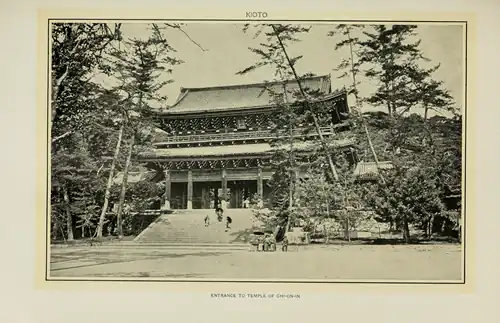
The city stands on the island of Hondo, in latitude 35° N., and longitude 135° 30′ E., in a fertile plain, bordered on three sides by moderately high mountains, near the centre of the Province of Yamashiro. It is 47 miles by rail from Kobe via Osaka on the coast, and 329 from Tokio (Map: Japan D 6), and is also connected by rail with Tsuruga on the Sea of Japan on the north, and westward 302 miles with Shimonoseki (q.v.), where the island of Hondo approaches Kiushiu. The city, which is unwalled, is traversed from north to south by the Kamogawa, which divides it into two unequal parts. The larger and more important part lies along the right bank of the river, the wide shingly bed of which is nearly dry except in the rainy season. The smaller and more picturesque part, where are found most of the hotels patronized by foreigners, rises gradually from the left bank to the wooded steeper slopes and spurs of the range of mountains, where many of the more famous temples and places of interest are situated. In general the plan of the city differs but little from that of 794, which Kuwammu, its founder, called Hei-an-jo, ‘the city of peace.’ It is about four miles in length from north to south, and two and one-half in breadth, and is laid out with mathematical regularity. The streets are wide, well kept, neat, and clean. In the northeast part is the Go-Sho or ‘Imperial Palace,’ which with its fine gardens, in true Japanese taste, covers 26 acres. The buildings are of wood, and arc characterized by a certain quiet elegance which is peculiarly Japanese. They contain many fine paintings by Japanese artists, and much fine carving. To the southwest of this is the Nijo, the castle of the Shogun, built in 1601, and now the seat of the city government. Though one of the gayest of cities, Kioto is a great religious centre, and temples and shrines abound. Shinto (q.v.) claims 93, and Buddhism about 950. In the southern part of the city are the Eastern and Western Hongwan-ji, the headquarters of the Shin sect, whose temples are noted for their great size, their magnificence, and their accessibility. On the eastern hills are many fine temples, such as the Chi-on-in and the San-ju-san-gen-Do. In this neighborhood is also found a large mound—the Mimidzuka—containing the ears and noses of the Koreans slain in the wars of Hideyoshi (1592–98). To the northeast of the Imperial palace on the way to Otsu, at a height of 2000 feet, and overlooking Lake Biwa, are the famous Buddhist monasteries of Hiyei-zan, founded about A.D. 800, and intended originally to shield the palace from the evil influences of the north.
Kioto is the centre of many art industries. Here the finest silks, crapes, velvet, brocades, and embroideries, porcelain, cloisonné enameled ware, bronzes, etc., arc produced, the manufacture giving employment to thousands of skilled hands. Much Satsuma and other ware is brought here to be decorated. Under the city government is an. industrial department for the promotion of the industrial arts, established in 1870, which includes experimental gardening, an experimental farm, a weaving department where foreign looms are used, a physical and chemical department, a female industrial school, a pauper industrial school, a shoemaking establishment, etc. Kioto is the seat of an Imperial university, with colleges of law, medicine, and engineering, supported by the Government, and under the auspices of the American Board of Commissioners for Foreign Missions is a college of good standing called the Doshisha, where theology is also taught. There are many schools, including five of the higher middle schools, and a training college for teachers. Population, in 1898, 353,139.