Wise Parenthood (1st edition)/Chapter 3
Chapter III.
Method Recommended
TO be entirely satisfactory a method should combine at least three essentials—safety, entire harmlessness, and the minimum disturbance of spontaneity in the sex act (that is to say, it should be as little inæsthetic as is possible).
Some people, generally those who have been brought up in the hazy ignorance of either an idealistic or a shame-faced attitude toward sex, refuse to use any preventive method. Not infrequently a woman who has had several children and acquired a fear of pregnancy so refuses, and cuts off her husband from all normal intercourse. Such people should try to realise that because there may be a few inartistic moments in a course of procedure, that cannot rationally be held to prohibit the procedure. It would be as reasonable to decide that as some of the processes of cooking and the after-effects of digestion are inartistic, solid food should not be taken. In this physical world we are to a considerable extent dependent on the physical facts of our bodies, which we cannot over-ride without making grievous trouble either for ourselves or those around us.
No method is absolutely safe, but if two methods, each very nearly reliable, are combined, then something approaching absolute safety is achieved. It must be remembered, however, that the most perfect procedure devisable cannot be safe in the hands of one who is careless. The one to whom the consequences of carelessness are most serious is, of course, the woman; she, therefore, is the one who should exercise the precaution. Consequently, she must have knowledge sufficient to be sure that she is taking the right steps. A large number of women are not acquainted with the physical structure of the human body; it is, therefore, necessary to describe a few essential features which all women must understand in order to take the best precautions.
A married woman has no difficulty in distinguishing the entrance of the vagina. The vagina itself is not a sex organ, but is the canal leading to the important internal organ—the womb. The ovaries, the actual source of the egg cells, are entirely internal and do not concern us here. The womb, however, though it is internal, can readily be felt near the end of the vaginal canal (v in diagram) if the woman feels for it with her longest finger (which, of course.
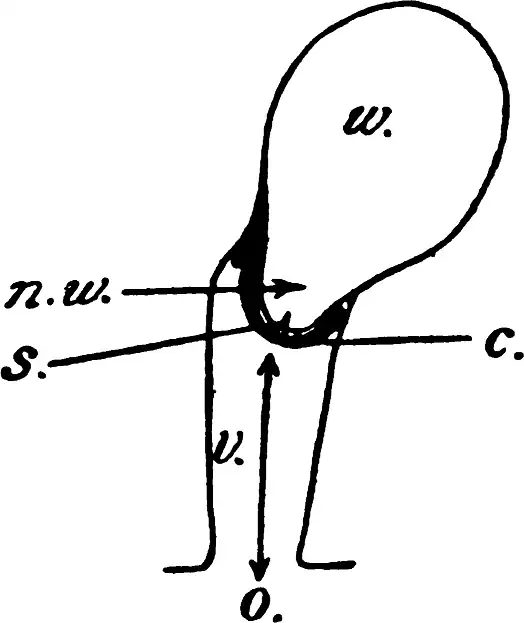 should be very clean, with the nails also clean before it is inserted gently). The distance from the opening of the vaginal orifice (o), which is the external opening, to the end of the vaginal canal where the womb can be just felt by most women, is generally about the length of the woman's own finger. The womb (w) lies internally but at the end of the canal and a little to one side, its neck projects like an inverted dome of soft, firm tissue (n w); in the centre of this is the very small actual opening (s) through which the sperm will pass if it is to fertilise an egg cell. This opening, however, is very small, and would not be felt under normal circumstances by most women.
The woman should know that it is there and that, therefore, if she wishes to prevent the sperm reaching the ovum this small entrance is the critical gateway through which the sperm must not pass. In the vagina itself, the sperms are merely waiting in the ante-room. The vagina, however, is of great importance to the man in the sex act, for it is into the vagina that his organ is fitted, and there it receives the sensations necessary for the completion of the normal act, the contact of the soft tissues of the parts being an important element in the right performance of the vital function. The ideal preventive method, therefore, does not interpose anything between the tissues of the vaginal canal and the male organ, but it should close the minute entrance of the womb and shut away the sperm from entering that critical part.
The best appliance at present available for doing this is a small rubber cap, made on a firm rubber ring, which is accurately fixed round the dome-like end of the womb, and, adhering by suction, remains securely in place, whatever movement the woman may make. (In the diagram, c shows the rubber cap in position.) These small rubber caps are quite simple, strong, easily fitted, and should be procurable from any first-class chemist.[1] The important point about adjusting them is that they should be of the right size. The average woman is fitted by a small or a medium size, but the woman who has had several children generally wants them larger. Before insertion the rubber cap should be moistened with very soapy water, so as to allow it to slip in easily. It should be fitted at any convenient time, preferably when dressing in the evening and some hours before going to bed. The great advantage of this cap is that once it is in and firmly and properly fitted it can be entirely forgotten, and neither the man nor the woman can detect its presence. It should be put in at least some hours before bedtime, and left in undisturbed until at least the following day; but I very much advise it being left in two or three days after any individual act of union. The reason for this will be mentioned below. Some women put it in when the monthly period has entirely ceased, and leave it in for three weeks. I am not sure that to leave the cap in so long is quite advisable, but it may remain undisturbed for a few days or a week quite safely under normal circumstances.
Now this method alone, if the cap really fits and if it is left in for some days so that the sperm are naturally got rid of without having a chance to enter. should be completely safe in itself. There is, however, always the possibility of a slight displacement or of a particularly active sperm remaining after the cap has been taken out and then using the opportunity to swim into the entrance of the womb. To render this impossible, or at any rate unlikely in the extreme, it is as well to plasmolize the sperms when they first come in; and in order to do this the best method is to have some plasmolizing substance in the vagina at the time when the sperms are deposited. The reason why it is better to do this rather than to wait and deal with the sperms afterwards is given in the paragraph on douching (see page 26).
Several substances may be used for the purpose of plasmolizing the sperms. One which is the easiest, because it is specially prepared and can be purchased readily, is the soluble quinine pessary. As this is in a form which enables the woman to slip it in undetected, the crisis is not æsthetically interfered with. In a few words, therefore, the readiest method of safe prevention is to combine the previously fitted rubber cap, which remains for some time in place, with the soluble quinine pessary slipped in a few minutes before the act. With these precautions, nothing further need be done. There is no getting up to douche or to take other precautions in the middle of the night. I do not even advise the removal of the cap or any steps being taken the following morning. The usual processes of Nature will dispose of the now impotent sperms. Those who are very anxious, however, who may feel this calm inactivity insufficient, may desire to douche the next morning and take out the cap. If they wish to do so, there is no harm in using one of the douches mentioned on page 29, so long as douching is not too frequently indulged in and does not become a regular habit.
About the action of quinine on the vagina I am still uncertain. For the average woman it is quite harmless; but, on the other hand, I am far from persuaded that it may not be partly absorbed by the walls of the vaginal canal and thus penetrate the system in such a way as to make peculiarly sensitive women either somewhat sleepless or to interfere slightly with the digestion, or to initiate local tenderness. It has been proved by scientific experiment that some substances (iodine, for instance) do penetrate through the walls of the vagina and get into the circulatory system with remarkable rapidity. Whether or not the same applies to quinine has never been tested, so far as I am aware. It is likely, however, that it may do so. If, therefore, after using the quinine the woman finds herself in any way doubtful of its action, I should recommend her to try one of the following methods:
(a) Instead of soluble quinine, to insert a small sponge (a fine-textured sponge about one and a half inches in diameter), which has been moistened and into which she has thoroughly rubbed soap powder, filling the pores of the sponge with powdered soap. This, if pushed up to the end of the vagina, should in itself be sufficient to render the sperm inactive. The sponge, however, should be taken out next morning; and, as this may displace the rubber cap, a douche may have to be used. It is therefore not quite so satisfactory a method as the soluble pessary which requires no further attention.
(b) A pad of cotton wool, thoroughly smeared with vaseline, which has been mixed with powdered borax, may be inserted into the end of the vagina. This may be used by those who find soap in any way unpleasant, or irritating, as it would tend to be more soothing.
Neither of these methods, however, seems to me so easy nor quite so satisfactory as the soluble quinine pessary. The great drawback to the soluble quinine pessary, however, is that it is itself made of cocoa butter, and that the cocoa butter has an odour some people object to (this can be got over by purchasing the more expensive, scented kind), and that the melted cocoa butter tends to spread on to linen.
Several varieties of soluble pessaries are made with other substances on the Continent, but they are not so easily obtained in this country. In France the peasant women make up such things for themselves, and a woman who has time and skill could do this, using gelatine instead of cocoa butter.
The greatest care should be exercised in getting a rubber cap exactly to fit. In order to put it in, the woman should be in a stooping position, and she should press the rim of the cap together so as to slip it into the opening. When the cap reaches the end of the vaginal canal it will naturally expand, and then tends to find its place itself (c in diagram). It wants pressing firmly round the protuberance of the womb, however, and if it is too small it may miss covering the critical opening. It should be the largest size which fits with comfort. One too large, of course, will leave a gap and be more disastrous than one too small. A woman who is afraid of her own body or ignorant of her own physiology should get a practitioner to fit her with a rubber cap; but for women of average intelligence this is not necessary. (It is shown in place in the diagram at c.) On the other hand, as the relative sizes of all the parts of our bodies vary very much, a woman may have a vaginal canal longer than her own centre finger, and would then have to be fitted by a medical practitioner, a nurse, or some competent person. In the first instance, she should purchase more than one size to find out exactly what suits her. On each occasion it should be pressed firmly, after some active movement, to see that it does not slip. When the cap is once firmly on, both the man and the woman can be at ease about it, as it will remain in for days without dislodgment. It should perhaps be mentioned that it is quite impossible for the cap to enter further or get into the body cavity and "lose itself" among the organs, as some ignorant people fear.
In order to get it out, all that is necessary is to bend a finger under its rim and jerk it off. The cap can then be brought out, washed and left to dry until it is next wanted. Rubber tends to rot; so, after some months' use, it should be carefully examined to see that it is not torn or become liable to be readily perforated. If for a long time it is out of use it will be found to keep better in water than in the air, as rubber is preserved for a longer period if kept under water than if exposed. If the woman can afford it, I should recommend a new one every six months or so, though with great care they will last a couple of years.
Various forms of rubber caps are on the market, shaped in various ways, but the circular, strong ring, with the dome-shaped soft centre, is the kind I recommend and which to the average woman is by far the most satisfactory.
This procedure on the part of the woman, though it may sound elaborate and a little sordid when described in full detail, is, nevertheless, after the first usage, so simple and so unobtrusive, that it can be entirely forgotten during the marriage rite itself. It, therefore, alone among mechanical preventive methods, does not tend to destroy the sense of spontaneous and uninterrupted feeling, which is so vital an element in the perfected union, and at the same time allows all the benefit to be derived from it. Doubtless when once the intelligent inquiry and scientific research commensurate with the importance of the subject are devoted to it, better preventive methods may be devised; but, in the meantime this combination of methods is far the best course which I can recommend, and, indeed, the only one which I can sincerely recommend.
There are, however, great varieties of individual needs on the part of various people, and as a good many other methods are in common use a few words about them are necessary.
- ↑ This round rubber cap is also called the small check pessary, or small occlusive pessary. I am not here speaking of the larger mensinga or matrisalus pessaries.