Willamette Landings
(Upload an image to replace this placeholder.)
(Upload an image to replace this placeholder.)
(Upload an image to replace this placeholder.)
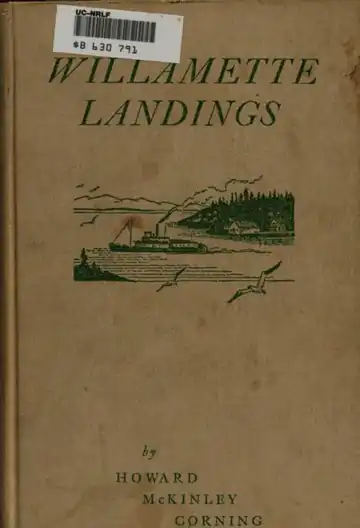
WILLAMETTE
LANDINGS
Ghost Towns of the River
by
Howard McKinley Corning
Published by
Binfords & Mort
for the
Oregon Historical Society
COPYRIGHT 1947, BY OREGON HISTORICAL SOCIETY
PRINTED AND BOUND IN
United States of America
INTRODUCTION
When the settlers along the Atlantic coast had disposed of the soldiers of George III, and forced a peace, and set up a nation to be known as the "United States of America," they promptly forgot about the Old World, so far as they could. They turned with all possible dispatch to home affairs. They thought, in particular, of the untold and virtually unknown riches to the westward, beyond Cumberland Gap, the headwaters of the Ohio and the other passes of the Alleghenies leading to the interior of the continent. And, since thought was the equivalent of action with these pioneer Americans, they promptly departed, by whatever means they could manage, through the mountain passes into the continent.
And this is something which we tend to forget, since so much intervenes to obscure our picture of that old migration: They did not fan out across plains and through forests when they made that crossing. There were no roads. There were no railways. And, coming from the seacoasts and the coastal rivers, they were used to water traffic. So they followed down the reaches of the Ohio and the reaches of the Tennessee, and followed up the tributaries of these and other rivers. They settled as close as possible to the banks, and once settled they used the network of rivers and streams for highways. This method of settlement and this way of life were so striking that in the final decades of the Eighteenth century and the first decades of the Nineteenth century, the men of the migration into the interior of the continent were known as the "Men of the Western Waters."
First there were the flatboats, or scows, and the many varieties of rowboats and canoes. Sail was used at times. Then steam power. And the river flourished into greater and greater importance.
It was toward the end of this period of river greatness—but still in that period—that the westernmost of the pioneers began moving from the Mississippi Valley to the Pacific Coast; specifically, so far as most of the farmers were concerned, to the Willamette Valley in Oregon. During the 1840's, their wagon wheels dug the ruts of the Oregon Trail. In the latter years of that decade there was the California gold rush to deepen those ruts. And all through the 1850's, and after, the wagons rolled on and the ruts worked farther into the hard plain and the harder mountains.
But these travelers were still the "Men of the Western Waters." They had not yet accepted the plain. Entering the valley of the Willamette, they did as they had been accustomed to do. The first of them established their farms on the banks of the Willamette. The next followed up the tributaries. Those a little later, and so excluded from these choicer sites, nevertheless crowded as close as possible. And all promptly began using the stream for the transport of their crops to market, for their journeys to town, and for their visits in the neighborhood. This was particularly necessary because of the sogginess of the land in the rainy season. Steam-use was logical, and, besides, romance just then surrounded the steamboat. So scores of landings were built along the Willamette, and many more along tributaries that today look unnavigable.
It is this story of development that is told in Willamette Landings. Here is the record of the boisterous and yet bucolic years of river traffic. And of course the story ends with the construction of railways and roads, over which produce and people could move swiftly and more directly. And so the old landings were left to fall into decay or to be carried away by the freshets.
The historian always finds it an adventure to come upon a good study, such as this, in some comparatively new field. But this book is more than just a good study. It has been done with due regard for the romance and the drama involved, and in admirable literary style. The layman will get as much pleasure as the historian in the reading of this book.
Philip H. Parrish
| Introduction—By Philip H. Parrish | 3 |
| Wilderness River | 7 |
| The Lower Willamette and the Towns That Grew | 13 |
| Preludes of Sail and Steam | 23 |
| Lost Towns of Willamette Falls | 35 |
| Linn City, Terminal of Commerce | 36 |
| Hugh Burns's Multnomah City | 52 |
| Clackamas City at the Rapids | 58 |
| Canemah, "The Canoe Place" | 61 |
| Wheat Ports of the Middle River | 73 |
| Butteville of Yesterday | 74 |
| Old Champoeg | 80 |
| Fairfield Landing | 92 |
| Wheatland at Matheny's Ferry | 97 |
| Lincoln, Metropolis of Wheat | 102 |
| Towns of the Middle and Upper Willamette | 111 |
| Paddle Wheels and Smoke Plumes | 121 |
| Trade Towns of Yesterday | 135 |
| Eola, the Town that Was Cincinnati | 136 |
| The Red Kilns of Buena Vista | 142 |
| Orleans in Indian Country | 148 |
| The Ferry Hamlet of Burlington | 154 |
| The Early Trade Center of Peoria | 156 |
| Booneville on the Old Channel | 160 |
| Lancaster, Fightin'est Town on the River | 162 |
| Other Landings of a Bygone Day | 169 |
| The Port of Springville | 170 |
| Old Oswego and the Lower Tualatin | 174 |
| Lafayette and the Towns of the Yamhill | 183 |
| Ray's and Fulquartz Landings | 190 |
| Still Flows the River | 193 |
| The River Landings—A List | 197 |
ACKNOWLEDGMENTS
Research for this book was begun by the WPA Oregon Writers' Project in 1936, under the general supervision of Dean Alfred Powers. Five or six persons worked on it until 1938 when Howard McKinley Corning was assigned to write the final draft. At the time the Writers' project was terminated, in 1942, the manuscript had not yet been published, and was sent with other material to the Oregon State Library at Salem. The manuscript was released to the Oregon Historical Society in 1945, and for final revision was turned over to Mr. Corning, who has thus prepared the present copy as well as doing much of the research. However, special acknowledgments must be made to the work done by Verne Bright, the book's first editor, and to Charles Oluf Olsen, Joseph H. McLaughlin, Curtis Merrick, Andrew Sherbert and Robert Wilmot. Credit is also due to Clare Warner Churchill, under whose direct supervision the work was carried on during 1937–41. Finally, the completed manuscript, as it here appears in book form, was read and helpful suggestions were made by Mrs. Lewis A. McArthur.
Permission to reprint in this revised form and under present sponsorship is by Luther H. Evans, Librarian of Congress.
Lancaster Pollard,
Superintendent
Oregon Historical Society

This work is in the public domain in the United States because it was legally published within the United States (or the United Nations Headquarters in New York subject to Section 7 of the United States Headquarters Agreement) before 1964, and copyright was not renewed.
- For Class A renewal records (books only) published between 1923 and 1963, check the Stanford University Copyright Renewal Database.
- For other renewal records of publications between 1922–1950, see the University of Pennsylvania copyright records.
- For all records since 1978, search the U.S. Copyright Office records.
Works published in 1947 could have had their copyright renewed in 1974 or 1975, i.e. between January 1st of the 27th year after publication or registration and December 31st of the 28th year. As this work's copyright was not renewed, it entered the public domain on January 1st, 1976.
The longest-living author of this work died in 1977, so this work is in the public domain in countries and areas where the copyright term is the author's life plus 47 years or less. This work may be in the public domain in countries and areas with longer native copyright terms that apply the rule of the shorter term to foreign works.


Public domainPublic domainfalsefalse