Utah and the Mormons/Chapter 18
CHAPTER XVIII.
- Social Intercourse.
- Governor's Party.
- Influence of Polygamy upon Amusements.
- Style of Building.
- Amusing Scenes growing out of Polygamy.
- Superstition.
- Endowment Robes.
- Initiation Ceremonies.
- The Curse.
- The Patriarch and his Blessings.
- Gift of Tongues.
- Notions on Slavery.
The Mormons are a social people. They have erected a large building called "Social Hall," with express reference to their gratification in this respect, and the building is so arranged as to answer the double purpose of a theatre and a place for social parties. In the basement is a kitchen, having all the means and appliances for cooking; adjacent to which is a saloon, capable of seating four to five hundred people. When a gathering takes place too large for the private residence of the one who intends to be the master of the feast, "Social Hall" presents ample "room and verge" enough for all the guests. These parties have their oddities, like every thing else connected with this strange people.
The Governor made a party in this building in January, 1853, for which the invitation cards, very neatly executed, were sent around some days beforehand. At the entrance each guest was met by the "private secretary," and required to pay two dollars and a half toward the expenses of the entertainment. This seemed odd enough; but it is the universal custom in all their parties of pleasure, and is no bad idea where luxuries are expensive. The party was large, and, after a goodly number had assembled, the business of the evening was opened by a short prayer; after which the dancing commenced, and was kept up during the whole evening. A band of music, which performed exceedingly well, was stationed on the raised platform, and there was room enough on the main floor for half a dozen sets of cotillions. Those who did not see fit to engage in dancing made themselves agreeable in conversation; and many being present who had traveled over almost the entire globe as missionaries, a stranger could not fail to pass the evening pleasantly. The supper came off at eleven, and was first-rate; all the elements of a good feast were there, and were enjoyed with great good humor. The latest sultana, who is quite pretty, was present as a guest. Some dozen others, however, of the harem, gave efficient aid in preparing the supper, and were hospitable in their attentions during the feast.
The Governor did not appear to enter with much zest into the enjoyments of the evening—did not dance, and seemed abstracted. Perhaps he was not in the vein, or he may have been solicitous that every thing should go off right; at any rate, no one could complain of any want of attention. He wore his hat, as usual. By-the-way, he seldom or never takes off his hat: in "Social Hall"—by his own fireside—in the State House delivering his message to the Legislative Assembly, it is all the same; the eternal hat is ever topmost. Is this intended as a species of ecclesiastical crown—a kind of Mormon tiara, emblematical of his sovereignty? Or has he got a bald spot, or ugly wen on the top of his bump of veneration? I don't know; I only know that Brigham and his hat, like the Centaur and his horse, are inseparable companions. His appearance is injured by this confounded hat, because he and his hat are always associated in the minds of all who have ever seen him.
He must have been a very good-looking young man. He is now about fifty-five; dresses well and in good taste; has a dignified presence; is of fair height, and well-rounded and well-proportioned figure, but stoops a little too much for his age. To a stranger his manners are affable, and his conversation possesses the interest natural to a shrewd mind and large experience in some of the roughest phases of human life. He has not the daring, reckless genius of Smith (dealing little in the prophet's bold and dashing revelations), nor does he possess the same popularity; but he is his equal in cunning, and his superior in sagacity. In Utah he is a great man; in the States he would be lost in the multitude of greater men. He is probably in the only place in the world where he could ever be distinguished.
Social parties are very common, at which music and dancing are the universal accompaniments. The invited guests generally contribute something toward the expenses, and often the sum for each one to pay is noted upon the card of invitation. Sometimes the contributions appear in the form of pies, cake, roasted fowl, &c., or some drinkable, forming a regular in-door pic-nic. During the winter, they keep up theatrical exhibitions at Social Hall, and generally the performances are better sustained in all their parts than in theatres in the Atlantic cities, though the principal part would not so well bear comparison. They lack in costume, but their music is good, and they have a scene-painter who would embellish theatres of much greater pretensions.
But the misery of all their social and theatrical entertainments is that they are too often made the places of assignation. At the theatre, the audience combines the peculiar characteristics of the pit and third tier of eastern cities; and as the room is imperfectly lighted, there are things said and done which would not bear a stronger light or a more definite description. Polygamy poisons every thing; it seems to break down all the barriers of female virtue. And how can it well be otherwise? A dozen women, the common property of one man, some of them divorced from other men, lodged under the same roof, and often more than one in the same room, soon begin to feel that they might as well be the common property each of a dozen men. I have been in small huts where the man and his two wives lodged in the only room in the house. I was in a wretched hut, in a small village on Utah Lake, where the man and his two wives and grown-up daughter lodged in the same room, containing two beds: it was their parlor, kitchen, and bed-room. It was a manifest struggle between poverty and licentiousness, and there was filth enough to manure a garden. A child in Utah who knows his own father is wiser than common children—wiser even than his mother, who, in many instances, would be exceedingly puzzled to fix the paternity.
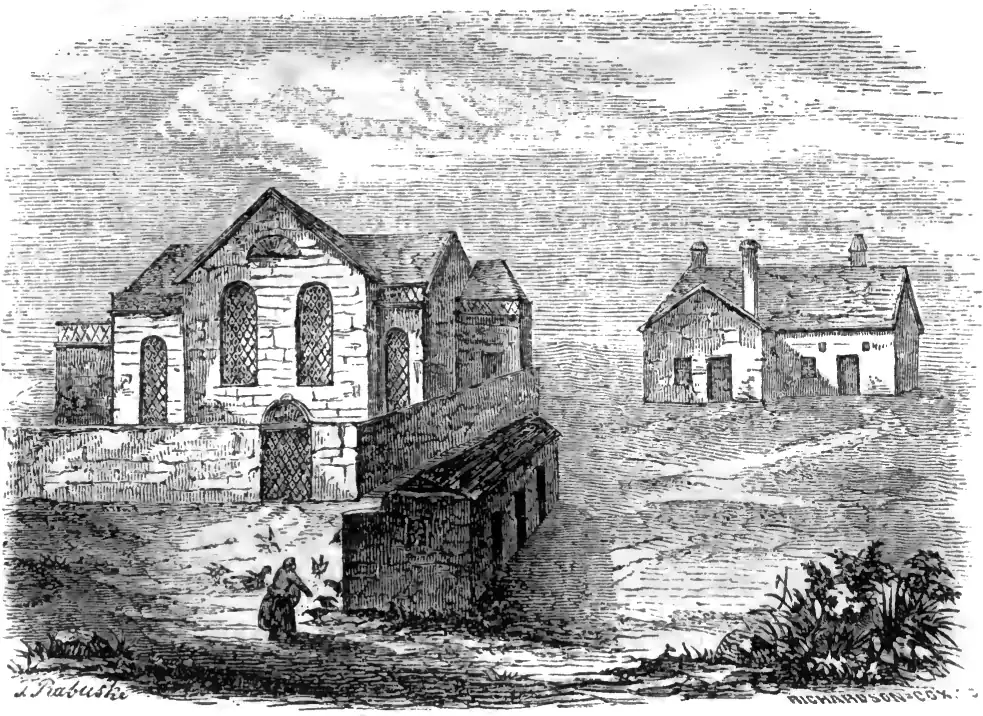
Polygamy is introducing a new style of building at Salt Lake City. A man with half a dozen wives builds, if he can, a long, low dwelling, having six entrances from the outside; and when he takes in a new wife, if able to do so, adds another apartment. The object is to keep the women and babies, as much as possible,
 DR. CLINTON'S HAREM.
apart, and prevent those terrible cat-fights which sometimes occur, with all the accompaniments of Billingsgate, torn caps, and broken broom-sticks. As the "divine institution" extends, these buildings increase, and in a few years the city will look like a collection of barracks for the accommodation of soldiers. Some have separate buildings in parts of the city remote from each other, and others have farm-houses, and the wives are thus kept separate, the husband dividing his time between them all.
DR. CLINTON'S HAREM.
apart, and prevent those terrible cat-fights which sometimes occur, with all the accompaniments of Billingsgate, torn caps, and broken broom-sticks. As the "divine institution" extends, these buildings increase, and in a few years the city will look like a collection of barracks for the accommodation of soldiers. Some have separate buildings in parts of the city remote from each other, and others have farm-houses, and the wives are thus kept separate, the husband dividing his time between them all.
Some funny scenes occur occasionally. Joseph Young, a brother of Brigham, had a wife who was more of a man than himself, and managed to ward off plurality for some time. But he belonged to the blood-royal, and was persuaded to make good his claim to royal privileges, by taking in a concubine from his own kitchen. This would seem to have settled the question, but the virago made a fight of it; she not only cleared the house of her rival, but effectually interrupted the honey-moon by maintaining a close espionage upon the good man. One day, however, she was absent, and, returning sooner than expected, found the bride and groom in rather too intimate proximity to suit her fancy. She seized the broom-stick, and laid on with such good-will that the pair were glad to quit the house in a very embarrassing predicament—very. It cost Brother Young a dollar to buy a new broom; and the veritable Sister Young, like the young fowler who came home empty-handed, if she did not absolutely bring down her game, had the satisfaction, at least, of making the feathers fly.
In the singularly made up population of Salt Lake Valley is a colony of Welsh, of whom the head man is Dan Ap Jones, and his wife is called the "Welsh Queen." Polygamy has made its inroads, too, upon these Britons, and a noted case is often related, in which the Welsh Queen figures as the principal personage. It seems that this queen claims a prodigiously long pedigree, reaching back as far as Gwenwin, the "Wolf of Plinlimmon," in the time of the Crusades, and is a personage of more than ordinary importance. The "divine institution" had been kept, a profound secret from her Welsh majesty before she left her native mountains, though her dear Ap had got an inkling of how matters stood in this respect at Zion; and being connected at least with royal blood, he had a slight hankering after some of its privileges. On the way over the Plains they encountered scattered parties of Mormon emigrants, from whom the princess ascertained, with some distinctness, the true state of things in the Valley of Salt. In connection with this intelligence, her attention became disagreeably fixed upon some significant signs of intimacy between Ap and a servant-girl; and, to cap the climax, the girl began to assume the airs of an equal. The Amazon
until an overt act of treason took place, when, pouncing upon her victim unexpectedly, she tore her clothes from her body; and in the war of words which ensued, Queen No. 2 dropped from her mouth a set of teeth, which Dan, like a loving husband, had provided for her, but which Queen No. 1 stamped into the ground in her fury, utterly destroying their capacity for grinding any more food.
Any number of anecdotes might be related illustrative of the same subject: one more must suffice. This was a tragi-comic scene, connected with no less a personage than W. W. Phelps, King's Jester, Almanac-maker, &c., &c. His wife, it seems, had given her consent, as she thought, to his enlarging his domestic borders by taking in another helpmate; but, after the deed was done, found herself so goaded with jealousy, that the immortal W. W. was compelled to lodge the new-comer elsewhere than under the homestead roof. This allayed some of the irritation; but still, when he was absent attending upon the new wife, the old one felt so much annoyed, that she was impelled to constitute herself a spy upon their actions. One night she stationed herself by the window of the apartment, where the lovers were too much engrossed with each other to pay any attention to intruders, but incautiously leaning too heavily against the sash, the whole fell in, including her own person. Phelps of the male gender, of course, bounced up in great alarm at the crash, and was much surprised to find Phelps No. 1 of the female gender prone upon the floor, with face and hands cut with broken bits of glass.
The Mormon system adapts itself readily to popular superstitions, and infuses into them new life and activity. The reigning prophet is the only true medium of a direct revelation from heaven; but, notwithstanding this, there are any number of dreams dreamed, and sights seen, of a supernatural character. The saints are surrounded by the spirits of the earth and the air; their movements individually and collectively are regulated by an invisible and supernatural agency. Remarkable dreams, and quasi visions, and strange sights, and mysterious omens, are exceedingly common, and are related with grave solemnity. One man dreamed that a dead uncle appeared to him, and entreated that he would be baptized for him, which of course was a convincing argument in favor of the doctrine of baptism for the dead. Another was perfectly sure that he had seen one of the three Lamanites spoken of in the Book of Mormon, who were to wander over the earth until the final consummation of all things—an idea borrowed undoubtedly from the popular notion of the "Wandering Jew."
In their initiation into the Church, the novitiates are invested with a mysterious garment called the endowment robe, to which many virtues are ascribed. These curious robes may be seen on the clothes-line in the afternoon of every washing-day, and consist of a white garment, made up of common shirting, with strips and crosses of scarlet stitched in, emblematical of some of their temple mysteries. It is believed that Doctor Richards had on one of these robes, and thereby escaped unhurt at the Carthage jail; and that Joseph and Hyrum neglected to put them on, and therefore lost their lives. The person thus invested is supposed to be safe against the arts of the devil to bring harm upon him, and in a condition to escape danger from shipwreck, disease, bullets, &c. Some of them are so imbued with this idea, that in changing the garment, they will keep one leg in the old one until they invest the other with the new, lest the devil or some of his imps should obtain a temporary advantage.
Mrs. Catharine Lewis has given us some insight into the ceremonies of the first initiation—the following is condensed from a pamphlet written by her while the Saints were at Nauvoo:
"She was taken to the Temple at Nauvoo, carried up three flights of stairs to the Hall of Initiation. There she was disrobed, washed, and anointed with great ceremony by females. After the washing, a blanket was put round her, and the priestess whispered a new name in her ear, which she was never to disclose. The next ceremony was the garden of Eden, where one person, representing God, creates a world, then makes man, takes a rib and forms a helpmeet for him. Then another person, representing the devil, tempts Eve with forbidden fruit; then the men and women hide, because God is coming; and so they go through a lot of mummery, including the flaming sword—the men wearing nothing but white drawers with shirts over them, and white linen caps. She was required to perform several ceremonies, such as drawing her hand across her throat as if in the act of cutting, and afterward learned that it would have been certain death to have resisted. The last sign was then given, accompanied with the incantation, 'Marrow in the bones, strength in the sinews, and virtue in the loins throughout all generations.' Her clothes were then restored to her."
This lady had the good fortune to escape from Nauvoo before being initiated into the deeper mysteries.
In these secret initiatory rites, a curse is invoked by each one upon him or herself in case of apostacy, and, in addition to this, the prophet is careful to fulminate an additional curse upon those who escape from his jurisdiction. These ecclesiastical thunders often prove more potent than would generally be believed. Many persons, who feel themselves robbed and oppressed by the authorities of the Church, and resolve time and again to escape from their unpleasant situation, are nevertheless restrained and kept in bondage by the superstitious fear that they may in some way be brought under the curse. The discontented Mormon mind presents a singular bundle of contradictions. I have heard persons of this description speak freely of the manner in which they had been plundered of their property, and of the numberless rascalities of Brigham and his associates, and of the abominable and lamentable effects of polygamy, and express their determination to leave the Territory; and yet these same persons, even after making some preparations for the journey, would remember the curse to which they stood exposed, and slide back into the lap of Mormonism, the passive slaves of this gross and filthy imposture. The leaders take unwearied pains to ascertain the subsequent history of those who have apostatized, and publish in the pulpit and by the press cases in which they have met with misfortune, some of which—whether in the form of destruction of property by fire or otherwise, or untimely death—are supposed to have been produced by the direct agency of the Saints themselves.
Among other singular institutions, they have a Patriarch, whose business it is to bestow blessings. The blessing is given in writing to the applicant, who pays for the same one dollar and a half, of which one dollar belongs to the Patriarch, and the balance is paid to the scribe for recording the document. This constitutes a revenue similar to that procured from the sale of indulgences, or of masses in popish times. At an early period, the mantle of patriarchal inspiration fell upon Uncle John Smith—it now covers the shoulders of Uncle Joseph Smith. It seems to be necessary that the incumbent should be an uncle and a Smith: there is no danger of the failure of the latter, and it is supposed the former will last the few years yet remaining before the great terrestrial clock finally runs down.
These blessings, like the endowment robes, are supposed to possess wonderful virtues in protecting the subjects of them from misfortune. A simple fool, by the name of Colborn, took great apparent satisfaction in exhibiting a blessing he had received from the veritable John Smith, while in Nauvoo in 1835. It covered two pages, and promised him almost every thing, and, among them, freedom from poverty and disease. He had, previous to this, been trying to excite sympathy by complaining of his miserable state of poverty and disease ever since he came to the valley; he was, nevertheless, fully persuaded that the blessing had been fulfilled to the very letter.
Any number of conversions can be traced to the supposed performance of miracles, among which the exercise of the gift of tongues is very conspicuous. One man stated that he was listening to a discourse by a Mormon elder, who all at once let forth a perfect flood of language entirely new to him. It caused "a sudden thrill," as he described it, "from the back of his head down his back-bone;" and, of course, he was converted from that hour. Another compared it to a shock of electricity.
These miraculous powers are generally taken upon trust. A Mormon lady related the case of an elder so ignorant that he could neither read nor write, who was a remarkably fluent preacher, and could repeat the Bible from beginning to end without missing a word. On being asked how he obtained such a knowledge of the Bible, he answered that it was given him of the Spirit while he was preaching. This fellow afterward apostatized, but, notwithstanding, she still persisted in the most implicit faith in his supernatural knowledge.
A. Mrs. Western, an old and simple-minded lady, relates that she was dissatisfied with all other doctrines and preachings because no claim was made to the signs which are to follow those who believe, and that she was converted by the first Mormon sermon she heard because the elder claimed to be in the possession of these proofs of discipleship, and actually joined the Church with no other evidence that he possessed them except his own assertion. She really believes she was healed twice miraculously, once by consecrated oil and the laying on of hands, and once by baptism; and it was a great mystery to her that she could not be so healed at other times. It seems she was at one period very anxious to have a demonstration of the gift of tongues. Lodging one night with a woman who pretended to the gift, her artful companion broke out in her sleep with a song in an unknown tongue, and, after an interval of genuine snoring, tuned up her pipes in English by way of translation. This, with other things, so completely fastened the simple-minded old lady, that the plurality system, though it greatly shocked her when introduced, did not drive her off. She now consoles herself that it was permitted to try the Church, and will eventually be abolished. She became a convert at a time of life when she could not be an object of desire to any of the Latter-day bashaws, and has escaped contamination from the worst pollutions of Mormonism.
So generally diffused is the notion that our bodies are tabernacles for pre-existing spirits to enter into, that mothers pretend to surmise from what particular tribe their children come from. One lady gravely stated that her little Ruth came from the tribe of Joseph. "She is a selfish little thing," said she, "and, you know, Joseph knew how to feather his own nest."
The Mormons justify slavery, and would be slaveholders upon religious principle if in their power. It will be recollected that, in the grand council of the gods convened to deliberate on the salvation of the human race, the devil and his adherents raised a factious opposition to Christ, and were defeated, cursed, and banished. They believe that the spirit of one of this crew entered into the tabernacle called Cain and committed the first murder, and that the negroes are descendants of Cain, and furnish tabernacles for these pre-existing devils. They believe that they have a black skin because they are under a curse, and that it is perfectly right for those having white skins to carry the celestial sentence into execution by enslaving them. I asked one of the elders how this sable pedigree escaped the flood: his answer was, that Ham's wife was a descendant of Cain, and was saved in the ark, and that the same curse was subsequently pronounced upon Ham.