1.
The theory of quadratic residues has been reduced to a few fundamental theorems, to be numbered among the most beautiful relics of Higher Arithmetic. These were first easily discovered by induction, and then were demonstrated in many ways, so that nothing more was left to be desired.
However, the theory of cubic and biquadratic residues is a far deeper undertaking. When we began to investigate this in the year 1805, some special theorems presented themselves, beyond those which had been placed on the threshold, which were very remarkable owing both to their simplicity and to the difficulty of their demonstrations. We soon found out that the principles of higher arithmetic hitherto used were by no means sufficient for establishing the general theory, and rather this necessarily required that the field of higher arithmetic be advanced as if to infinity. How this is to be understood will be elucidated clearly in the remainder of these discussions. As soon as we entered this new field, an approach to the knowledge of the simplest theorems was at once obvious, and the whole theory was exhausted by induction. Yet the demonstrations lay so deeply concealed, that it was only after many fruitless attempts that they could at last be brought to light.
Now that we are preparing to publish these lucubrations, we will begin with the theory of biquadratic residues, and indeed in this first commentary we will describe those investigations which have already been completed within the expanded field of Arithmetic, and which paved the way, as it were. At the same time, we will present some new developments in the theory of division of the circle.
2.
We introduced the concept of a biquadratic residue in Disquisitiones Arithmeticae art. 115. Specifically, an integer  , positive or negative, is said to be a biquadratic residue modulo
  if is congruent to a biquadrate modulo , and likewise a non-residue, if no such congruence exists. In all of the following discussions, unless explicitly stated otherwise, we will assume that the modulus is a prime number (odd positive), and that is not divisible by , since all of the remaining cases can easily be reduced to this one.
3.
It is clear that every biquadratic residue modulo is also a quadratic residue, and therefore every quadratic non-residue is also a biquadratic non-residue. We may also invert this statement whenever is a prime number of the form  . For in this case, if is a quadratic residue modulo , we can set
  , and
, and  will either be a quadratic residue or non-residue modulo . In the former case, we can set
  , and hence
  , i.e. will be a biquadratic residue modulo . In the latter case,
  will be a quadratic residue modulo (since
  is a quadratic non-residue of any prime of the form ), and setting
  , we will have as before , so will be a biquadratic residue modulo . At the same time, it can be easily seen that, aside from the solutions
  and
and  , no other solutions of the congruence
  can be found in this case. Since these propositions clearly exhaust the entire theory of biquadratic residues for prime moduli of the form , we will exclude such moduli entirely from our investigation, or in other words we will limit ourselves to prime moduli of the form
  .
.
4.
Given a prime number of the form , the converse of the proposition in the previous article is invalid: namely, there can exist quadratic residues that are not at the same time biquadratic residues. Indeed, this happens whenever a quadratic residue is congruent to the square of a quadratic non-residue. For setting  , where is a quadratic non-residue modulo , if the congruence
  could be satisfied by a value , then we would have
  , or the product
  would be divisible by . Thus would divide one of the two factors
  or
or  , i.e., either
  or would be a quadratic residue modulo , and therefore (since is a quadratic residue) both would be quadratic residues, contrary to the hypothesis.
Therefore, all integers not divisible by can be distributed into three classes, the first containing the biquadratic residues, the second containing the biquadratic non-residues which are at the same time quadratic residues, and the third containing the quadratic non-residues. Clearly, it is sufficient to subject only the numbers  ,
,  ,
,  to this classification, and half of these will be reduced to the third class, whereas the other half will be distributed between the first and second classes.
5.
However, it will be better to establish four classes, whose nature is as follows.
Let  be the complex of all biquadratic residues modulo that are situated between and
  (inclusive), and let
  be an arbitrary quadratic non-residue modulo . Let
  be the complex of minimal positive residues arising from the products
  taken modulo , and likewise let
  and
and  be the complexes of minimal positive residues arising from the products
  ,
,  modulo . Having done this, it is easy to see that the numbers in will be distinct from each other, and likewise for and . Furthermore, it is clear that all numbers contained in and are quadratic residues of , while all those in and are quadratic non-residues, so that certainly the complexes and cannot have a number in common with the either of the complexes or . Moreover, cannot have any number in common with , and cannot have any number in common with . For suppose
I. that some number from , e.g. , can also be found in , where it is congruent to a product  , with
  being a number from the complex . Let
  ,
,  , and let an integer
  be chosen such that
  . Then we have
  , and therefore, by multiplying by
  ,
,

i.e.  is a biquadratic residue, and therefore is a quadratic residue, contrary to the hypothesis.
II. Similarly, suppose that some number is common to the complexes , , and that it comes from products  ,
,  , with , being numbers from the complex . Then the congruence
  would imply
  , hence a number would be obtained, which being a product would originate from , but at the same time would belong to , which we have just shown to be impossible.
Furthermore, it is easily shown that all quadratic residues modulo , between and inclusive, must necessarily lie in either or , and all quadratic non-residues of between those limits must necessarily lie in either or in . For
I. Every such quadratic residue, which is also a biquadratic residue, is found in by hypothesis.
II. Given a quadratic residue  (less than ), which is also a biquadratic non-residue, one can find a quadratic non-residue such that is
  . Find an integer
  such that
  . Then will be a quadratic residue modulo , which we set
  . Hence

Therefore, since the minimum residue of  is found in , the number , which arises from it by taking the product with , must necessarily be contained in .
III. Let denote a quadratic non-residue modulo between the limits and , and let  be an integer between the same limits such that
  . Then is a quadratic residue, and therefore it is contained in either or . In the former case, will clearly be found among the numbers in , and in the latter case, it will be found among the numbers in .
From all this it is deduced that the numbers , ,  , … are distributed among the four series , , , in such a way that each of them is found in exactly one of these. Therefore, each series must contain exactly
  numbers. In this classification, classes and possess their numbers naturally, but the distinction between classes and is arbitrary, insofar as it depends on the choice of the number , which is always referred to class . Therefore, if another number from class is adopted in its place, the classes and will be interchanged.
6.
Since is a quadratic residue modulo , let us set  , so that the four roots of the congruence
  will be ,
  , ,
, ,  . Then if is a biquadratic residue modulo , say
  , the four roots of the congruence will be
  ,
,  ,
,  ,
,  , which are easily seen to be incongruent to each other. Hence, it is clear that if the least positive residues of the biquadrates ,
  ,
,  ,
, 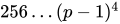 are collected, each will be present four times, so that the distinct biquadratic residues forming the complex will be obtained. If only the minimal residues of biquadrates up to
  are collected, then each will occur twice.
7.
The product of two biquadratic residues is clearly a biquadratic residue, as multiplication of two numbers of class will always produce a product whose minimal positive residue belongs to the same class. Similarly, products of numbers from with numbers from , or numbers from with numbers from , will always have their minimal positive residues in .
Likewise, the residues of the products  and
and  fall in ; the residues of the products
  ,
,  , and
, and  fall in ; and finally, the residues of the products
  and
and  fall in .
The proofs are so obvious that it suffices to indicate just one. Let e.g.  and
and  be numbers from and , with
  ,
,  , where and are numbers from . Then
  will be a biquadratic residue, i.e. its minimal residue will lie in : thus, since the product
  is
is  , its minimal residue will lie in .
At the same time, it can now be easily judged to which class the product of several factors should be referred. Namely, by assigning characters  , , , to the classes , , , respectively, the character of a product will be equal to the sum of the characters, or rather its minimal residue modulo 4.
8.
It seemed worthwhile to develop these elementary propositions without the support of the theory of powers of residues, with whose help it would have been far easier to demonstrate everything thus far.
Let be a primitive root modulo , i.e. a number such that in the series of powers ,  ,
,  no value before
  is congruent to unity modulo . Then without regard to order, the minimal positive residues of the numbers , , ,
  agree with , ,
  , and they can be conveniently distributed into four classes in the following manner:
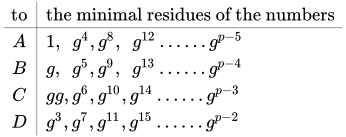
Hence all the previous propositions follow automatically.
Moreover, just as here the numbers , , have been distributed into four classes, whose complexes we denoted by , , , , so may any integer not divisible by be assigned to one of these classes, according to the class of its minimal residue modulo .
9.
We shall denote by the minimal residue of the power  modulo . Then it follows that
 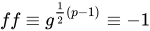 (Disquis. Arithm. art. 62), and it is clear that here has the same meaning as in article 6. Thus for an arbitrary positive integer
  , the power
  will be congruent to , , , modulo , depending on whether takes the form
  ,
,  ,
,  ,
,  resp., or as the minimal residue of
  is found in , , , resp. From this we obtain a very simple criterion for deciding to which class a given number (not divisible by ) should be referred; namely, will belong to , , , or , depending on whether the power
  turns out to be congruent to , , , or modulo .
As a corollary, it follows from this that is always referred to class whenever is of the form  , and to class whenever is of the form
  . A proof of this theorem which is independent of the theory of residual powers can be easily constructed from what we have shown in Disquisitionibus Arithmeticis art. 115, III.
10.
Since all primitive roots modulo come from residues of powers , by taking for all numbers relatively prime to , it is easy to see that these will be equally distributed between the sets  and
and  , with the base always contained in . If, instead of the number , a different primitive root from the set is chosen as the base, the classification will remain the same; however, if a primitive root from the set is adopted as the base, the sets and will be interchanged.
If the classification criterion is built upon the theorem in the previous article, the distinction between the classes and will depend on which root of congruence  we adopt as the characteristic number .
11.
In order for the more subtle investigations which we are about to undertake to be illustrated by examples, we present here the construction of the classes for all moduli less than  . We have adopted the smallest primitive root in each case.
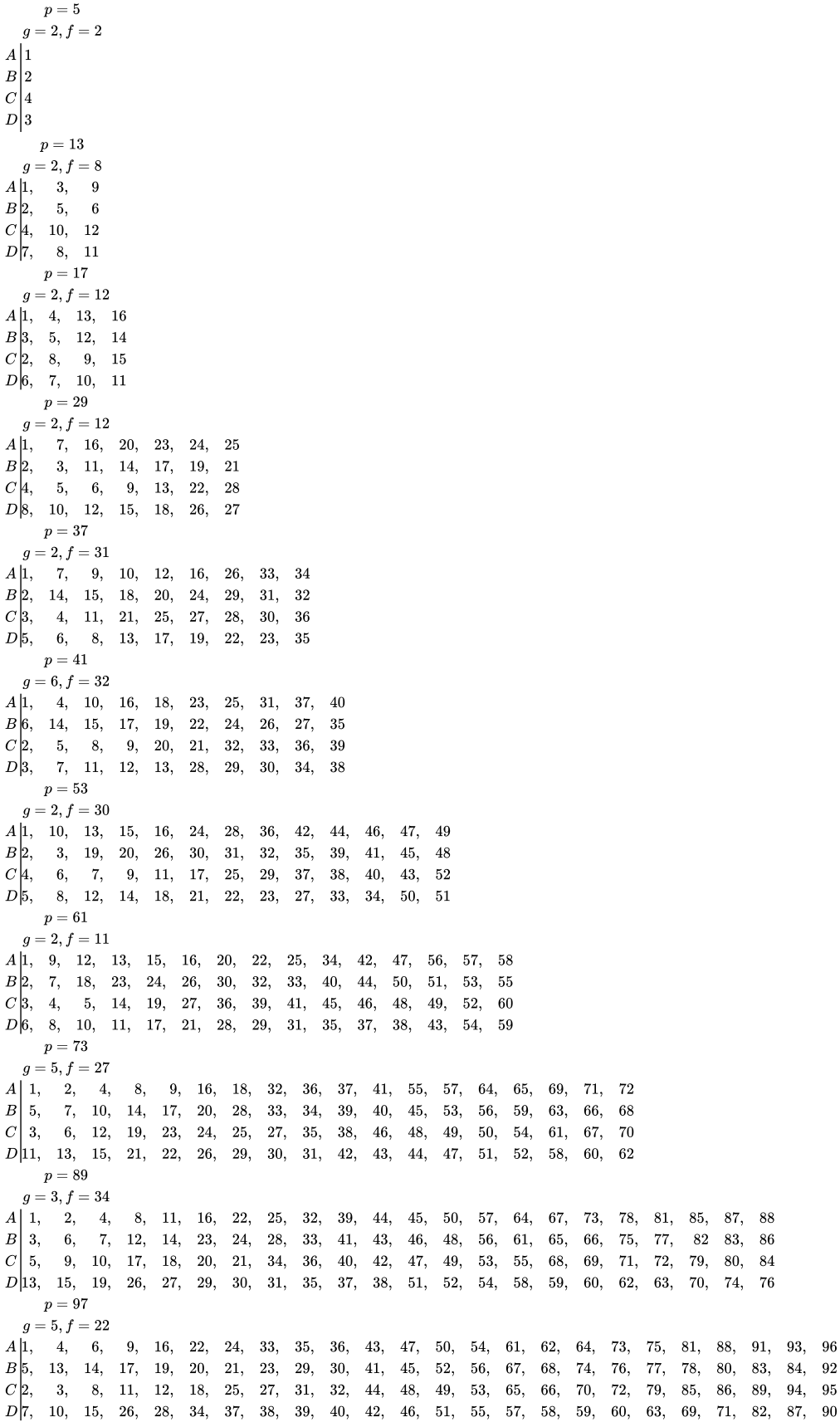
12.
Since the number 2 is a quadratic residue modulo all prime numbers of the form , and a non-residue modulo all prime numbers of the form , it will be found in classes or for prime moduli of the former form, and in classes or for prime moduli of the latter form. Since the distinction between classes and is not essential, and indeed depends only on the choice of the number , we will temporarily set aside the moduli of the form . By applying induction to moduli of the form , we find that belongs to for  ,
,  ,
,  ,
,  ,
,  ,
,  ,
,  ,
,  , etc.; on the contrary, belongs to for
  ,
,  ,
,  ,
,  ,
,  ,
,  ,
,  ,
,  ,
,  ,
,  ,
,  ,
,  , etc.
Moreover, since the number is a biquadratic residue modulo any prime of the form , it is evident that  always belongs to the same class as
  .
.
13.
If the examples of the previous article are compared to each other, no simple criterion seems to offer itself, at least at first sight, by which it would be possible to distinguish the former moduli from the latter. Nevertheless, two such criteria can be found, distinguished by their elegance and remarkable simplicity, to which the consideration of the following observations will pave the way.
The modulus being a prime number of the form, it is reducible, and indeed in only one way, to the form  (Disquiss. Arithm. art. 182, II); we will assume that roots , are taken positively. Clearly will be odd, and will be even; let us set
  , where is odd. We now observe
I. By assumption,  , so is a quadratic residue modulo , and therefore it is also a quadratic residue modulo each prime factor of . Therefore, by the fundamental theorem, each of these prime factors will be a quadratic residue modulo , and therefore also their product will be a quadratic residue modulo . Since this also holds for the number , it is clear that is a quadratic residue modulo , and therefore both
  and
and  are biquadratic residues.
II. It follows that  must belong to the same class as the number . Therefore, since
  , it is clear that will belong to class or class , depending on whether is a quadratic residue or non-residue modulo .
III. Now let us suppose that has been resolved into its prime factors, among which those which are of the form  or
or  are denoted by ,
  ,
,  etc., and those which are of the form
  or
or  are denoted by
  ,
,  ,
,  etc. Let the multitude of the latter be
  . Since
  , will be a quadratic residue modulo those prime factors of for which 2 is a quadratic residue, i.e. the factors , , etc.; and it will be a quadratic non-residue modulo those factors for which is a quadratic non-residue, i.e. the factors , , etc. Therefore, by the fundamental theorem, each of the numbers , , , etc. will be a quadratic residue modulo , and each of the numbers , , etc. will be a quadratic non-residue. From this it follows that the product will be a quadratic residue or non-residue modulo , depending on whether
  is even or odd.
IV. But it is easily confirmed that the product of all , , etc. will be of the form or , and the same holds for the product of all , , etc., if the multitude of these is even. So, in this case the product must necessarily be of the form or . On the other hand, the product of all , , etc., whenever their multitude is odd, will be of the form or , and the same holds in this case for the product .
From all of this, an elegant theorem can be deduced:
When is of the form or , the number will be in the complex ; but whenever is of the form or , it will be in the complex .
This is confirmed by the examples enumerated in the preceding article; the former moduli are thus resolved:  ,
,  ,
,  ,
,  ,
,  ,
,  ,
,  ,
,  ; but the latter thus:
  ,
,  ,
,  ,
,  ,
,  ,
,  ,
,  ,
,  ,
,  ,
,  ,
,  ,
,  .
.
14.
Since the factorization of the number into a simple and double square has produced such a remarkable connection with the classification of the number , it seems worthwhile to investigate whether the decomposition into two squares, to which the number is equally liable, may provide a similar success. Behold then, the decompositions of the numbers for which belongs to the class
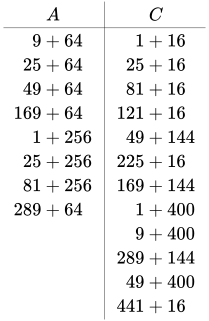
First of all we observe that, of the two squares into which has been divided, one must be odd, which we set  , and the other must even, which we set
  . Since
  is of the form , it is clear that the oddly even correspond to values of of the form , which are excluded by our induction, since they would have the number in class or . For the values of which are of the form , the value of must be evenly even, and if we have faith in the induction presented before our eyes, the number must be assigned to class for all moduli such that is of the form
  , and to class for all moduli such that is of the form
  . But this theorem requires a far deeper investigation than that which we have brought forth in the preceding article, and the demonstration must be preceded by several preliminary investigations regarding the order in which the numbers of the sets , , , follow each other.
15.
Let us denote the multitude of numbers from the complex , that are immediately followed by numbers from the complexes , , , resp., by  ,
,  ,
,  ,
,  . Likewise, denote the multitude of numbers from complex that are followed by numbers from complex , , , resp. by
  ,
,  ,
,  ,
,  ; and likewise in the complex by
  ,
,  ,
,  ,
,  , and in complex by
  ,
,  ,
,  ,
,  . We propose to determine these sixteen multitudes a priori. In order that the reader can compare the general reasoning with some examples, it was thought to add here the numerical values of the terms in a diagram (
 )
)
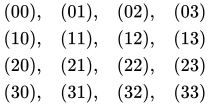
for each modulus for which we have given the classifications in article 11.
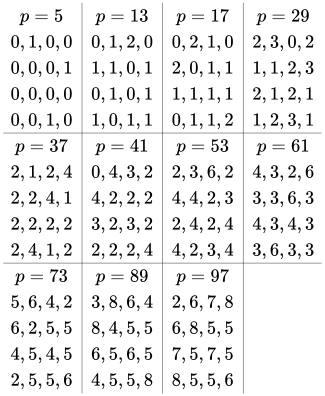
Since moduli of the form and behave in different ways, each must be treated separately: we will begin with the former.
16.
The symbol indicates the multitude of different ways that the equation  can be satisfied, where , denote indefinite numbers in the complex . Whereas for a modulus of the form , such as we understand here, and
  belong to the same complex, we will say more succinctly that expresses the multitude of different ways to satisfy the equation
  . Clearly, this equation can be replaced by the congruence
  .
.
Likewise,
where and are indefinite numbers from the complex , is an indefinite number from the complex , and  is an indefinite number from the complex . Hence we immediately obtain the following six equations:

From any given solution of the congruence  , there arises a solution of the congruence
  , where a number within the limits
  such that
  (which is clearly from the complex ), and
  is the minimal positive residue of the product
  (which will also be from the complex ). Likewise it is clear how to return from a given solution of the congruence to a solution of the congruence , if is taken in such a way that , and we simultaneously let
  . Hence, we conclude that both congruences enjoy an equal multitude of solutions, that is,
  .
.
In a similar manner, from the congruence  we deduce
  , if
, if  is taken from the complex in such a way that
  , and
, and  is congruent to the product
  from the same complex. Hence, we easily infer that these two congruences admit an equal multitude of solutions, that is,
  .
.
Similarly, from the congruence  we deduce
  , where , are chosen in such a way that
  . Therefore,
  .
.
Finally, from the congruence  , we derive in a similar manner h the congruence
  , and hence also
  , and thus we conclude that
  .
.
We have thus obtained, among our sixteen unknowns, eleven equations, such that they can be reduced to five, and the scheme can thus be exhibited as follows:
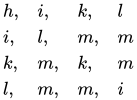
Three new conditional equations can now be easily added. For since every number of the complex , except the final , must be followed by a number from one of the complexes , , or , we will have

and similarly
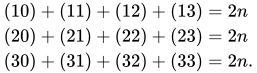
In terms of the variables we have just introduced, the first three equations supply:
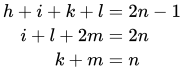
and the fourth is identical to the second. With the aid of these equations it is possible to eliminate three of the unknowns, by which means the sixteen unknowns are now reduced to two.
17.
In order to obtain a complete determination, it will be necessary to investigate the number of solutions of the congruence

where , , denote indefinite numbers from the complex , , . Clearly the value  is not admissible, since we cannot have
  . Therefore, substituting for the remaining values produces ,
  ,
,  ,
,  values of
  from , , , respectively. Similarly, for any given value of from , say for
  , the congruence
  will admit the same number of solutions as the congruence
  (by setting
  ,
,  ), i.e. the number of solutions will be
  . Likewise, for any given value of from , say
  , the congruence
 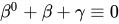 will have as many solutions as the congruence
  (by setting
  ,
,  ), i.e. the number of solutions will be
  . Similarly, for any given value of from , say
  , the congruence
 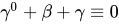 has the same number of solutions as the congruence
  (by setting
  ,
,  ), i.e. the number of solutions will be
  . Finally, for any given value of from , say for
  , the congruence
 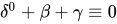 will have as many solutions as the congruence
  (by setting
  ,
,  ), i.e. there will be
  solutions. Putting all of this together, it is clear that the congruence
  will admit

distinct solutions.
In exactly the same way we can deduce that if each of the numbers from are substituted for , then  obtains resp. , , , or , ,
  , values from , , , , and for any given value of from the relevant complexes, the congruence
  admits , , , or , , , distinct solutions, so that the multitude of all solutions becomes

We are led to the same value if we apply the same considerations to the values of  .
.
18.
From this double expression of the same multitude we obtain the equation:

and hence, eliminating with the aid of the equation  ,
,

But the last two equations of article 16 yield  , and substituting this value for ,
  becomes
  . Therefore the preceding equation, after multiplying by
  , becomes

Hence, because  , it follows that

or

Therefore, setting

we find that

However, it is clear that there is a unique way to decompose as a sum of two squares, if one of them must be odd and denoted by , and the other is required to be even and denoted by , so that and are uniquely determined. Also, itself will be a completely determined number; for the square root must be taken as positive or negative, depending on whether the positive root is of the form  or
or  . We will soon discuss the determination of the sign of .
Now combining these new equations with the last three from article 16, the five numbers , , , , are completely determined by , , and  in the following way:
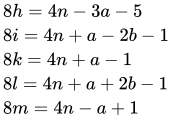
If these are expressed in terms of the modulus rather than , then the diagram  , with each term multiplied by to avoid fractions, is as follows:
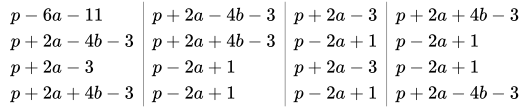
19.
It remains for us to explain how to assign the correct sign to . Already in article 10 above we have pointed out that the distinction between the sets and is not essential in itself, but rather depends on the choice of a number , for which one of the roots of the congruence  must be taken, and they are interchanged with each other if one of the roots is adopted instead of the other. Now, since an inspection of the diagram just presented shows that changing the sign of results in a similar permutation, it may be foreseen that there must be a connection between the sign of and the number . In order to understand this, we first of all observe that if is a non-negative integer, and
  runs through all the values , , , then either
  modulo (if is not divisible by ) or
  (if is divisible by ). The latter part of the theorem is clear from the fact that if is divisible by , then we have
  . The former part can be demonstrated as follows. Letting be a primitive root, all the values of agree with the minimal residues of all
  , where we take for
  all the numbers , , ,
  as . Therefore
  . But
. But

Since  cannot be congruent to for values of not divisible by , i.e.
  cannot be divisible by , it follows that . Q. E. D.
Now, if the power 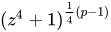 is expanded using the binomial theorem, then by the preceding lemma, we will have

But the minimal residues of all  exhibit all the numbers A, with each occurring four times. Therefore, among the minimal residues of
  ,
,
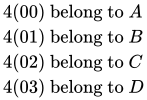
and four will be  (in the cases where
  ). Hence, considering how the complexes , , , were defined, we deduce

and therefore

or, substituting for for , etc. the values found in the previous section,

Hence we conclude that  must always be satisfied, or, multiplying by f,

This congruence serves to determine the sign of , if the number has already been chosen, or to determine the number , if the sign of is prescribed elsewhere.
20.
Having completely solved our problem for moduli of the form , we proceed to the other case, in which is of the form : we will be able to complete this more briefly because the reasoning differs little from the previous case.
Whereas for such a modulus, belongs to the class , the complements with respect to of the number in the complexes , , , will be in classes , , , respectively. Hence it is easily found that
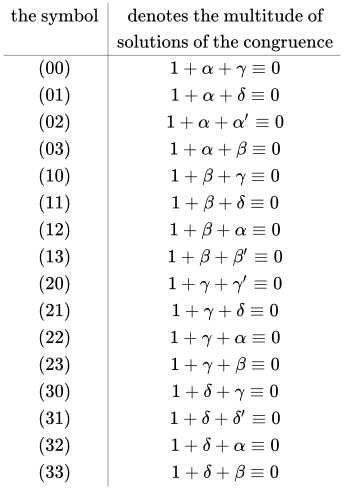
from which we immediately we have six equations:

Multiplying the congruence by the number from the complex such that , and taking for the minimal residue of the product , which will evidently also be from the complex , we obtain , from which we conclude that  .
.
Equations  ,
,  ,
,  can be obtained in a completely similar manner.
With the help of these eleven equations, we can reduce our sixteen unknowns to five, and present the diagram as follows:
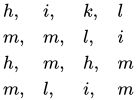
Furthermore, we have the equations
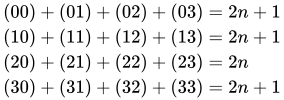
or, using the symbols we have just introduced, these three (I):
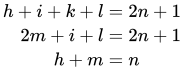
with the help of which we may now reduce our unknowns to two.
We will derive the remaining equations by considering the multitude of solutions of the congruence ,where , , denote indefinite numbers from the complexes , , respectively. Namely, by considering firstly , we obtain , , , numbers from , , , respectively, and for any given value of we have, in these four cases, , , , solution respectively. Thus the total number of solutions will be

Secondly, since yields , , , numbers from the complexes , , , , and for any given value of , there are , , , solutions in these four cases, the total number of solutions will be

from which we derive the equation

which, with the help of the equation  from (I), transforms into this:

Now, from the equations from (I), we also have  , hence
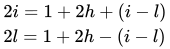
Substituting these values into the preceding equation, we get:

Finally, if we substitute  for , or, due to the last equation in (I),
  , we obtain:

and therefore

Setting

this becomes
Since in this case too, can be decomposed into two squares in only one way, with one even and the other odd, and will be completely determined numbers; for it is evident that must be the square of an odd number, and of an even number. Moreover, the sign of must be chosen in such a way that  , and the sign of must be chosen in such a way that
  , as can be proved easily using reasoning similar to that which we employed in the previous article.
The numbers , , , , can then be determined from , , and :
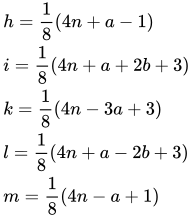
or if we prefer expressions in terms of , the diagram , with each term multiplied by , will be as follows:
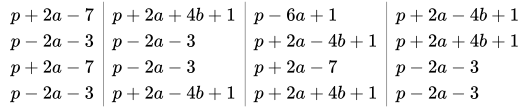
21
Having solved our problem, we return to the main discussion. We will now completely determine the complex to which the number 2 belongs.
I. Whenever is of the form , it is already established that the number 2 either belongs to the complex or to the complex . In the former case, it is easily seen that the numbers  and
and  also belong to , and in the latter case, they belong to . Now consider that if and
  are consecutive numbers in the complex , then
  and
and  are also two such numbers, or, which is the same, numbers of the complex that are followed by a number from the same complex, always come in associated pairs,
  and
and  . Therefore, the multitude of such numbers, , will always be even, unless a number exists which is associated with itself, i.e. unless belongs to , in which case will be odd. Hence we conclude that is odd whenever belongs to the complex , and even whenever belongs to . But we have

or setting  ,
,  (see article 14),

Therefore, since  is clearly always even, will be odd or even, according as
  is even or odd. Therefore, will belong to or depending on whether is of the form
  or
or  , which is the very theorem that was found by induction in article 14.
II. We may also complete the other case, where is of the form . The number here belongs to either or , and it is easily seen that in the former case belongs to and belongs to , and in the latter case belongs to and belongs to . Now consider that if is a number in that is followed by a number in , then the number  will also be in and
  will be in , i.e. numbers with this property are always present in associated pairs. Their multitude, , will therefore be even, except in the case when a number is associated with itself, i.e. when belongs to and to ; then of course will be odd. Hence we conclude that is even whenever belongs to , and odd whenever belongs to . But we have

or, setting ,  ,
,

Therefore, will be odd whenever is even; and on the other hand, will be even whenever is odd. From this we conclude that belongs to whenever is of the form  , and to whenever is of the form
  .
.
The conclusion of these investigations can be stated as follows:
The number 2 belongs to the set , , , or , according to whether the number  is of the form , , , or .
22.
In Disquisitiones Arithmeticae we explained the general theory of the division of the circle, and the solution of the equation  , and among other things, we showed that if is a divisor of the number , then the function
  can be resolved into factors of order
  , with the help of an auxiliary equation of order . In addition to the general theory of this resolution, we separately considered special cases where
  or
or  in articles 356-358 of that work, and we showed how to assign the auxiliary equation a priori, i.e. without finding the minimal residue of a primitive root modulo . Now, even without a reminder, attentive readers will easily perceive a close connection between the next simplest case of this theory, namely
  , with the investigations explained here in articles 15-20. Indeed, with the help of the former, the latter can also be completed without much difficulty. But we reserve this treatment for another occasion, and therefore in the present commentary, we preferred to complete the discussion using purely arithmetic methods, without mixing in the theory of the equation . Rather, in the conclusion of this work, we will add some new and purely arithmetic theorems, closely connected the subject which has been treated so far.
23.
If the power 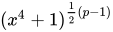 is expanded using the binomial theorem, there will be three terms in which the exponent of
  is divisible by , namely

where  denotes the middle coefficient

Therefore, substituting the numbers , , in turn for , we obtain by the lemma of article 19,

But considering what we explained in article 19, namely that the numbers of the complexes , , , , when raised to the  power, are congruent modulo to the numbers
  , , , respectively, it is easy to see that

and therefore, according to the diagrams given at the ends of articles 18 and 20, we have

Comparing these two values yields a most elegant theorem: namely, we have

Denoting the four products
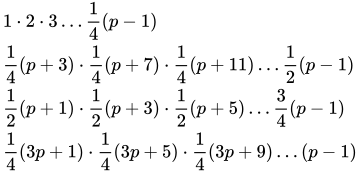
by  , ,
, ,  ,
,  respectively, the preceding theorem can be presented as follows:
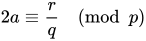
Since each factor of has its complement with respect to in , we have  whenever the multiplicity of factors is even, i.e. whenever is of the form . On the other hand,
  whenever the multiplicity of factors is odd, or is of the form . Similarly, in the former case we will have
  , and in the latter case
  . In both cases we will have,
  , and because it is clear that
  , we will also have
  , and consequently
  . Combining this congruence with the theorem just found, we obtain
  , and therefore, by articles 19 and 20,
 [1]
[1]
It is very remarkable that the decomposition of the number into two squares can be found by completely direct operations; namely, the square root of the odd square will be the absolutely minimal residue of  modulo , and the square root of the even square will be the absolutely minimal residue of
  modulo . The expression , which becomes
  for
for  , ican be presented for larger values of as follows:
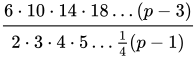
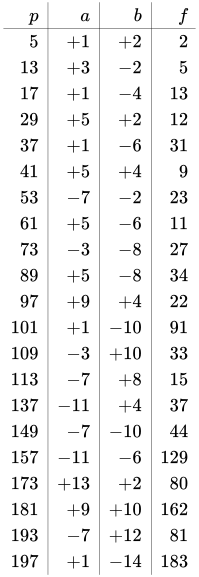
But since we furthermore know by which sign this formula for the square root of an odd number is affected, namely, so that it always takes the form , it is highly noteworthy that a similar general criterion with respect to the sign of the square root of the even number has not yet been found. If anyone finds it and communicates it to us, they will do us a great favor. Meanwhile, it seems appropriate to include here the values of the numbers , , , which produce the minimal residues of the expressions , ,  , for all values of less than 200.
24.
In the first commentary, that which is required for the biquadratic character of the number was completely determined. Specifically, if we conceive of all numbers that are not divisible by the modulus (which is assumed to be a prime number of the form ) as being distributed amongst four complexes , , , according to whether they become congruent to ,  , , modulo when raised to the
  power, where denotes one of the roots of the congruence
  , then we find that the complex to which the number should be assigned depends on the resolution of the number into two squares. Namely, if
  , with being an odd square, and being an even square, and assuming that the signs of , are taken in such a way that we have , , then the number will belong to the complex , , , according to whether is of the form
  , ,
, ,  , resp.
The rule governing the classification of the number also naturally arises in this way. Specifically, since belongs to the class for even values of , and to class for odd values, it follows from the theorem of article 7 that the number will belong to the complex , , , according to whether is of the form , , , resp.
The above theorems can also be expressed as follows:
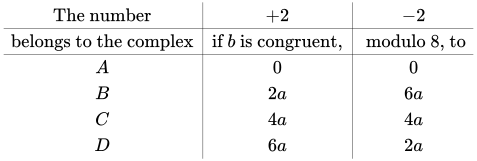
It is easily understood that the theorems thus stated no longer depend on the condition , but still hold if  , provided that the other condition,
  , is preserved.
It can be easily seen that all of these theorems can be elegantly condensed into a single formula, namely:
if and are assumed to be positive, then we always have

25.
Let us now see to what extent induction reveals the classification of the number 3. The table in article 11, continued further (and always adopting the minimum primitive root), shows that  belongs to the complex
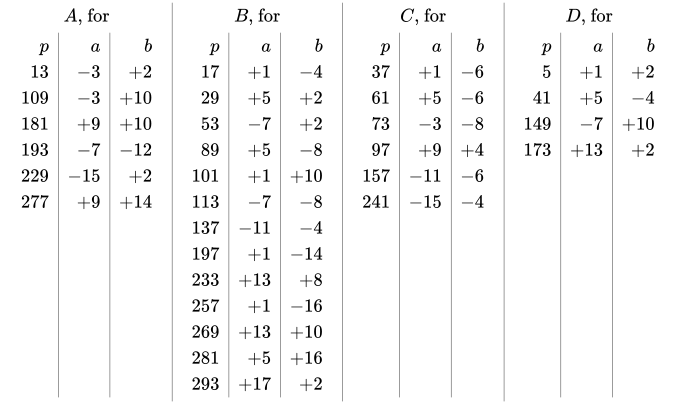
At first glance, we do not observe a simple connection between the values of the numbers , that correspond to the same complex. However, if we consider that a similar question in the theory of quadratic residues can be resolved by a simpler rule for the number  than for the number , there is hope for an equally successful outcome in the theory of biquadratic residues. Indeed, we find that belongs to the complex
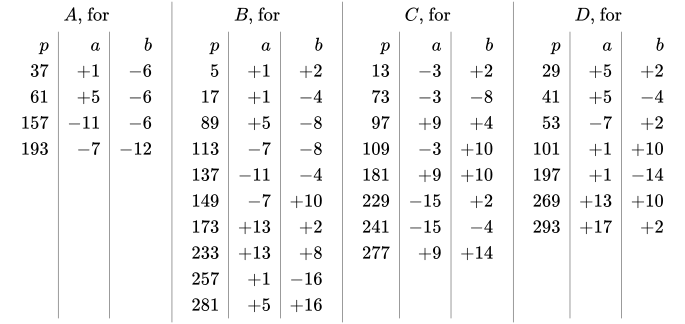
from which the inductive rule presents itself spontaneously. Namely, belongs to the complex
26.
We find that the number  belongs to the complex
, for

,

,

,

,

, for  ,
,  ,
,  , ,
, ,  , ,
, ,  , ,
, ,  ,
, 
, for  , ,
, ,  , ,
, ,  , ,
, ,
, for  ,
,  , , ,
, , ,  ,
,
Upon consideration of the values of the numbers  corresponding to each , the law here is just as easily grasped as it is for the classification of the number . Specifically, belongs to the complex
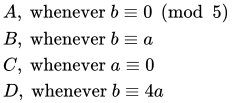
It is clear that these rules encompass all cases, since for  or
or  , we would have
  , Q.E.A., since by hypothesis is a prime number different from 5.
27.
Applying induction in the same way to the numbers  ,
,  ,
,  ,
,  ,
,  ,
,  yields the following rules:
For the number
.
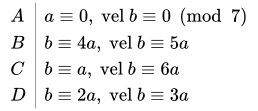
For the number
.
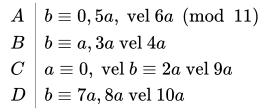
For the number
.
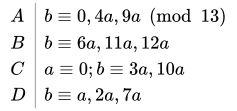
For the number
.
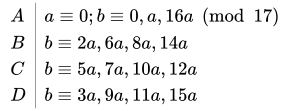
For the number
.
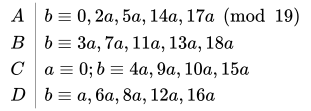
For the number
.
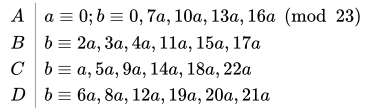
28.
The special theorems found in this way are found confirmed, as long one continues, and they reveal criteria of the most beautiful form. If they are compared with each other, so that general conclusions may be derived from them, the following observations immediately present themselves at first sight.
The criteria for deciding to which complex number a given prime number  should be referred (where the sign is taken positively or negatively, depending on whether is of the form or ), depend on the forms of the numbers , modulo . Specifically,
I. When  , belongs to a specific complex, which is for
  , ,
, ,  , and for
  ,
,  ,
,  ,
,  . From this arises the conjecture that the former case generally holds whenever is of the form
  , and the latter holds whenever is of the form
  . Moreover, the complexes and can already be excluded without induction when is divisible by , as we then have
  , i.e. is a quadratic residue modulo , and hence by the fundamental theorem, must be a quadratic residue modulo .
II. When is not divisible by , the criterion depends on the value of the expression  . This expression indeed admits different values of , namely , , ,
  , but whenever is of the form , we must exclude the two values of the expression
 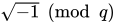 , which obviously cannot be values of the expression , since is always assumed to be a prime number different from . Therefore, the number of admissible values of the expression is
  for
for  , while it remains
  for
for  .
.
We can now distribute these values into four classes, so that some, denoted indefinitely by , correspond to the complex ; others, denoted by , correspond to the complex ; others correspond to the complex ; and finally the remaining correspond to the complex . We do this in such a way that belongs to the complex , , , or depending on whether  ,
,  ,
,  , or
, or  .
.
The law of this distribution seems more abstruse than it actually is, although some general observations can be made promptly. Three of the classes have the same multitude, namely  or
or  , while for the fourth (the one corresponding to the criterion
  ), the number is one less, so that the number of different criteria corresponding to each complex is the same, namely or . Furthermore, we note that is always found in the first class (among ), and that the complements of the numbers , , , to , i.e.
  ,
,  ,
,  ,
,  correspond to the first, fourth, third, second class, respectively. Finally, we see that the values of the expressions
  ,
,  ,
,  ,
,  belong to the first, fourth, third, second class, whenever the criterion corresponds to the complex ; and to the third, second, first, fourth class, whenever the criterion is referred to the complex . But these are almost all the observations that can be reached by induction, unless we presumptuously dare to anticipate those which will be derived below from genuine sources.
29.
Before we proceed further, it is worth noting that the criteria for prime numbers (taken positively if they are of the form , and negatively if they are of the form ) suffice for the determination of all other numbers, provided that the theorem of article 7 and the criteria for and  are called upon to assist. Thus, for example, if criteria for the number is desired, then the criteria stated in article 25, which refer to , will still apply for whenever is an even number; on the other hand, the complexes , , , should be interchanged with the complexes , , , whenever is odd. From this, the following criteria can be obtained:
belongs

Similarly, the criteria for  can be found by combining the criteria for
  and ; specifically,

belongs


belongs

In a similar way, the criteria for the number  can be put together from the criteria for and ; the criteria for
  from the criteria for , , , , etc.
30.
Induction therefore opens up a very abundant harvest of special theorems, similar for the theorem for the number . However, a common link and rigorous demonstrations are desired, since the method by which we classified the number in the first commentary does not allow further application. Now, there are various methods by which it would be possible to obtain demonstrations for particular cases, especially those which concern the distribution of quadratic residues among the complex , . However, we do not linger with these, since the theory should encompass all cases in general. When we started dedicating our thoughts to this matter in 1805, we soon became aware that the genuine source of the general theory was to be sought in the field of arithmetic, as we already mentioned in article 1.
Whereas higher arithmetic, in the questions hitherto treated, concerns only real integral numbers, so the theorems about biquadratic residues shine forth in the highest simplicity and genuine beauty only when the field of arithmetic is extended to imaginary quantities, so that, without restriction, the object of study consists of numbers of the form  , where denotes the usual imaginary quantity
  , and , indefinitely denote all real integral numbers between
  and
and  . We shall call such numbers complex integral numbers, so that they are not opposed to real complex numbers, but are rather considered to be contained among these as a species. The present essay will present both the elementary doctrine of complex numbers and the initial elements of the theory of biquadratic residues, which we will undertake to render perfect in every respect in the subsequent continuation[2].
31.
In the interest of brevity and clarity, we first introduce some notation.
The field of complex numbers contains
I. real numbers, where  , and, among these, depending on the nature of ,
1) zero
2) positive numbers
3) negative numbers
II. imaginary numbers, where is a non-zero number. Here again we distinguish
1) purely imaginary numbers, i.e. those for which 
2) imaginary numbers with a real part, for which neither nor equals 0.
If you like, the former can be called pure imaginary numbers, the latter can be called mixed imaginary numbers.
We use four units in this theory, , ,  ,
,  , which are positive, negative, positive imaginary, and negative imaginary.
We will call the products of any complex number by , , its associates or numbers associated with it. Except for the number zero (which is its own associate), there are always four unequal associates of any number.
On the other hand, we call a complex number conjugate if it arises from a permutation of with . Therefore, among imaginary numbers, any two unequal numbers are always conjugate, while real numbers are conjugate to themselves, if it is pleasing to extend the denomination to them.
The product of a complex number with its conjugate is called the norm of that number. So, the norm of a real number is the same as its square.
In general, we have eight related numbers,
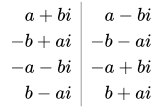
in which we see two quartets of associated numbers, four pairs of conjugates, and the common norm of all is  . However, these eight numbers are reduced to four unequal numbers when
  , or when one of the numbers , .
The following are immediate consequences of the given definitions:
The conjugate of a product of two complex numbers is the product of the conjugates of those numbers.
The same holds for products with several factors, as well as for quotients.
The norm of a product of two complex numbers is equal to the product of their norms.
This theorem also extends to products with any number of factors and to quotients.
The norm of any complex number (except for zero, which is usually tacitly understood from now on) is a positive number.
There is nothing preventing our definitions from extending to fractional or even irrational values of , ; but is only called an integer complex number when both , are integers, and it is only rational when both , are rational.
32.
The algorithms for arithmetic operations on complex numbers are commonly known: division, through the introduction of the norm, is reduced to multiplication, since we have

Extraction of square roots is accomplished with the help of the formula

if is a positive number, or with this

if is a negative number. It is not necessary to dwell here on the use of the transformation of the complex quantity into  for the purpose of facilitating calculations.
33.
We call a complex integer which can be resolved into two factors which are not units[3], a composite complex number; conversely, a complex number is said to be prime if it admits no such resolution. From this it immediately follows that any composite real number also is a composite complex number. But a prime real number could be a composite complex number, and indeed this holds for the number and for all positive real prime numbers of the form (except for the number ), since it is known that they can be decomposed into two positive squares; namely,  ,
,  ,
,  ,
,  , etc.
On the other hand, positive real prime numbers of the form are always prime complex numbers. For if such a number were  , it would also be
  , and therefore
  . But
. But  can only be resolved into positive factors greater than unity in a single way, namely as
  , from which it would follow that
  , Q.E.D.; since a sum of two squares cannot be of the form .
Real negative numbers are classified as prime or composite in the same way as positive numbers, and the same holds for pure imaginary numbers.
Thus it remains for us to explain how to distinguish between prime and composite mixed imaginary numbers, as can be done by the following
Theorem. A mixed imaginary integer is either a complex prime number or a composite number, depending on whether its norm is a prime or a composite real number.
Proof. I. Since the norm of composite complex numbers is always a composite number, it is clear that a complex number whose norm is a prime real number must necessarily be a complex prime number. Q. E. P.
II. If the norm is a composite number, let be a positive real prime number that divides it. There are now two distinct cases to consider.
1) If is of the form , it is clear that cannot be divisible by unless also divides and , so will be a composite number.
2) If is not of the form , it can definitely be decomposed into two squares: so let us assume that  . Since we have

it is divisible by , and thus it must divide either the factor  or the factor
  . In addition, since

and so is divisible by  , it is clear that in the first case
  must also be divisible by , while in the latter case
  must also be divisible by . Therefore, in the first case

will be a complex integer, and in the latter case

will be an integer. Therefore, since the given number is divisible either by  or by
or by  , and since the norm of the quotient
  is different from unity by the hypothesis, it is clear that is a composite complex number in both cases. Q. E. S.
34.
Therefore, the entire set of prime numbers can be exhausted by the following four species:
1) the four units, , , , , which, however, we will usually understand to be excluded when discussing prime numbers.
2) the number  with its three associates
  ,
,  ,
,  .
.
3) positive real prime numbers of the form along with their three associates.
4) complex numbers, the norms of which are real prime numbers of the form greater than unity, and indeed for any given norm there will always be exactly eight such prime complex numbers, since a norm of this kind can be decomposed into only two squares in a unique way.
35.
Just as the integers are distributed into evens and odds, and the evens are further divided into evenly even and oddly even, so too does an equally essential distinction present itself among complex numbers: namely,
either they are not divisible by , which is the case for numbers such that one of , is odd and the other is even;
or they are divisible by but not by , whenever both , are odd;
or they are divisible by , whenever both , are even.
For convenience, the numbers of the first class can be called odd complex numbers, those of the second semi-even, and those of the third even.
The product of multiple complex factors will always be odd, provided all factors are odd; semi-even, whenever one factor is semi-even and the rest are odd; and even, whenever among the factors, either two are semi-even, or at least one is even.
The norm of any odd complex number is of the form ; the norm of a semi-even number is of the form  ; and finally, the norm of an even number is the product of a number of the form and a power of two which is greater than or equal to .
36.
Since the connection between four associated complex numbers is analogous to the connection between two opposite real numbers (i.e. they are absolutely equally and affected by opposite signs), and among these, the positive number is usually considered as the primary one, the question arises whether a similar distinction can be established for four associated complex numbers, and whether it should be considered useful. In order to decide this, we must consider that the principle of distinction should be such that the product of two numbers, which are considered as primary among their associates, always becomes a primary number among their associates. But we are soon assured that such a principle does not exist at all unless the distinction is restricted to integers: so much so that the only useful distinction should be limited to odd numbers. For these purposes, the proposed goal can be achieved in two ways. Namely,
I. Given two numbers ,  such that , are of the form , and ,
  are even, their product will enjoy the same property, that the real part is
 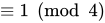 , and the imaginary part is even. And it can be easily seen that among four odd associates, only one is of that form.
II. Given a number such that  and are either both even or both odd, then its product with a complex number of the same form will be of the same form, and it is easily seen that among four odd associates, only one is of this form.
From these two almost equally suitable principles, we will adopt the latter, namely that among four odd associated complex numbers, the one which is congruent to the positive unit modulo  will be considered to be primary. In this way, it will be possible to state several important theorems with greater concision. Thus, the primary complex prime numbers are
  ,
,  ,
,  ,
,  ,
,  ,
,  , etc., and also the real numbers , , , , etc., which are always explicitly marked with a negative sign. The conjugate of a primary odd complex number will always be primary.
For semi-even and even numbers in general, a similar distinction would be too arbitrary and of little use. From the associated prime numbers , , , , we can indeed choose one as primary over the others, but we will not extend such a distinction to composite numbers.
37.
If among the factors of a complex composite number, numbers are found which are themselves composite, and these again are resolved into their factors, it is clear that we will eventually descend to prime factors, i.e., any composite number is resolvable into prime factors. If any non-primary numbers are found, substitute in place of each of them the product of the primary associate by , or . In this way, it is clear that any composite complex number  can be reduced to the form

such that , , etc. are distinct primary complex prime numbers, and  , , or . Concerning such resolutions, a theorem presents itself, that it can only be done in one way. This theorem might appear obvious in passing, but it certainly requires a demonstration. To which the following lays out a path
Theorem. A product  , where , , are distinct primary complex prime numbers, cannot be divisible by any primary complex prime number, which is not found among , , , etc.
Proof. Let be a primary complex prime number not contained among , , , etc., and let , , , , etc. be the norms of the numbers , , , , etc. It is easily seen that the norm of the number is  etc., from which it follows that if were divisible by
  , then its norm would be divisible by . Since the norms are either real prime numbers (from the sequence ,
  , , etc.), or squares of real prime numbers (from the sequence
  ,
,  ,
,  etc.), it is clear that this cannot occur, unless is identical to some norm , , , etc.: we thus suppose
  . But since and are assumed to be distinct primary complex prime numbers, it is easy to see that these cannot simultaneously hold, unless and are imaginary complex numbers, and therefore is an odd real prime number (not the square of a prime number). We therefore set
  ,
,  . It follows (by extending the concept and sign of congruence to complex integers) that we have
  , from which it is easily deduced that

Therefore, while is supposed to be divisible by ,

will also be divisible by , and hence the norm of this number,

will be divisible by . But since 2 and are not divisible by , it follows that must be identical to some of the numbers , , etc.: let’s say  . From this, we conclude that either
  , or
, or  , i.e. either
  , or
, or  , both of which contradict the hypothesis.
From this theorem, another one is easily derived, namely that the resolution into prime factors can only be accomplished in a single way. This follows using reasoning entirely analogous to that which we used for real numbers in Disquisitiones Arithmeticae (art. 16); it would therefore be superfluous to dwell on it here.
38.
We now proceed to congruences of numbers with respect to complex moduli. But at the outset of this discussion, it is convenient to indicate how the domain of complex quantities can be visualized intuitively.
Just as every real quantity can be expressed in terms of a segment originating from an arbitrary starting point on a doubly infinite line, by comparing it to another arbitrary segment which is taken as a unit, and can thus also be represented by another point, so that points on one side of the starting point represent positive quantities and on the other side represent negative quantities, so can any complex quantity be represented by a point in an infinite plane, in which a line is fixed for real quantities, so that a complex quantity  is represented by a point whose abscissa is
  and whose ordinate (taken positively on one side of the line of abscissas, and negative on the other) is
  . In this way, it can be said that an arbitrary complex quantity can be measured by the distance between the position of the referred point and the position of the initial point, with a positive unit denoting a determined arbitrary deflection towards a determined arbitrary direction; a negative unit denoting an equally large deflection towards the opposite direction; and finally imaginary units denoting equally large deflections towards two perpendicular directions.
In this way the metaphysics of so-called imaginary quantities is remarkably elucidated. If the initial point is denoted by  , and two complex quantities ,
  are referred to the points ,
  , which express their relative position to , the difference
  will be nothing but the position of the point relative to the point ; likewise, by representing the product
  as the position of the point
  relative to , you will easily see that this position is determined just as much by the position of the point to , as the position of the point is determined by the position of the point corresponding to the positive unit, so that it is not inappropriate to say that the positions of the points corresponding to the complex quantities , , , form a proportion. But we reserve a more extensive treatment of this matter for another occasion. The difficulties which are supposedly involved in the theory of imaginary quantities largely derive from unsuitable nomenclature (indeed, some have inappropriately referred to them as impossible quantities). If, starting from the concept of variations in two dimensions (which are understood most purely through spatial intuition), we had called positive quantities direct, negative quantities inverse, and imaginary quantities lateral, then clarity would succeeded over obscurity.
39.
The things that were brought forth in the preceding article referred to continuous complex quantities: in arithmetic, which deals only with integers, the schema of complex numbers will be a system of equidistant points and lines arranged in such a way that the infinite plane is divided into infinitely many equal squares. All numbers divisible by a given complex number  will also form infinitely many squares, whose sides
  and areas
  ; the latter squares will be inclined to the former whenever neither of the numbers , is . To every number not divisible by the modulus , there will be a corresponding point, either situated inside such a square, or in a side adjacent to two squares; however, the latter cannot occur unless , have a common divisor. Furthermore, it is clear that numbers congruent modulo will occupy congruent positions in their squares. Hence it is easily concluded that if we collect all numbers situated within a determined square, together with all those which may lie on two of its non-opposite sides, and finally one number divisible by , then we will have a complete system of incongruent residues modulo , i.e. any integer will be congruent to precisely one of them. It would not be hard to show that the number of these residues is equal to the norm of the modulus, . But it seems advisable to demonstrate this weighty theorem in a purely arithmetic way.
40.
Theorem. Let  be a given complex modulus, with norm
  , and assume that , are relatively prime numbers. Then any complex integer will be congruent, modulo , to at least one residue from the series , , , , and not to more than one.
Proof. I. Let , be integers such that  . Then we have

Therefore, given an integral complex number  , we have

Hence, denoting by the smallest positive residue of the number  modulo , and setting

we get

or

II. If a given complex number is congruent to two real numbers ,  modulo , then these will also be congruent to each other. Therefore, letting
  , we have

and hence

Moreover, since  ,
,

Therefore, since and are not equal, they cannot both be included in the complex of numbers , , , . Q. E. S.
41.
Theorem. Let be a complex modulus, whose norm is , and assume that , are not relatively prime, but instead have a greatest common divisor (which we assume to be positive). Then any complex number will be congruent to one and only one residue  such that is one of the numbers
 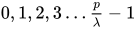 , and is one of the numbers , , ,
  .
.
Proof. I. By taking integers  such that
  , we have
  . Now let be the given complex number, let the minimal positive residue of modulo , let be the minimal positive residue of
  modulo
  , and set

Then
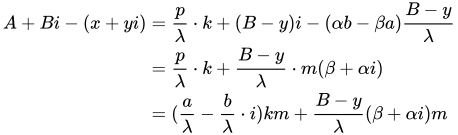
which is divisible by , i.e.  Q. E. P.
II. Let us suppose that two complex numbers ,  are congruent to the same complex number modulo , so that they will also be congruent to each other modulo . Then they will also be congruent modulo , and thus
  . Therefore, if both ,
  are assumed to be among the numbers , , , , then we must necessarily have
  . Likewise, we must also have
  , i.e.
  is divisible by , and therefore
  is an integer divisible by
  , i.e.

From this, since  ,
,  are relatively prime, it is concluded by the second part of the theorem of the previous article that is also divisible by the norm of the number , i.e. by the number
  , and therefore is divisible by . Therefore, if both ,
  are assumed to be in the complex of numbers , , ,
  , then we must necessarily have
  , i.e. the residues , are identical. Q. E. S.
It is clearly also necessary to refer to the case where the modulus is a real number, in which case and  , and also where it is a pure imaginary number, in which case and
  . In both cases, we have
  .
.
42.
Therefore, if we sort all complex numbers into classes in such a way that numbers which are congruent with respect to a given modulus are in the same class, and incongruent numbers are assigned to different classes, then there will be exactly classes exhaustively covering the entire domain of complex integers, where denotes the norm of the modulus. If we form a complex of numbers by choosing one number from each class as in articles 40, 41, then we will have a complete system of incongruent residues. In this system, the choice of a representative from each class was based on the principle, that for any class, a residue should be adopted, such that has the minimum possible non-negative value, and such that has the minimum possible non-negative value among all residues with the same minimum value of . But for other purposes, it will be suitable to use different principles. Of particular note is the method where residues are adopted which, when divided by the modulus, yield the simplest possible quotients. Clearly, if ,  ,
,  etc. are quotients resulting from the division of congruent numbers by the modulus, then the differences between the quantities , , etc. will be whole numbers, as will be the differences between the quantities , , etc., so it is clear that there will always be one residue for which both and lie between the limits and , with the former being included and the latter excluded: we will simply call such a residue the minimal residue. If preferable, the limits
  and
and  may be adopted instead (with one included and the other excluded): we will call the residue which satisfies these conditions the absolute minimum.
Regarding these minimal residues, the following problems present themselves.
43.
The minimum residue of a given complex number with respect to the modulus , whose norm is  , can found in the following way. If is the minimal residue to be found, then
  will be the minimal residue of the product
  with respect to the modulus
  , i.e. with respect to the modulus . Therefore, assuming

so that , are the minimum residues of the numbers  ,
,  with respect to the modulus , then
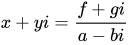
or
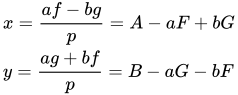
Clearly, the minimum residues , should be taken either within the limits and , or within  and
and  , depending on whether the simply minimal or the absolutely minimal residue is desired.
44.
The construction of a complete system of minimal residues for a given modulus can be accomplished in several ways. The first method proceeds by first determining the limits within which the real parts must lie, and then assigning limits for the imaginary parts for each value within these limits. The general criterion for a minimal residue modulo consists in the conditions that both  and
and  must lie within the limits and , whenever we deal with simply minimal residues, or lie within the limits
 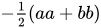 and
and  whenever absolutely minimal residues are desired, with one of the limits excluded. Specific rules are required to distinguishing cases that are brought about by the variety of signs of the numbers , , but since the the solution of this presents no difficulty, it has been deferred and we shall refrain from lingering on it here: a single example will suffice to explain the nature of the method.
For the modulus  , the simply minimal residues must be prepared in such a way that both
  and
and  are among the numbers
  . The equation
  shows that the positive values of cannot exceed
  , and by considering the sign, the negative values cannot exceed
  . Therefore, the admissible values of are , , , , , . For
  ,
,  must be among the numbers ,
  ,
,  , and
, and  must be among , , ,
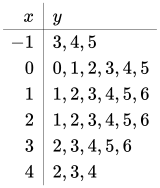
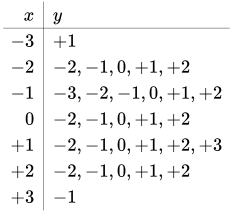
  . Hence, the minimum value of is , and the maximum is . Treating the remaining values of similarly, the following schema for all minimal residues arises:
In a similar manner, for the absolutely minimal residues,  and
and  must be among the numbers
  ,
,  ,
,  ; hence
  cannot be outside the limits
  and
and  , and therefore must be among the numbers , , , , , , . For
  ,
,  will be among the numbers , ,
  , however
  will be among
  , ,
, ,  : hence it follows that for only the value is possible. Proceeding in the same way for the other values of , we have the following schema for all absolutely minimal residues:
45.
In applications of the second method, it is convenient to distinguish two cases.
In the first case, where and do not have a common divisor, let , and let be the minimal positive residue of  modulo . Then the identities

show that  ,
,  . Therefore, if we assume that , as above, then we have
  ,
,  . So all numbers
  corresponding to simply minimal residues are obtained when the values , , , are successively taken for , and the minimal positive residues of the products
  modulo are taken for . Likewise the simply minimal residues will be obtained, but in a different order, if the values , , , are taken for and the minimum residues of the products
  are taken for . From each , the corresponding are given by the formula

Now, it is clear that when increases by unity, will undergo an increase of or a decrease of  , and thus will become

an observation which serves to facilitate the construction.
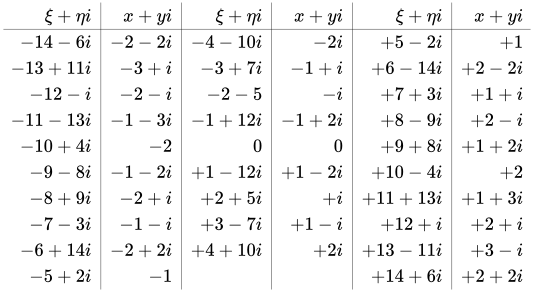
Finally, it is clear that if the absolutely minimal residues of are desired, these instructions are only to be changed in such a way that the values of are subsequently assigned to be between the limits and  , while for one should obtain the absolutely minimal residues of the products . Here is a table of the absolute minimum residues for the modulus arranged in this way:
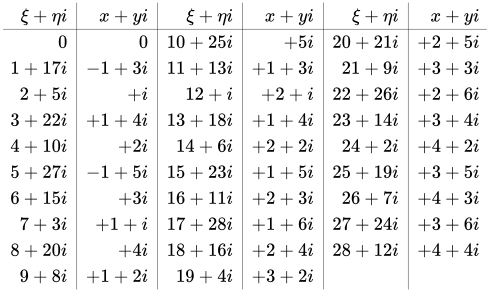
Absolutely minimal residues.
In the second case, where , are not coprime, it is easy to reduce to the previous case. Let be the greatest common divisor of the numbers , , and let  ,
,  . Let
. Let  denote an indefinite minimal residue for the modulus , insofar as it is considered as a complex number, i.e., it represents an indefinite number such that , are either between and or between
  and
and  (depending on whether simply or absolutely minimal residues are in question). Let
  denote an indefinite minimal residue for the modulus . Then
  will be an indefinite minimal residue for the modulus , and the complete system of these residues will emerge as all are combined with all .
46.
Two complex numbers are said to be prime to each other if they do not admit any common divisors other than units. But whenever such common divisors are present, the one with the maximum norm is called the greatest common divisor.
If the resolution of two numbers into prime factors is given, the determination of the greatest common divisor is carried out entirely in the same way as for real numbers (Disquiss. Ar. art. 18). At the same time it becomes clear from this that all the common divisors of the two given numbers must be divisible by the greatest common divisor found in this way. Since it is already evident that the three associated numbers are also common divisors, it follows that there will always be four greatest common divisors, and no more, and their norm will be a multiple of the norm of any other common divisor.
If the factorization of two given numbers into prime factors is not known, the greatest common divisor can be found using a similar algorithm as for real numbers. Let , be the two given numbers, and form a repeated division series  ,
,  , etc., such that is the absolutely minimal residue of with respect to the modulus , is the absolutely minimal residue of with respect to the modulus , and so on. Denoting the norms of the numbers , , , , etc., by ,
  ,
,  ,
,  , etc., we have
  as the norm of the quotient
  , and therefore, by the definition of absolutely minimal residue, it is certainly not greater than
  ; the same holds for
  etc. Therefore, the positive real integers , , , etc., will form a continuously decreasing series, which necessarily reaches at some point, or, equivalently, in the series , , , , etc., we will eventually reach a term that measures the preceding without residue. Let this term be
  , and suppose that
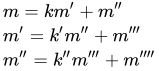
etc., up to

By going through these equations in reverse order, it is clear that divides each preceding term  , , ; going through the same equations in direct order, it is clear that any common divisor of the numbers , also divides each subsequent term. The former conclusion shows that is a common divisor of the numbers , ; the latter shows that this divisor is the greatest.
Moreover, whenever the final residue turns out to be equal to one of the four units , , , , this will indicate that and are relatively prime.
47.
If the equations of the foregoing article, except for the last one, are combined in such a way that  ,
,  are eliminated, there arises an equation of the form

where , will be integers. Indeed, if we use the notation introduced in Disquiss. Ar. art. 27 then
![{\displaystyle {\begin{aligned}&h=\pm \left[k^{\prime },k^{\prime \prime },k^{\prime \prime \prime }\ldots k^{(n-1)}\right]=\pm \left[k^{(n-1)},k^{(n-2)}\ldots k^{\prime \prime },k^{\prime }\right]\\&h^{\prime }=\mp \left[k,k^{\prime },k^{\prime \prime },k^{\prime \prime \prime }\ldots k^{(n-1)}\right]=\mp \left[k^{(n-1)},k^{n-2)}\ldots k^{\prime \prime },k^{\prime },k\right]\end{aligned}}}](./_assets_/eb734a37dd21ce173a46342d1cc64c92/6e1026d0742f2d363d93a56623d1ff7d8ace2e00.svg)
where the upper or lower signs hold, depending on whether is even or odd. We state this theorem as follows:
The greatest common divisor of two complex numbers , can be reduced to the form  , in such a way that , are integers.
This is clearly valid not only for the greatest common divisor to which the algorithm in the previous article led, but also for the three associated divisors, for which one should replace the coefficients , with either  ,
,  or
or  ,
,  , or
, or  ,
,  .
.
Therefore, whenever the numbers , are relatively prime, the equation

can be satisfied.
Let us consider e.g. the numbers  and
and  . Here we find
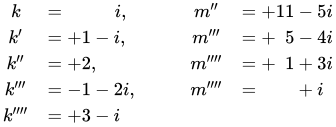
and thus
![{\displaystyle {\begin{aligned}&{\left[k^{\prime },k^{\prime \prime },k^{\prime \prime \prime }\right]=-6-5i}\\&{\left[k,k^{\prime },k^{\prime \prime },k^{\prime \prime \prime }\right]=+4-10i}\end{aligned}}}](./_assets_/eb734a37dd21ce173a46342d1cc64c92/206960539959904c9880ee32fb425f606e8cc561.svg)
and therefore

as well as

which is confirmed by calculation.
48.
By all of the above, everything required for the theory of congruences of the first degree in the arithmetic of complex numbers has been prepared; but since it does not essentially differ from that which holds for the arithmetic of real numbers, and which is copiously set out in the Disquisitiones Arithmeticae, it will suffice to set down the principal points here.
I. The congruence  is equivalent to the indeterminate equation
  , and if this is satisfied by the values
 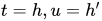 , then its general solution is exhibited by
  ; the condition for solvability is that the modulus does not have a common divisor with the coefficient .
II. The solution of the congruence  in the case where , are relatively prime, depends on the solution of

and if this is satisfied by  , the general solution is given in the formula

III. In the case where , have a common divisor , the congruence is equivalent to
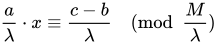
Therefore, when the greatest common divisor of the numbers , is adopted for , the solution of the proposed congruence is reduced to the preceding case, and for this to be solvable it is clearly necessary and sufficient that also divides the difference  .
.
49.
So far we have only touched on elementary matters, yet it was not permissible to omit the logical connections. In more advanced investigations, the arithmetic of complex numbers is similar to the arithmetic of real numbers, in that more elegant and simpler theorems emerge, if we only consider such moduli which are prime numbers: in fact, the extension to composite moduli is usually more lengthy than difficult, and involves more labor than skill. Therefore, in the following, we will primarily deal with prime moduli.
50.
Let  denote a function of the variable of the form

where is a positive real integer, , , , etc. are real or imaginary integers, and is a complex integer. Any integer that, when substituted for , yields a value of which is divisible by , we will call a root of the congruence  . Roots which are congruent with respect to the modulus will not be considered distinct.
When the modulus is a prime number, such a congruence of order cannot admit more than distinct solutions. Letting be an arbitrary integer (complex), can be divided by  and thereby reduced to the indefinite form
  , where is an integer and
  is a function of degree
  with integer coefficients. Now, whenever is a root of the congruence , it is clear that will be divisible by , and therefore we obtain indefinitely
  .
.
Now, if is a given integer, and is reduced to the form  , then
  will be a function of degree
  with integral coefficients. However, if is assumed to be a root of congruence
  , it must also satisfy
 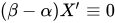 and
and  , since the roots , are incongruent. Hence, it follows that must be divisible by , or indefinitely,
  .
.
Similarly, with the introduction of a third root incongruent to the previous ones, we will have indefinitely  , such that
  is a function of order
  with integral coefficients. This process can be further extended, and it is evident that the coefficient of the highest term in each function is
  , which is assumed to be indivisible by . Otherwise, the congruence
  would essentially have a lower degree. Therefore, whenever there are incongruent roots, say
  , we will have indefinitely

Hence, the substitution of new values which are not congruent to one of will produce a value of which is not divisible by , and the truth of the theorem follows naturally.
Moreover, this demonstration essentially agrees with that which we presented in Disq. Ar. art. 43, with every step being equally valid for complex numbers as for real numbers.
51.
For the most part, the results presented in the third section of the Disquisitiones Arithmeticae concerning residues of powers also hold true, with slight modifications, in the arithmetic of complex numbers. Indeed, the proofs of the theorems can often be retained. Nevertheless, in order to provide a complete account, we will present the main theorems and establish them with concise proofs, in which it should always be understood that the modulus is a prime number.
Theorem. Let denote an integer not divisible by the modulus . If the norm of is , then  .
.
Proof. Let , , , etc. be a complete system of incongruent residues for the modulus . Remove the residue divisible by , and denote the resulting complex by , so that the multitude of is  . Let
. Let  be the complex of products
  ,
,  ,
,  , etc. By hypothesis, none of these products will be divisible by , so each of them will be congruent to a residue in the complex . Set
  ,
,  ,
,  , etc.
  , where the numbers , ,
  , etc. are found in the complex : let us denote the complex of numbers , , , etc. by
  . Let ,
  ,
,  be the products of individual numbers of the complexes , , , respectively, that is,
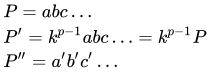
Since the numbers of the complex are congruent to the numbers of the complex ,  or
or  . But since it is easy to see that any two numbers of the complex are incongruent with each other, and thus all of them are distinct, the complex of numbers must agree completely with the complex of numbers , with only the order changed, whence
  . Thus,
  will be divisible by , and thus, since is a prime number that does not divide any of the factors of ,
  will necessarily have to be divisible by . Q. E. D.
52.
Theorem. If denotes, as in the preceding article, an integer not divisible by the modulus , and denotes the smallest exponent (other than 0) for which  , then will be a divisor of any other exponent
  for which
  .
.
Proof. Suppose is not a divisor of , and let  be the multiple of that is just greater than , so that
  is a positive integer less than . From
  ,
,  , it follows that
  , so
, so  , that is, a power of with exponent less than is equivalent to 1, contrary to the hypothesis.
As a corollary, it follows that must divide the number .
We will call numbers for which  , primitive roots for the modulus : we will show that they in fact exist.
53.
Let the number be resolved into its prime factors, so that we have

where , , , etc. are distinct real positive prime numbers. Let , , , etc. be integers (complex) not divisible by , which do not satisfy the respective congruences

modulo . The existence of , , , etc. is clearly guaranteed by the theorem of article 50. Finally, let be congruent, modulo , to the product
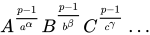
Then I claim that will be a primitive root.
Proof. Let denote the exponent of the lowest power  which is congruent to unity. If were not a primitive root, then would be a proper divisor of , or equivalently
  would be an integer greater than unity. Evidently, this integer will have its real prime factors among , , , etc.: let us therefore suppose (which is allowed), that is divisible by , and set
  . Then, since
  , we also have
  or
or

But evidently  is an integer, so

similarly,

Next, let a positive integer be determined so that

which can be done, since the prime number does not divide  , and set
  . Then it is clear that

we have  , and hence, since we automatically have
  , we also have
  , contrary to the hypothesis. Therefore, the assumption that is a proper divisor of is inconsistent, and so must necessarily be a primitive root.
54.
Let denote a primitive root modulo , with norm . Then the terms of the sequence

will be incongruent to each other. Hence we easily conclude that any integer not divisible by the modulus must be congruent to one of these, or in other words, it must exhibit a complete system of incongruent residues excluding zero. The exponent of the power to which a given number is congruent can be called its index, while can be called the base. Here are some examples in which we have given the absolutely minimal residue for each index.
55.
We add some observations about primitive roots and indices, omitting the proofs for the sake of simplicity.
I. Indices which are congruent modulo correspond to residues which are congruent modulo and vice versa.
II. The residues corresponding to the indices which are relatively prime to are primitive roots and vice versa.
III. If a primitive root is accepted as the base, and the index of another primitive root is , and  is the index of when is taken as the base, then
  ; and if the indices of any other number in these two systems are ,
  respectively, then
  ,
,  .
.
IV. While the numbers , and their three associates (being too meager) are excluded from the moduli we consider, the remaining prime numbers are those which we referred to as the third and fourth species in article 34. The norms of the latter will be prime numbers of the form ; the norms of the former will be the squares of real prime numbers: in both cases, therefore, will be divisible by .
V. Denoting the index of the number by , we will have  , and therefore either
  or
or 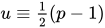 : but since the index corresponds to the residue , the index of the number must necessarily be .
VI. Likewise, denoting the index of the number by , we will have  , and therefore either
 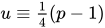 or
or 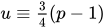 . But this ambiguity depends on our choice of a primitive root. Specifically, if the primitive root is taken as the base and the index of the number is , then the index will become
  when
when  is taken as the base, where denotes a positive integer of the form which is relatively prime to , e.g. the number
  , and vice versa. Therefore, with different choices of primitive root, the number will have the index for one base, and the index for the other, and for the latter base, will clearly have the index , and for the former, it will have the index .
 When the modulus is a positive real prime of the form , say , and thus
  , the indices of all real numbers will be divisible by
  ; for denoting the index of the real number by , we will have, since
  ,
,  , and therefore
  will be an integer. Likewise, the indices of purely imaginary numbers like
  will be divisible by
  . It is therefore clear that only mixed numbers can be primitive roots for such moduli.
 On the contrary, for a modulus which is a prime complex mixed number (whose norm is a prime real number of the form ), all primitive roots can be chosen from among the real numbers, among which a complete system of incongruent residues can be demonstrated (article 40). It is clear that any real number which is a primitive root for the complex modulus will at the same time be a primitive root modulo in the arithmetic of the real numbers, and vice versa.
56.
The theory of quadratic residues and non-residues in the arithmetic of complex numbers is contained within the theory of biquadratic residues, but before we discuss this, we will separately present its remarkable theorems here. For the sake of brevity, however, we will speak here only about the principal case, in which the modulus is a complex prime number (odd).
Let be such a modulus, and let be its norm. It is clear that any given integer (which is always understood to be indivisible by ) will either be congruent to a quadratic residue modulo or not, depending on whether its index, taken with respect to some primitive root as a base, is even or odd. In the former case, that integer is said to be a quadratic residue modulo , and in the latter case, it is said to be a non-residue. It is concluded from this that among the numbers that constitute a complete system of incongruent residues (indivisible by ), half are quadratic residues and the other half are quadratic non-residues. For any other number outside this system, the same character is attributed to it as to the number which is congruent to it and belongs to the system.
It follows from this that the product of two quadratic residues, as well as the product of two quadratic non-residues, is a quadratic residue. On the other hand, the product of a quadratic residue with a quadratic non-residue results in a quadratic non-residue. Generally, the product of any number of factors is a quadratic residue or a non-residue, depending on whether the number of quadratic non-residues among the factors is even or odd.
The following general criterion for distinguishing quadratic residues from quadratic non-residues immediately presents itself:
A number , which is not divisible by the modulus, is a quadratic residue or non-residue depending on whether  or
or  .
.
The truth of this theorem immediately follows from the fact that, no matter which primitive root is taken for the base, the index of the power  will be either
  or
or  , depending on whether the index of the number is even or odd.
57.
It is indeed easy, given a modulus, to divide the system of incongruent residues into two classes, namely quadratic residues and non-residues, by which means at the same time all other numbers are automatically assigned to these classes. However, a much more profound inquiry is required to develop criteria that distinguish the moduli for which a given number is a quadratic residue from those for which it is a non-residue.
As regards the real units and , these are actually squares in the arithmetic of complex numbers, and therefore they are also quadratic residues for any modulus. From the criterion in the preceding article, it follows equally easily that the number (and similarly ) is a quadratic residue for any modulus whose norm is of the form , and a quadratic non-residue for any modulus whose norm is of the form . Since clearly it makes no difference whether the number or any of the associated numbers  ,
,  ,
,  is adopted as the modulus, it may be assumed, according to article 36, II, that the modulus is a primary associate, and hence by stipulating that the modulus
  , that is odd and is even. Thus, since it is always the case that
  , and is either or
 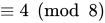 , depending on whether is also even or is odd, it is clear that the numbers and are quadratic residues of the modulus in the former case, and non-residues in the latter.
58.
Since the character of a composite number (whether it is a quadratic residue or non-residue), depends on the characters of the factors, it will be sufficient to limit the development of criteria for distinguishing the moduli for which a given number is a quadratic residue or non-residue, to values of which are prime numbers, and moreover to those among them which are primary associates. In this investigation, induction immediately provides particularly elegant theorems.
Let us begin with the number , which is found to be a quadratic residue modulo
, ,  ,
,  ,
,  ,
,  , ,
, ,  ,
,  , etc.
and a quadratic non-residue modulo
, , , , ,  ,
,  ,
,  ,
,  ,
,  ,
,  ,
,  ,
,  ,
,  ,
,  , etc.
If we carefully examine the above lists, in which we have always recorded the primary associate, we straightforwardly observe that the moduli for which  are all in the former class, and the moduli for which
  are all in the latter class. If we had chosen as the modulus instead of the primary associate , the criteria would need to be modified, so that moduli for which
  would be in the former class, and moduli for which
  would be in the latter class. Therefore, if the induction has not failed, in general, denoting the primary number by , where is odd and is even, will be a quadratic residue or quadratic non-residue, depending on whether
  or
or  .
.
The same rule applies to the number as for the number . Conversely, considering as the product of and , it is evident that the number has the same character as when is even, and the opposite character when is odd. Hence, it can be easily inferred that is a quadratic residue modulo the primary number whenever  , and it is a quadratic non-residue when
  , assuming as always that is odd and is even.
Moreover, this second proposition can also be deduced from the previous one, with the help of the following more general theorem, which we state as follows:
In the theory of quadratic residues, the characteristic of the number with respect to the modulus is the same as that of the number with respect to the modulus  .
.
The proof of this theorem is found in the fact that each modulus has the same norm , and that as many times as 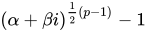 is divisible by ,
 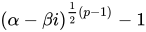 must also be divisible by ; and as many times as
 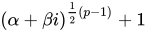 is divisible by ,
 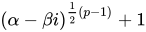 must also be divisible by .
59.
Let us proceed to odd prime numbers.
We find that the number is a quadratic residue modulo , , , , , , , , , , etc.
and it is a non-residue modulo , , , , , , , , , , , , , etc.
When we reduce the moduli of the former class to their absolutely minimal residues modulo , we obtain only and . Namely,  ,
,  ,
,  ,
,  , etc.
On the other hand, all moduli of the latter class are found to be congruent to or with respect to the modulus .
Now, the numbers and are quadratic residues modulo , whereas and are non-residues. Hence, as far as induction is concerned, the theorem is as follows: The number is a quadratic residue or non-residue modulo the prime number , depending on whether is a quadratic residue or non-residue modulo , provided that is the primary number among its four associates, that is, if is odd and is even.
Furthermore, from this theorem, analogous theorems naturally follow concerning the numbers  , ,
, ,  .
.
60.
By performing a similar induction for the numbers and , we find that each of them is a quadratic residue modulo , , , , , , , , , , etc.
and each is a quadratic non-residue modulo , , , , , , , , , , , etc.
The former are all congruent to one of the four numbers , , , modulo ; whereas the latter are all congruent to one of  ,
,  , , . The former are precisely the quadratic residues modulo , whereas the latter are the quadratic non-residues.
Therefore, this induction shows us that the primary number , assuming is odd and is even, has the same relation with the number (and also with ) as does with , with regard to whether each is a quadratic residue or non-residue modulo the other.
Extending a similar induction to other primary numbers, we find that this most elegant law of reciprocity is confirmed everywhere, and we are brought to the following fundamental theorem concerning quadratic residues in the arithmetic of complex numbers.
Let , be primary numbers, so that , are odd and , are even. Then either both of them are quadratic residues of the other, or both of them are quadratic non-residues of the other.
Despite the great simplicity of the theorem, its proof is pressed by great difficulties, which, however, we do not dwell on here, since the theorem itself is only a special case of a more general theorem, which almost exhausts the theory of biquadratic residues. Let us now move on to this.
61.
The concepts expounded in article 2 of the previous treatise regarding biquadratic residues and nonresidues can be extended to the arithmetic of complex numbers, and similarly, here as there, our examination is limited to moduli that are prime numbers; furthermore, it will generally be understood tacitly that the modulus should be taken such that it is the primary number among its associates, namely  modulo , and also that the numbers whose character is in question (regarding whether they are biquadratic residues or non-residues), are not divisible by the modulus.
Thus, given a modulus, the numbers not divisible by it can be divided into three classes, with the first containing the biquadratic residues, the second containing the biquadratic non-residues which are quadratic residues, and the third containing the quadratic non-residues.
But here too it is better to establish two classes in place of the third, so that in total there are four.
Whichever primitive root is taken as the base, the biquadratic residues will have indices divisible by , or of the form ; the biquadratic non-residues which are quadratic residues will have indices of the form ; finally, the indices of quadratic non-residues will be partly of the form , and partly of the form . In this way, four classes indeed arise, but the distinction between the latter two classes are not absolute, and rather depend on the choice of primitive root; for it is easy to see that, given a quadratic non-residue, its index will have the form for half of the primitive roots, and for the other half the index will be of the form . In order to remove this ambiguity, we will always suppose that a primitive root is adopted for which the index corresponds to the number (cf. article 55, VI). In this way, a classification arises, which we can describe more concisely in a way that does not involve primitive roots.
The first class contains the numbers for which  ; these numbers are the biquadratic residues.
The second class contains those for which  .
.
The third class contains those for which 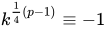 .
.
Lastly, the fourth class contains those for which 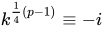 .
.
The third class will include biquadratic non-residues which are quadratic residues; the quadratic non-residues will be distributed between the second and fourth.
We assign the respective numbers of these classes as biquadratic characters , , , . If the character of the number modulo is defined to be the exponent of the power of to which the number is congruent, then it is clear that characters which are equivalent modulo are to be considered equivalent. However, this notion is limited for the time being to moduli which are prime numbers: in the continuation of these discussions, we will show how it can also be adapted to composite moduli.
62.
To make it easier to construct a comprehensive induction for the characters of numbers, we attach a concise table here, by the help of which the character of any given number with respect to a modulus whose norm does not exceed the value 157 can be easily obtained, provided that attention is paid to the following observations.
Since the character of a composite number is equal (or rather, congruent modulo ) to the sum of the characters of its individual factors, it suffices to compute the characters of all prime numbers for the given modulus. Moreover, since the characters of the units , , are clearly congruent to the numbers , , modulo , it is also sufficient to have exhibited the characters of numbers which are primary among their associates. Furthermore, since numbers which are congruent modulo have the same character, it suffices to include in the table the characters of those numbers which are contained in the system of absolutely minimal residues modulo . Finally, by reasoning similar to that of article 58, if the character of a number is for the modulus , and the character of the number  is
is  for the modulus , then we always have
  , or equivalently,
  is divisible by . Therefore, it suffices to include moduli for which is either or positive in the table.
Thus if we seek e.g. the character of the number  with respect to the modulus , we substitute
  , for the given numbers; then we determine (article 43) the absolutely minimal residue of the number modulo , which is
  ; therefore, since the character of with respect to the modulus is
  , and the character of the number
  , from the table, is 2, it follows that the character of the number with respect to the modulus will be
  or , and consequently, by the final observation, the character of the number with respect to the modulus will also be . Similarly, if we seek the character of the number with respect to the modulus , its absolutely minimal residue
  is resolved into the factors , ,
  , which correspond to characters
  , , , whence the sought character will be
  or ; the number will have the same character with respect to the modulus .
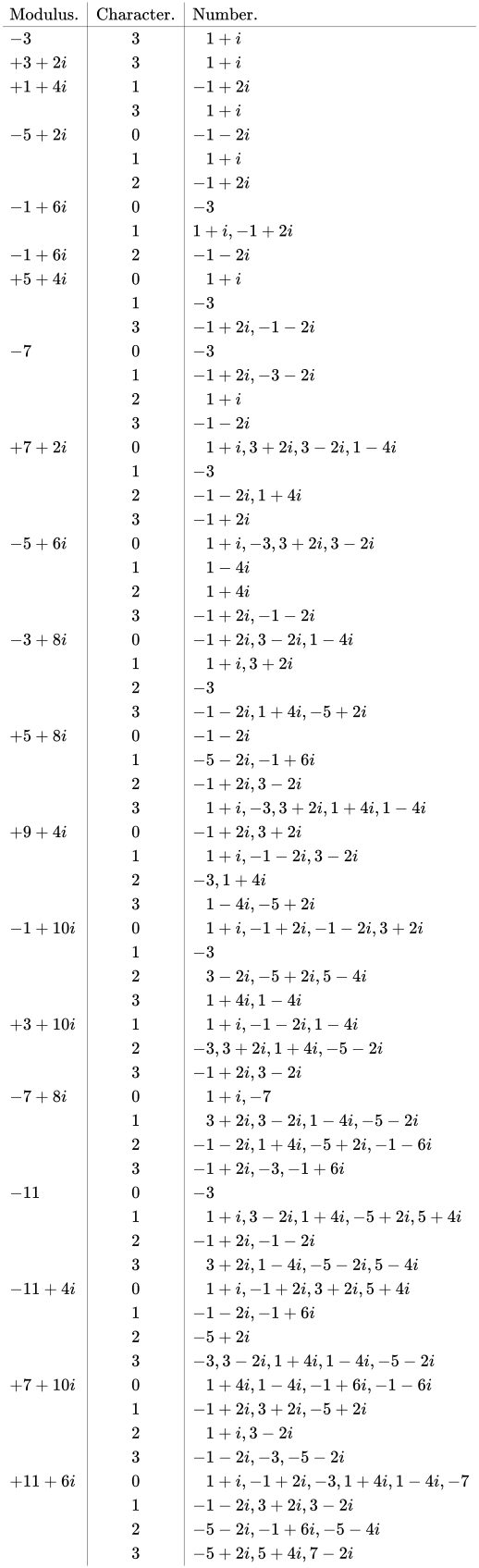
63.
We shall now endeavor to discover, by induction, common properties of moduli for which a given prime number has the same character. We always assume that the moduli are primary among their associates, meaning that they are of the form , where either  ,
,  , or
, or  ,
,  .
.
With respect to the number , from which we begin the induction, the law is more easily grasped if we separate the moduli of the former type (for which , ) from the moduli of the latter type (for which ,  ). With the help of the table in the previous article, we find the result
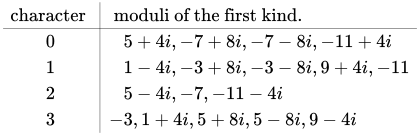
If we consider these seventeen examples attentively, we find that for all of them the character is  .
.
Likewise, we have the result
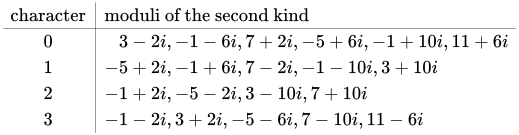
In all of these twenty examples, with a little attention, we find that the character is  .
.
One can easily condense these two rules into one that can be applied to both types of moduli, by observing that  is
is 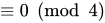 for moduli of the former type, and for moduli of the latter type. Thus the character of the number with respect to any prime modulus is
  .
.
It is convenient to note here, that since  is always of the form , or
  is even, this character will be even or odd, depending on whether
 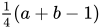 is even or odd, which accords with the rule for the quadratic character stated in article 58.
Since 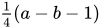 ,
, 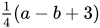 are integers, of which one is even and the other odd, their product will be even, so
  . Hence, in place of the above expression for the biquadratic character, the following can also be adopted

This formula also recommends itself by the fact that it is not restricted to primary moduli, but only assumes that is odd and is even. It is clear that under this assumption, either or  will be primary among its associates, and the value of this formula will be the same for both moduli.
64.
Departing from the last rule extracted in the previous article, we find
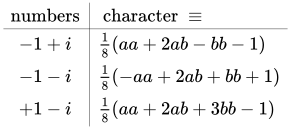
This immediately implies that the character of is 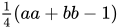 , and the character of is
 , since
  is always of the form . Clearly these four rules, even if they have so far been borrowed from induction, are so interconnected that as soon as the demonstration of one is complete, the other three are demonstrated simultaneously. There is scarcely any need to mention that in these rules we only assume to be odd and to be even.
If you do not mind using formulas restricted to primary moduli, we can use them in the following way. It is
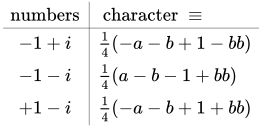
The simplest formulas emerge if, as we did at the beginning of our induction, we distinguish between moduli of the first and second kind. That is, the character is
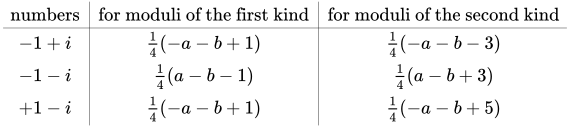
65.
For the number , to which we now proceed, we will use the same distinction between moduli for which , , and those for which , . The table in article 62 shows that, with respect to this number, we have the result
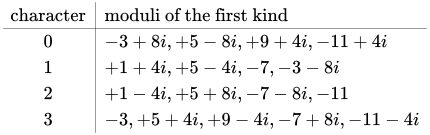
Reducing each of these moduli to their absolutely minimal residues modulo , we observe that all those corresponding to character are congruent to ; those corresponding to character 1 are congruent to ; those with character 2 become congruent to ; finally, all those with character 3 become congruent to . Now the characters of the numbers , , , with respect to the modulus are themselves , , , respectively, thus in each of these 17 examples the character of the number with respect to the modulus of the first kind is identical to the character of this number with respect to the modulus .
Likewise, from the table, we have the result
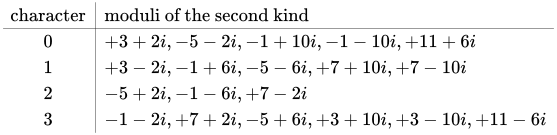
Reducing these moduli to their minimal residues modulo , those corresponding to characters , , , are found to be congruent to the numbers , , , respectively; however, if is adopted as the modulus, these same numbers corresponding to the characters , , , respectively. Therefore, in all these 19 examples, the character of with respect to a modulus of the second kind differs by two units from the character of this number with respect to .
Moreover, it is easily understood that the situation will be completely similar with respect to the number .
66.
We omit the distinction between moduli of the first and second kind for the number , since experience shows that it is superfluous here. The result is thus

Reducing these moduli to their minimal residues modulo , we see that those corresponding to the character become either or  ; those with character become either
  or
or  ; those with the character become either
  or
or  ; and finally, those with character become either
  or
or  . From this induction, we conclude that the character of the number with respect to a prime modulus which is primary among its associates, is identical to the character of that number modulo , or equivalently modulo .
67.
By carrying out a similar induction with respect to other prime numbers, we find that the numbers  ,
,  ,
,  ,
,  , etc., are subject to theorems similar to those which we found in article 65 for the number ; on the other hand, the numbers
  ,
,  ,
,  ,
,  ,
,  , etc., behave just like the number . Therefore, induction leads to a most elegant theorem, which, following the theory of quadratic residues in the arithmetic of real numbers, may be called the Fundamental Theorem of the theory of biquadratic residues, namely:
Let , be distinct numbers which are primary among their associates, i.e., which are congruent to unity modulo . Then the biquadratic character of the number with respect to the modulus will be identical with the character of the number with respect to the modulus , if one or both of the numbers , , is of the first kind i.e., is congruent to unity modulo : on the other hand, the characters will differ by two units if neither of the numbers , is of the first kind, i.e., if both are congruent to the number  modulo 4.
Despite the simplicity of this theorem, its demonstration should be considered among the most hidden mysteries of the higher arithmetic, so that, at least for now, it can be unravelled only through the most subtle investigations, which would far exceed the limits of the present discussion. Therefore, we reserve the publication of this proof, as well as the development of the connection between this theorem and those which we began to establish by induction at the beginning of this discussion, for a third discussion. In the place of a conclusion, however, we will now present what is required for the proof of the theorems proposed in articles 63, 64.
68.
We begin with the prime numbers , for which (the third kind in article 34), where (so that the number will be primary among its associates) must be a negative real prime number of the form  , for which we write
  , such as , , , etc. Denoting by the character of the number with respect to this modulus, we must have

But it is known that 2 is a quadratic residue or non-residue modulo , depending on whether is of the form  or of the form
  , from which we infer, in general,

and raising this to the  power,

Therefore, the preceding equation takes the form

from which it follows that

or since we have  ,
,  . Which is the theorem of article 63, for the case .
69.
Far more difficult are the moduli for which is not equal to (numbers of the fourth kind in article 34), and various investigations need to be carried out before treating these cases. We will denote the norm , which will be a prime number of the form , by .
Let be the complex of all simply minimal residues for the modulus , excluding , such that the multitude of numbers contained in is . Let denote an indefinite number of this system, and suppose that , . Then , will be integers between the limits and exclusive: in the present case, where , are prime to one another, the formulas of article 45, namely , , show that neither of the numbers , can be unless the other simultaneously vanishes, and thus  ,
,  , a combination which we have already dismissed. Therefore, the criterion for the number to be contained in is that the four numbers , ,
  ,
,  are positive.
Furthermore, we observe that for no such numbers can  hold; for it would then follow that
  , which is absurd, as none of the factors , , is divisible by . By similar reasoning, the equation
  shows that
  cannot be equal to . Therefore, since the numbers
  ,
,  must be either positive or negative, we can subdivide the system into four complexes , , ,
  , as follows:
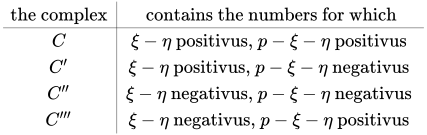
Therefore, the criterion for a number to be in the complex is properly sixfold, namely, six numbers , , , , , must be positive; but clearly, conditions 2, 5, and 6 already imply the remaining ones. Similar considerations apply to the complexes , , , so that the complete criteria are threefold, namely,
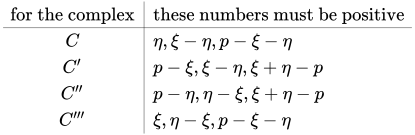
Moreover, even without our guidance, anyone will easily understand that, in the graphical representation of complex numbers (see article 39), the numbers of the system are contained within a square, whose sides connect points representing the numbers , , 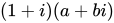 ,
,  , and the subdivision of the system corresponds to the partition of the square by diagonal lines. However, we prefer to use purely arithmetic reasoning here, leaving the illustration through figurative intuition to the knowledgeable reader for the sake of brevity.
70.
If four complex numbers  ,
,  ,
,  ,
,  are connected in such a way that
  ,
, 
 ,
,  , and it is assumed that belongs to the complex , then the remaining
  ,
,  ,
,  respectively will belong to the complexes , , . For if we assume
  ,
,  ,
,  ,
, 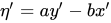 ,
,  ,
,  ,
,  ,
,  , we find
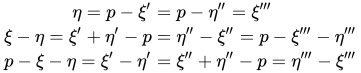
and hence, with the help of the criteria above, the truth of the theorem follows automatically. Moreover, if  , then it is easy to see that, if is assumed to belong to , then numbers , , respectively belong to , , ; if it belongs to , then they belong to , , ; and finally, if it belongs to , then they belong to , , .
It follows that in each of the complexes , , , an equal multitude of numbers is found, namely .
71.
Theorem. Let be an integer not divisible by . If each number in the complex is multiplied by , and the simply minimal residues of the products modulo are distributed among the complexes , , , , and the multitudes of each of these complexes are denoted by , ,  ,
,  respectively, then the character of the number with respect to the modulus will be
  .
.
Proof. Let be the number of minimal residues , , , , etc. belonging to ; let be the number of minimal residues  ,
,  ,
,  ,
,  , etc. belonging to ; let be the number of minimal residues
 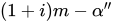 ,
, 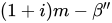 ,
, 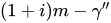 ,
, 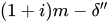 , etc. belonging to ; and finally, let be the number of minimal residues
  ,
,  ,
,  ,
,  , etc. belonging to . Now let us consider four products, namely
- the product of all numbers from the complex ;
- the product of all numbers obtained from these upon multiplying them by ;
- the product of the minimal residues of these products, i.e., of numbers , , , , etc., , etc. etc.;
- the product of all
 numbers , , , etc., , , , etc., , , ,
  etc.,
etc.,  ,
,  ,
,  ,
,  etc.
etc.
Denoting these four products , , ,  respectively, it is clear that

and thus

But it is easy to see that the numbers , , , , etc., , , , , etc., , , , , etc. all belong to complex , and are distinct from each other and from the numbers , , , etc., just as these very numbers are distinct from each other. Therefore, all these numbers taken together, and disregarding order, must be entirely identical with all of the numbers constituting . From this we deduce that  , and therefore

Finally, since each factor of the product is not divisible by , we may conclude

and thus  will be the character of the number with respect to the modulus . Q. E. D.
72.
To apply the general theorem of the preceding article to the number , it is necessary to subdivide the complex again into two smaller complexes  and
and  . To the complex we will assign all numbers such that is less than , and to the complex we will assign those for which is greater than . We denote the multitude of numbers contained in the complexes , respectively by ,
  , so that
  .
.
The complete criterion for a number to belong to will therefore be that the three numbers , ,  are positive: indeed, the third condition for the complex , according to which must be positive, is implicitly contained in these, since
  . Similarly, the complete criterion for a number to belong to will consist in the positivity of the three numbers , ,
  .
.
Hence it is easily concluded that the product of any number from the complex with belongs to the complex ; for if we set

then we find

i.e. the criterion for the number to be belong the complex is identical to the criterion for the number to belong to the complex .
It can be shown in a completely similar way that the product of any number from the complex with belongs to the complex .
Therefore, if in the preceding article we assign the value to , we will have  ,
,  ,
,  ,
,  , and therefore for the character of the number we will have
  . And whereas the characters of the numbers , , are , , the characters of the numbers , , respectively will be
 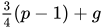 , ,
, , 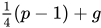 . Therefore, the whole essence of the matter now turns on the investigation of the number .
73.
What we have explained in articles 69-72 is completely independent of the assumption that is a primary number: from now on, however, we will at least assume that is odd and is even, and further that , , and  are positive numbers. First of all, it is necessary to establish the limits of the values of in the complex .
Setting ,  ,
,  , the criterion for a number to belong to the complex consists of three conditions, that ,
  , and
, and  are positive numbers. Since
  ,
,  , it is clear that and
  must be positive numbers, i.e., should be equal to one of the numbers , ,
 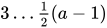 . Furthermore, since
  , it is evident that as long as is less than
  , the second condition (that must be positive) already implies the third condition (that must be positive); conversely, whenever is greater than , the second condition is already contained in the third condition. Therefore, if is equal to one of the values , ,
 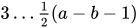 , it is only necessary to require that and are positive, i.e., that is greater than
  and less than
  . Therefore, for a given value of , there will be
![{\displaystyle \left[{\frac {(a+b)x}{a-b}}\right]-\left[{\frac {bx}{a}}\right]}](./_assets_/eb734a37dd21ce173a46342d1cc64c92/710c47153e110e2aa102361ef36fd7a715883072.svg)
values of , if we use brackets in the same sense that we have already used them elsewhere (compare Theorematis arithm. dem. nova art. 4 and Theorematis fund. in doctr. de residuis quadr. etc. Algorithm. nov. art. 3). On the other hand, for the values of being 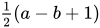 ,
,  , it will suffice to reconcile the positive values of and , i.e., that is greater than and less than
  or
or  . Therefore, for such a given value of , the numbers will be present
![{\displaystyle \left[{\frac {1}{2}}b+{\frac {aa-2ax}{2b}}\right]-\left[{\frac {bx}{a}}\right]}](./_assets_/eb734a37dd21ce173a46342d1cc64c92/a3f00b28be989f90ad09b5662164eafe57e373e0.svg)
Hence, we conclude that the multitude of numbers in the complex is
![{\displaystyle g=\Sigma \left[{\frac {(a+b)x}{a-b}}\right]+\Sigma \left[{\frac {1}{2}}b+{\frac {aa-2ax}{2b}}\right]-\Sigma \left[{\frac {bx}{a}}\right]}](./_assets_/eb734a37dd21ce173a46342d1cc64c92/810ee9c5a0a4b7328f91732f9e47b4310239da61.svg)
where, in the first term, the summation should extend over all integral values of from to 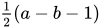 , in the second from to
  , and in the third from to .
If we use the symbol  in the same sense as in loc. cit. (cf. Theorematis fund. etc. Algor. nov. art. 3), so that
![{\displaystyle \varphi (t,u)=\left[{\frac {u}{t}}\right]+\left[{\frac {2u}{t}}\right]+\left[{\frac {3u}{t}}\right]\ldots +\left[{\frac {t^{\prime }u}{t}}\right]}](./_assets_/eb734a37dd21ce173a46342d1cc64c92/0e5652a29cd4667e8ee2758f2b853da91286efca.svg)
where , denote arbitrary positive numbers, and is the number ![{\textstyle \left[{\frac {1}{2}}t\right]}](./_assets_/eb734a37dd21ce173a46342d1cc64c92/9deebb18c0b4d72811966a1b915d99b0c4b23396.svg) , then the first term is
, then the first term is  , the third
  ; but the second is
![{\displaystyle ={\frac {1}{4}}bb+\Sigma \left[{\frac {aa-2ax}{2b}}\right]}](./_assets_/eb734a37dd21ce173a46342d1cc64c92/886d9b236e7c69f5cfffb294f1c26ce0bd852b91.svg)
However, by writing the terms in reverse order, we have
![{\displaystyle \Sigma \left[{\frac {aa-2ax}{2b}}\right]=\left[{\frac {a}{2b}}\right]+\left[{\frac {3a}{2b}}\right]+\left[{\frac {5a}{2b}}\right]+\ldots +\left[{\frac {(b-1)a}{2b}}\right]=\varphi (2b,a)-\varphi (b,a)}](./_assets_/eb734a37dd21ce173a46342d1cc64c92/91fbef5fe97f5f6e1ecc0f605ae7ef1548e8cd22.svg)
Therefore, our formula takes the following form:

Let us consider the first term  , which is immediately transformed into
  or into

Then, since by the general theorem we have ![{\textstyle \varphi (t,u)+\varphi (u,t)=\left[{\frac {1}{2}}t\right]\cdot \left[{\frac {1}{2}}u\right]}](./_assets_/eb734a37dd21ce173a46342d1cc64c92/7c4fafa14898d6bbb784e9a20409fff2a14dbdc8.svg) when
when  are positive relatively prime integers, we have

and thus

Let us arrange the parts of  in the following manner
![{\displaystyle {\begin{aligned}&{\left[{\frac {a-b}{2b}}\right]+\left[{\frac {3(a-b)}{2b}}\right]+\left[{\frac {5(a-b)}{2b}}\right]+{\text{etc.}}+\left[{\frac {(b-1)(a-b)}{2b}}\right]}\\+&{\left[{\frac {a-b}{b}}\right]+\left[{\frac {2(a-b)}{b}}\right]+\left[{\frac {3(a-b)}{b}}\right]+{\text{etc.}}+\left[{\frac {{\frac {1}{2}}b(a-b)}{b}}\right]}\end{aligned}}}](./_assets_/eb734a37dd21ce173a46342d1cc64c92/070c5322b25fac4fb89780fa0d280886d27d64cd.svg)
The second series is evidently

We represent the first series in reverse order of terms as follows:
![{\displaystyle \left[{\frac {1}{2}}(a+1-b)-{\frac {a}{2b}}\right]+\left[{\frac {1}{2}}(a+3-b)-{\frac {3a}{2b}}\right]+\left[{\frac {1}{2}}(a+5-b)-{\frac {5a}{2b}}\right]+{\text{etc.}}+\left[{\frac {1}{2}}(a-1)-{\frac {(b-1)a}{2b}}\right]}](./_assets_/eb734a37dd21ce173a46342d1cc64c92/c28c0282b96344d1da7e885f65e15d83533ed1ab.svg)
This expression, where denotes an integer and denotes a fraction, is transformed, since we generally have ![{\textstyle [t-u]=t-1-[u]}](./_assets_/eb734a37dd21ce173a46342d1cc64c92/8969fc455d607c4950a4aa50b4af508306f5e611.svg) , into the following
, into the following
![{\displaystyle {\begin{aligned}&{\frac {1}{8}}b(2a-4-b)-\left[{\frac {a}{2b}}\right]-\left[{\frac {3a}{2b}}\right]-\left[{\frac {5a}{2b}}\right]-{\text{etc.}}-\left[{\frac {(b-1)a}{2b}}\right]\\=&{\frac {1}{8}}b(2a-4-b)-\varphi (2b,a)+\varphi (b,a)\end{aligned}}}](./_assets_/eb734a37dd21ce173a46342d1cc64c92/8eddd565020e121d3ed1efb05aa89fee1e62aba7.svg)
Hence,

and therefore,

Substituting this value into the formula for given above, and also using the fact that  , we obtain

74.
The case where , remain positive and is negative or  is positive can be completely resolved by very similar reasoning. The equations
  ,
,  show that
  and
and 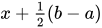 are positive, and so must be equal to one of the numbers
 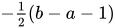 ,
, 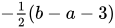 ,
,  . Furthermore, from the equation
  , it follows that for negative values of , the condition for to be positive, is already contained in the condition for to be positive, but the contrary happens whenever a positive value is assigned to . Hence, the values of for a given negative value of must lie between and , while for a positive value of , they must lie between and . For it is clear that these limits are and , with the value being excluded. Thus, we deduce
![{\displaystyle g=-\Sigma \left[{\frac {(a+b)x}{a-b}}\right]+\Sigma \left[{\frac {1}{2}}b+{\frac {aa-2ax}{2b}}\right]-\Sigma \left[{\frac {bx}{a}}\right]}](./_assets_/eb734a37dd21ce173a46342d1cc64c92/1f2d8fd39d99ffcfcdb2ba18de0bc68183a8a4a8.svg)
where in the first term, the summation extends over all negative values of from down to ; in the second term, over all values of from 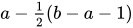 up to ; and in the third, over all positive values of from up to . Thus, the first summation becomes
  , the second becomes
  as in the preceding article, and finally the third becomes
  , giving us

In a similar manner as in the previous article, we find

and also

thus

and finally

It has therefore been shown that the same formula holds for , whether is positive or negative, provided that , are positive.
75.
In order to obtain further a reduction, we set
![{\displaystyle {\begin{aligned}&L=\left[{\frac {a}{2b}}\right]+\left[{\frac {2a}{2b}}\right]+\left[{\frac {3a}{2b}}\right]+{\text{etc.}}+\left[{\frac {{\frac {1}{2}}ba}{2b}}\right]\\&M=\left[{\frac {({\frac {1}{2}}b+1)a}{2b}}\right]+\left[{\frac {({\frac {1}{2}}b+2)a}{2b}}\right]+\left[{\frac {({\frac {1}{2}}b+3)a}{2b}}\right]+{\text{etc.}}+\left[{\frac {ba}{2b}}\right]\\&N=\left[{\frac {a+b}{2b}}\right]+\left[{\frac {2a+b}{2b}}\right]+\left[{\frac {3a+b}{2b}}\right]+{\text{etc.}}+\left[{\frac {{\frac {1}{2}}ba+b}{2b}}\right]\end{aligned}}}](./_assets_/eb734a37dd21ce173a46342d1cc64c92/218637b21ad5892e1975cb4322204a5bb7a110e1.svg)
Since it is easily seen that in general, ![{\textstyle [u]+\left[u+{\frac {1}{2}}\right]=[2u]}](./_assets_/eb734a37dd21ce173a46342d1cc64c92/df84753a76b7e102d8ef68dbbc2e65dfd328404d.svg) , for any arbitrary real quantity , we have
, for any arbitrary real quantity , we have  , and since it is clear that
  , we obtain

Moreover, it is obvious that the sum of the first term of the series with the penultimate term of the series , for example ![{\textstyle \left[{\frac {a+b}{2b}}\right]+\left[{\frac {(b-1)a}{2b}}\right]}](./_assets_/eb734a37dd21ce173a46342d1cc64c92/c3fc61aece45783a8b7e314c1eddd4a147ad37ad.svg) becomes
becomes  , and the same sum is produced by the second term of the series with the antepenultimate series , and so on. Therefore, since the ultimate term of the series also becomes , and the ultimate term of the series will be
 ![{\textstyle =\left[{\frac {a+2}{4}}\right]={\frac {1}{4}}(a\mp 1)}](./_assets_/eb734a37dd21ce173a46342d1cc64c92/46182e9ea8b349de8c614b17ef34ee6c5acbe68f.svg) , with the upper or lower sign depending on whether is of the form or
, with the upper or lower sign depending on whether is of the form or  . Thus we have

and therefore

Setting  , where is an integer, the formula for found in articles 73 and 74 becomes

But since we have  here, this formula can also be expressed in the following way:

Therefore, since is the character of the number modulo , this character becomes  , which is the theorem obtained above by induction (article 64), and hence the theorems concerning the characters of the numbers , , naturally follow. Therefore, these four theorems, for the case where and are positive, are now rigorously demonstrated.
76.
If remains positive and is negative, let  , so that is positive. Since it has already been proved that the character of the number modulo
  is
is  , by the theorem in article 62 the character of the number for the modulus
  will be
  , that is, the character of the number for the modulus becomes
  : but this is the same theorem as that mentioned in article 64, from which the three remaining characters , , are automatically determined. Therefore, these theorems have also been proved for the case where is negative, and thus for all cases where is positive.
Finally, if is negative, let  . Then, by what has already been proved, the character of the number with respect to the modulus is
  , and it makes no difference as to whether we have the number or its opposite
  in place of the modulus; it is clear that the character of the number with respect to the modulus is
  , and the same is valid for the characters of the numbers , , .
From all this, it is clear that the demonstration of the theorems concerning the characters of the numbers , , , (arts. 63. 64) is no longer subject to any limitation.
- ↑ and

- ↑ It is appropriate to note here that the field defined in this manner is adapted primarily to the theory of biquadratic residues. The theory of cubic residues can be built in a similar way by considering numbers of the form
 , where is an imaginary root of the equation
  , for instance
 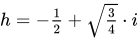 . Similarly, the theory of residues of higher powers will require the introduction of other imaginary quantities.
- ↑ or equivalently, whose norms are greater than unity.













