1.
Among the remarkable truths to which the theory of the division of the circle has opened the way, the summation proposed in Disquisitiones Arithmeticae art. 356 claims not the last place for itself, not only because of its particular elegance and wonderful fecundity, which will be explained more fully on another occasion, but also because its rigorous demonstration is not burdened by uncommon difficulties. Of course, this should have been expected, since the difficulties do not fall so much into the theorem itself, but rather into a limitation of the theorem, which was then ignored, but whose demonstration is immediately available and easily derived from the theory explained in the present work. The theorem is presented there in the following form. Supposing  to be a prime number, denoting all of the quadratic residues modulo between the limits 1 and
  (incl.) indefinitely by
  denoting all the non-residues between the same limits by
  denoting by
  the arc
  and denoting by
  any fixed integer not divisible by
  we have
- I. for values of which are of the form

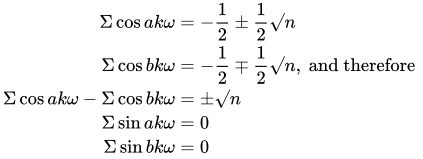
- II. for values of which are of the form

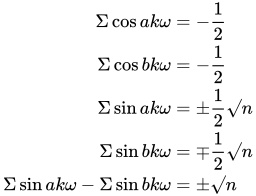
These sums have been demonstrated with all rigor in loc. cit., and the only remaining difficulty is in determining the sign to be assigned to the radical quantity. It can easily be shown that this sign depends only on the number  that the same sign must hold for all values of that are quadratic residues modulo and that the opposite sign must hold for all values of that are quadratic non-residues modulo
  Therefore, the whole matter depends upon the case
  and it is evident that as soon as the sign for this value is known, the signs for all other values of will immediately follow. But in this very question, which at first glance seems to be among the easier ones, we encounter unforeseen difficulties, and the method with which we have made progress so far completely denies us further help.
2.
It would not be out of place, before proceeding further, to work out some examples of our summation by numerical calculation. However, it will be convenient to preface this with some general observations.
- I. If in the case where is a prime number of the form all quadratic residues of lying between 1 and
 (inclusive) are denoted indefinitely by
  and all non-residues between the same limits are denoted by
  then certainly all
  are included in and all
  are included in
  Therefore, since
  together clearly exhaust the entire set of numbers

 all
all  together with all include all and likewise all
  together with all include all Hence we have
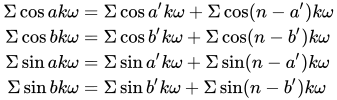
- Now, considering that



 it is clear that

- The summation of cosines, on the other hand, takes on the form
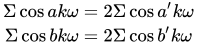
- from which it follows that
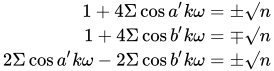
- II. In the case where is of the form the complement of any quadratic residue
 modulo will be a quadratic non-residue, and the complement of any quadratic non-residue
  will be a quadratic residue; therefore, all
  will coincide with all and all
  will coincide with all
  Hence we conclude

- and so, since and together fill out all the numbers and therefore

- the summations
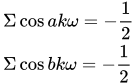
- are automatically evident. Similarly,

- and from this it is clear how the summations
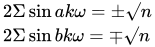
- depend upon each other.
3.
Now here are some examples of numerical computations:
- I. For
 there is one value of namely
  and one value of namely
  and these are

- Hence


- II. For
 there are three values of namely
 and an equal number of values of namely
 from which we compute
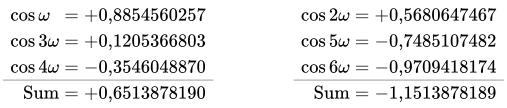
- Hence


- III. For
 we have four values of namely
  and an equal number of values of namely
  From this, we compute the cosines
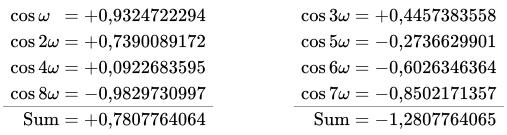
- Hence

- IV. For
 there is one value of namely
  which corresponds to

- Hence,

- V. For
 there are three values of namely
  hence we have the sines
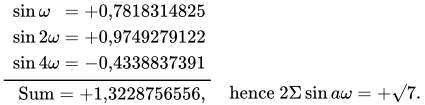
- VI. For
 the values of are
  which correspond to sines
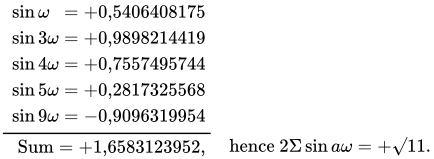
- VII. For
 the values of are


 which correspond to sines
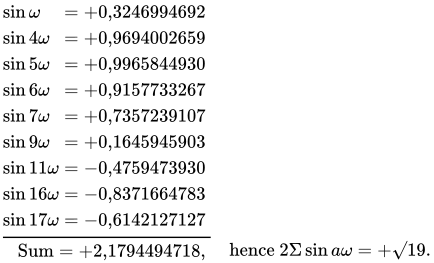
4.
In all these examples the radical quantity has a positive sign, and the same is easily confirmed for larger values 
 etc., from which a strong likelihood emerges that this holds generally. However, the proof of this phenomenon cannot be sought from the principles set forth in loc. cit., and must be regarded as deserving of a thorough investigation. Therefore, the purpose of this commentary is to present a rigorous proof of this most elegant theorem, which has been attempted in vain in various ways for many years, and was finally achieved successfully through careful and subtle considerations. At the same time, we will bring the theorem itself, with its elegance preserved or rather enhanced, to a much greater generality. Finally, in the conclusion, we will reveal a remarkable and close connection between this summation and another very important arithmetic theorem. We hope that not only will geometers be gratified by the results of these investigations, but also that the methods, which may well be useful on other occasions, will be deemed worth of their attention.
5.
Our proof relies on the consideration of a specific type of series, whose terms depend on expressions of the form

For the sake of brevity, we will denote such a fraction by  and we will first present some general observations about such functions.
- I. Whenever
 is a positive integer smaller than
  the function
  clearly vanishes, since the numerator involves the factor
  For
For  the factors in the numerator will be identical, but in the reverse order compared to the factors in the denominator, so that
  Finally, in the case where is a positive integer greater than we have the formulas
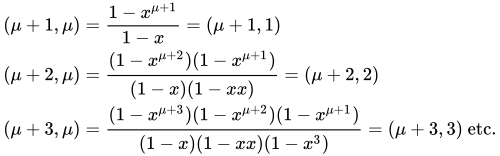
- or more generally,

- II. Furthermore, it is easily confirmed that, in general,

- and likewise

- which continues until

- and therefore, as long as is a positive integer greater than


- Hence it is clear that if, for any given value of the function is integral for all positive integer values of
 then the function
  must also be integral. Therefore, since this assumption holds for
  the same will hold for
  and thus for
  etc., i.e. in general for any positive integer value of the function will be integral, or in other words the product

- will be divisible by

6.
We will now consider two series, each of which can be used to achieve our goal. The first series is

or

which for the sake of brevity we will denote by  It is immediately clear that when is a positive integer, this series terminates after its
  term (which is
  ), and therefore in this case, the sum must be a finite integral function of
  Furthermore, according to observation II of article 5, it is clear that in general, for any value of we have
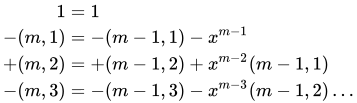
and therefore

But it is also clear that
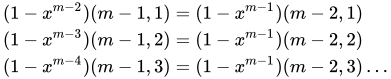
from which we deduce the equation
[1]

7.
Since for  we have
  we obtain, from the formula we have just found,
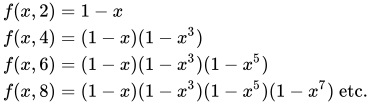
or more generally, for any even value of
[2]

On the other hand, since for  we have
  we have
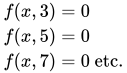
or, in general, for any odd value of

Indeed, the latter sum could have already been derived from the fact that in the series

the last term destroys the first, the penultimate destroys the second, etc.
8.
For our purpose it suffices to consider the case where is a positive odd integer. However, it will not hurt to add a few remarks about the cases where is fractional or negative, due to the singularity of the matter. Clearly in these cases our series will not be interrupted, but will diverge to infinity. Moreover, it is easily seen that the series diverges whenever the value of  is less than 1, so its summation should be restricted to values of which are greater than 1.
According to formula [1] in article 6, we have
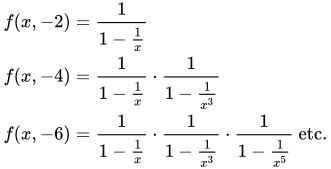
so that for negative, integral, even values of the function  can also be assigned a value with finitely many terms. For the remaining values of we will convert the function into an infinite product using the following method.
As approaches negative infinity, the function converges to

Therefore, this series is equal to the infinite product

Moreover, since it is generally true that

we have

whose factors clearly converge to unity.
The case  deserves special attention. Here we have

It follows that this series can be expressed as an infinite product

or, by replacing with 

This equality between two somewhat complicated expressions, to which we will return on another occasion, is indeed very remarkable.
9.
Secondly, we consider the series

or

which we will denote by  We will restrict this discussion to the case where is a positive integer, so that the series always terminates at the
  term, which is
 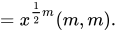 Since
Since

the above series can also be expressed as:

Hence we have

Therefore, since we have (art. 5, II)
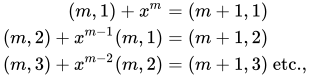
we obtain the result
[3]

But  therefore we have
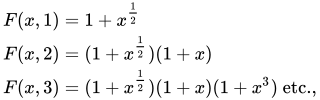
or in general
[4]

10.
Having made these preliminary observations, let us now proceed towards our objective. Since the squares 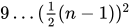 are all incongruent to each other modulo it is clear that their minimal residues modulo must be identical to the numbers and therefore

Similarly, since the same squares are congruent to 

 in reverse order, we have

Therefore, assuming

we will have
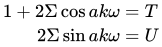
Hence it is clear that the summations proposed in article 1 depend on the summations of the series  and
and  We will therefore direct our discussion to these, and complete it in a general way that it includes not only prime values of but composite values as well. Let us also suppose that the number is relatively prime to
  for the case where and have a common divisor can be reduced to this one without any difficulty.
11.
Let us denote the imaginary quantity  by
by  and let

so that  or equivalently
  is a root of the equation
  It is easy to see that the numbers
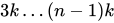 are all indivisible by and are incongruent to each other modulo
  therefore, the powers of

will all be distinct, and each of them will satisfy the equation  Because of this, these powers represent all of the roots of the equation
These conclusions would be invalid if had a common divisor with For if  were such a common divisor, then
  would be divisible by and hence a power less than
  say
say  would be equal to unity. In this case, therefore, the powers of up to the
  would all be roots of the equation
  and indeed they would be distinct roots, if were the greatest common divisor of and In our case, where and are assumed to be prime to each other, can conveniently be called a proper root of the equation In the other case, where and have a (greatest) common divisor
  we will say that is an improper root of that equation. Clearly in the latter case, would be a proper root of the equation
  The simplest improper root is unity, and in the case where is a prime number, there are no other improper roots whatsoever.
12.
If we now set

it is clear that  so that is the real part of
  and
and  is obtained from the imaginary part of
  by suppressing the factor
  The whole matter is therefore reduced to finding the sum
  for this purpose, either the series considered in article 6 or the one we have shown how to sum in article 9 can be used, although the former is less suitable in the case where is an even number. Nonetheless, we hope that it will be agreeable to the reader if we treat the case where is odd according to both methods.
Let us first suppose that is an odd number, that is an arbitrary proper root of the equation and that in the function we set  and
and  Then clearly
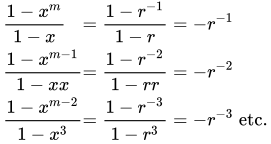
up to

(It will not be superfluous to mention that these equations are valid only to the extent that is assumed to be a proper root: for if were an improper root, the numerator and denominator of some of these fractions would simultaneously vanish, and thus the fractions would become indeterminate).
From this, we derive the following equation:

The same equation will still hold if we substitute  for
for  where
where  is any arbitrary integer relatively prime to for then will also be a proper root of the equation Let us write
  instead of or equivalently
  Then
Then

Next, let us multiply both sides of this equation by

Since
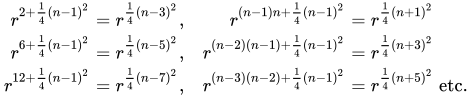
we get the following equation

or, by rearranging the terms of the first member,
[5]

13.
The factors of the second member of the equation [5] can also be written as
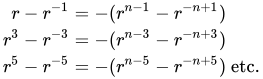
up to

in which case the equation takes the following form:

Multiplying this equation by [5] in its original form, we obtain

where  is either
  or
or  depending on whether is of the form
  or
or  Therefore,

But it is clear that 

 are precisely the roots of the equation except for the root
  Hence the following equation must hold

and setting  we find that

Since it is evident that  our equation becomes:
[6]

In the case where is of the form  we have:
On the other hand, in the case where is of the form  we have:
14.
The method of the previous article determines only the absolute values of and  and leaves their signs ambiguous, so it is necessary to determine whether (in the first case) and (in the second case) are equal to
  or
or  . However, at least when this can be deduced from equation [5] in the following way. Since, for
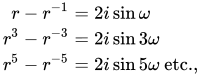
this equation is transformed into

Now, in the case where is of the form in the series of odd numbers

there can be found  which are less than
  and these clearly correspond to positive sines. On the other hand, the remaining will be larger than and these correspond to negative sines. Therefore, the product of all the sines must be equal to a product of a positive quantities, multiplied by the factor
  and thus will be equal to the product of a positive real quantity with
  or since
  and is divisible by 4. That is, the quantity will be a positive real quantity, and hence we must have

In the second case, where is of the form in the series of odd numbers

the first  will be smaller than and the remaining
  will be larger. Among the sines of the arcs

 therefore, will be negative, and thus will be the product of
  with a positive real quantity and
  the third factor is
  which when combined with the first, gives
  since
since  Therefore we must have

and

15.
We will now show how the same conclusions can be deduced from the series considered in article 9. Let us write  in place of
  in equation [4], so that

up to the term will be
[7]

If we take  to be a proper root of the equation
  say and at the same time we set
  then we have
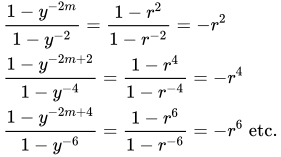
up to

where it should be noted that none of the denominators 
 etc. will be
  Hence equation [7] takes the form

in the second member of this equation, if we multiply the first term by the last, the second term by the penultimate, etc., then we obtain
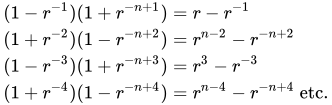
From these products, it is easy to see that the product

will be

This equation is identical to equation [5] in article 12, which was derived from the first series, so the rest of the argument can be carried out in the same way as in articles 13 and 14.
16.
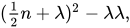
We now move on to the other case, where is an even number. First let be of the form  or equivalently an oddly even number. It is clear that the numbers
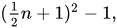
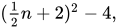 etc., or in general
  can be divided by
  to produce odd quotients, and thus they are congruent to modulo Hence, if is a proper root of the equation and thus
  it follows that
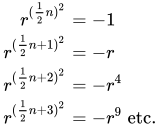
Hence, in the series

the term  destroys the first term, the following term destroys the second term, etc., and therefore

17.
There remains the case where is of the form  or evenly even. Here, in general,
 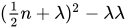 will be divisible by and therefore
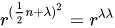
Hence, in the series
the term will be equal the first term, the following term will be equal to the second term, etc., so that

Let us now suppose that in equation [7] of article 15, we set 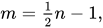 and for we substitute a proper root of the equation
  Then just as in article 15, the equation takes the form

or
[8]

Furthermore, since and thus
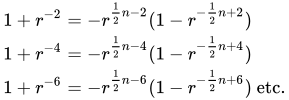
and since the product of the factors 

 etc. up to
  is
is  the previous equation can also be expressed as

Since
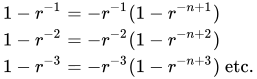
we have

and therefore

Multiplying this value of by the one we previously found, and adjoining the factor  to both sides, we get

But we have
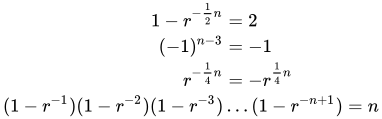
From which it finally follows that
[9]
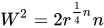
Now it can be easily seen that  is either
  or
or  depending on whether is of the form or And since

we will have, in the case where is of the form
 and thus
and in the other case, where is of the form
 and thus
18.
The method of the previous article provided the absolute values of the functions and and determined the conditions under which equal or opposite signs should be given to them. But the signs themselves are not yet determined at this point. We will supply this for the case as follows.
Let  so that
  and
and  It is clear that equation [8] can be expressed as

or, by arranging the factors in a different order,

Now we have
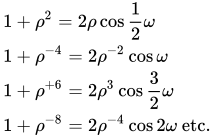
up to
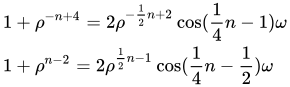
Therefore, we have:

The cosines in this product are clearly positive, but the factor  becomes
  Hence we conclude that is the product of
  and a positive real quantity, so we must have

19.
It will be worthwhile to gather together here all of the summations we have evaluated so far. In general, we have
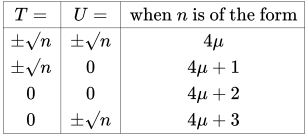
and in the case where is assumed to be  the positive sign must be assigned to the radical quantity. All of the things which had been observed by induction in article 3, for the first few values of , have now been demonstrated with all rigor, and nothing remains but to determine the signs for other values of in all cases. But before this task can be undertaken in all generality, it will be necessary to first consider more closely the cases in which is either a prime number or a power of a prime number.
20.
Let be a prime odd number. Then it is clear from what was explained in article 10 that  where we set
  and denotes all of the quadratic residues of between
  and indefinitely. But if we also denote indefinitely by all the quadratic non-residues between the same limits, it is seen without any difficulty that all of the numbers
  will be congruent modulo to either all of or all of without respect to order, depending on whether is a quadratic residue or non-residue modulo . Therefore, in the former case, we have

and thus  if is of the form and if is of the form
On the other hand, in the case where is a quadratic non-residue modulo we have

Hence, since it is clear that all integers and together complete the complex integer numbers  and thus

we have

and thus  if is of the form and
  if is of the form
Hence we conclude:
- first, if is of the form and is a quadratic residue modulo

- second, if is of the form and is a quadratic non-residue modulo

- third, if is of the form and is a quadratic residue modulo

- fourth, if is of the form and is a quadratic non-residue modulo

21.
Let be a square or higher power of an odd prime  , and let
  where
where  is either or
  It is first of all important to observe here that if is any integer not divisible by
  then we have

From this it is easy to see that

Indeed, the remaining terms of the series
can be distributed into  partial sums, each of which has
  terms, and is seen to vanish by applying the transformation given above.
Hence it follows, in the case where  or where is a power of a prime number with an even exponent, that
On the other hand, in the case where  or where is a power of a prime number with an odd exponent, let us set
  where
where  is a proper root of the equation
  specifically
  Then
Then

But the sum of the series  has been determined in the preceding article, and from this we conclude that
with a positive or negative sign depending on whether is a quadratic residue or a non-residue modulo
22.
The following proposition, which is easily derived from that which has been set forth in articles 20 and 21, will be of considerable use to us below. Let

where  is any integer not divisible by Then in the case where
  or where is a power of with an odd exponent, we have
For it is clear that  arises from if
  is substituted for
  In the former case, and will be the same, and in the latter different, insofar as they are quadratic residues or non-residues modulo
However, in the case where is a power of with an even exponent, it is clear that  and therefore always
23.
In articles 20, 21, 22 we considered odd prime numbers and their powers. It remains, therefore, to consider the case where is a power of two.
For  it is clear that
For  we obtain
  Hence
Hence  whenever is of the form and
  whenever is of the form
For  we have
 Hence
Hence
If is a higher power of two, let  so that is either equal to 1 or 2, and
  is greater than 1. It must first of all be observed here that if is an integer not divisible by
  then we have

Hence it is easy to see that

Let us set  Then will be a root of the equation
  and in fact
  Thus we have

But the sum of the series  is determined by what we have already explained in the cases
  Hence we conclude that
- in the case where or where is a power of 4,
- which are the exact formulas already given for

- in the case where
 or where is a power of two with an odd exponent greater than 3,
- which also precisely match the formulas we provided for
24.
It will also be worthwhile to determine the ratio of the sum of the series

to where is an arbitrary odd integer. Since  arises from by replacing with
  the value of will depend on the form of the number in the same way as depends on the form of the number Let us set
  Then it is clear that
I. In the case where or any higher power of two with an even exponent,
 if is of the form
 if is of the form and is of the form

if
is of the form
and
is of the same form
II. In the case where or any higher power of two with an odd exponent,
if
is of the form

 if is of the form
if either is of the form  and is of the form
 or is of the form
  and is of the form
if either is of the form and is of the form

or
is of the form
and
is of the form

With this, the determination of in those cases where is a prime number or a power of a prime number is complete. It remains, therefore, for us to finish those cases where is composed of several prime factors, to which end the following theorem paves the way.
25.
Theorem. Let be the product of two relatively prime positive integers and and set

Then I claim that 
Proof. Let  indefinitely denote the numbers
 let
let  indefinitely denote the numbers
  and let indefinitely denote the numbers
  Then it is clear that

Thus, we have  where all possible values of and are to be substituted. Furthermore, because
  we have
  But it is clearly seen, without difficulty, that the individual values of
  are distinct from each other, and each is equal to some value of
  Thus, we have
It should also be noted that  is a proper root of the equation
  and
and  is a proper root of the equation
26.
Now let be the product of three mutually prime numbers  Then clearly if we set
  then and
  will be relatively prime. Therefore, is a product of two factors:

However, since is a proper root of the equation  the first factor will be the product of two factors

if we set  Hence it is clear that is the product of three factors:
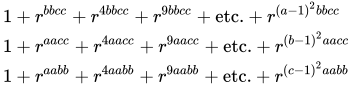
where 
 and
and  are proper roots of the equations
 respectively.
27.
From this it is easily concluded that in general, if is the product of any prime factors  etc., then will be a product of as many factors
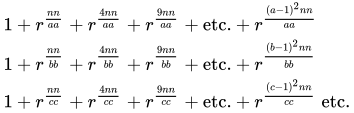
where 

 etc. are proper roots of the equations
  etc.
etc.
28.
Out of these principles, a passage to the complete determination of for any given value of has appeared before us. Let be decomposed into factors etc., which are either distinct prime numbers or powers of distinct prime numbers. Let 

 etc., and let

 etc. be the respective roots of the equations etc. Then is the product of the factors
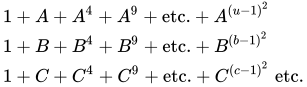
But each of these factors can be determined by the methods explained in articles 20, 21, 23. Hence, the value of the product can also be known. It will be useful to collect the rules for determining these factors here. When the root  is
is  the sum
  which we shall denote by
  will be determined by the number
  in the same way that was determined by in our general discussion. We have already distinguished twelve cases:
- I. If is a prime number of the form say
 or a power of such a prime number with an odd exponent, and at the same time
  is a quadratic residue modulo
  then
then 
- II. If is a quadratic non-residue modulo then

- III. If is a prime number of the form say or a power of such a prime number with an odd exponent, and at the same time is a quadratic residue modulo then

- IV. If, with the rest of the assumptions as in III, is a quadratic non-residue modulo then

- V. If is a square number, or a higher power of a prime number (with an even exponent), then
- VI. If
 then
then 
- VII. If
 or a higher power of two with an even exponent, and also is of the form then
- VIII. If, with the rest of the assumptions as in VII, is of the form then

- IX. If
 or a higher power of two with an odd exponent, and at the same time is of the form then
- X. If, with the rest of the assumptions as in IX, is of the form then

- XI. If, with the rest of the assumptions as in IX, is of the form then

- XII. If, with the rest of the assumptions as in IX, is of the form then
29.
For example, let  and
and  In this case, we have
for
by case XII,
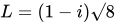
for the factor 9, by case V, the corresponding sum will be 
for the factor 5, by case II, the corresponding sum will be 
for the factor 7, by case III, the corresponding sum will be

Hence, we get 
If, for the same value of we set then
Hence, the product is 
30.
Another method of finding the sum in a general manner is suggested by that which was set forth in articles 22 and 24. Set  and
and

so that we have 


 etc. Then

will be a product of factors
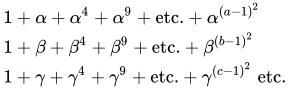
and therefore will be a product of factors
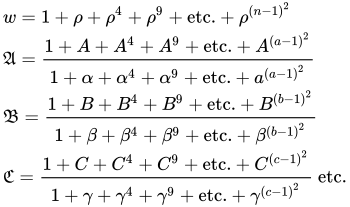
Now, the first factor  is determined by the discussion in article 19 above; the remaining factors

 etc. come from the formulas of articles 22 and 24, which are collected here again so that they can all be considered together[1]. Twelve cases must be distinguished here, namely
- I. If is a prime number (odd) or a power of such a number with an odd exponent, and is a quadratic residue modulo then the corresponding factor will be

- II. If, with the rest of the assumptions as in I, is a quadratic non-residue modulo then

- III. If is the square of an odd prime number, or a higher power with an even exponent, then
- IV. If is
 or a higher power of two with an even exponent, and is of the form then
- V. If, with the rest of the assumptions as in IV, is of the form and
 is of the form then
- VI. If, with the rest of the assumptions as in IV, is of the form and is of the form then

- VII. If is
 or a higher power of two with an odd exponent, and is of the form then
- VIII. If, with the rest of the assumptions as in VII, is of the form then
- IX. If, with the rest of the assumptions as in VII, is of the form and is of the form then
- X. If, with the rest of the assumptions as in VII, is of the form and is of the form then
- XI. If, with the rest of the assumptions as in VII, is of the form and is of the form then
- XII. If, with the rest of the assumptions as in VII, is of the form and is of the form then
We omit the case where  indeed, in this case
  would be
  or indeterminate, but then anyway
  .
.
The remaining factors  etc. depend in the same way on etc., as depends on
31.
According to this second method, the first example in article 29 is as follows:
- The factor is

- For the corresponding factor is, by case VIII,

- The second factor
 corresponds to a factor (by case III)
- The factor
 corresponds to a factor
  (by case II)
- The factor
 corresponds to a factor (by case II)
Hence, the product  is obtained, as in article 29.
32.
Since the value of can be determined using two methods, one of which is based on the relations of the numbers 

 etc. with the numbers etc., and the other depending on the relations of with the numbers etc., there must be a certain conditional connection between all these relations, so that each of them must be determinable from the others. Let us suppose that all the numbers etc. are odd prime numbers, and take
  Let the factors etc. be distributed into two classes, one of which contains those that are of the form and which are denoted by
 etc., and the other consisting of those that are of the form and which are denoted by

 etc. We will designate the multitude of the latter by
  Having done this, we observe first that will be of the form when is even (which also applies to the case where the factors of the other class are completely absent, or where ), whereas will be of the form when is odd. Now the determination of is achieved by the first method as follows. Let numbers

 etc.,
etc., 

 etc. be determined from the relations between the numbers

 etc.,
etc., 

 and the numbers etc., etc., respectively, by setting
and likewise for the rest. Then will be the product of the factors 

 etc.,
etc., 

 etc., and hence

By the second method, or rather directly by the rules from article 19,
Both cases may be included together in the following formula:
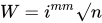
Hence it follows that

But  is
is  whenever is of the form
  or and whenever is of the form
  or and from this we deduce the following very elegant
Theorem. Let etc. denote positive odd prime numbers that are not equal to each other, and let their product be  Let be the number of the form
  among them, so that the other numbers are of the form Then the multitude of those numbers among etc. such that

 etc. are quadratic non-residues, will be even whenever is of the form or but odd whenever is of the form or
By setting e.g. 


 we have three numbers of the form namely and
  and we have


 so there is a unique
  which is a quadratic non-residue modulo
33.
The celebrated fundamental theorem concerning quadratic residues is nothing but a special case of the theorem just developed. By limiting the multitude of the numbers etc. to two, it is evident that if only one of them, or neither, is of the form then we must have simultaneously 
 or simultaneously
 On the other hand, if both are of the form then one of them must be a quadratic non-residue modulo the other, and the other a quadratic residue modulo the one. And so a fourth demonstration has been given for this most important theorem, the first and second demonstration having been given in Disquisitiones Arithmeticae, and the third recently in a special commentary (Commentt. T. XVI). We will present two other proofs in the future, based again on completely different principles. It is exceedingly surprising that this most beautiful theorem, which at first so obstinately eluded all attempts, could be approached later by methods so very distant from one other.
34.
In fact, the remaining theorems, which act as a supplement to the fundamental theorem, that is, by which the prime numbers for which and  are quadratic residues or non-residues may be identified, can also be derived from the same principles. Let us start with the residue
Set  where is a prime number, and let Then by the method of article 28, will be the product of two factors, of which one will be
  or
or  if or equivalently is a quadratic residue modulo
  or else
  or
or  if 2 is a quadratic non-residue modulo The second factor is
But by article 18, we will always have  Dividing this value by the four values of the second factor, it is clear that the first factor must be
From this it follows automatically that  must be a quadratic residue modulo in the first and fourth cases, and in the second and third cases it must be a quadratic non-residue.
35.
Prime numbers for which is a quadratic residue or non-residue are easily recognized with the help of the following theorem, which is also quite memorable by itself.
Theorem. The product of the two factors

is  if is odd, or
  if is odd even, or
  if is evenly even.
Proof. Since it is clear that
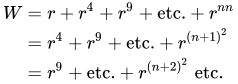
the product  can also be presented as
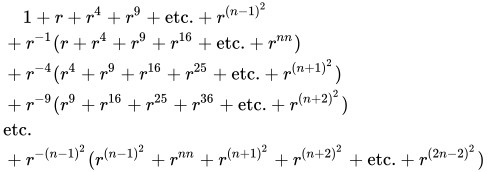
which, when summed vertically, produces
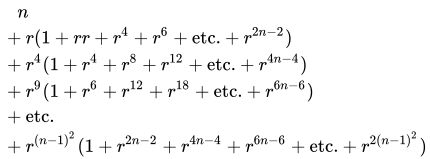
Now if is odd, each part of this sum, except the first will be For the second part is clear  the third
  etc. When is even, it is also be necessary to study the part

which is  In the former case, we therefore obtain
  but in the latter,
 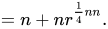 But
But  will be
  if is evenly even, and thus
  On the other hand, if is oddly even, then
  and thus
  Q. E. D.
36.
Already from article 22, it is clear that if is an odd prime number, then  will be equal to or depending on whether is a quadratic residue or a non-residue modulo Hence in the former case, we must have
  in the latter
  wherefore, by article 13, we conclude that the former case can only occur when is of the form and the latter case when is of the form
Finally, from the combination of conditions for the residues  and it naturally follows that is a quadratic residue modulo any prime number of the form
  or and it is a quadratic non-residue modulo any prime number of the form
  or
or 
- ↑ Clearly, what was and there, will here be and in the second factor,
 and in the third factor etc.






















