1.
Among the methods proposed for the numerical approximation of integrals, a prominent place is held by the rules which were developed by Newton and refined by Cotes. Specifically, if the value of the integral  taken from
  to
to  is required, then the values of
  for these limiting values of
  and for several other intermediate values progressing by equal increments from first to last, are to be multiplied by certain numerical coefficients. This being done, the sum of the products, multiplied by
  will supply the desired integral, with greater precision as more terms are used in this operation. Since the principles of this method, which seems to be called into use less frequently by geometers than it should, have nowhere, as far as I know, been fully explained, it will not be out of place to say a few things about them.
2.
Let us agree to use a multitude of  terms, and let
  so that the values of are


 etc. up to
  and correspondingly the values of are


 etc. up to
  finally, let
  so that can also be regarded as a function of
  Let
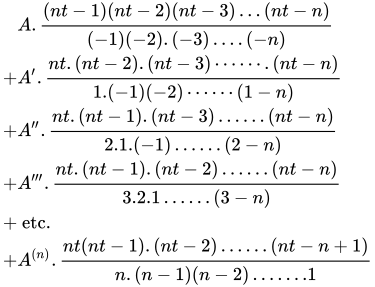
Let  represent the function
or  where
where  represents each of the integers
  ,
,  ,
,  ,
, 

and

is the value of

for

It is clear that represents an integral algebraic function of  of order
  and its values for each of the values of namely


 are equal to the values of
  It is also clear that if
  is another integral function producing the same values of for the same values of then
  will vanish for the same values, and therefore it must be divisible by the factors

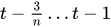 and therefore also by their product (which is of order ), from which it is clear that must, unless it is identical to
  be of a higher order, meaning that
  is the only integral function among those not exceeding order
  which coincides with for those values. Therefore, if , when expanded into a series of powers of
  , breaks off before the term involving
  , it will be identical to and if the series converges so quickly as to allow the subsequent terms to be neglected, then the function can replace within the limits
 or
or  .
.
3.
Now our integral  is transformed into
  taken from
  to
to  and as we have just indicated, we will replace this with
  Thus by expanding
  into
into

the integral  from to will be

and setting this quantity  the desired integral will be

For example, let us compute the coefficient  for
for  Here we have

Hence  and therefore
The computation can be shortened a bit by setting  Then we have

Let us set

where the numerator should end in  if is odd, or in
  if is even. Then
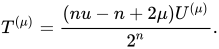
Now the integral  taken from to is equal to the integral

from  to
to 
Therefore, by setting

(it being evident that the powers  etc. are absent), the first part
  of the integral will vanish for odd values of while the other part
 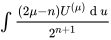 will vanish for even values, so that the integral becomes

for even values of and

for odd values of  In our example we have

hence

as above.
It is worth noting that  and therefore
  with the upper sign holding for even and the lower sign for odd Hence, since it is easy to see that
  we will always have
 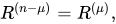 meaning that the last coefficient is equal to the first, the penultimate to the second, and so on.
4.
We hereby append the numerical values of these coefficients, up to  which were computed by Cotes in Harmonia Mensurarum.
For  or two terms.

For  or three terms.
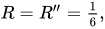

For  or four terms.
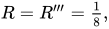
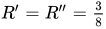
For  or five terms.
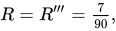
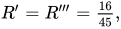

For  or six terms.
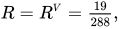
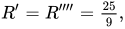
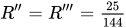
For  or seven terms.
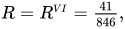
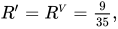
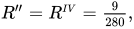

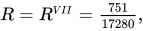
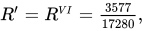
For  or eight terms.


For  or nine terms.

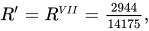

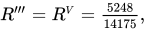
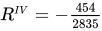
For  or ten terms.
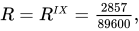
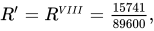
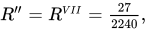
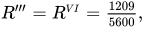
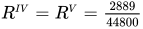
For or eleven terms.
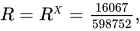
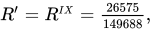




5.
Since the formula  exactly represents the integral from to
  or the integral
  from to whenever the expansion of into a series does not go beyond the power
  , but otherwise only approximates it, it remains to show how to account for the error induced by the immediately following terms. Let us denote generally by
  the difference between the true value of the integral
  from to and the value derived from the formula. Then
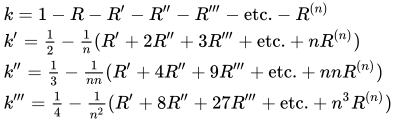
etc. It is evident, therefore, that if is expanded into a series

then the difference between the true value of the integral  and the approximated value derived from the formula can be expressed as

But evidently, 

 , etc. up to
  are all automatically
  thus, the correction of the approximated formula will be

The nature of quantities 
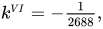
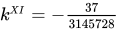
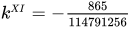
 , etc. will be examined more accurately later; here, it suffices to provide the numerical values of the first or second, for each value of so that the degree of precision afforded by the approximate formula can be estimated.
- For
 , we have


- For
 , we find


- For
 , it is

- For


- For

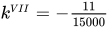
- For

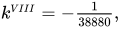

- For

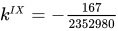
- For

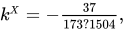
- For

- For


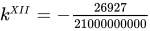
For all even values of here, we observe  and furthermore
  for odd values of , however, we always have
  The reason why this occurs can be deduced easily from the following considerations.
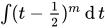
In general, let  denote the difference between the true value of the integral
  from to and the value derived from the approximate formula, so that we have
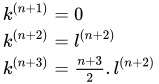
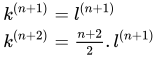
![{\displaystyle {\begin{array}{c}l^{(m)}=\int (t-{\frac {1}{2}})^{m}\operatorname {d} t-\left[(-{\frac {1}{2}})^{m}R+({\frac {1}{n}}-{\frac {1}{2}})^{m}R^{\prime }+({\frac {2}{n}}-{\frac {1}{2}})^{m}R^{\prime \prime }+({\frac {3}{n}}-{\frac {1}{2}})^{m}R^{\prime \prime \prime }+\right.{\text{etc.}}\\\left.+({\frac {1}{2}}-{\frac {1}{n}})^{m}R^{(n-1)}+({\frac {1}{2}})^{m}R^{(n)}\right]\end{array}}}](./_assets_/eb734a37dd21ce173a46342d1cc64c92/35abd385f7bb813ef5e602e7fa94be29cd87edc8.svg)
with the integral being taken from to . Clearly, for odd values of  both the true and approximate integral values vanish: hence
 , etc., and generally
  for all odd values of
  For even values of
  on the other hand, the formula can be written as

if is even; or

if is odd.
Therefore, if expanding in a series according to powers of  yields

then the correction to be applied to the approximate value of the integral from to will be

or rather, since necessarily vanishes for any integer value of no greater than the correction will be

for even or

for odd
The corrections can be easily converted to and vice versa. For if we have

then

And similarly,

The terms where  is affected by an odd index will be eliminated from the latter formula, and each should only be continued up to the index (inclusive). Therefore, it is clear that we will have
from which the above observations can be deduced.
6.
Generally speaking, it will therefore be preferable to assign an even value to or to employ an odd number of terms, when applying the method of Cotes. Indeed, very little precision will be gained by ascending from an even value of to the next highest odd one, as the error remains of the same order, although affected by a slightly smaller coefficient. Conversely, ascending from an odd value of to the next highest even one will increase the order of the error by two, and the coefficient being significantly reduced, so the precision will increase. So if five terms are used, that is, for the error is approximately expressed by  or
or  if we set the error will be approximately
  or
or  thus it will not even be half of the former: on the other hand, for the error becomes approximately
  or
or 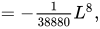 and the precision is increased all the more, as the series into which the function has been expanded converges more quickly.
7.
Following these preliminaries regarding the method of Cotes, we proceed to a general inquiry, discarding the condition that the values of progress in an arithmetic progression. We thus address the problem of determining the value of the integral between given limits from some given values of  either exactly or as closely as possible. Let us assume that the integral is to be taken from to and let us introduce another variable
  so that the integral from to needs to be investigated.
Let 


 be distinct values of let the corresponding values of be
  and let denote the following integral algebraic function of order
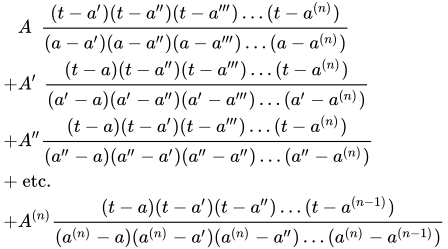
If is set equal to any of the quantities  , it is clear that the values of this function, coincide with the corresponding values of the function from which, as concluded in art. 2, we deduce that is identical to , provided that is also an integral algebraic function of order no greater than or at least it can take the place of if can be converted into a series of powers of which exhibits such convergence that it is permissible to neglect the higher order terms.
8.
To evaluate the integral  let us consider each part of separately. Let denote the product

and through the expansion of this product, let

The numerator of the fraction by which  is multiplied in its respective part of
  becomes
  the numerators in the subsequent parts are likewise

 , etc. The denominators are nothing but the values determined by these numerators if is set respectively to
  , etc. Let us denote these denominators respectively by


 , etc., so that we have

When  for
for  we have the identical equation

and therefore

Thus, dividing by  , we get
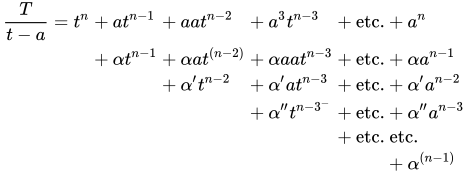
The value of this function for  is obtained as

Hence  is equal to the value of
  for as is evident for other reasons. Similarly,
  etc. will be the values of for

 , etc.
Furthermore, we find the value of the integral  from to to be:
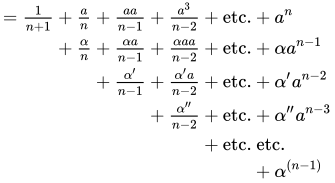
Let us arrange these terms in the following order:
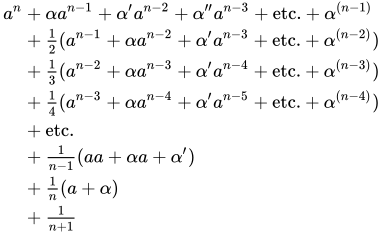
It is clear that the same quantity arises if, in the product obtained by multiplying the function by the infinite series

all terms involving negative powers of are rejected (or in short, in the integral part of the product, which is an integral function of ), is replaced by  Therefore let us set [1]

so that  is the integral function of contained in this product, and
  is the other part, namely the series descending to negative infinity. Then the value of the integral from to will be equal to the value of the function at
  So, if we denote the values of the function

determined by , etc., up to  resp. by


 then the integral
  from to will be

which, when multiplied by  , will give the value, either exact or approximate, of the integral from to
  .
.
9.
These operations are somewhat easier to perform if we introduce another variable  For the sake of brevity, we also write
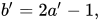
 etc. By substituting the value
  for let be transformed into
  or equivalently let

Then 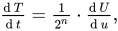 and hence
  etc. are the values of
  determined by

 etc.
etc.
Since the series  etc. is nothing but
  substituting
  will transform it into
  etc. Therefore, if we set

so that  is the integral function of
  contained in this product, and
  is the other part, which is an infinite descending series, it is clear that

However, it is clear that , being an integral function of will necessarily become an integral function of as a result of the substitution  on the other hand, , which contains only negative powers of will only generate negative powers of as a result of the same substitution. Therefore, will be nothing but
  transformed by this substitution, and likewise will be produced from
  Consequently, it makes no difference whether we substitute
  into
into  or
or  into
into  From this we conclude that
  etc. are also the values of the function
  determined by
 etc.
etc.
10.
Before we proceed further, we will illustrate these precepts with an example. Let and suppose that 


 Then we have

Multiplying by etc., we obtain

Hence the values of the coefficients 


 are expressed by the fractional function

wherein the values 


 are subsequently substituted for The other method, which is a bit faster, yields


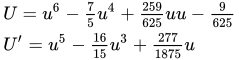
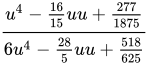
from which , etc. will be values of the fractional function
for 

 , etc. Both methods yield the same numbers given in Art. 4 of Harmonia Mensurarum. However, in such an example like this, where
  , etc. are all rational quantities, the values of the denominator are more conveniently computed in the original form, namely
  for and likewise for the others. The same holds for the denominator
  , which for becomes
11.
When , etc., are either partially or altogether irrational, it will be useful to transform the fractional function, from which we derive the numbers , etc., into an integral function. Since an elementary explanation of this transformation cannot be found in algebraic books, we will provide one here. Specifically, let 

 be three indeterminate integral functions of
  and let us seek an integral function which can be substituted for the fraction
  , as far as
  is taken to be any root of the equation
  Let us assume that
  does not vanish for any of these values of , or equivalently, that and imply no common indeterminate divisor. We will denote the exponents of the highest powers of in and by respectively.
Divide by  as is usual, until the order of the remainder is less than
  let the remainder be
  and let its order be
  so that
  is the highest order term of the remainder; we will denote the quotient of this division by
  Similarly, divide the function by
  let the residue
  of order
  be obtained as
  then again from the division of the function
  by
by  let the residue
  of order
  be obtained as
  , and so on, until in the series of functions
  etc., each having its highest term affected by a coefficient of
  we arrive at
  It is easy to see that this must eventually happen, since none of the functions etc., cannot have a common indeterminate divisor with the preceding one, and therefore, a division without remainder cannot happen as long as the divisor is of order greater than
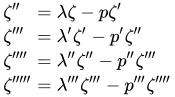
  Thus, we will have a series of equations:
etc., up to

where etc.,  are integral functions of of orders

 where the numbers etc., continuously decrease until the last one
  and
and 


 , etc., are integral functions of of orders


 , etc. (except in the case where
  where it is clear that we must set
  ).
).
Having prepared in this manner, we form a second series of integral functions of which we call 


 etc., up to
  Indeed, let us set
 and for the remaining functions we derive each from the preceding two according to the same rule by which the functions
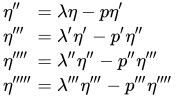
  , etc., are related to each other, namely through the following equations:
etc., up to

Clearly  is of order here;
  is of order and likewise the subsequent functions
 , etc., are of orders
 , etc., so that the last one
  is of order
Next we consider a "third" series of functions, 


 etc., among which any three consecutive terms will manifestly have a similar relation, namely,
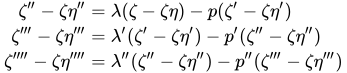
Now, the first of these functions is  the second is
  hence it is easily inferred that each is divisible by
Moreover, it follows without difficulty that we can replace the fraction  with the integral function
  provided that no values are assigned to
  other than those which are roots of the equation
  for it is clear that the difference
  must vanish for such a value of since
  is divisible by
Instead of the function we can also take the remainder which arises upon dividing it by whose order will be lower than the order of the function
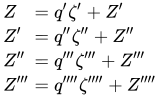
Indeed, this remainder can be immediately and more conveniently extracted using the following algorithm. We form the following equations:
etc., up to

by dividing  by then the remainder of the first division
  by then the remainder of the second division by and so forth. Since the remainder always belongs to an order lower than the divisor, the order of the functions

 etc. will be respectively lower than etc.; while the last
  necessarily becomes since the divisor is
  Therefore, we have

Moreover, since only the roots of the equation  are taken for it follows that


 etc., and under the same restriction, it follows that

However, the order of this expression will necessarily be less than than  since the order of the quotients
 etc. must be less than
  etc., the order of each part

 etc. will be less than etc.
Finally we observe that if it so happens that among the values of the indeterminate those that need to be substituted in the fraction are a mixture of rationals and irrationals, it will be more practical to separate them and only include the latter in the equation For rational values, there will be no need for calculation; for irrational values, however, the calculation will be simpler the lower the degree of the integral function to which the fraction can be reduced.
12.
Here is an example of the transformation explained in the preceding article. Let the given fractional function be
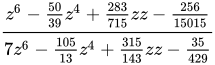
where indefinitely represents the roots of the equation

If we wanted to include all seven roots here, we would descend to a sixth-order integral function. However, for the rational value  the calculation of the fraction is straightforward, giving the value
  so excluding this root from the equation of sixth degree, we have:

from which it is easily foreseen that there will arise a fourth-order integral function. Now, from the application of the preceding rules, the following sequences emerge:
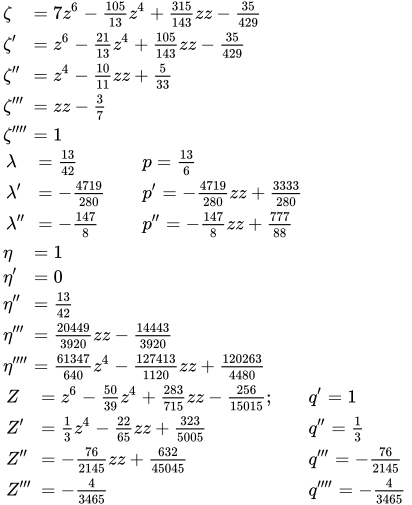
Hence, the integral function equivalent to the given fraction is derived to be:

13.
To determine the degree of precision of our integral formula  let us generally set

so that is the difference between the true and approximate values of the integral  taken from to . Thus, expanding each fraction into a series gives us
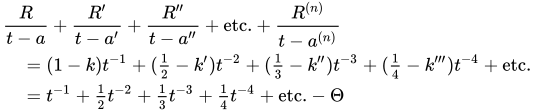
where

or rather (since we already know that etc. up to vanish automatically)

Multiplying this by gives

The first part of this equation is an integral function of of order and its values for  etc. are

 etc.: therefore, since the same holds for the function
  it is clear from the method by which the numbers etc. are determined that this first part of the equation must be identical to and thus
  Therefore,
  can be found by expanding the fraction
  and accordingly the coefficients
  etc. can be determined. These being found, the correction to the approximate value of our integral will be

if the series into which has been expanded is

14.
If desired, the correction can be expressed in terms of the coefficients of powers of  in the series
which is

if we generally write for the correction to the approximate value of the integral 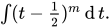 These corrections are related to the corrections via the equation

Thus we can independently determine them, by considering that the substitution transforms the function into
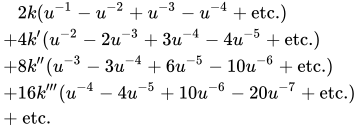
or into

or into

or finally, since we know a priori that 


 etc. up to
  automatically vanish, into

But  therefore, since the substitution transforms
  into
into  (art. 9), the same substitution will transform the function into
  Therefore, if we let
  denote the series expansion of the fraction
  we will have

in this manner, as many of the coefficients 
 etc. as are desired may be found.
Thus in the example of art. 10, we find

and so the correction to the approximate value of the integral is

15.
The coefficient  in the series expansion of the function is, by the theorem of Taylor, equal to the value of the expression
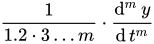
or
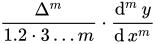
for or  similarly, the coefficient
  is the value of the same expression at
  or
or  or
or 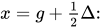 We assign the order to both coefficients. Therefore, generally speaking, our integration will be exact for orders up to and including , no matter which values are chosen for
  . However, there is nothing to prevent the precision from being raised to a higher degree by judiciously selecting the values of these quantities. Thus, as we have already seen, in Cotes's method, i.e., for

 , etc., the precision is automatically extended to order whenever is even. Generally, it is evident that if the values of , etc. are chosen so that in the function or , one or more terms vanish from the beginning, the precision will be increased by as many degrees beyond order as there are terms vanishing. Hence, it is easily inferred that when the number of quantities allowed to be chosen is
  by properly determining them, the precision can always be raised to order
  inclusive. Thus, with only terms, the same order of precision can be achieved, which would require or
  terms if we were following the method of Cotes.
16.
The whole matter revolves around determining, for any given value of , a function of the form  etc., such that when the product

is expanded into powers 

 , all of the coefficients are found to be
  or if one prefers, a function
  of the form
  etc., whose product with
  etc. is free of the powers


 The latter method will be somewhat simpler, since it is easily seen that the coefficients of , to satisfy the prescribed condition, must alternately vanish, i.e.,

 , etc., so around half of the work can already be considered complete. Let us consider some of the simpler cases.
I. For  the sole coefficient of
  in the product

must vanish. This yields  hence
hence  Similarly,
II. For the determination of depends on two equations:
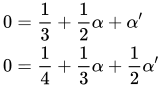
From which we deduce 
 hence
hence  The determination of yields a single equation:

Thus,  leading to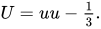
III. For the function is determined by three equations:
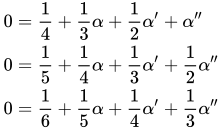
This yields  hence
hence  To determine
  a single equation suffices:
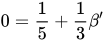
Thus,  leading to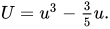
However, we will not further pursue this method, which leads to more and more complicated calculations. Instead, we will proceed to the genuine source of the general solution.
17.
Given a continued fraction
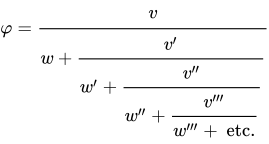
a series of fractions that are succesively closer to it can be found using the following algorithm. Two series of quantities, 


 etc., and


 etc., are formed using the formulas
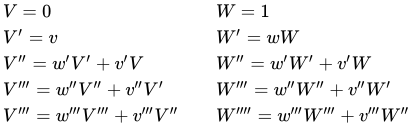
and so on, where:
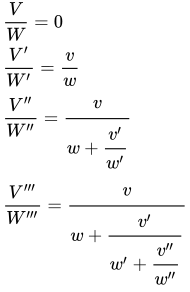
and so forth. Furthermore, it is evident, or easily confirmed from the preceding equations, that:
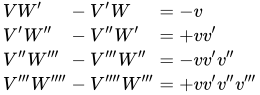
and so on. Hence, it is clear that in the series:

the first term is 
the sum of the first two terms is 
the sum of the first three terms is 
the sum of the first four terms is 
and so on; therefore, the series itself, either extended infinitely or until it is terminated, represents the continued fraction  . Additionally, from this, the difference between and each of the approximating fractions

 , etc., is obtained.
By changing to  in formula 33 in art. 14 of Disquisitionum generalium circa seriem infinitam, we easily obtain the transformation of the series

into the following continued fraction:

so that we have

Hence for , etc., , etc., we obtain the following values.
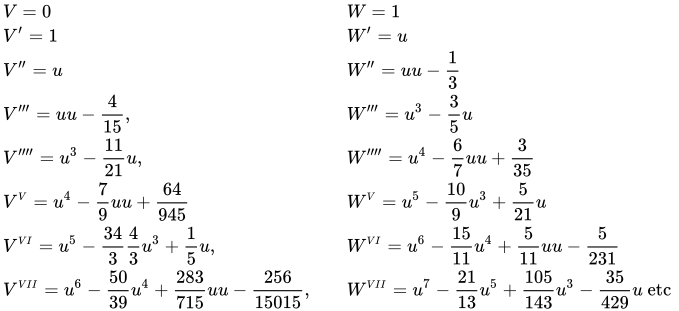
With careful attention, it becomes clear that all of the functions  , etc.,

 , etc., will be integral functions of the indeterminate
  the highest term in
  will be
  and the powers

 , etc., are absent; while the highest term in
  will be
  , and the powers
 , etc., are absent. By what has been shown above, we have

and thus generally
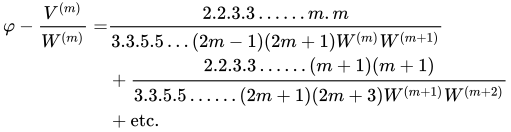
Therefore, if  is converted into a descending series, its first term will be
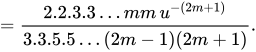
The product  will indeed be composed of the integral function and an infinite series whose first term is
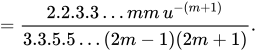
Therefore, a function of order is automatically obtained, which satisfies the condition established in the previous article, namely, that the product  be free from powers
  Namely, it is none other than
  and it is evident that will be equal to
  and that the first term of is

Therefore, if for 

 are taken to be the roots of the equation
  , and the values of the coefficients
  are obtained through the precepts stated above, our integral formula will enjoy precision of order , and its correction will be expressed approximately by

18.
The previous articles describe how to find suitable functions for each value of the number , but only successively, as one moves from smaller to larger values. However, we easily observe that these functions can generally be expressed as:

or, if we use the symbol  as in the commentary cited above, as:

This induction can easily be converted into a rigorous demonstration by the well-known method, or, if one prefers, with the assistance of formula 19 in the aforementioned discussion. The function , if desired, can also be expressed in the reverse order of terms by:

for even , with the upper or lower sign depending on whether  is even or odd, or by:

for odd , with the upper or lower sign depending on whether  is even or odd.
The function does not admit an equally simple general expression; however, from the origin of quantities  , etc., it is clear that the last term of for even becomes:

with the upper or lower sign depending on whether is even or odd.
The function  , whose first term we have already given in the previous article, can also be computed by a recursive algorithm, since we generally have:

and so on, and therefore in the case at hand,

Thus, we find
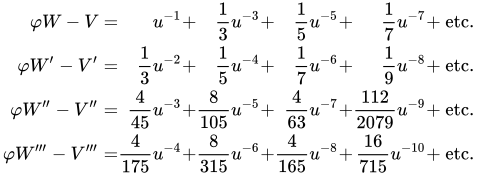
etc., which can also be represented by series as follows:
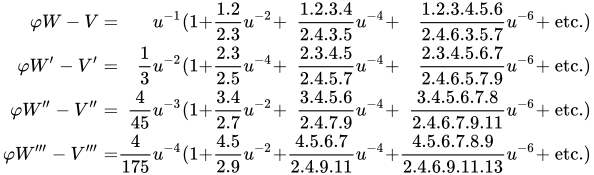
etc. Following this induction, we will generally have
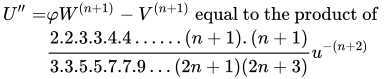
with the infinite series

or, if one prefers, with  This induction can also be easily elevated to full certainty either by the well-known method or with the help of formula 19 in the aforementioned discussion.
19.
Since it suffices to know either of the functions or , we have preferred the determination of the latter as simpler. This determination, relying on the expansion of the series  etc. into a continued fraction, could have been derived by similar reasoning from the expansion of the series etc. into a continued fraction:
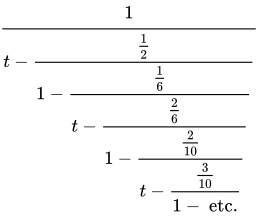
However, we arrive at the same conclusion by considering that is none other than  or
or  with replaced by
  In this way, the functions successively adopted for can be determined by the following algorithm:
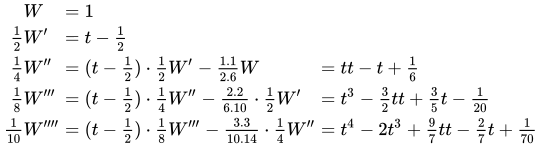
etc. By induction, it follows that generally

or  , which can be easily demonstrated. If one prefers, can also be expressed with the inverse order of terms, as

where the upper sign holds for odd , and the lower for even . Finally, in a similar manner, one finds that is equal to the product of

with the infinite series

or with  .
.
20.
Since the powers 

 etc. are absent from the function , the roots of the equation
  will always occur in pairs of equal magnitude but opposite signs, except that for even values of , it is necessary to include a singular root . Once the roots are found, the values of coefficients etc. will be obtained according to the method in art. 11, through an integral function of . For odd values of , this function will be of the form:

For even values, if the coefficient corresponding to the root is excluded, it will be of the form:

The example in art. 12 illustrates this reduction for  It is clear that opposite values of always correspond to equal coefficients. Of course, in the case where n is even, the coefficient corresponding to the root can be easily assigned a priori. This coefficient will be obtained if is substituted into
  We have already provided the value of the numerator
  for in art. 18, and the value of the denominator is

Thus the sought coefficient is:
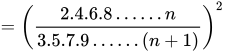
21.
The integral function of which produces the coefficients  etc. in the case we are treating here can also be derived independently of the general method of art. 11, in the following manner. By differentiating the equation
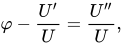
substituting  and multiplying by
 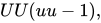 we obtain

The terms on the left-hand side of this equation clearly constitute an integral function of  thus it follows that on the right-hand side, the coefficients of powers of with negative exponents must destroy each other.
But  produces an infinite series starting from the term

which when multiplied by  can only result in a constant quantity

From this, we deduce that[2]

must be divisible by and therefore the fractional function which produces the coefficients  etc., will be equivalent to the integral function

This function, which is of order  clearly implying only even powers of , can be replaced with the remainder arising from its division by , which will be of order or
  depending on whether is even or odd. However, if in the former case we prefer to exclude the coefficient corresponding to the root
  we can instead replace it with its remainder upon division by
  , which will only be of order
22.
In order to make available that which is required for the application of the method thus far presented, it seemed appropriate to append, for successive values of the number numerical values of the quantities etc., and also of the coefficients etc., computed to sixteen figures, together with their logarithms to ten figures.
I. First term, 
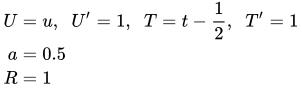
Correction to the integral formula approximately 
II. Second term, 
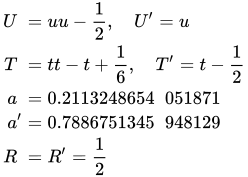
Correction approximately 
III. Third term, 
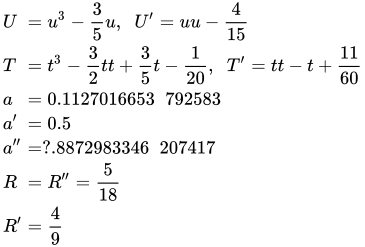
Correction approximately 
IV. Fourth term, 

General expression for the coefficients
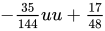
Correction approximately 
V. Fifth term, 
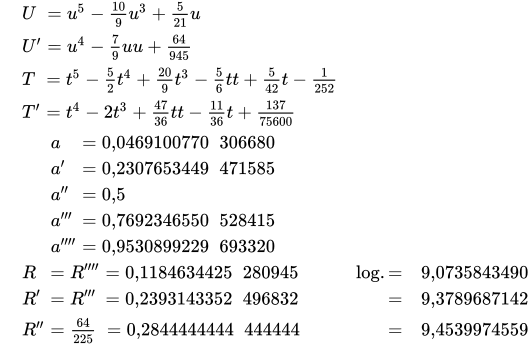
General expression for the coefficients, excluding
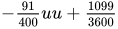
Correction approximately 
VI. Sixth term,
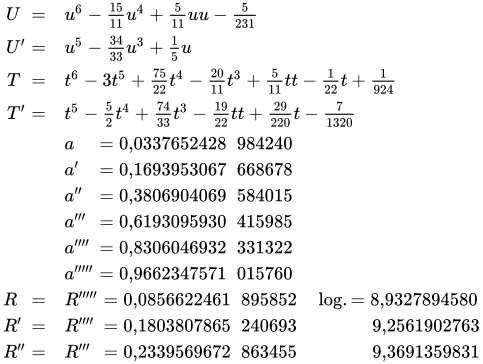
General expression for the coefficients

Correction approximately 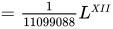
VII. Seventh term,
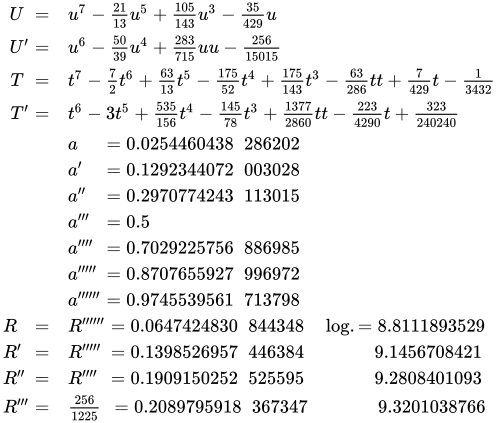
General expression for the coefficients, excluding

Correction approximately 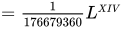
23.
Coronidis loco, we will illustrate the effectiveness of our method by computing the value of the integral

from  to
to 
- I. From the first term, we have

- II. From the second terms we get
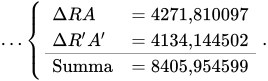
- III. From the third terms
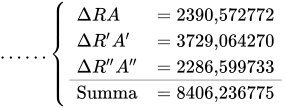
- IV. From the fourth terms
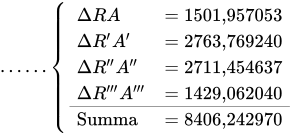
- V. From the fifth terms
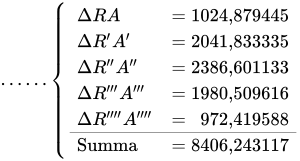
- VI. From the sixth terms
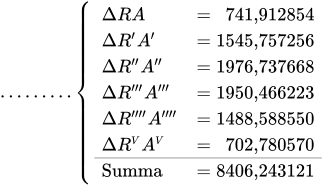
- VII. From the seventh terms
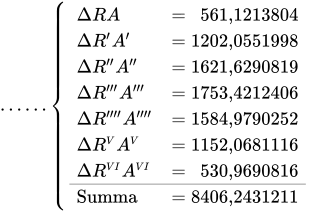
In the calculations of Bessel, the value of the integral was found to be 
- ↑ It will hardly be necessary to point out that the characters
 are to be understood here in a different sense than in art. 2.
- ↑ At the same time, it is requested to demonstrate that cannot have a common indeterminate divisor with , nor can the equation have equal roots.