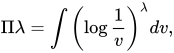
The series which we propose to investigate in this treatise can be regarded as a function of four quantities 


 which we shall call its elements. We will distinguish these by their order, with the first element being the second the third and the fourth
  It is clear that the first and second elements can be interchanged: therefore, if for the sake of brevity we denote our series by the symbol
 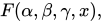 then we shall have
By assigning definite values to the elements our series becomes a function of a single variable which is clearly cut off after the  or
or  term if
  or
or  is a negative integer, but in other cases it extends indefinitely. In the former case, the series yields a rational algebraic function, but in the latter case, it usually yields a transcendental function. The third element
  must neither be a negative integer nor equal to zero, so that we do not have infinitely large terms.
The coefficients of the powers 
 in our series are as

and therefore they approach equality as the value of  increases. So, if a definite value is also assigned to the fourth element the convergence or divergence of the series will depend on the nature of this value. Indeed, whenever a real value, positive or negative but less than unity, is assigned to the series, while not convergent immediately from the beginning, will nevertheless converge after a certain interval and will lead to a sum which is finite and determinate. The same will occur for an imaginary value of
  of the form
  whenever
  On the other hand, for a real value of greater than unity, or for an imaginary value of the form
  with
with  the series will diverge, perhaps not immediately, but after a certain interval, so that it is meaningless to speak of its "sum". Finally, for the value
  (or more generally for a value of the form with
  ), the convergence or divergence of the series will depend on the nature of the elements as we will discuss, with particular attention to the sum of the series for
  in the third section.
It is therefore clear that, to the extent that our function is defined as the sum of a definite series, our investigation must, by its nature, be restricted to those cases where the series actually converges, and hence it is meaningless to ask for the value of the series for values of which are greater than unity. Furthermore, from the fourth section onwards, we will construct our function on the basis of a deeper principle, which permits the most general application.
Differentiation of our series, considering only the fourth element as the variable, leads to a similar function, since it is clear that

The same applies to repeated differentiation.
It will be worth our while to include here certain functions that can be reduced to our series and whose use is very common in analysis.

where the element  is arbitrary.

where  is an infinitely small quantity.




where  is the base of the hyperbolic logarithm, and
  is an infinitely large number.
where  are infinitely large numbers.













The preceding functions are algebraic or transcendental depending upon logarithms and the circle. However, we do not undertake our general investigation for the sake of these functions, but rather to advance the theory of higher transcendental functions, of which our series encompasses a vast range. Among these, amid countless others, are the coefficients which arise in the expansion of the function  into a series in terms of the cosines of the angles
  etc., about which we will speak particularly on another occasion. However, those coefficients can be reduced to the form of our series in several ways. Namely, setting

we have "firstly",
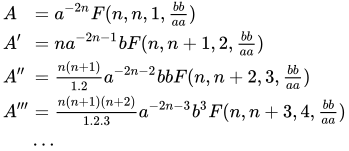
For if we view  as the product of
  and
and  (where
  denotes the quantity
  ), then
  is equal to the product of
  with
with

and

Since this must be identical to

the values given above are obtained automatically.
Secondly, we have
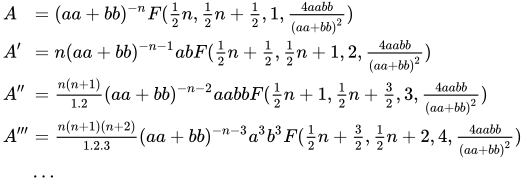
These values are easily derived from

Thirdly,
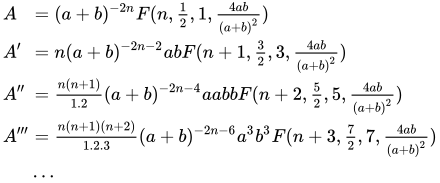
Finally fourthly,
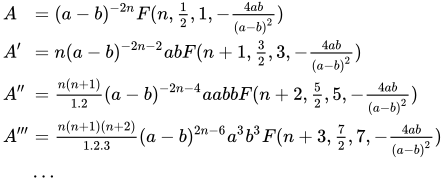
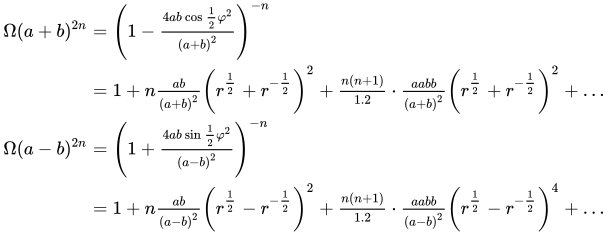
These values and those following are easily derived from
FIRST SECTION.
Relations between contiguous functions.
7.
We say that a function is contiguous with 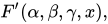 if it is obtained from the latter by increasing or decreasing the first, second, or third element by unity, with the remaining three elements being held constant. Thus the primary function
  produces six contiguous ones, any two of which are related to the primary function by a very simple linear equation. These equations, fifteen in number, are given below. For the sake of brevity we have omitted the fourth element, which is always understood to be
  and we have denoted the primary function simply by
| [1]
|

|
| [2]
|

|
| [3]
|

|
| [4]
|

|
| [5]
|

|
| [6]
|

|
| [7]
|

|
| [8]
|

|
| [9]
|

|
| [10]
|

|
| [11]
|

|
| [12] |

|
| [13] |

|
| [14] |

|
| [15] |

|
Now here is the proof of these formulas. If we set

then the coefficient of  will be as follows:
in  |

|
in  |

|
in  |

|
in  |

|
Moreover, the coefficient of  in
in 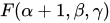 , or the coefficient of in
  is
is

Hence, the truth of formulas 5 and 3 is immediately apparent. Formula 12 arises from 5 by swapping  and and from these two, elimination yields 2. Similarly, by the same permutation, formula 6 arises from 3; combining 6 and 12 yields 9, permuting yields 14, and combining these gives 7. Finally, from 2 and 6, 1 is derived, and then by permutation, 10. Formula 8 can be derived in a similar manner to formulas 5 and 3 above, from the consideration of coefficients (if desired, all 15 formulas could be derived in a similar way), or more elegantly from the known equations, as follows.
By changing the element to and to  in formula 5, we obtain

On the other hand, by changing only to in formula 9, we get

Subtracting these formulas immediately yields 8, and hence by permutation, 13. From 1 and 8, 4 follows, and then by permutating, 11. Finally, 15 is deduced from 8 and 9.
If 

 and
and 

 are all integers (positive or negative), one can go from the function
  to the function
  , and likewise from there to the function
 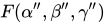 through a series of similar functions, such that each one is contiguous to the preceding and succeeding ones. This is achieved by changing one element, e.g. , by one unit repeatedly, until one reaches
  and then changing the second element until one reaches
  and finally changing the third element until one reaches
  and so on to
 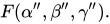 Since linear equations exist, according to art. 7, between the first, second, and third functions, and generally between any three consecutive functions in this series, it is easily understood that linear equations between the functions
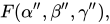 and so forth can be deduced by elimination. Thus, generally speaking, from two functions whose first three elements differ by integers, any other function with the same property can be obtained, provided that the fourth element remains the same. For what remains, it suffices to establish this remarkable truth generally; we shall not dwell on the shortcuts by which the operations required for this purpose can be made as brief as possible.
Suppose that we are given e.g. the functions

between which a linear relation must be found. We can connect them through the following contiguous functions:
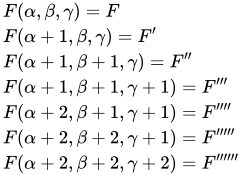
Thus we have five linear equations (from formulas 6, 13, 5 of art. 7):




Eliminating  from I and II yields

Eliminating  from this and III yields

Eliminating  from IV and V yields

Finally, eliminating  from this and VII yields

If we wanted to exhaust all relations among triplets of functions 

 where
where 


 are either
 or
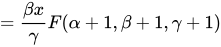
or  then the number of formulas would increase to 325. Such a collection would not be useless; but it will suffice to present only a few here. These can be easily demonstrated, either from the formulas in art. 7 or, if one prefers, in the same manner as in art. 8.
| [16]
|

|

|
| [17]
|

|

|
| [18]
|

|
|
| [19]
|

|

|
| [20]
|

|

|
| [21]
|

|

|
| [22]
|

|

|
| [23]
|

|

|
SECOND SECTION.
Continued Fractions.
12.
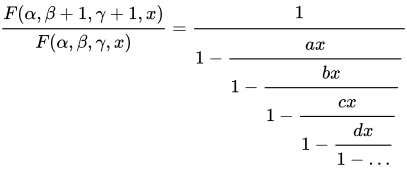
Denoting
\frac{F(\alpha, \beta+1, \gamma+1, x)}{F(\alpha, \beta, \gamma, x)}\;</math>
by 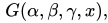 we have

and thus, dividing equation 19 by 

or
| [24]
|

|
and since similarly

etc., we obtain the following continued fraction for 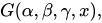
| [25]
|
|
where
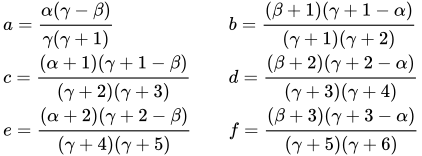
etc., where the law of the progression is obvious.
Moreover, from equations 17, 18, 21, 22, we have
| [26]
|

|
| [27]
|

|
| [28]
|

|
| [29]
|

|
from which, substituting the values of the function  into the continued fractions, an equal number of new continued fractions emerge.
Finally, it is clear that the continued fraction in formula 25 automatically terminates if any of the numbers 
 is a negative integer, and otherwise it runs to infinity.
The continued fractions in the previous article are of the utmost importance, and it can be asserted that hardly any continued fractions progressing according to a known law have so far been extracted by analysts, which are not special cases of ours. Especially notable is the case where we set  in formula 25, so that
  and therefore, writing
  instead of

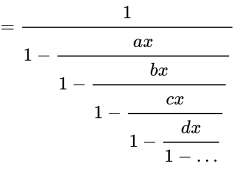
where
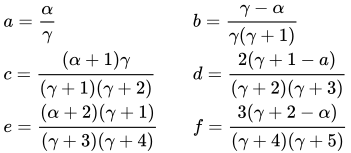
etc.
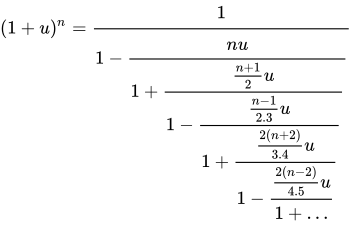
It will be worth our while to include some special cases here. Setting 
 it follows from formula I of art. 5 that
| [31]
|
|
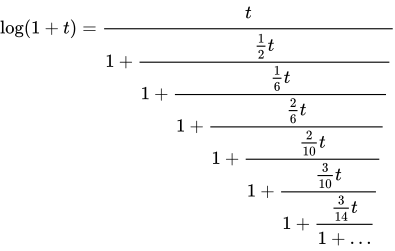
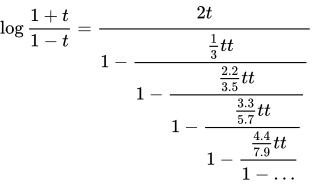
From formulas VI and VII of art. 5, we have
| [32]
|
|
| [33]
|
|
Changing the sign  to
to  here yields the continued fraction for
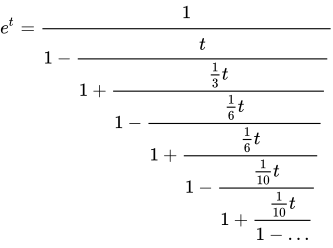
Furthermore, we have
| [34]
|
|
| [35]
|
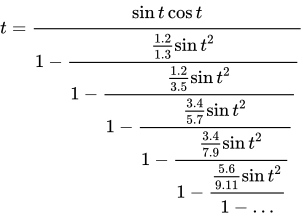
|
Setting 
 the continued fraction presented in art. 90 of Theoria motus corporum coelestium follows automatically from formula 30. Two other continued fractions are also proposed there, the development of which we thought to supply here. Setting
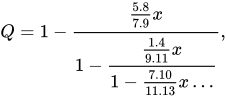
then (l.c.) 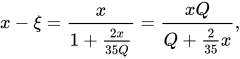 hence
hence
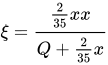
which is the first formula; the second is derived as follows. Setting
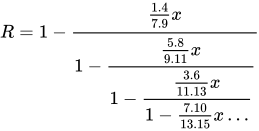
we have, by formula 25,
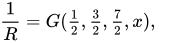 and
and 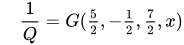
Hence
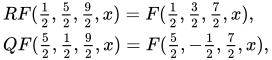
or by swapping the first and second elements,

However, by equation 21, we have

from which it follows that 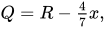 and substituting this value into the formula above yields
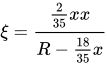
which is the second formula.
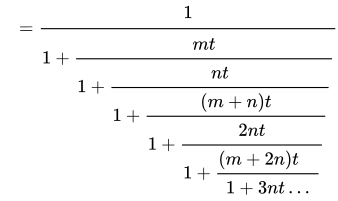
Setting 
 in formula 30 yields, for an infinitely large value of
| [36]
|

|
|
|
|
THIRD SECTION.
On the sum of our series, with the fourth element set  with a discussion of certain other transcendental functions.
15.
Whenever the elements are all positive quantities, all coefficients of powers of the fourth element become positive: and whenever one or another of those elements is negative, at least from some power onwards all coefficients will have the same sign, provided that is taken greater than the absolute value of the most negative element. It is clear from this that the sum of the series for cannot be finite unless the coefficients decrease to infinity after a certain term, or, to speak in the manner of analysts, unless the coefficient of the term  is
is  Indeed, for the benefit of those who favor the rigorous methods of the ancient geometers, we will show with all rigor that
first, the coefficients (since the series is not terminated) increase to infinity indefinitely whenever  is a positive quantity.
second, the coefficients converge continually towards a finite limit whenever 
third, the coefficients decrease to infinity indefinitely whenever is a negative quantity.
fourth, the sum of our series for notwithstanding convergence in the third case, is infinite whenever  is a positive quantity or
fifth, the sum is truly finite whenever is a negative quantity.
We will apply this general discussion to the infinite series 


 etc., which is formed so that the quotients

 etc. resp. are the values of the fraction

for 

 , etc. For brevity, we will denote the numerator of this fraction by
  and the denominator by
  . Furthermore, we assume that and are not identical, or equivalently that the differences

 etc., do not all vanish simultaneously.
I. Whenever the first of the differences etc., which does not vanish is positive, some limit  can be assigned, beyond which the values of the functions and will always be positive and
  . It is evident that this occurs when is taken as the largest real root of the equation
 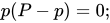 if this equation has no real roots at all, then this property holds for all values of
  . Therefore, in the series etc., at least after a certain interval (if not from the beginning), all terms will be positive and greater than unity. Consequently, if none of them tends to zero or infinity, it is clear that
the series etc., if not from the beginning, then at least after a certain interval, will have all its terms affected by the same sign and continually increasing.
By the same reasoning, if the first of the differences etc. which does not vanish is negative, then the series etc., will, if not from the beginning, then at least after a certain interval, have all its terms affected by the same sign and continually decreasing.
II. Now, if the coefficients 
 are unequal, the terms of the series etc., will either increase or decrease to infinity, depending on whether the difference
  is positive or negative: we demonstrate this as follows. If is positive, let an integer
  be chosen so that
 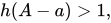 and let


 , etc., and also
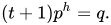 Then it is clear that

 etc., are values of the fraction
  when , etc., while
 themselves are algebraic functions of the form
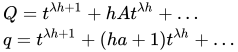
Therefore, since by hypothesis the difference 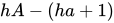 is positive, the terms of the series


 etc. will, if not from the beginning, then after a certain interval, continually increase (by I). Hence the terms of the series


 etc., will necessarily increase beyond all limits, and therefore the terms of the series
  , etc., whose exponents are equal to , will do so as well. Q.E.D.
If is negative, then the integer must be chosen so that  is greater than
  , and similar reasoning leads to the conclusion that the terms of the series

will continually decrease after a certain interval. Therefore, the terms of the series 

 etc., and consequently also the terms of the series , etc., will necessarily tend to infinity. Q.E.S.
III. On the other hand, if the coefficients are equal, then the terms of the series etc., converge continually to a finite limit: we demonstrate this as follows. First, let us suppose that the terms of the series increase continually after a certain interval, or equivalently that the first of the differences etc. which does not vanish is positive. Let be an integer such that  becomes a positive quantity. Set
and 
 such that
  , etc., are values of the fraction when
  , etc. Therefore, since we have

and since  is a negative quantity by hypothesis, the terms of the series etc., will decrease continually after a certain interval. Therefore, the corresponding terms of the series etc. which are always smaller, while also increasing continually, must converge to a finite limit. Q.E.D.
If the terms of the series etc., decrease continually after a certain interval, an integer must be chosen such that  becomes a positive quantity. It then becomes evident from entirely similar reasoning that the terms of the series

increase continually after a certain interval. Therefore, the corresponding terms of the series etc., which are always greater, while also decreasing continually, must converge to a finite limit. Q.E.S.
IV. Lastly, concerning the sum of the series whose terms are etc. in the case where these terms decrease indefinitely, let us first suppose that falls between  and
and  , meaning that
  is either a positive quantity or Let be a positive integer, chosen arbitrarily in the case where is positive, or so that it makes the quantity
  positive in the case where
  Then we will have

where either  is positive, or, if it equals then at least
  will be positive. Hence (by I), a value can be assigned to the quantity , which, once exceeded, will ensure that the values of the fraction
  will always be positive and greater than unity. Let
  be an integer greater than and also greater than
  and let the terms of the series etc., corresponding to the values

 etc., be denoted by etc. Then
will be positive quantities greater than one, so that
Consequently, the sum of the series  will be greater than the sum of the series

no matter how many terms are included. However, as the number of terms increases indefinitely, the latter series exceeds all limits, as the sum of the series  is known to be infinite and remains infinite even if the terms
  are removed from the beginning. Hence, the sum of the series
  and consequently the sum of
  of which it is a part, increases beyond all limits.
V. However, when is a negative quantity that is absolutely greater than one, the sum of the series will certainly be finite when continued indefinitely. Indeed, let be a positive quantity less than  Then similar reasoning shows that the quantity can be assigned a value
  beyond which the fraction
  always has positive values less than unity. Now, if we take an integer greater than
 and let the terms of the series etc., corresponding to the values

 etc., be denoted by etc., then

Consequently, the sum of the series  no matter how many terms are included, is less than the product of
  with the sum of the same number of terms of the series

However, the sum of this series can be easily found for any number of terms. In particular,
| The first term
|
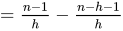
|
| The sum of the first two terms
|
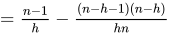
|
| The sum of the first three terms
|
 etc. etc.
|
and since the second part (by II) forms a series which decreases beyond all limits, the sum must be  Hence when continued infinitely, will always remain less than
  and thus
  will certainly converge to a finite sum. Q.E.D.
VI. In order to apply those general assertions concerning the series etc. to the coefficients of the powers 
 etc. in the series
 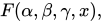 it is necessary to set


 from which the five assertions in the preceding article follow automatically.
Therefore, investigations of the nature of the sum of the series  are naturally restricted to the case where
  is a positive quantity, in which case the sum will always be a finite quantity. However, we must begin with the following observation. If, after a certain term, the coefficients of the series
  decrease beyond all limits, then the product

must  when for even if the sum of the series
  becomes infinitely large. For since the sum of two terms is
  the sum of three is
  the sum of four is
  , etc., the limit of the sum when continued indefinitely will be Therefore, whenever is a positive quantity, we must have
  for and hence, by equation 15 of art. 7,
|
|
 or or
|
| [37]
|

|
Thus, similarly, we have
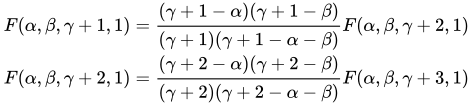
and so on, where denotes an arbitrary positive integer,
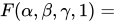 the product of
with 
and 
divided by the product of

with 
We now introduce the notation
| [38]
|

|
where is naturally restricted to be a positive integer, and with this restriction,  represents a function determined solely by the two quantities and
  . Then it is easy to understand that the theorem proposed at the end of the preceding article can be expressed as follows:
| [39]
|

|
It will be worthwhile to examine the nature of the function in more detail. Whenever is a negative integer, the function evidently has an infinitely large value, as long as a sufficiently large value is assigned to . For non-negative integer values of , we have:
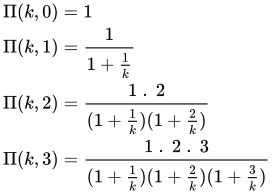
etc., and generally:
| [40]
|

|
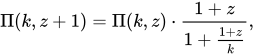
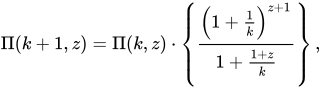
For arbitrary values of , we have:
| [41]
|
|
| [42]
|
|
and therefore, since 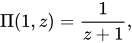
| [43]
|

|
It is worth giving special attention to the limit toward which the function \Pi(k, z) continually converges, as k increases to infinity. First, let be a finite value of which is greater than . Then it is clear that, as increases from to the logarithm of receives an increment which can be expressed by the following convergent series:

Therefore, as increases from to  the logarithm of will receive an increment
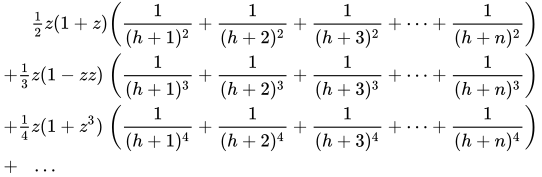
which will always remain finite, even when tends to infinity, as can be easily demonstrated. Therefore, unless an infinite factor is already present in  i.e., unless is a negative integer, the limit of as tends to infinity will certainly be a finite quantity. Hence, it is evident that
  depends solely on
  or in other words, it is a function of alone, which we will simply denote by
  We therefore define the function
  as the value of the product:

for  or, if one prefers, as the limit of the infinite product

Immediately following from equation 41, we have the fundamental equation:
| [44]
|

|
Hence, in general, for any positive integer 
| [45]
|

|
For a negative integer value of the value of the function will be infinitely large; for non-negative integer values, we have
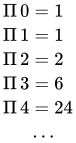
and, in general
| [46]
|

|
|
However, this property of our function should not be mistaken as its definition, as it is inherently limited to integer values and there exist countless other functions (e.g., 
 , etc., where
  denotes the circumference of a circle of radius
  ) that share the same property.
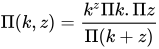
Although the function may appear to be more general than  it will henceforth be redundant for us, as it can easily be reduced to the latter. Indeed, it follows from the combination of equations 38, 45, and 46 that
| [47]
|
|
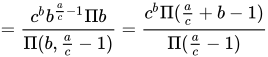
Moreover, the connection of these functions with that which Kramp has called "facultates numericae" is evident. Specifically, the facultates numericae, which this author denotes by  , can be expressed in our notation as:
However, it seems more advisable to introduce a function of one variable into the analysis, rather than a function of three variables, especially when the latter can be reduced to the former.
The continuity of the function is interrupted whenever its value becomes infinitely large, i.e., for negative integer values of  Therefore, it will be positive from
  to
to  and since for each limit obtains an infinitely large value, there will be a minimum value between them, which we found to be
  corresponding to the value
  Between the limits and
  the value of the function is negative, between
  and
and  it is positive again, and so forth, as follows from equation 44. Furthermore, it is clear that if one knows all the values of the function between two arbitrary limits that differ by unity, e.g. from
  to
to  then the value of the function for any other real value of can be easily deduced from equation 45. To this end, we constructed a table, appended to this section, which gives the Briggsian logarithms of the function to twenty figures, from to
  However, it should be noted that the final twentieth figure may be subject to an error of one or two units.
Since the limit of the function  as increases to infinity is clearly unity, equation 39 transforms into the following:
| [48]
|

|
This formula provides the complete solution to the question posed in this section. The following elegant equations follow automatically:
| [49]
|

|
| [50]
|

|
| [51]
|

|
In the first equation, must be a positive quantity, and so must be in the second and  in the third.
Let us apply formula 48 to some of the equations from art. 5. By setting 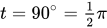 in Formula XIII, we find that
  , which is equivalent to the well-known equation

Therefore, since formula 48 gives us 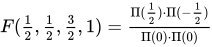 , and since
  ,
, 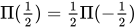 , we have
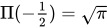
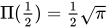
 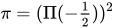 , or
, or
| [52]
|
|
| [53]
|
|
Formula XVI of art. 5, which is equivalent to the well-known equation

holds generally for any value of , as long as remains between the limits  and
and  . For
. For  , we have
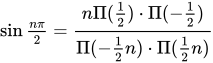
and from this we derive the elegant formula
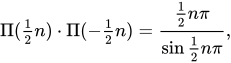
or setting  ,
,
| [54]
|

|
| [55]
|

|
and writing  for
for
| [56]
|

|
From formula 54, combined with the definition of the function  , it follows that
  is the limit of the product

as tends to infinity, and therefore

Similarly, from 56, we deduce

These are well-known formulas, that have been derived by analysts using entirely different methods.
Let be an integer. Then the value of expression

is found to be
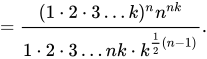
Thus it is independent of , or remains the same regardless of the value assigned to . Therefore, since  , it is given by the product

As increases to infinity, we obtain

According to formula 55, the product on the right, when multiplied by itself with order of the factors reversed, yields

Hence, we have the elegant theorem
| [57]
|

|
The integral 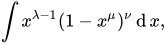 taken in such a way that it vanishes for
  can be expressed by the following series, provided that
  are positive quantities:

Hence its value for will be
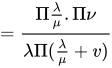
From this theorem, all the relations that the illustrious Euler once painstakingly developed emerge naturally. Thus, by setting e.g.

we have 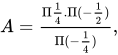
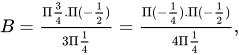 and thus
  Furthermore, it follows from this, since
 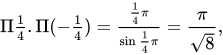 that
that
![{\displaystyle \Pi {\tfrac {1}{4}}={\sqrt[{4}]{{\tfrac {1}{8}}\pi AA}}={\sqrt[{4}]{\frac {\pi ^{3}}{128BB}}},\quad \Pi (-{\tfrac {1}{4}})={\sqrt[{4}]{\frac {\pi ^{3}}{8AA}}}={\sqrt[{4}]{2\pi BB}}}](./_assets_/eb734a37dd21ce173a46342d1cc64c92/0346339142f7be6f75b3ed35ee2ef659183ea4c6.svg)
The numerical value of  computed by Stirling is
  and the value of
  according to the same author, is
  while from our own calculation, employing a particular method, it is

In general, it can be easily shown that the value of the function  , if is a rational quantity
  where are integers, can be deduced from
  values of such integrals evaluated at , and indeed in many different ways. Indeed, taking an integer value for
  and a fraction with denominator
  for the value of that integral is always reduced to three , where is a fraction with a denominator
  any such can be reduced to
  or to
or to  or to
or to  etc., or to
  by formula 45, if is a fraction; for indeed, if is an integer, then itself is known. From those values of the integrals, generally speaking, any
  can be obtained by elimination, provided that
  [1] Indeed, it suffices to take half as many integrals if we also invoke formula 54. Thus, setting e.g.
we will have
Therefore, since 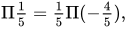 we have
Formulas 54, 55 still yield
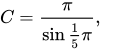
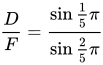
so that two integrals  and
and  or
or  and
and  suffice to compute all values of
 etc.
etc.
Setting  and
and  the value of the integral
 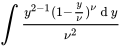 from
from  to
to  or the value of the integral
 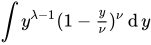 between the same limits, is
 (form. 47), provided that
  is an integer. Now, the limit of
  as increases to infinity will be
  and the limit of
  will be
  where denotes the base of the hyperbolic logarithm. Therefore, if is positive, the value of the integral
 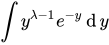 from to
  will be
  or
or  or by writing for
  the value of the integral
  from to will be
  provided that
  is a positive quantity.
More generally, by setting 
 the integral becomes
 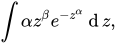 which, when taken between the limits and is expressed by
  or in other words,
The value of the integral 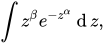 from to
  is
is 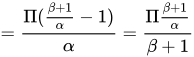 provided that both and
  are positive quantities (if either is negative, the value of the integral is
  ). Thus for e.g.
 the value of the integral
  is found to be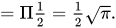
The illustrious Euler derived, for the sum of logarithms

, the series

where 

 , etc. are the Bernoulli numbers. Thus, this series evaluates to
  although at first glance this conclusion may seem restricted to integer values, upon closer inspection it will be found that the method employed by Euler (Instit. Calc. Diff. Cap. vi. 159) can be applied, at least for positive fractional values, with the same justification as for integers: he assumes only that the function of
  to be developed in a series, can be expressed in such a way that its decrement, if changes to
  can be found using Taylor's theorem, and simultaneously that the same decrement is
  The former condition relies on the continuity of the function, and therefore does not apply to negative values of
  to which it is not permitted to extend the series; however, the latter condition applies generally to the function
  without restriction to integer values of
  Therefore, we set
| [58]
|

|
From this, since we have

and by setting  in formula 57,

we get
| [59]
|

|
For large values of these two series converge sufficiently rapidly from the beginning that an approximate and sufficiently exact sum can be conveniently obtained. However, it should be noted that for any given value of , no matter how large, only limited precision can be achieved, since the Bernoulli numbers constitute a hypergeometric series, and therefore these series, if extended sufficiently far, will certainly turn from convergent to divergent. It cannot be denied that the theory of such divergent series is still fraught with difficulties, which we may discuss in more detail on another occasion.
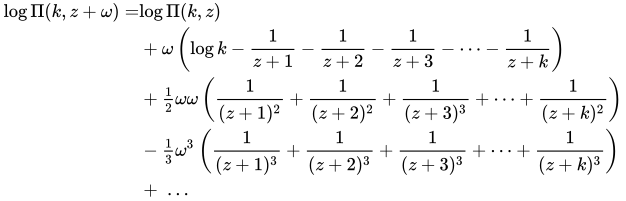
From formula 38, it follows that

Taking logarithms and expanding into infinite series yields
| [60]
|
|
The series multiplied by , which, if one prefers, can also be expressed as

consists of a finite number of terms, but as tends to infinity, it converges to a certain limit, which presents to us a new species of transcendental functions, to be denoted from now on by  .
.
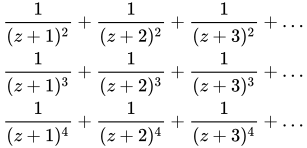
Furthermore, if we denote the sums of the infinitely extended series

by 
 etc. respectively (for which it seems less than necessary to introduce functional symbols), we will have
| [61]
|

|
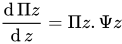
The function will clearly be the first derivative of the function  and therefore
| [62]
|
|
Similarly, we have  etc.
etc.
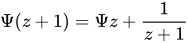
The function is almost as remarkable as the function  we will gather here some significant relations pertaining to it. Differentiating equation 44 yields
| [63]
|
|
from which we have
| [64]
|

|
This formula allows us to progress from smaller values of to larger ones, or to regress from larger values to smaller ones. For larger positive values of the numerical values of the function are quite conveniently computed by the following formulas, obtained by differentiating equations 58, 59, to which the same considerations apply as in art. 29 regarding formulas 58 and 59.
| [65]
|

|
| [66]
|

|
Thus for  we have calculated

from which we regress to
 [2]
[2]
For positive integer values of we generally have
| [67]
|

|
For negative integer values, however, it is clear that becomes infinitely large.
Formula 55 provides us with  and differentiating this yields
| [68]
|

|
Moreover, from the definition of the function  we generally have
| [69]
|

|
This yields the well-known series

Similarly, by differentiation formula 57, we obtain
| [70]
|

|
and therefore, by setting ,
| [71]
|
 }} }}
|
For example, we have

and thus

Just as in the previous article we reduced  to
to  and logarithms, so in generally can we reduce
  where are integers with
  to and logarithms. Let us set
  and let
  be any one of the angles

 ; then
  etc.,
etc.,  etc.,
etc.,  etc., and also
  etc.
etc.  Thus, we have
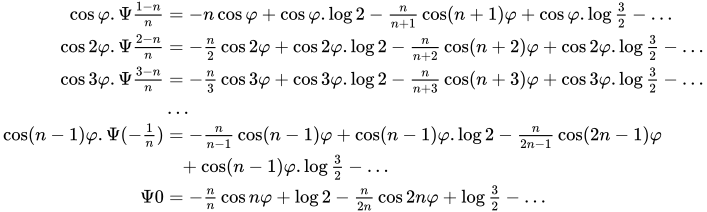
and by summation,

 )
)
But we generally have, for values of not greater than unity,

which easily follows from the expansion of  where denotes the quantity
  Hence, the preceding equation becomes
| [72]
|

|
|
|

|
Now, let us set 

 , etc. up to
 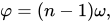 and multiply these equations in their respective order by

 etc. up to
  and add the sum of these products to equation 71:

If we now consider that

where denotes any one of the numbers 

 except for and
  for which the sum is
  then it will is apparent, after adding these equations and dividing by
  that:
that:
| [73]
|


|
The last term of this equation is clearly  the penultimate one
  , etc., so that the terms are always equal in pairs, except when is even, in which case there is a singular term
  which is either
  for even or
  for odd . Combining the equation

with equation 73, we obtain, for odd values of
| [74]
|

|
provided that is a positive integer less than  For even values of we have
| [75]
|

|
where the upper sign holds for even and the lower sign holds for odd . For example, we find:

In fact, upon combining these equations with equation 64, it is evident that can generally be determined for "arbitrary rational values" of whether positive or negative, in terms of  and logarithms, which is a most remarkable theorem.
According to art. 28,  represents the value of the integral from to
  provided that is a positive quantity. Therefore, differentiating with respect to we obtain

or
| [76]
|
 from to from to
|
More generally, by setting  and the value of the integral
 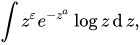 from to becomes

provided that both and are positive quantities, or equal to the same quantity with the opposite sign, in the case where one of and is negative.
Not only the product  but also the function
  itself can be expressed through a definite integral. Letting denote a positive integer, it is clear that the value of the integral
 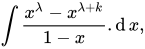 from
from  to is
to is

Moreover, since the value of the integral 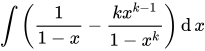 is generally
 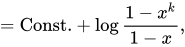 it will be
  between the limits and
  Hence, it is clear that the value of the integral
  between the same limits is

which we denote by  Let us break down the integral into two parts

After the substitution  the first part
 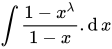 becomes
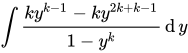
from which it is clear that its value from to is equal to the value of the integral
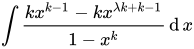
between the same limits, since it is clear that the letter  can be substituted by under this restriction. Hence the integral
  , between the same limits, becomes
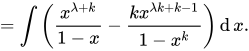
Now, by setting  this integral becomes
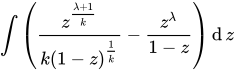
which therefore, between the limits and  , must be equal to However, when increases to infinity, the limit of is
  the limit of
  is
is  and the limit of
  is
is  or
or  Therefore, we have
| [77]
|

|
from to
The definite integrals by which the functions have been expressed above must be restricted to values of such that becomes a positive quantity: this restriction arose naturally from the derivation itself, and indeed it is easily understood that for other values of those integrals always become infinite, even if the functions  might remain finite. The truth of formula 77 surely requires the same condition, that be a positive quantity (otherwise, the integral would certainly become infinite, even if the function remains finite): but at first glance, the deduction of the formula seems to be general and not subject to any restriction. However, upon closer inspection, it is easy to see that this restriction is already inherent in the analysis itself by which the formula was derived. Namely, we tacitly assumed that the integral
 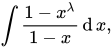 which is equal to
 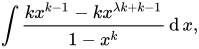 has a finite value, a condition that requires to be a positive quantity. From our analysis, it indeed follows that these two integrals are always equal if the latter is extended from to
  and the former from to
 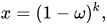 however small the quantity may be, as long as it is not equal to zero. But notwithstanding this, in the case where is not a positive quantity, the two integrals, extended from to the same limit do not converge to equality, but rather their difference grows infinitely as becomes infinitely small. This example shows how much circumspection is needed in dealing with infinite quantities, which in our analytic reasoning are only to be admitted insofar as they can be reduced to the theory of limits.
By setting  it is clear that formula 77 can also be expressed as
|
|
 from from  to to 
|
| [78]
|
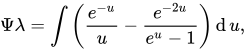 from from  to to
|
(Thus by setting  the value of in art. 28 becomes
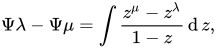
Furthermore, it is clear from formula 77 that
| [79]
|
 from to from to
|
where not only but also  must be a positive quantity.
In the same formula 77, if we set  where denotes a positive quantity, we get
and since, for a positive value of we likewise have

it is clear that

or equivalently,

with all of these integrals being extended from to  However, by setting
  the latter integral can be evaluated "indefinitely"; namely, it is
  if it is to vanish for
  therefore, since for
  we must set
  the integral becomes
 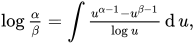 from to
  a theorem which was formerly deduced by the illustrious Euler using other methods.
- ↑ If we introduce logarithms for the quantities themselves, this elimination need only be applied to linear equations.
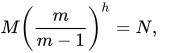
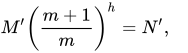
- ↑ Since this value differs from the one computed by the renowned Mascheroni in the Notes to Euler's Calculus of Integration, I have encouraged Friedrich Bernhard Gottfried Nicolai, a young man indefatigable in computation, to recalculate it and extend it further. Thus, through double calculation, descending from
 and
and  he found

Credit is also owed to this very skilled calculator for the table appended to the end of this section, which presents the values of the function to 18 figures (the last of which is uncertain) for all values of from to at each hundredth. However, the methods by which both tables were constructed rely partly on the theorems presented here and partly on specific computational techniques, which I will address on another occasion.
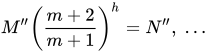
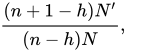
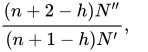
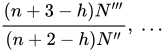
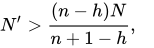
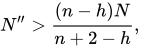
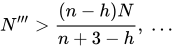
![{\displaystyle \int {\frac {\operatorname {d} x}{\sqrt[{5}]{(1-x^{5})}}}=C,\quad }](./_assets_/eb734a37dd21ce173a46342d1cc64c92/7b5fcac6a72640421f5fe5f276caad4c4659d062.svg)
![{\displaystyle \int {\frac {\operatorname {d} x}{\sqrt[{5}]{(1-x^{5})^{2}}}}=D,\quad }](./_assets_/eb734a37dd21ce173a46342d1cc64c92/5ea4fbfb0aec2cc399ca3c6cf12b9edf47420ab9.svg)
![{\displaystyle \int {\frac {\operatorname {d} x}{\sqrt[{5}]{(1-x^{5})^{3}}}}=E,\quad }](./_assets_/eb734a37dd21ce173a46342d1cc64c92/17ca4f6a9d3feceb3e3f5f26f240c3432d1e8fd8.svg)
![{\displaystyle \int {\frac {\operatorname {d} x}{\sqrt[{5}]{(1-x^{5})^{4}}}}=F,}](./_assets_/eb734a37dd21ce173a46342d1cc64c92/f6c4e2e4a9af1aed76bfb3e85494ed7440a056d0.svg)

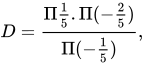
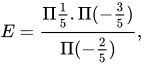
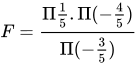
![{\displaystyle \Pi (-{\tfrac {1}{5}})={\sqrt[{5}]{\frac {5C^{4}}{DEF}}},\quad }](./_assets_/eb734a37dd21ce173a46342d1cc64c92/18d0a976aef2f3d1eff660d0ab8c2752d6d5bdff.svg)
![{\displaystyle \Pi (-{\tfrac {2}{5}})={\sqrt[{5}]{\frac {25C^{3}D^{3}}{EEFF}}},\quad }](./_assets_/eb734a37dd21ce173a46342d1cc64c92/5e8284241b512ca780e5b10ec5f089aec58b8f50.svg)
![{\displaystyle \Pi (-{\tfrac {3}{5}})={\sqrt[{5}]{\frac {125CCDDEE}{F^{3}}}},\quad }](./_assets_/eb734a37dd21ce173a46342d1cc64c92/66088428249bb117312003f39c8561cffc334f66.svg)
![{\displaystyle \Pi (-{\tfrac {4}{5}})={\sqrt[{5}]{625CDEF}}}](./_assets_/eb734a37dd21ce173a46342d1cc64c92/b89268be45d1df1af0be5c4865f95b4cf3bcd7af.svg)