On Congruences of the First Degree
Article 13
Preliminary theorems about prime numbers, factorizations, etc.
Theorem. The product of two positive numbers, each of which is smaller than a given prime, cannot be divisible by this prime.
Let  be the prime, and let
  be a positive number
  then it is not possible to find a number
  smaller than
  such that
Proof. If anyone denies it, let us suppose that numbers 
 etc. are given, all of which are less than such that
 etc. Let
  be the smallest of these, so that all numbers smaller than are deprived of this property. Clearly
  for if
  then we would have
  so
so  would not be divisible by
  Now, as a prime number, cannot be divisible by and must instead fall between two multiples of
  and
and  Let
Let 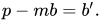 Then
Then  will be positive and
  Since we have assumed it is also true that
  (Art. 7), and hence subtracting from
  we will have
  ; i.e. is included among the numbers etc., even though was supposed to be the smallest of them. Q.E.A.
Article 14
If neither nor is divisible by a given prime number then the product will also not be divisible by .
Let  and
and  be the minimal positive residues of the numbers and modulo By hypothesis, neither of these will be zero. Now, if it were true that then since
  it would also be true that
  But this is impossible, by the previous theorem.
The proof of this theorem has already been given by Euclid, Elements, vii, 32. However, we did not want to omit it, both because several modern authors have presented vague reasoning instead of a proof, or have neglected this theorem; and also because the nature of the method used here, which we will later apply to much more difficult problems, can be more easily understood from a simpler case.
Article 15
If none of the numbers  is divisible by the prime number then the product
  etc. will also not be divisible by .
According to the previous article, is not divisible by so the same is true for  hence also for
  etc.
etc.
Article 16
Theorem. A composite number can only be resolved into prime factors in one way.
Proof. It is evident from first principles that any number can always be decomposed into prime factors; but it is often tacitly assumed that this decomposition is only possible in one way. Let us imagine a composite number  etc., where
 etc. are unequal prime numbers, and suppose that
  can be resolved into prime factors in yet another way. It is first of all clear that in this second system of factors, primes other than etc. cannot enter, since these are the only primes which divide
  . Similarly, none of the prime numbers etc. can be missing, because if that were the case, the missing primes would not divide (Art. 15); thus the two factorizations can only differ insofar as a prime is repeated more times in one than in the other. Let be a prime number, which is repeated
  times in one system and
  times in the other, with
  . Now let the factor be removed from each system times, so that it remains in one system
  times, and has disappeared from the other. Then the number
  has two different factorizations, one of which is completely free of the factor , while the other still contains it times, contrary to what we have just shown.
Article 17
Therefore, if a composite number is the product of 

 etc., then it is clear that the numbers etc. cannot have prime factors different from those of
  and that each of these factors must occur as many times altogether in the numbers etc. as it does in
  From this, one obtains a criterion to determine whether one number
  divides another number This will happen if does not involve any prime more times than
  if this condition is not satisfied, then will not divide
With the help of the calculus of combinations, it is easy to see that if etc., where as above etc. denote distinct prime numbers, then has

distinct divisors, including  and
and
Article 18
It is therefore clear that if etc.,  etc., and if the primes etc.,
 etc. are all distinct from one another, then and
  will have no common divisor other than
  or in other words they will be relatively prime.
Given several numbers  etc., their greatest common divisor is determined as follows. The numbers are resolved into their prime factors, and those that are common to all the numbers etc. are taken (if there are none, the given numbers would have no common divisor). Then one notes how many times each of these prime factors is contained in etc., or equivalently the exponents of these factor in each of the numbers etc. Then each factor is given the smallest of the exponents that it has in etc. Finally, the product of the resulting powers is computed; this will be the greatest common divisor.
On the other hand, if the least common multiple of the numbers etc. is desired, one can proceed as follows. Collect all the prime numbers that divide any of the numbers etc., and assign to each of them the largest exponent that it has in the numbers etc. The product of all these powers will be the required common multiple.
Ex. Let 

 . To find the greatest common divisor, the prime factors
  and
and  which must be assigned exponents and
  this gives the greatest common divisor
  the least common multiple will be
We omit the proofs because of their simplicity; after all, it is known how to solve these problems in an elementary way, even when the factorizations of the numbers etc. are not given.
Article 19
If the numbers etc. are relatively prime to then their product will also be relatively prime to 
Indeed, because none of the numbers etc. has prime factors in common with the product  etc. cannot have prime factors that do not belong to any of etc. Thus from the previous article, etc. will be relatively prime to
If the numbers etc. are relatively prime to each other, and  is divisible by each of them, then is also divisible by their product.
This is easily derived from Arts. 17 and 18. Let be any prime divisor of the product etc., which is repeated  times. Then it is clear that one of the numbers etc. will be divisible by
  and consequently which is divisible by this number, will also be divisible by
  . The same reasoning holds for the remaining divisors of the product etc.
Therefore, if two numbers  are congruent modulo several relatively prime moduli etc. then they will also be congruent modulo the product. Indeed, since is divisible by each of the numbers etc., it must also be divisible by their product.
Finally, if is relatively prime to and  is divisible by then will also be divisible by
  Indeed, since is divisible by and it will be divisible by their product, i.e.
  will be an integer.
Article 20
If etc., where etc. are distinct prime numbers, and is equal to a perfect power  then all of the exponents

 etc. will be divisible by
The number does not involve prime numbers other than etc. Let  be the exponent of in Then
  will contain this factor
  times, so
  and
and  is an integer. It can be shown in a similar way that
  etc. are integers.
Article 21
If etc. are relatively prime to each other, and their product etc. is a perfect power then each number etc. will also be an th power.
Let  etc., where etc. are distinct prime numbers, none of which (by hypothesis) divide any of the numbers etc. Then the product etc. will include
  as a factor
  times, as a factor
  times, etc.: hence (by the previous article)
 will all be divisible by
  and therefore
![{\displaystyle {\sqrt[{n}]{a}}=l^{\frac {\lambda }{n}}m^{\frac {\mu }{n}}p^{\frac {\pi }{n}}}](../_assets_/eb734a37dd21ce173a46342d1cc64c92/5d170effeb67d5ff4b2c683f6d105c71a8b6453f.svg)
will be an integer. The same will be true for etc.
These facts about prime numbers having been put forth, we now turn to other things which will lead us more directly to our goal.
Article 22
If the numbers and are divisible by and are congruent with respect to a modulus that is relatively prime to then  and
and  are congruent with respect to that same modulus.
It is clear that  is divisible by and also by (by hypothesis); thus
  will be divisible by (Art. 19), i.e.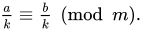
If the numbers and instead have a common divisor  then we will have
 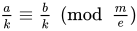 . For
. For  and
and  are relatively prime, and is divisible by and by so
  is divisible by and by and therefore by
  i.e. is divisible by
  or equivalently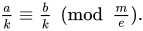
Article 23
If numbers and are relatively prime, and numbers  and
and  are incongruent modulo then
  and
and  will also be incongruent modulo .
This is a restatement of the theorem of the preceding article.
Hence it is clear that if we multiply all of the integers from  to
to  by , and reduce these products to their minimal residues modulo the resulting residues will all be distinct. Since the number of these residues is and none of them is
  it is also clear that every integer in the series from to will be found among them.
Article 24
The expression  in which and are given numbers and
  is an indeterminate or variable number, can be made congruent to any given number modulo provided that is relatively prime to
Let be the number to which it must be congruent, and let the minimal positive residue of  By the preceding article, it is possible to find a value
  such that the minimal residue of the product
  modulo is equal to
  let
let  be this value. Then
  thus
thus  Q.E.F.
Article 25
We will call any expression which takes the form of an equation, and relates two congruent quantities, a congruence; if it contains an unknown, to solve it means to find a value for this unknown which satisfies the congruence (a root). By this we understand what it means for a congruence to be solvable or unsolvable. It is easy to see that the same distinctions that apply to equations can also be applied congruences. Later we will see examples of transcendental congruences; as for algebraic congruences, they are divided according to the highest power of the unknown, into congruences of the first, second, and higher degree. One can even propose several congruences containing several unknowns, to which elimination must be applied.
Article 26
Solution of congruences of the first degree
From Art. 24 it follows that first degree congruences  are always solvable, provided that the modulus is relatively prime to In this case, let be the appropriate value for
  or the root of the congruence. Then it is clear that all numbers congruent to modulo , will also be roots (Art. 9). It is equally clear that all roots must be congruent to
  for if
  is another root, then we have
  so
so  and thus
  (Art. 22). We conclude from this that the congruence
  gives the complete solution to the congruence
Since the congruence is solved by values of which are all congruent to each other, and in this context congruent numbers must be considered equivalent, we will consider these solutions as one and the same. Therefore, since our congruence  does not admit any other solutions, we say that it can only be solved in one way or has only one root. So e.g. the congruence
  does not admit any roots other than those which are
  The situation is different for higher degree congruences, and even for first degree congruences where the coefficient of the unknown is not relatively prime to the modulus.
Article 27
It remains for us to add some details about how to solve this kind of congruence. First, observe that any congruence of the form  in which the modulus is assumed to be relatively prime to can be reduced to the congruence
  For if
  satisfies the latter, then
 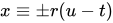 will satisfy the former. But the congruence
  , whose modulus is denoted by is equivalent to the indeterminate equation
 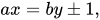 whose solution is known; therefore it will be sufficient for us to provide an algorithm by which this calculation can be carried out.
If quantities 
 etc. depend on others
  etc. in such a way that

then for the sake of brevity we write[1]
![{\displaystyle A=[\alpha ],\;\;B=[\alpha ,\beta ],\;\;C=[\alpha ,\beta ,\gamma ],\;\;D=[\alpha ,\beta ,\gamma ,\delta ]{\text{ etc.}}}](../_assets_/eb734a37dd21ce173a46342d1cc64c92/abda84770c7f58643d3f86b32dfa6c2e704419d7.svg)
Now, consider the equation where and are positive. Suppose, as is permitted, that is not less than Then, according to the well-known algorithm for finding the greatest common divisor of two numbers, the following equations will be formed by division,

so that etc. are positive integers, and  etc. are continually decreasing, until we reach
 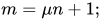 which must always happen. Then we will have
![{\displaystyle a=[n,\mu ,\dots \gamma ,\beta ,\alpha ],\quad b=[n,\mu ,\dots \gamma ,\beta ]}](../_assets_/eb734a37dd21ce173a46342d1cc64c92/680302162bd230796bdf5606c4b6d90e41329214.svg)
Setting
![{\displaystyle x=[\mu ,\dots \gamma ,\beta ],\quad y=[\mu ,\dots \gamma ,\beta ,\alpha ]}](../_assets_/eb734a37dd21ce173a46342d1cc64c92/658e7060ab212d1ca201f4218258d47b37eecd00.svg)
we will have 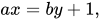 when the number of quantities
  is even, and
 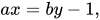 when it is odd.
Article 28
The general solution of these equations was first given by Euler, Comment. de Petersb. T. VII, p. 46. The method he used consists of substituting other unknowns in place of and  and it is indeed well known. Lagrange treated the problem in a slightly different manner. He observed that if one decomposes the fraction
  into a continued fraction
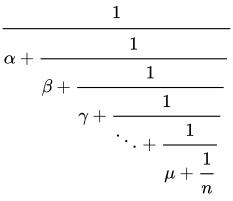
then after erasing the last part  it reduces to an ordinary fraction
  and one has so long as and are relatively prime. In fact, the two methods lead to the same algorithm. Lagrange’s investigations can be found in the Histoire de l’Académie de Berlin, Année 1767, p. 175, and along with others in Supplementis versioni gallicae Algebrea Eulerianae adiectis.
Article 29
The congruence in which the modulus is not relatively prime to is easily reduced to the previous case. Let be the modulus and let be the greatest common divisor of and  It is first of all clear that any value of which satisfies the proposed congruence modulo will also satisfy it modulo (Art. 5). But since divides we always have
  Therefore, we must have
  i.e.
i.e.  must be divisible by
  in order for the congruence to be solvable.
Let us therefore set 

 so that and will be relatively prime. Then the proposed congruence
  will be equivalent to
  i.e. any value of that satisfies the second one will also satisfy the first one, and vice versa. For it is clear that
  will be divisible by whenever
  is divisible by
  and vice versa. But we have already seen how to solve the congruence hence it is clear that if
  is one of the values of then
  gives the complete solution of the proposed congruence.
Article 30
When the modulus is composite, it is often advantageous to use the following method:
Let the modulus  and let the proposed congruence
  First solve the congruence modulo and suppose that it is satisfied for
  where is the greatest common divisor of the numbers and Now it is evident that any value of which satisfies the congruence
  will also satisfy the congruence
  and thus it will be included in the form
  where
where  denotes an undetermined number. However, not all numbers of this form will satisfy the congruence modulo
  Rather, the values of must be chosen in such a way that is a root of the congruence
  hence we will have
  or equivalently
  It follows from this that the solution of any congruence of the first degree modulo
  can be reduced to the solution of two congruences, one modulo and the other modulo It is easy to see that if is the product of two factors, the solution of the congruence modulo depends on the solution of two congruences with these factors as moduli; and generally, the resolution of a congruence modulo any composite modulus depends on the resolution of other congruences, whose moduli are the factors of the first one, and these moduli can always be chosen to be prime numbers, if it seems convenient.
Ex. consider the congruence  if we first solve it modulo
  we get
  By setting
  we get
  or
or  Solving this modulo we get
  and setting
  we get
  or
or  Solving this modulo
  gives
gives  and substituting
  we have
  or
or  From this it follows that
  and thus
  from which we have
  therefore
  is the complete solution of the proposed congruence.
Article 31
In the same way that the root of the equation  is expressed by
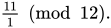
  we will also denote the root of the congruence
  by including the modulus of the congruence for the sake of clarity. So e.g.
 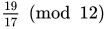 represents an arbitrary number which is
  .[2] It is generally clear from the above that
  does not have a real meaning in the case where and have a common divisor that does not divide (or, if one prefers, it is imaginary). However, except in this case, the expression will always have real values, and indeed infinitely many, which will all be congruent modulo when is relatively prime to , or more generally modulo
  where is the greatest common divisor of and
These expressions have almost the same arithmetic as ordinary fractions. Here we add some properties that can be easily deduced from what we have already shown:
- If
 and
and  modulo then the expressions
  and
and  are equivalent.
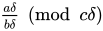 and are equivalent.
 and are equivalent if is relatively prime to
Many other similar propositions might be added here: but as they are not difficult, and unnecessary for what follows, we now move on to other things.
Article 32
On finding numbers congruent to given residues with respect to given moduli
A problem which will be of great use in what follows is to find all the numbers which form given remainders according to several given moduli. It is easy to solve this from what has already been presented. Let and be two given moduli, and let us seek a number  which is congruent to the numbers and with respect to these moduli, respectively. Then all values of will necessarily be contained in the form
  where is undetermined, but also satisfies
  If the greatest common divisor of and is , then the complete solution of this congruence will take the form
 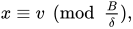 or equivalently
  where is an undetermined integer; thus the form
 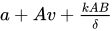 contains all values of
  i.e. the complete solution of the problem will be
  Now if there were a third modulus relative to which the number must be
  then it is clear how to proceed in the same way, since the two original conditions have already been merged into one. Namely, letting
  be the greatest common divisor of the numbers
  and we will obtain the congruence
  which can be solved by a congruence of the form
 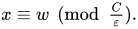 Then the problem will be solved by the congruence
  One can proceed in the same way, regardless of the number of moduli. It is worth noting that and
  are the least numbers divisible by and by respectively. Thus one easily deduces, regardless of the number of moduli etc., that if
  denotes the smallest number divisible by all of them, then the complete solution will be of the form
  Moreover, if one of the congruences is not solvable, it must be concluded that the problem is impossible. However, it is evident that this cannot happen if the numbers
  etc. are all relatively prime to each other.
Ex. Let 


 . Here the first two conditions,
  and
and  can be reduced to a single condition
  Combining this with the third condition,
  one obtains
Article 33
When the numbers etc. are all relatively prime to each other, their product is the smallest number divisible by each of them; and in this case it is obvious that the congruences 
 etc. together will be equivalent to a single congruence
  where
where  denotes the product of the numbers etc. Conversely, it follows from this that a single condition
  can be decomposed into several; namely, if is decomposed into several mutually relatively prime factors etc., then the combined conditions

 etc. will be equivalent to the original one. This observation gives us not only the means to discover an impossibility when it exists, but also a more convenient and elegant method of calculation.
Article 34
Let the conditions proposed above be 
 . Resolve all of the moduli into mutually relatively prime factors, into
  etc.; into
  etc. etc., so that the numbers
 etc.
etc. 
 etc. etc. are either primes or powers of primes. Of course, if one of the numbers is already prime itself, or a power of a prime number, then it need not be resolved into factors. Then it is clear from the above that, in place of the proposed conditions, one can substitute

 etc.,
etc., 
 etc. etc. Now, unless all the numbers etc. are mutually prime, e.g. if and are not relatively prime, then it is clear that the prime divisors of and cannot all be different, and one of the divisors
 etc. must find its equal, its multiple, or its submultiple among the divisors
  etc. In the first case, if
  , then the conditions must be identical, or equivalently
  then one or the other of these two conditions can be rejected. On the other hand, if
  does not hold, the problem is impossible. In the second case, if
  is a multiple of then the condition
  must be contained in or in other words it can be used to deduce
  Under these conditions, the condition can be rejected, if it does not contradict the other one (in which case the problem would be impossible). When all the superfluous conditions are thus rejected, it is clear that all the remaining moduli are mutually prime; one is then sure of the possibility of the problem, and one can proceed according to the method given above.
Article 35
If as above we set  and
and  then these conditions can be reduced to the following:




 From these conditions, we can reject
  and
and  since the former is contained in the condition and the latter is equivalent to
  we are then left with
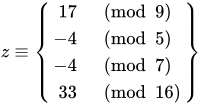
from which we obtain

Now, it is clear that it would often be more convenient if, of the remaining conditions, those which had been derived from one and the same condition were combined into a single condition. This can be done easily; e.g. when some of the conditions  etc. have been rejected, the rest can be restored as
  with respect to the modulus formed by the product of the remaining moduli. Thus in our example the condition
  can be recovered from the conditions
  and
and  Now, it does make some difference which of the superfluous conditions are rejected, as far as the brevity of the calculation is concerned. But this is not the place to discuss these details or other practical tricks, which are learned from practice much more easily than from precepts.
Article 36
When the moduli etc. are mutually relatively prime, it is often preferable to use the following method. Let be a number which is congruent to unity modulo and which is divisible by the product of the other moduli; that is, will be any value (the minimum is generally best) of the expression  multiplied by
  etc. (see Art. 32); similarly, let
  and
and 
 and
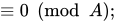
and  etc. Then to find a number which is congruent to the numbers etc. modulo etc. respectively, we can set

Then we clearly have  and the other terms are
  hence
hence  The demonstration is the same for the other moduli. This solution is preferable to the first one when solving several problems of the same kind, for which the values of etc. are the same; for then the values of
  etc. remain constant. This can be applied to the chronological problem in which we must find the Julian year which has a given indiction, the golden number, and the solar cycle. Here

 thus the value of the expression
 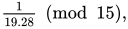 or
or 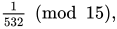 is
is  and we have
  Similarly, we find
  hence the desired number will be the minimal residue of the number
  where denotes the indiction, the golden number, and the solar cycle.
Article 37
Linear congruences involving several unknowns
Enough has been said about congruences of the first degree which contain only one unknown. It remains to deal with congruences that involve several unknowns, but since it would be too extensive to present everything rigorously in this chapter, and our goal is not to exhaust the subject here, but only to present what is most worthy of attention, we will limit our discussion to a few observations, reserving the complete exposition for another occasion.
1. Just as for equations, it can be seen that there must be as many congruences as there are unknowns for a solution to determined.
2. Let the following congruences be proposed

and assume that the number of these congruences is the same as the number of unknowns etc.
Then determine numbers 

 etc. so that
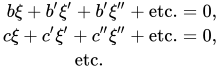
and so that these numbers are integers with no common divisor (which is always possible, by the theory of linear equations).
In a similar way, determine 

 etc.,
etc., 

 etc. etc. so that
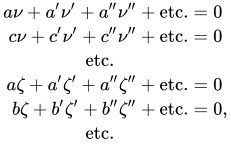
3. It is clear that if we multiply the congruences etc. first by etc. and then by etc. etc. and add them, we will obtain the following:

For the sake of brevity, we will write these congruences as

4. There are now several cases to distinguish.
First, when the coefficients of the unknowns, 
 etc. are all relatively prime to the modulus , the above congruences can be solved by the methods already presented, and the complete solution of the problem will be given by congruences of the form
 etc.[3]. E.g. if we propose the congruences

we will find 

 hence
hence  and therefore
  likewise, we will find
 and hence

5. Second, If the coefficients etc. are not all relatively prime to the modulus, let etc. be the greatest common divisors of and 
 etc. respectively. Then it is clear that the problem is impossible unless the numbers

 etc. are divisible by etc. respectively. On the other hand, when these conditions hold, the problem will be completely solved by congruences of the form
  etc., or if you prefer, there will be different values for (i.e. the values
  which are incongruent modulo ), values for etc. that will satisfy the congruences. Clearly, all solutions to the problem, if there are any, must be found among those we have just indicated. However, it is not allowed to reverse this conclusion; for in general it is not true that all combinations of the values of with those of
  and those of etc. will satisfy the problem, but only some of them whose connection must be expressed by means of one or more conditional congruences. However, since the complete solution of this problem is not necessary for the following, we will not go any further on this subject and content ourselves to give the idea with an example.
Let the following congruences be proposed:

Then we will have
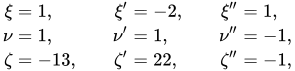
hence 

 From this we obtain four values of namely,


 one value of namely
  and four values of namely,
  To find out which combinations of the values of and are permissible, substitute

 for in the given congruences. After this, they become

which are easily seen to be equivalent to

The first congruence clearly requires that  and the rest will clearly be satisfies if this value is substituted in them. We conclude from this that the values
  (which are obtained by successively setting
  ) must be combined respectively with the values


 so there are four solutions altogether,
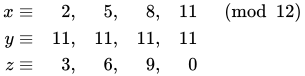
To these investigations, which complete the task we had set ourselves in this section, we will add some propositions based on similar principles, which will be needed frequently in what follows.
Article 38
Various theorems
Problem. Determine how many numbers are less than and relatively prime to a given positive number
For the sake of brevity, let us denote the number we seek by the prefixed symbol  . So, the problem is to find
I. When is prime, it is clear that all numbers from to  are relatively prime to therefore, in this case, we have

II. When is a power of a prime number say  then all numbers divisible by will not be prime with and the others will be. Therefore, of the
  numbers, we must reject


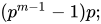 so there remain
  Hence
Hence

III. The other cases can be easily reduced to these, by means of the following proposition: If we factor into factors 

 etc. which are all relatively prime to each other, then

which can demonstrated as follows. Let 
 etc. be the numbers which are less than and relatively prime to , whose multitude is therefore
  . Similarly, let the numbers less than and relatively prime to
  etc. be
 etc.;
etc.; 
 etc. etc., whose multitudes are
 etc. It is clear that any number relatively prime to will also be relatively prime to the factors etc. and vice versa (Art. 19). Furthermore, all numbers that are congruent to one of the numbers etc. modulo will be relatively prime to and the same applies for etc. The question is therefore reduced to determining how many numbers are less than and congruent to one of the numbers etc. modulo to one of the numbers etc. modulo
  , etc. However, it follows from Art. 32 that all numbers with given residues modulo etc. must be congruent modulo the product and therefore there can only be one number less than which is congruent to the given residues modulo etc. Therefore, the number we seek will be equal to the number of combinations of the individual numbers etc. with the individual numbers etc. and etc. etc. It is evident from the theory of combinations that this number is
  etc. Q.E.D.
IV. It is easy to see how to apply this proposition in the case at hand. We will decompose into prime factors; that is, we will reduce it to the form  etc., with etc. being distinct prime numbers. Then we will have

which can be put in the more elegant form

Example: Take  Then we have
  The numbers which are less than and relatively prime to
  are
are 


The first solution of this problem can be found in Euler’s commentary, Theoremata arithmetica nova methodo demonstrata, Comm. nov. Ac. Petrop. VIII p. 74. A demonstration was also provided in another dissertation Speculationes circa quasdam insignes proprietates numerorum Acta Petrop. VIII, p. 17.
Article 39
If the meaning of the symbol is determined in such a way that  expresses how many numbers are relatively prime to and not greater than then we will have
  instead of
  However, in all other cases, nothing will change. Adopting this definition, we have the following theorem:
If 
 etc. are all of the divisors of including 1 and then

Ex. If  we have

Proof. If we multiply all numbers coprime with and not greater than by  and similarly all numbers coprime with
  by
by  etc., then we will have
  etc. numbers, all of which are not greater than However,
- All of these numbers will be distinct. Indeed, it is clear that those coming from the same divisor of are all distinct. On the other hand, if two equal numbers resulted from different divisors and and from numbers and respectively, that is, if
 then we would have
  Assuming that
  (which is allowed), then since is relatively prime to and divides
  it would follow that the larger number divides the smaller number Q.E.A.
- Among these numbers, we will find all of those which make up the sequence
 Indeed, let be any number that does not exceed and let be the greatest common divisor of and
  Then
Then  will be a divisor of which is relatively prime to
  . Then clearly the number will be among those that were produced by the divisor .
- It follows from this that the multitude of these numbers is and hence
 Q.E.D.
Article 40
If is the greatest common divisor of the numbers etc., then numbers etc. can be determined so that

Let us first consider only two numbers and and let be their greatest common divisor. Then the congruence  will be solvable (Art. 30). Let the root be
  and set
  Then we will have
  as desired.
If there is a third number let  be the greatest common divisor of and
  Note that will also be the greatest common divisor of the three numbers .[4] Then let numbers and be determined so that
 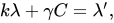 and we will have
If there is a fourth number let  be the greatest common divisor of and (which, it is easily seen, will also be the greatest common divisor of the four numbers and ). Then let
  and we will have
We would proceed in a similar way if there were more numbers.
In particular, if the numbers etc. have no common divisor, then it is clear that we can find etc. so that

Article 41
If is a prime number, and if there are objects among which any number may be equal (provided that they are not all equal), then the number of permutations of these objects will be divisible by
For example, five objects  can be arranged in ten different ways.
The demonstration of this theorem is easily deduced from the well-known theory of permutations. Indeed, suppose that, among these things, there are equal to equal to equal to etc. (where the numbers  can also represent unity), so that we have

Then the number of permutations will be

It is clear that the numerator of this fraction is divisible by the denominator, since the number of permutations is an integer: but the numerator is divisible by whereas the denominator, which is composed of factors smaller than is not divisible by (Art. 15). Therefore, the number of permutations will be divisible by (Art. 19).
That being said, we hope that the following demonstration will not be unwelcome.
When in two permutations the order of the objects only differs in that the item which occupied the first place in one, now occupies a different one in the other, while the other objects, starting from that one, follow the same order in each of the permutations, so that the last item in one is immediately before the first item in the other. Then we will call them similar permutations[5]. So, for example, the permutations  and
and  will be similar, since the things which in the former occupy the first place, second place, etc. occupy the third place, fourth place, etc. in the latter.
Now, as each permutation consists of objects, it is clear that one can find  similar permutations, if one puts successively at the second place, third place, etc. the item which occupied the first place. Therefore, if none of these similar permutations are identical, it is evident that the total number of permutations will be equal to times the number of dissimilar permutations, and consequently will be divisible by Let us suppose, then, that two similar permutations

one of which has arisen from the other by the promotion of terms, are identical, in the sense that  etc. Suppose that the term
  which occupies the first place in the first permutation, occupies the
  in the second. Then in the latter series, the term will be equal to the first, the
  will be equal to the second, etc., from which it follows that the
  will again be equal to the first, and likewise for the
  and in general the
  will be equal to the
  (where, when
  it is necessary to imagine that either the series
  is repeated from the beginning, or that we subtract a multiple of from
  ). Therefore, if we determine in such a way that
  which can always be done since is prime, it will follow that generally the
  term will be equal to the
  i.e. all the terms will be equal to each other, contrary to the hypothesis.
Article 42
If the coefficients 
 of two functions of the form

are all rational, but not all integers, and their product is

then the coefficients 
 cannot all be integers.
Indeed, let us simplify to their simplest form all fractions that may be found among the numbers etc. etc., and choose a prime number that divides one or more of the denominators of these fractions. Let us assume, as we may, that divides the denominator of a fractional coefficient in  It is clear that if
  is divided by then at least one fractional coefficient in
  will have a denominator divisible by (in particular, the coefficient of the first term will be
  ). It is then easy to see that in
  there is a term whose denominator contains a power of raised to a power which is greater than in all of the preceding terms, and not less than in all of the terms which follow. Let
  be such a term, and let be the exponent of in its denominator. Let the analogous term in be
  and let the exponent of in the denominator be
  Then clearly
  will be at least
  With this in mind, the term
  of the product of and will have a fractional coefficient whose denominator contains raised to the power
  as will now be shown.
Let 
 etc. be the terms preceding in
  and let
 etc. be those which follow it. Similarly, let
 etc. be the terms preceding
  in
in  and let
 be those which follow it. Then in the product of and the coefficient of will clearly be
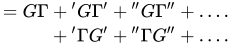
The term  will be a fraction which, when reduced to its simplest form, will have a denominator divisible by
  If the other terms are fractional, then their denominators will contain only powers of less than
  since each of them is the product of two factors, one of which contains only a power of smaller than
  or
or  and the other a power not greater than or
  Thus will be of the form
  and the rest will be of the form
  where
where  and
and  are relatively prime to Therefore the sum of these will be
  a fraction whose numerator is not divisible by Hence this fraction cannot be reduced in any way so that its denominator contains a a power of smaller than Therefore, the coefficient of the term in the product of by will be

i.e. a fraction, whose denominator is divisible by at least the  power of Q.E.D.
Article 43
A congruence of the degree,

whose modulus is a prime number that does not divide cannot have more than solutions, or equivalently cannot have more than incongruent roots modulo (See Arts. 25, 26).
If anyone denies it, let us suppose that congruences of different degrees etc. are given, which have more than etc. roots. Let be the smallest of all of these, so that all congruences of degree lower than are consistent with our theorem. Since it has already been demonstrated above (Art. 26) that the theorem holds for congruences of the first degree, it is clear that will be  or greater. Let us therefore assume that the congruence
has at least  roots
roots 

 etc., and suppose that all of the numbers etc. are positive and less than , with the smallest being . Now let us substitute
  for in the proposed congruence, with the result being

Then it is clear that this congruence will be satisfied if we put  or
or  or
or  etc., and that all of these roots will be distinct, with their multitude being
  However, since is a root, it follows that
  is divisible by From this we obtain

a congruence that will be satisfied by substituting for any of the values 
 etc. which are all
  and
and  and therefore in these cases

will become  (Art. 22), i.e. the congruence

which is of degree  would have roots; which contradicts our theorem (for it is easy to see that
  and therefore it is not divisible by as required), even though we assumed that all congruences of a degree lower than satisfy it. Q.E.A.
Article 44
Although we have assumed here that the modulus does not divide the coefficient of the first term, the theorem is not restricted to this case. For if the first coefficient, and even some of the following ones, were divisible by then these terms could be neglected without error, and the congruence would be reduced to a lower degree, such that the coefficient of the first term would no longer be divisible by Indeed, not all coefficients can be divisible by ; in this case the congruence would be an identity, and the unknown would be completely indeterminate.
Lagrange was the first to propose and prove the theorem (Mem. de l'Ac de Berlin, Année 1768 p.192). It is also found in Legendre’s dissertation, Recherches d’Analyse indéterminée, Hist. de l'Acad. de Paris 1785 p. 466). Euler proved, in Nouveaux Commentaires Académiques. Pétersb. XVIII, p. 93, that the congruence  could not have more than roots. Although this is only a particular case, his method can easily be applied to all congruences. He had already dealt with a still more limited case, Comm. nov. Ac. Petr. V. p. 6, but this method cannot be used in general. In Section VIII below, we will demonstrate this theorem in yet another way; but no matter how different all these methods may seem at first glance, experts who wish to compare them will easily verify that they all originate from the same principle. Furthermore, this theorem should only be considered here as a lemma, and the complete exposition does not belong to this section, so we will treat the case of a composite modulus elsewhere.
- ↑ This relationship of quantities can be considered in a much more general manner, and we may do so on another occasion. Here we will add only two propositions, which find their application in the present question, namely:
- 1.
![{\textstyle [\alpha ,\beta ,\gamma ,\dots \lambda ,\mu ].[\beta ,\gamma ,\dots \lambda ]-[\alpha ,\beta ,\gamma ,\dots \lambda ].[\beta ,\gamma ,\dots \lambda ,\mu ]=\pm 1;}](../_assets_/eb734a37dd21ce173a46342d1cc64c92/a34927c90404be11e4280057d215080136779d4f.svg)
where the upper sign will be taken when the number of quantities is even, and the lower sign otherwise.
- 2. The order of the quantities
 can be reversed, so that
 ![{\textstyle [\alpha ,\beta ,\gamma ,\dots \lambda ,\mu ]=[\mu ,\lambda ,\dots \gamma ,\beta ,\alpha ]}](../_assets_/eb734a37dd21ce173a46342d1cc64c92/6a61020e9e4bae7fc6698f3549105c52e84d4359.svg)
We omit the demonstrations, which are not difficult.
- ↑ This could just as well be denoted by
- ↑ It should be noted that this conclusion lacks a demonstration, which we omit here. Strictly speaking, nothing follows from our analysis other than that the proposed congruences cannot be solved by other values of etc. but not necessarily that these values satisfy the congruences; it is even possible that there may be no solution. The same fallacy arises in solving linear equations.
- ↑ It is clear that divides each of the numbers If it were not the greatest common divisor of then there would be one greater than
 However, this one would divide
  , i.e.
  Q.E.A. This can still more easily be deduced from Art. 18
- ↑ If one were to write the similar permutations in a circle, in such a way that the last item is adjacent to the first, then there would be no difference between them, because no place could be called the first or the last