Tochio's Computation on the Soroban/Multiplication
MULTIPLICATION.
The table is omitted being too well known.
Note.—In the East, the following table is in use, in which, you will observe, same product is all omitted:—
| × | 1 | 2 | 3 | 4 | 5 | 6 | 7 | 8 | 9 |
| 1 | 1 | 2 | 3 | 4 | 5 | 6 | 7 | 8 | 9 |
| 2 | 4 | 6 | 8 | 10 | 12 | 14 | 16 | 18 | |
| 3 | 9 | 12 | 15 | 18 | 21 | 24 | 27 | ||
| 4 | 16 | 20 | 24 | 28 | 32 | 36 | |||
| 5 | 25 | 30 | 35 | 40 | 45 | ||||
| 6 | 36 | 42 | 48 | 54 | |||||
| 7 | 49 | 56 | 63 | ||||||
| 8 | 64 | 72 | |||||||
| 9 | 81 |
Left-hand figure × top figure = product.
| 1 × 1 = 1. | 1 × 2 = 2, | 2 × 2 = 4 etc. |
Rule:— Place multiplicand on the right and multiplier on the left. Multiply each column of the multiplicand with the multiplier, commencing from the last column of the multiplicand.
Multiply 564 by 3.
Fig. 9.

Place the multiplicand on the right and the multiplier on the left, as in the figure. Operation begins from the last column of the multiplicand; 4 × 3 are 12—C column is cleared and 1 is put in C and 2 in c', thus showing 12. Next, 6 in B column is cleared; 6 × 3 are 18—clear the column and B column gets 1 and C 8, thereby making C column 9. Now, 5 in A column is cleared; 5 × 3 are 15—clear the A column and put 1 in A and 5 in B column which now becomes 6. The result is 1692.
Multiply 862 by 15.
Fig. 10.

Place the multiplicand and multiplier as in the former figure. Multiply 2 hy the last column of the multiplier and you get 10, but, different from the 1-digit multiplication, you have to fill in the number one column lower, i.e. 1 in the C column and 0 in the C" column. Next, multiply 2 with the tens column of the multiplier; 2 × 1 are 2—that number is filled in the C' column, which becomes now 3, clearing at the same time 2 off the column C. Next, 6 in B column is multiplied with the last column of the multiplier; and obtaining 30, 3 is put in C column; and multiplying 6 by 1, 6 is obtained which is filled in C column, clearing B column simultaneously. The same process is repeated with 8 in A column. The figure that now stands in the Soroban is the required result, 12930.
To make the matter more clear to the learner and to show certain possible circumstances with multiplication of larger numbers, one more example is given below:—
Multiply 798 by 893.
Fig. 11.

As the multiplier consists of 3 columns, the sub-partial result, 8 × 3 are 24, is put in the columns C" and C''', and 8 × 9 are 72 is put in columns C' & C", and lastly, clearing the C column, 8 × 8 are 64, is filled in columns C & C'. At this stage, the Soroban will stand as in Fig. 12.
Fig. 12.

Now, to multiply B column with the multiplier. 9 × 3 are 27, is filled in the columns C' & C" prime prime making the columns 4 and 1 respectively. 9 × 9 are 81, then is to be filled in the columns C & C'. But, to fill 8 in the C column, you have to take 2 off the column and carry i forward into the column B. However, 9 in B has yet to be multiplied with the first column of the multiplier. In such circumstance,[1] take 2 off the C column, making C & C' 5 & 5 respectively, and, meantime, reserve the 1 to go into the B column and proceed filling 9 × 8 are 72 in B & C. thereby making the respective columns 7 & 7. And then, the 1 reserved is added to the B column, which now shows 8. The Soroban at this stage will stand as in Fig. 13.
Fig. 13.
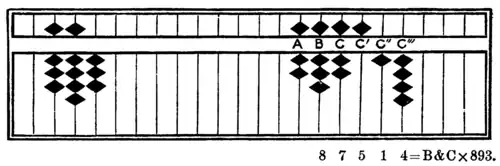
Proceeding with the A column in similar manner, we arrive at the result 712614. From the foregoing examples, you will observe:
Rule 3.—Multiplication.—Multiply each column of the multiplicand individually commencing from the last with the multiplier, placing the partial product as many places to the right of the original column as the columns of the multiplier. In so doing, the multiplier is multiplied from the last.
Rule 4.—In multiplication the unit descends in the result as many columns as in the multiplier.
Remarks.—For beginners, it will be advisable to make a pencil mark on the beam or to apply tip of a finger at the lower edge of soroban before operation, to indicate the unit of the result, especially when multiplier and/or multiplicand is followed by a cipher or ciphers,
The above remark applies also to Division.
- ↑ Shwampan, or soroban, used in China, is provided with extra 5-piecев to meet such an emergency, but practically they are unnecessary, as they do not answer the purpose in certain circumstances.