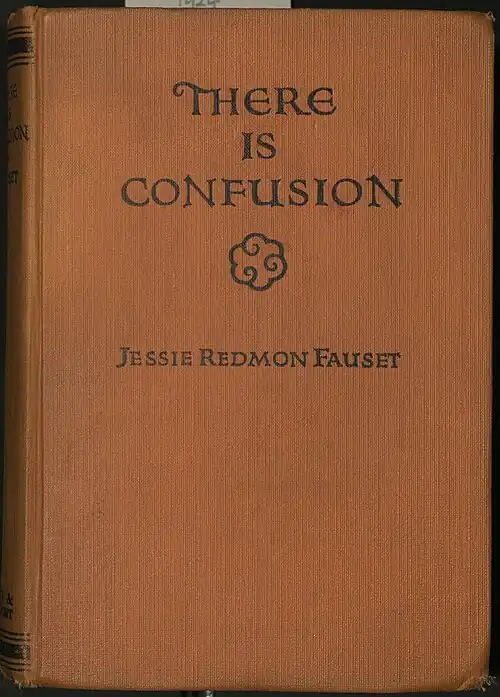
There Is Confusion

There Is Confusion
THERE IS CONFUSION
BY
JESSIE REDMON FAUSET

BONI and LIVERIGHT
PublishersNew York::::
1924
Copyright, 1924, by
Boni & Liveright, Inc.
Printed in the United States of America
First Printing, March, 1924
Second Printing, May, 1924
Third Printing, August, 1924
To my sister
Helen Fauset Lanning
Whose persistent faith has made me
ashamed to falter
There Is Confusion
Chapters (not listed in original)
- Chapter 1
- Chapter 2
- Chapter 3
- Chapter 4
- Chapter 5
- Chapter 6
- Chapter 7
- Chapter 8
- Chapter 9
- Chapter 10
- Chapter 11
- Chapter 12
- Chapter 13
- Chapter 14
- Chapter 15
- Chapter 16
- Chapter 17
- Chapter 18
- Chapter 19
- Chapter 20
- Chapter 21
- Chapter 22
- Chapter 23
- Chapter 24
- Chapter 25
- Chapter 26
- Chapter 27
- Chapter 28
- Chapter 29
- Chapter 30
- Chapter 31
- Chapter 32
- Chapter 33
- Chapter 34
- Chapter 35
- Chapter 36
[Dust jacket]
THERE IS CONFUSION
THERE IS CONFUSION is a novel about the educated Negro of the North. The world of this absorbing story is the new society that is growing up among the Northern Negroes; the society that is fulfilling the belief of sociologists that the solution of our colored problem lies in the development of a milieu which, self-contained, parallels the life of the white Americans. In the place of sentimentality and darky humor, THERE IS CONFUSION, through its intensely dramatic story of a highly spirited young colored woman and her circle, gives us the realities of this life, utterly unknown to the great mass of educated, posted readers.
Jessie Redmon Fauset
$2.00
JESSIE REDMON FAUSET is one of the eager, intelligent personalities who are evolving an independent, forceful culture in Negro life, particularly in Northern cities. She is a university graduate, holder of a Phi Beta Kappa key and has been engaged in important social service activities. Other writings of hers have appeared and have won acclaim. THERE IS CONFUSION is not only her first novel, but it is also the first strikingly realistic, creative expression from her race, and by all odds the first book from any source to make concrete the newly organizing facets of Negro life in this country.
"CANE is a volume depicting what one is convinced are the real negroes of the South. The stories possess a sweep of emotional power saturated with a moist lyric beauty that positively sings. The heavy, langorous beauty of the book as a whole stuns the intelligence entirely, lulls it into torpor and compels it to recognize the authenticity of the racy negroes delineated. The author of CANE has created a distinct achievement wholly unlike anything of this sort done before. The book is, indeed, a spiritual chronicle of the negro."—N. Y. Tribune.
"Mr. Toomer has moments of sweeping power, and rarely loses a sense of moving tragedy or pathos. He achieves striking effects and his style and method are peculiarly suited to the subject—the negro on the plantations of Georgia and in the crowded tenements of Washington."—N. Y. Evening Post.
Zona Gale writes—
NOTHING in American letters is more dramatic than this decade's emerging of the American Negro into literary expression.
That these mililons of long-silent folk should speak in art forms is inevitable—but the moment when they do so is highly spectacular and it is so that the future will regard it.
Jessie Redmon Fauset was certain to write a good book sometime. It is significant of her own account that her first book should be such a long and careful piece of work. But it is still more important that she has chosen to approach her task in her own fashion.
Yet it must annoy her excessively to be praised for just this very thing. Why should she not write about her own people, the American Negroes, as going about their lives without central reference to any "problem" attaching to them? Though for them so much of life is spent in trying to find a normal means of living, still after all the white race and its vagaries toward them present only one set of factors in that living. Otherwise there are to them, for example, birth and death, love and youth, sacrifice, ambition, hatred, courage, business and recreation. Of action and reaction to some of these impacts and ambitions Miss Fauset's novel is made, even as yours and mine. Only that we do not always have such living people as she presents, nor do we often do such a long and painstaking piece of work.
Jessie Fauset's name has probably come into American literature to stay.

This work is in the public domain in the United States because it was published before January 1, 1930.
The longest-living author of this work died in 1961, so this work is in the public domain in countries and areas where the copyright term is the author's life plus 63 years or less. This work may be in the public domain in countries and areas with longer native copyright terms that apply the rule of the shorter term to foreign works.

Public domainPublic domainfalsefalse