The Songs of Ensign Stål/Canto 1
THE SONGS OF
ENSIGN STÅL
EARLIER COLLECTION 1848
.jpg)
CANTO FIRST.
OUR LAND.
A hymn to native land.
This apostrophe to Finland—the only non-narrative canto of the Cycle except the Björneborgers' March—is a pure lyric, portraying intense devotion to the homeland.
It met such a response in the hearts of the people that it became the National Hymn of Finland. It is played or sung on all festal occasions. Twelve or more musical settings have been given to it, the principal ones being those of Fredrick Pacius and J. A. Josephson. The poem first appeared in 1847, in a "Fosterlandskt Album."
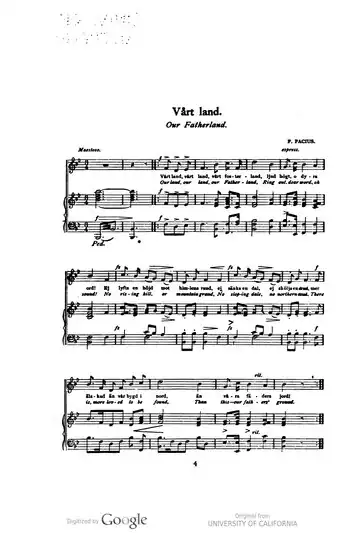
The Pacius melody was first sung at a Students' Festival in Helsingfors, in May, 1848. It is bold, angular, massive, and withal tuneful; and is adapted to solo or choral rendition. The vocal score and piano accompaniment are here submitted. I believe it exemplifies the dictum of Wordsworth, that "For the production of the full effect, an accompaniment of music is indispensable to a lyrical work."
This ode looks backward and forward. It is a memory and a hope. It is one of the few hymns of literary character, that would seem to take its place beside those of Wallin, Wesley, Heber, Cowper or Proctor.
The sincerity and simplicity of this hymn, making one inattentive to its details, might long deter the reader from noting that the poet has employed the possessive "our" twenty-three times and the adverb "here" fifteen times in its composition, without rendering the words in the least obtrusive.
I.
OUR LAND.
_(no_text).jpg)
Our land, our land, our fatherland,
Sound loud, O name of worth!
No mount that meets the heaven's band
No hidden vale, no wave-washed strand,
Is loved as is our native North,
Our own forefathers' earth.
Our land is poor; true, we reply,
For him who covets gold;
The stranger proud may pass us by,
But we our land yet glorify;
For in each crag and fell and wold
A gold-land we behold.
We love our rivers' rushing flight,
Our brooks that purl along,
Our darksome groves whose sighs unite,
Our starry night, our summer light,—
All, all that here, in scene or song,
Did to our hearts belong.
Here was our fathers' combat fought,
With mind, sword, plowshare too;
When light or darkness fortune brought,
In mournful or in joyous lot,
Yet Finland's heart beat ever true,
Bore brave the ills she knew.
Ah, who could tell the slaughter-tale,
The ills our fathers stood?
When battles roared from dale to dale,
When came the frost with hunger's wail,
Who measured all the outpoured blood
And all the fortitude?
And it was here the blood-streams flowed,
They did for us outpour;
Here oft their hearts with gladness glowed,
Here were their sighs anon bestowed,—
The hearts that once our burdeas bore
In distant days of yore.
The sweet, the good, is round us strown,
Ordained us from our birth;
Where'er by fate our lot is thrown,
A land, a fatherland, we own;
What rarer gift is found on earth
To cherish for its worth?
Around us spreads our native land,
Before the eye unrolled;
And we can outward stretch our hand
And joyful gaze o'er sea and strand,
And say: "For us these scenes unfold;—
Our fatherland behold!"
If we could dwell in splendor bright
Mid gold-clouds in the blue,
And life-long dance in starry light,
Where tears nor sighs could bring their blight,—
Yet to this land we'd turn anew,
With longing ever true.
_(no_text).jpg)
O land, of thousand lakes the band,
By song and faith so blest,
Where us life's ocean gives a strand,
Our old-time land, our future land,—
Be not of poverty distressed,
Be glad, secure, at rest.
Thy blossom, in the bud laid low,
Yet ripened shall upspring.
See! From our love once more shall grow
Thy light, thy joy, thy hope, thy glow!
And clearer yet one day shall ring
The song our land shall sing!
(Upload an image to replace this placeholder.)