The Secrets of Specialists/Chapter 3

- Frontalis,
- Facial nerve (super.).
- Corrugator supercil.
- Orbicularis palp.
- Nasal muscles,
- Zygomatici.
- Orbicularis oris.
- Facial nerve (med.),
- Masseter.
- Levator menti.
- Quadratus menti.
- Triangularis menti.
- Hypoglossal nerve.
- Factal nerve (infer.).
- Platysma myoides.
- Hyoid muscles.
- Omohyoideus
- Ext. ant. thoracic nerve (pectoralis major).
- Phrenic nerve.
- Fifth and Sixth cerv. nerves (deltoideus, biceps, brachialls, supin. longus).
- Brachial plexus.
- Long thoracic nerve (serratus magnus).
- Circumflex nerve.
- Dorsalis scapulae nerve (rhomboidei).
- Trapezius.
- Levator anguli scapulae.
- Spinal accessory nerve.
- Sterno-mastoideus.
- Splenius.
- Facial nerve (inf. branch).
- Facial nerve (med. branch).
- Tost. auricular nerve.
- Facial nerve (trunk).
- Facial nerve (sup. branch).
- Temporalis.
- Third frontal convol. and insula (centre of speech).
- As end. front and parict. convol. (motor area).
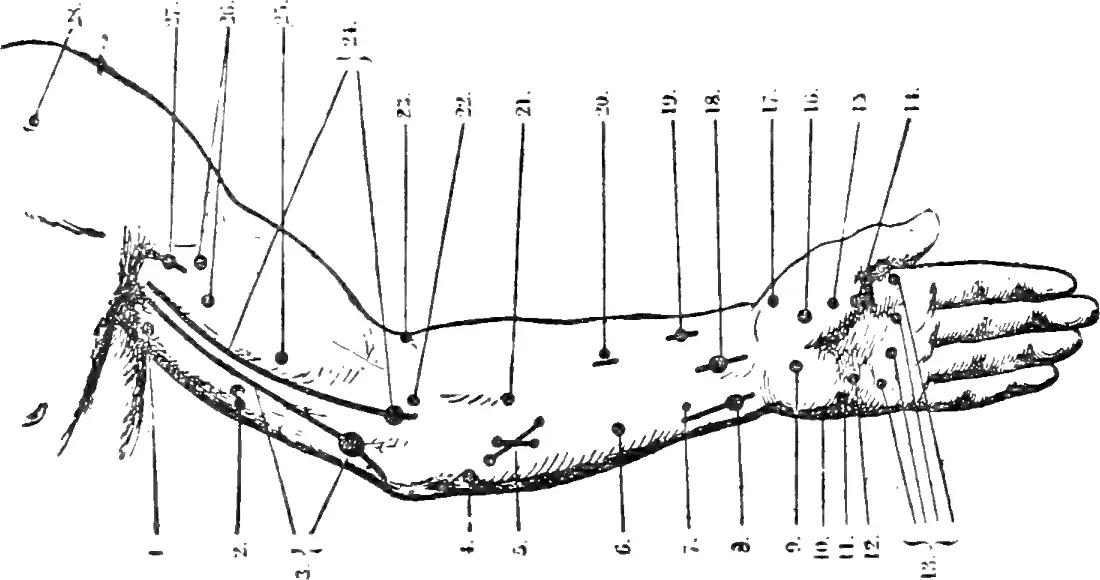
- Triceps (cap. long.).
- Triceps (cap. intern.).
- Ulnar nerve.
- Flex. carpi ulnaris.
- Flex. dig. com. prof.
- Flex. dig. (II et III) subl.
- Flex. dig. (ind. et min.) subl.
- Ulnar nerve.
- Palmaris brevis.
- Abductor dig. min.
- Flexor dig. min
- Opponens dig. min.
- Lubricales.
- Adductor poll, brev.
- Flex. poll. brev.
- Oppanens pollicis.
- Abductor pollicis,
- Median nerve.
- Flex. poll. longus.
- Flex subl. digit.
- Flex. carpí radialis.
- Pronator radii teres.
- Supinator longus.
- Median nerve.
- Brachialis anticus.
- Biceps
- Musculo-cutan. nerve.
- Deltoideus (ant. port.).
In order that the reader may form a clear conception of the nature of physiotherapy I quote the following from an editorial in the American Journal of Physiologic Therapeutics:
"The modern conception of disease regards it no longer as a concrete entity to be forcibly driven out nor as the objective clash of contending elements across the passive arena of the patient's body; but as the interplay of action and reaction between the whole organism and its environment—a dynamic affair of perverted reaction to stimulus. Under this conception of disease, it is inevitable that our conception of therapeutics should become similarly dynamic and reactionary. Rational therapy no longer aims to force action, whether of drugs or of anything else, upon the organism, but to arouse proper reaction within it, in which the whole organism must participate. This is Physiologic Therapeutics in its broadest and profoundest sense. And it calls forth, as its materia mediea, every means and agency which experience has shown certain, or reason renders likely, to bring about such desired and adequate reaction.

- Deltoideus.
- Museulo-Spiral nerve.
- Brachialls anticus.
- Supinator longus.
- Extens, carp. rad. long.
- Extens. carp. rad. brev.
- Extens. comm. digit.
- Extens. indicis,
- Ext. oss. metac, poll.
- Ext. prim. intern. poll.
- Interessei dorsal.
- Interossci dorsal.
- Abduct. min. digit!
- Ext. sec. intern. poll.
- Extens, indicis,
- Extens. min. digiti.
- Supinator brevis.
- Extens. earpi. ulnar.
- Triceps.
- Triceps.

- Sciatic nerve.
- Biceps femoris (cap. long.).
- Biceps femoris (cap. brev.).
- Peroneal nerve.
- Gastrocnemius (cap. ext.).
- Soleus.
- Flexor hallucis long.
- Tibial nerve.
- Flexor digit, comm. long.
- Soleus.
- Gastrocnemius (cap. int.).
- Posterior tibial nerve.
- Semi-mebranosus.
- Semi-tendinosus.
- Adductor magnus.
- Gluteus maximus.
It is not denied that drugs may, and in many instances do, come within the range of this conception of therapeutics. Certainly there is no intention of suggesting that therapeutics can dispense with drugs—not in our lifetime, at all events. But there are several reasons why drugs do not most fitly represent, or most readily identify themselves with dynamic therapeutics. For one thing, we have used them so long for their pharmacological effect that practically all of our drug therapeutics must be learned over again to adapt it to dynamic therapy. For another, our control of drug action, while it is much more accurate than it used to be, is still, and must in the nature of things continue to be, too uncertain to compete, in physiologic results, with the drugless modes. But of far deeper import yet is the fact that drug therapy does not represent the same degree of proximate principle in therapeutics that these other modes do. That is to say, the latter constitute a group of therapeutic agents "existing ready formed" (as we say of chemical proximate principles) and available for application by means which do not alter or destroy their complex unit of potentiality.

- Tibialis anticus.
- Extens, digit. longus,
- Feroneus brevis.
- Extens. hallucis longus.
- Interossei dorsales.
- Abductor min. digiti.
- Extens. digit. brevis.
- Flex. hallucis long.
- Soleus,
- Peroneus longus.
- Gastrocnemius.
- Peroneal nerve.
The whole future of therapeutics is without doubt a question of body defense—in which are to be included, not alone the phagocytic defenses of the blood, as exemplified in the sera and vaccines, but all the natural or acquired processes of functional reaction by which the organism, or any part of it, defends itself against disease and death. This is Physiologic Therapeutics, in its broad intent. It is not a mere arbitrary fad in medicine that has created a new class of materia medica and labeled the "physiologic methods," in distinction from drug remedies; not a passing vogue that has given these methods accuracy. It is, that in the unfolding of the new dynamic concept of disease and the consequent search for a corresponding system of therapy, medicine has been obliged to transcend the realm of drugs and to cultivate a field of therapeutics which afforded, as stated, a more proximate principle of dynamic reaction. And this field constitutes the class of so-called drugless or physiological remedies.
We do not belittle the place of drugs in medicine. It is probable that they will play an important role in therapeutics. But we unhesitatingly predict that the principle of Physiologic Therapeutics, as we have briefly tried to expound it, will dominate the spirit and practice of medicine of the future—even of the near future."
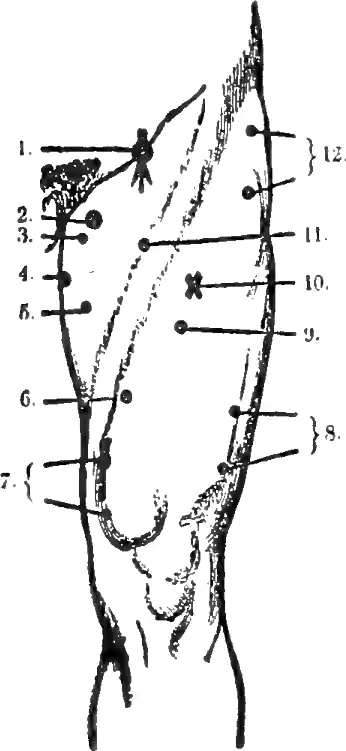
- Crural nerve.
- Obturator nerve.
- Pectineus.
- Abductor magnus.
- Abductor longus.
- Cruralis.
- Vastus internus.
- Vastus externus.
- Rectus femoris.
- Quardiceps.
- Sartorius.
- Tensor vag. femoris.
Taking from this the basic principle of physiologic therapeutics as a "defense against disease," we find the physical methods far superior to drugs in many diseases. Where can we find a drug in the Materia Medica that will produce the reaction upon muscular and nerve fiber to compare with electricity? Where is there a drug that will compete with light and heat, relative to its influence upon the skin and bacteria, and so on through the entire chain of physical methods of defending the body from the invading enemy—disease?
These methods have been classified under different names and systems, incorporating electricity, hydrotherapy, phototherapy, mechano-therapy, thermotherapy, vibrotherapy, osteopathy, massage, physical training and all the kindred sciences. Many of these systems are so closely allied as to involve many of the fundamental principles; each has its independent therapeutic action, however, inasmuch as the vaso-motor centers of the body enter largely into the basic principles of this field of practice. I have inserted among the foregoing pages illustrations outlining these centers, which are of the greatest value to the physiotherapeutist.
It is an easy matter to locate these centers when you are in a dissecting room where the map portraying the geography of the body is before you, but when this is covered by the integument, these landmarks are more obscure. I have also tried to illustrate the following chapters with drawings that each chapter will be easily comprehended.
In conclusion, I will add, if there is any one cause to create harmony among the sectarian schools of medicine and promote a united medical profession, it is physiologic therapeutics.
The allopathic physician will cease to pseudonym the homeopath a "dispenser of imagination" and the homeopath and eclectic will not refer to the allopath as a member of the "dominant school of medicine," but all will unite in one tenet, and
And those who know you true;
For the heaven that smiles above you,
And the good that you can do."