"Brother Brigham" opposed to Manifestations of the "Gift"
His Ideas of Unreasoning Obedience
The Prophet at Home
The "Trustee in Trust"
The Prophet's Wives
His Favourites
Brigham's Domestic Life
His Habits and Traits of Character
His Hours of Business
The Prophet in his Office
Extraordinary Influence with the People
Unheardof Claims to Dictation in Secular Affairs
Lovers to ask Brigham's Permission to love
Troublesome Elders sent on Mission
Ordered to go to "Dixie"
Mission to the Indians
How the "Lamanites" were to be made a "White and Delightsome People"
Heber's Hint to the Missionaries, and how they took it
Brigham on his Travels
The "Royal Blood of Young"
Reception of the Prophet among the Saints
"The Lion of the Lord" in his Glory
The Saints listen to the Prophet
His Style of Preaching
The Prophet's Successor
Brigham the Second
Founding a Dynasty
Nepotism greater than Birthright and Priesthood
The Precedent given by Brigham
George A. Smith, Brigham's Rightful Successor
Apostle George Q. Cannon
A Mission to Jerusalem
Influence of the Railroad
Influx of Gentiles
Brigham's Lost Opportunities
Great Wealth of the Prophet
How Brigham balanced his Account with the Church
How the Prophet got rich
The Probable Future of Mormonism at his Death.
The engraving at the beginning of this work is a perfect representation of Brigham Young, on the seventy-first anniversary of his birth—June 1, 1872. His most intimate friends, and members of his family, pronounce it a faultless likeness.
In a personal sketch of the man, there need be but little said of his early life; the story of his later years is of more interest. A brief paragraph relative to his family, and furnished by himself, contains, probably, all that the reader will care to know:
"I was born in Whittingham, Windham County, Vermont, June 1, 1801. My father and mother removed to Smyrna, Chenango County, N. Y., when I was about eighteen months old. We lived in that place until 1813. Shortly after the commencement of the late war with Great Britain, my father and his family removed to the town of Genoa, Cayuga County,
(Upload an image to replace this placeholder.)
N. Y., in which county I lived until 1829. I then moved to Mendon, Monroe County, and in 1830 removed from thence to No. 9 Canandaigua, into a small house owned by Jonathan Mack, situated on the west side of the road, opposite to where Mr. Mack then lived. I helped to finish his new house, so that he moved into it before I left the place. I left Canandaigua in the first part of 1832, and returned to Mendon. April 14th, same year, I was baptized into the Church of Jesus Christ of Latter-Day Saints. . . . . After my return to Mendon, I removed to Kirtland, Ohio; from thence to Far West, Mo.; from thence to Nauvoo, Ill.; and from thence to the mountains. There are five brothers of us, in the following order: John, Joseph, Phineas H., myself, and Lorenzo D. The two former never lived in No. 9. Phineas H. and Lorenzo D. did live there, but removed long before I came. The five of us, with my two living sisters (I have three dead), are here."
Brigham was reared in the humblest walks of life; he "came of poor but honest parents." By force of circumstances, he grew up in the practice of the strictest economy, and became early inured to hard work. The social position of his father's family may be judged from the boast of Brigham, in the days when the meek and the poor were to inherit the kingdom, that he had "only been eleven and a half days at school." He learned the trade of a painter and glazier, but, as that sometimes was insufficient for him, he tells that he "did many a hard day's work for six bits a day." His "straitened circumstances" were not improved for some time after his first acquaintance with Mormonism, as he relates that he had to borrow some articles of clothing as well as a pair of boots to enable him to attend a conference of the Saints. The acceptance of Mormonism was, therefore, no sacrifice to him, and preaching "without purse or scrip" was no lowering of his dignity. He was eminently suited to join the standard of the Prophet Joseph, which he did two years after the organization of the Church, when Sidney Rigdon was in the blush of his greatness in Ohio, and Oliver Cowdery was away in Western Missouri locating the New Jerusalem, where the kingdom was to be established "in power and glory." Upon such a man, it was a proper thing for the first manifestation of "the gift of tongues" to fall. Rigdon was "learned in the Scriptures;" Cowdery had "seen angels;" Parley P. Pratt was an eloquent preacher; Orson Pratt was a Bible-reader and thinker; and, as in all these Brigham was deficient, it was highly proper that "the Lord" should take care of him, and endow him with qualifications that rose above all argument, and spurned contemptuously the logic of facts. It was enough for Brigham Young to know that he had received "the gift of tongues;"[1] with that he started to "bear testimony" that "the Lord" had raised up a prophet "in these latter days," and that the Book of Mormon was necessarily true.
What Brigham Young felt in Kirtland exceeded in importance any thing that any one else would ever have to say. Compared with his experience, learning, eloquence, and reason, were but the snares of the evil one. He only once "felt a want of confidence in Brother Joseph Smith," and "the feeling did not last sixty seconds, and perhaps not thirty;" it gave him "sorrow of heart," and he "clearly saw and understood, by the spirit of revelation," that if he "was to harbour a thought in his heart that Joseph could be wrong in any thing," he would go from doubt to doubt, till, from "lack of confidence in his being the mouth-piece of the Almighty," he would continue in a course of unbelief till he said, "there is no God." Brigham says he repented of his unbelief "very suddenly. . . about as quickly as I committed the error." From this onward, "I never," says he, "had the feeling, for one moment, to believe that any man, or set of men, or beings upon the face of the whole earth, had any thing to do with him [Joseph], for he was superior to them all, and held the keys of salvation over them.[2]. . . He was God's servant, and not mine. He did not belong to the people, but to the Lord, and was doing the work of the Lord; and if he should suffer him to lead the people astray, it would be because they ought to be led astray. If he should suffer them to be chastised, and some of them destroyed, it would be because they deserved it, or to accomplish some righteous purpose. That was my faith, and it is my faith still."[3]
With such a blind, unreasoning faith in the mission of Joseph Smith, and the abject slavery of mind that it involves, the key to Brigham Young's whole life is clear. No one had a right to sit in judgment upon Joseph; no one should now question his successor, Brigham! With such teachings, the Prophet is never wrong. When failure would close the argument with other men, he is still right! But of the faith, more need not be added; of the Prophet personally, the reader may expect some information.
Up to within a few years, Brigham had little intercourse with the outside world; he was seldom seen by others than his own people, except on Sundays. There was nothing of the hermit about his disposition, but he always had "something to see to"—a house building, a mill repairing, something was going on about his farm or his garden, the Temple-building, or the Tabernacle; his numerous family had some share of his time, and the Church affairs every day were brought before him.
Image missing
Brigham Young's Home.
In this group of buildings the Prophet is understood to have his home, or that portion of it which a man with numerous wives can ever imagine that he possesses. The left building is called the "Lion-House," from the figure of a crouching lion over the portico—the work of a clever sculptor, now an "apostate." The next low building is the "Tithing-Office," where the clerks of the Trustee in Trust and the clerks of Brigham Young do the clerical service of the Church and the Prophet; the smaller building beside it is Brigham's "private office," where he is visited on business, and where he receives distinguished strangers who feel honoured in calling upon "Mr. President Young." The large building on the right is the Bee-Hive House, and was the official residence of Governor Young.
With fairness it may be said that his home is in the BeeHive House, as it is there that he has his chambre à coucher, gets his buttons fixed, and his hose repaired; but, as the Prophet is "master of his own actions," his whereabouts after businesshours is very difficult to determine. The Lion-House is a long building, with twenty rooms on the "living-floor," sleepingapartments for the children on the upper floor, and diningroom, weaving-rooms, laundry, and other divisions, on the lower floor. It was in that house that one of his dozen wives, residing together, is reported to have rubbed off the chalk-mark from her neighbouring sister's door, placing it on her own, and thereby enjoyed the extra teachings of the Prophet without his discovering the mistake.
East of the Bee-Hive House, the distance of a few hundred yards, and on the hill-side, is the White House, an unpretentious building, where the legal Mrs. Young resides. The house of his present favourite, Amelia, is about half a block and the width of a street from the Prophet's office; it is pleasantly and conveniently situated. On the opposite side of the street, the Nauvoo favourite lives quietly and undisturbed. Directly west of Amelia, on the same block, Emmeline, the longest favoured one, resides. A block and a half from the Prophet's office is the residence of his last loved one, a very handsome young lady, a "grass widow," who is said to have gained immensely. upon the affections of the Prophet. This lady added a little cherub to the Prophet's kingdom, in his seventieth year, a circumstance very much to his gratification, but not to Amelia's, as she makes no secret that she questions the paternity of the little stranger; but it is proper to add that Mrs. Cobb Young is a lady of blameless life.
Brigham Young gave the revelation of Polygamy to the world, and his own illustration of the patriarchal institution can therefore with propriety be here given to the world without any violation of the rights of domestic privacy.
Adjoining his private office he had for many years his dormitory, which he is said to have strictly preserved unto himself. To that room, however, there were two doors; one opening into the Bee-Hive House, and another to a passage-way that terminated at the Lion-House. While Emmeline was the favourite, or years after, when Amelia was the honoured one, some of the less favoured sisters tell that the Prophet made frequent and very prolonged visits to the Lion-House after the hour of evening prayer. Heber, in his humourous and coarse way, used to make a singular and exceedingly practical application to his own children of I. Thessalonians v. 5; and with Brigham's children it was much the same.
It has generally been supposed that Brigham had an immense number of wives, and that everything around him and them was in the gorgeous Oriental style; but this is purely imaginative. There are probably only nineteen "sisters" who call him "husband," and, with the exception of Amelia and Mary—the rival favourites—they are all working-women, without any pretensions to being mere "ornaments." Brigham is not capable of appreciating much of that kind of thing. His early poverty and hard-working experience, sustained by a natural acquisitive disposition, have enabled him to eschew all extravagance. Speaking of his wives, he said, "He would provide them comfortable homes, clothe them properly, and give them what they wanted to eat; but Brigham Young was master of his own actions." His wives have no idea, from their own experience, of the marital relations of husband and wife in the Christian sense. He sees them in the Lion-House, at the general dining-table, or at evening prayer in the parlour, where they are all collected at the ringing of the bell; but many of them he seldom sees elsewhere. He calls periodically upon a few of them, and inquires after their welfare, but there are others whom he rarely ever sees within their own particular habitations, unless in case of sickness, or when sent for. There is no romance about the lives of his wives: they are quiet, unobtrusive women, who have been sacrificed to their faith. There has been but a single instance of scandal associated with the name of one wife, many years ago, and that was evidently without foundation. When the penalty of certain death stares the transgressor in the face, few have the hardihood to brave it.
His attentions to his wives before the public are methodical and calculated. His first wife and Amelia will usually sit beside him on the sofa in the ballroom, and the other wives may find places elsewhere. When he goes on to the floor for the first cotilion, it is generally with Amelia; and the half-dozen others, who may be present, have the honour of dancing with the Prophet during the course of the evening. He is a lively dancer for a man of his years, evidently takes great pleasure in always being correct, and enjoys at times a thorough "brake-down" step at the close.
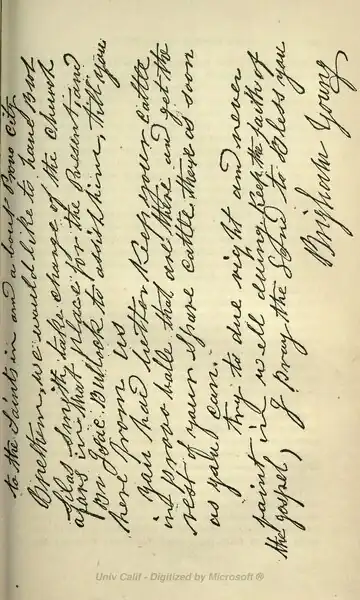
He is very regular in his habits. He generally rises between seven and eight in the morning, and dresses at once for all day. He steps into his office, at times, before breakfast, and takes a general survey of those who are there, and then he may, perhaps, saunter out and look at his premises; but, usually, he comes to the office about nine o'clock. The private secretary has his letters ready for his personal perusal, and also such items of business as may specially require his attention. He has, he says, schooled himself into the habit of never thinking twice upon any subject; and, when once it has received his attention, and he has pronounced his decision, he never wants to hear of it again. He is no scholar, and therefore never answers correspondence. As the autograph of all "great men" is sought after, the reader will probably peruse with interest the fac simile, on the opposite page, of a genuine letter, which the Prophet wrote over fifteen years ago. He has placed his name to so many letters and documents since that time, that his autograph on the steel engraving, at the beginning of this work, shows considerable improvement.
The barber is there about a quarter to ten, and shaves the Prophet in his office, no matter who may be present.
From ten to eleven he is to be seen on business.
The apostles, bishops, and leading citizens, have the entrée to his private office at any time, and enter without announcement, or even knocking at the door; but others have to pass through the Tithing-Office, and it is the duty of one of the clerks there to learn the visitor's business. Formerly the
(Upload an image to replace this placeholder.)
chief clerk of the Trustee in Trust had that duty to perform, and if the business could be disposed of without carrying it to the Prophet, the visitor was so instructed. When the "sisters" have any complaints to make of their husbands, they run to the Prophet; but if the clerk can turn the visitor to "the teachers," or to the bishop of her ward, it is done. When the aggrieved one is persistent, the clerk informs the Prophet, and he either sends an answer or grants an interview. To the humble, believing Saint, the answer or counsel has all the force of a revelation from heaven.
No one to-day, even in Utah, can form any idea of the thorough control that Brigham once had over the people. Nothing was ever undertaken without his permission—he knew of everything. No person could enter into business without consulting him, nor would any one ever think of leaving the city to reside in any other part of the country without first having his approval. Merchants who went East or West to purchase goods, had to present themselves at his office, and report their intention of going to the States at such a time—if he had no contrary orders to give them. Some, no doubt, may have sought his counsel on their proposed undertakings and journeys, believing that his superior wisdom could aid them, but in his own mind he claimed that the Saints should do nothing without his knowledge and approval. That oft-reiterated expression, that it was his right to dictate and control everything, "even to the ribbons that a woman should wear, or to the setting-up of a stocking," was the truthful illustration of his feelings.
A ball even could not take place until he was consulted upon the propriety of dancing, then, and before the invitations were issued, the list of the invited was read to him, and he erased or added names at his pleasure. Before any of the married brethren could make love to a maiden with the view of making her a second, third, or tenth wife, he was expected to go and obtain Brigham's permission, and even the young men were instructed that properly they should do likewise. But the worst form of this surveillance, control, and dependance upon his will was the power which Brigham assumed in the most vital interests of every man's affairs. He not only sent the missionaries abroad, when and whither he pleased, but when he desired it, he sent the elders away for some cause of offence, real or imaginary. He once told the best Mormon lawyer in Zion, who had been a Federal judge, that if he came again on to the platform where he stood, he would kick him off it, and he appointed him to a mission in Yan Diemen's Land, and told him never to return—he never wanted to see him there again. The lawyer went, performed his mission, and returned to his family, and has since been of great service to Brigham. Time after time he has called men living in Salt Lake City to close their business, and go down to "Dixie"—the southern part of the Territory, which has been regarded by most people as a penal settlement, or place of banishment. Re- pugnance to such a country, or the inadaptability of the person to any pursuits there, was nothing to him. Quite a number of persons had to sacrifice property in the city in order to go to "Dixie," and free tongues have not been slow to insinuate that, in some instances, those persons were sent away for the very purpose that the Prophet might the more easily purchase their property. He sent at one time a mission to Fort. Limhi, Salmon River, to civilize the Indians. The brethren were counselled not to take their families with them, but they were to live with the Indians, to educate and civilize them, and to teach them various trades and farming. When Brigham and Heber afterwards visited the missionaries to see how they were succeeding, Heber, in his quaint way, told them that he did not see how the modern predictions could well be fulfilled about the Indians becoming "a white and delightsome people" without extending polygamy to the natives. The approach of the United States army, in 1857, contributed to break up that mission, but not before Heber's hint had been clearly understood, and the prophecy half fulfilled! Heber was very practical, and believed that the people should never ask "the Lord" to do for them what they could do themselves, and, as all "Israel" had long prayed that the Indians might speedily become a "white and delightsome people," he thought it was the duty of the missionaries to assist "the Lord" in fulfilling his promises. This was not -the first time that a Mormon prophet attempted to aid in bringing to pass the prophecies of "the Lord." More than one missionary appears to have thoroughly understood him![4]
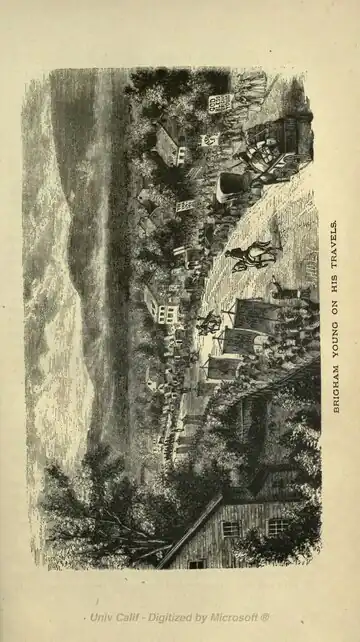
The illustration at the beginning of this chapter is a perfect representation of the Prophet's style of travelling through the settlements. He tries to visit all the Saints once a year. His visit north occupies between three and four weeks, and his southern trip takes between five and six weeks.
The order of travel after leaving Salt Lake City is: first, the Prophet's carriage.; next, the members of his family; then his counsellors, the apostles, chief-bishop, bishops generally; then distinguished visitors. The latter take the first vacant place in the long suite, and remain there all through the journey. The only rank and aristocracy in Zion is priesthood, and precedence in every quorum is seniority of ordination. In these journeys, the last-ordained apostle is the last in the order of travel among the apostles; but if the youngest apostle should be a son of the Prophet he overtops them all the "royal blood of Young" is more honoured than the royal priesthood of Melchisedec!
Some miles before "the President's company" arrives at the first settlement to be visited, he is met by a company of mounted cavalry, bearing aloft the stars and stripes, and, as they near the settlement, the citizens turn out to greet the Prophet, and there is usually a procession of the school-children. If it is a very large settlement, and the bishop is a very "live man," the procession often embraces all the people. On such occasions there is a brass-band heading the citizens, the elderly brethren are arranged together, bearing in front of them a banner with the inscription, "Fathers in Israel;" the elderly sisters have their banner, "Mothers in Israel;" the young men carry their banner, "Defenders of Zion;" the maidens their banner, "Daughters of Zion, Virtue;" and the little, toddling school-children are, "The Hope of Israel." Those too young to walk are, as usual, in the arms of indulgent mothers, standing by the doors to make up the other part of the picture. All along the procession may be seen banners bearing the devices, "Hail to Zion's Chief," "God Bless Brigham Young," and kindred sentiments of "Welcome." No doubt these honest, simple people truly and thankfully express on such occasions their kindly feeling for "Brother Brigham"—they see him but seldom!
On arrival, the Prophet is taken to the best accommodation in the settlement, his suite are distributed among the people, and every kind attention is extended to them all, and their horses and carriages no further require their care. The people are happy to see their "big brethren," and many of them strain their pockets to entertain their guests.
There is usually one or more "meetings" for preaching, and, as these visits occur in summer, "boweries" are improvised, and decorated with evergreens, flowers, and fruits, and oftentimes the homespun cloth and home-made coverlets are suspended through the Bowery to exhibit the manufactures of Zion.
The preaching is directed by the Prophet.[5] The people all want to hear him; but in such long journeys he calls upon every one of the visitors to speak to the Saints. The addresses are usually upon some general policy of the time, and exhorting the Saints to faithfulness. Frequently there is a dance in the evening, or a serenade-party of singers at the Prophet's headquarters, and before his door and around the house where he sleeps there is a vigilant armed guard walking all the night. Next morning he is escorted by the cavalry till another body of cavalry meets him, and thus he travels from settlement to settlement until his return to Salt Lake City. These visits are exceedingly pleasant to those who accompany the Prophet, and exhibit clearly his influence over the people for weal or woe.
The Prophet usually takes his favourite wife with him on such occasions, and of late years his second son, Brigham, Junior, has always accompanied him, and here occurs the thought: Who shall succeed him in all this?
Image missing
The Apostle George A. Smith.
By right of rank it should be his first counsellor, George A. Smith, a nephew of the Prophet Joseph Smith, and an apostle.
At the death of Joseph, Brigham claimed that the Quorum of the First Presidency—composed of Joseph and Hyrum Smith and Sidney Rigdon—was dissolved by the assassination of the first two named, and that the ruling authority then devolved upon the Quorum of the Twelve Apostles, of which he was the President. Had Hyrum Smith lived, he would have been the President at the death of Joseph, and by that same order George A. Smith should now succeed Brigham Young as President of the Mormon Church; but few, it any, believe that, if he outlives Brigham, such will be the case.
Image missing
The Apostle Brigham Young, Junior.
An apostle once asked Brigham, in a disinterested way [for, at that time, that apostle was certainly free from guile], who would be his successor. It was an ill-timed question, for Brigham had only just then taken a young wife, and was looking after others; besides, it was exceedingly unpleasant to suggest to a newly-married man, that there would be a pair of empty slippers in his house some day. The Prophet answered, very curtly, that "the Lord" would manifest that in due time. "The Lord's" due time has evidently come, and "Young "Brig," as he is called, is the manifestation.
Wherever the Prophet goes, the junior accompanies him, and the people are getting used to his presence. The junior is learning how the senior manages the bishops, and is garnishing his mind with useful information; and there is no doubt that, by this training and constant association of the son with the father before the people, the latter will clearly get into their minds what "the Lord" has set his hand to do.[6]
Personally, Brigham Young, Junior, is not a popular man with the Saints; he is not their choice for president; but the Prophet his father has determined to build up a dynasty, and preserve his name to the world, and Brigham, Junior, is a fortunate accident. Brigham the Second will always suggest to the memory Brigham the First. Further, no one could imagine Brigham Young, Senior, so excessively foolish as ever to leave such an inheritance to the Smith family! George A. Smith, by favour with the people, as well as by rank, is the legitimate successor of Brigham Young, according to Brigham's own precedent, but he will never attain to that position, except by revolution, and there is nothing of that character in him. Brigham, in this, however, shows to the Saints that he will permit nothing to stand in the way of his own ambition; that rank in George A. Smith, and birthright in his own son, Joseph A., are nothing when his purposes are considered. All the past preaching of the rank and birthright of the priesthood is negatived in the successorship of Brigham Young, Senior, by Brigham Young, Junior.[7]
The most promising man among the Mormons for the successor of Brigham, at one time, was the young apostle George Q. Cannon.
Image missing
The Apostle George Q. Cannon.
He is by far the ablest young man among the apostles. He has the education of travel, is a reader, a writer, and a man of pleasant manners. When he returned from his mission in Europe, several years ago, he spoke like a thinker, and showed, for a time, a capacity that commanded respect; but he soon learned that there was but one leader in "Israel," and he gradually settled down to the level of the other apostles, and, while Brigham sends George A. Smith on a mission to Jerusalem, he sends George Q. Cannon delegate to Congress, to let the Saints feel and realize that the Church affairs can do without them both: and meantime "Briggy" is being initiated into the mysteries.
The public generally are looking forward to the death of Brigham Young for the utter disintegration of Mormonism, but in this there will be disappointment. There will, doubtless, be many changes and some opposition,[8] and, with the removal of Brigham's iron hand, there will be an independence never before realized since he ruled the Church; but it will take a long time to educate the people out of the system. As railroads are built, mines developed, and enterprise grows up in the Territory, the influx of Gentiles, and the establishment of Christian schools and institutions, will soon break in upon the doctrine of exclusive salvation.
Had Brigham Young been a great man, he had the best opportunity that mortal ever possessed of showing it. There never was a people more willing to do what they were told than the Mormons, and he could have swayed them whither he pleased. He could have left behind him imperishable records of his care for the poor, the aged, and the infirm; but, while there is not a single hospital or institution, worthy the name, founded in Zion, he has himself become immensely rich. Having control of the tithing, and possessing unlimited credit, he has added "house to house and field to field," while every one knew that he had no personal enterprises sufficient to enable him to meet anything like the current expenses of his numerous wives and children. As Trustee in Trust he renders no account of the funds that come into his hands, but tells the faithful that they are at perfect liberty to examine the books at any moment. He is charged with having, in 1852, balanced his account with the Church to the modest sum of $200,000, by directing the clerk to place to his credit the same amount "for services rendered;" and, in 1867, he further discharged his obligations, amounting to the small sum of $967,000, in a similar manner.[9]
For several years past, the agent of the Church, A. M. Musser, has been engaged in securing legal deeds for all the property the Prophet claims, and by this he will be able to secure in his lifetime to his different families such property as will render them independent at his death. The building of the Pacific Railroad was said to have yielded him about a quarter of a million; the Utah Central Railroad brought him also a very large sum of money, and, altogether, "the Lord" has dealt liberally with his servant Brigham.
The actual wealth of the Prophet will never be known. There is probably not a county in Utah where he has not some valuable property. Whenever new settlements have been laid out, he has not been the last to "place" his name upon the records. With his "opportunities," a man of his characteristics could not fail to become a great landed proprietor. Heber used to preach that Brigham and he would one day "own the people," and had the Tabernacle predictions about "famines, and wars, and rumours of wars," received the terrible fulfilment that they expected, there was quite a possibility of Heber's words coming true. Brigham took up great tracts of land, and the Legislature gave him grants of all he coveted.[10] With these constantly accumulating in value, and a tithing- office at the Prophet's command, in a time of great scarcity, when the Gentiles were to come to Zion begging for bread, it is not difficult to imagine the facilities which Brigham would have had for realizing Heber's boast.
The report has been circulated that Brigham was the third largest depositor in the Bank of England; but, though George Peabody has been mentioned as confirming this story, it does not seem possible. A wealthy Gentile, who called upon the Prophet some years ago, assured the Author that Brigham voluntarily stated to him that he really had several millions deposited there. In seeking to fathom Brigham's reasons for such a communication, the gentleman could only account for it by the Prophet's own statement that "he had not asked him concerning the number of his family, or tried to pry into anything." Brigham was rather charmed with his visitor on this account, and was very frank and communicative. The Prophet's sermons have long established for him the reputation of a boaster; and, as he will be second to no man, it is quite likely that he took some pleasure in informing this gentleman that he had a bank-account which could not be despised. Some years later—in 1871—a New York journalist visiting the Prophet, referred to the rumour about his having a deposit of $17,000,000 in the Bank of England; and Brigham is said to have regretted that it was untrue, and that he had not a dollar outside of Utah, but that the Church[11] had some small amount abroad for its use. That Brigham Young has money "salted away," that he will not touch under the pressure of any necessity but that for which it was "salted," is most assuredly believed by some who have had excellent opportunities of knowing his business. A man of his shrewdness, with so many threatenings of forced removal from Utah, and the possible contingencies of the application of law, never would permit himself to be caught penniless. Brigham has money—plenty of it.
Of his income from his numerous and vast estates, his theatre, the Coöperative business, his railroad-bonds,[12] mills, farms, rents in the city, and from all sources, the Internal Revenue Office at Washington has on record the following statement: For 1867, $18,400; for 1868, $20,005; 1869, $28,584; 1870, $25,500; 1871, $111,680; 1872, $39,592. Of course, no one believes that these are anything like the correct figures.[13]
Brigham, though of a "long-lived family," is not a strong man physically. He has flattered himself with the hope that he would live to the age of Moses, but he is not likely to "drag out" to a hundred and twenty years. It is to be hoped, however, that the limit of his days may not yet arrive. Enlightening agencies now at work in Utah are quietly telling upon the first faith of the people, and the formerly unchallenged authority of Brigham to dictate in all things is being set aside. He should live on till the issue of Mormonism with Christianity has been fairly reached; and when the barbarism of the worst phases of the Jewish polity revived has given place to civilization and development, Mormonism, having abandoned its Theocracy, will take its place among the innumerable sects of the day. This can be better achieved in his lifetime.
The early death of Brigham Young would make the fight with his successor the more difficult, as the latter would then feel it incumbent upon him to contend for the idiosyncrasies of his predecessor. If Brigham lives but a few years longer, much that is now tottering will be cast down and disappear for ever. But die when he will, and succeed him who may, the "one-man power" can never be inherited. Brigham succeeded Joseph when the people were in trouble and consternation, and they threw their individuality at his feet, and gave him absolute dictatorship—they needed a deliverer. Now, all this is changed, and hundreds who hailed with acclamation the sceptre in the hands of Brigham in Nauvoo, are fatigued, tired, and weary of it in Salt Lake City, and never would endure it in the hands of Brigham Young, Junior. The experiment of Theocracy will die out with Brigham's flickering flame of life; and, when he is laid in the tomb, many who are silent now will curse his memory for the cruel suffering that his ambition caused them to endure.
(Upload an image to replace this placeholder.)
↑It is a curious fact that Brigham Young is to-day the least desirous of listening to the exercise of this "gift." A lady tells that, one day, she was in the Prophet's house, when one of his wives laid hands upon her to bless her, and she "spoke in tongues." Another of his wives was present, and she had the "gift of interpretation." Before the lady left, they both requested her not to mention the circumstance, as "Brother Young" was opposed to such manifestations.
↑One young man replied to Brother Heber that it was the teaching of the Church that the elders should always follow their "file-leaders," and that "if President Young and he should each take a squaw to wife and thus set the example, they would certainly follow suit." That ended the "bleaching" of the "Lamanites." There was no further instruction upon the fulfilment of the modern prophecies.
↑As a preacher, Brigham is always listened to attentively—not so much either for style or the matter of his discourse, as from the expectation that he may "say something " that the auditor is anxious to learn. When he has moments of "great freedom " he can make himself interesting; but his utterance is the declamation of the unmethodical itinerant, and not the logical oratory of the thinker or reader. When he tries to make a set speech, he is a fearful failure. At the request of Vice-President Colfax and his friends, he spoke in the Bowery, and made astonishing havoc with history and Lindley Murray. On that occasion in support of Polygamy he brought up the very questionable charge against Martin Luther, that he countenanced Polygamy in acquiescing in the marriage of Philip, Landgrave of Hesse-Darmstadt, to a second wife while his first was still alive. Brigham was utterly ignorant of history, and the brethren in his office prepared him notes for this special occasion—the first he had ever tried to use and he was perfectly confounded. On the paper before him were a few hard words about Philip, Landgrave of Hesse, and poor Brigham, innocent that the word "Landgrave" was a title of nobility, spoke of the supposed poylgamist as "Mr. Philip Landgrave"—a worthy example for the world to follow. The visitors could hardly contain their mirth, while the intelligent Mormons almost expired with mortification.
Of that occasion, Mr. Bowles wrote:
"There was every incentive for him to do his best; he had an immense audience spread out under the 'Bowery' to the number of five or six thousand; before him was Mr. Colfax, who had asked him to preach upon the distinctive Mormon doctrines; around him were all his elders and bishops, in unusual numbers; and he was fresh from the exciting discussion of yesterday on the subject of Polygamy. But his address lacked logic, lacked effect, lacked wholly magnetism or impressiveness. It was a curious medley of Scriptural exposition and exhortation, bold and bare statement, coarse denunciation, and vulgar allusion, cheap rant, and poor cant."—"Across the Continent," page 118.
↑Several years ago, Brigham secretly ordained his three sons apostles—Joseph .A., Brigham, and John W.—with the intention that Brigham, Junior, should subsequently be the President of the Church, and his two brothers be his counsellors. This gave terrible offence to Brother Heber, who was the first in the line of succession; but Brigham shrewdly asked Heber to join him in the ordination of the three sons. To have refused would have caused an open rupture, and for Heber to comply, and take part in the ordination, for ever closed Heber's lips—almost.
Joseph A., the eldest son, is the most popular of the Young family, but he has far too much sense to desire to be a prophet. John W. has, of late years, become engrossed in secular affairs, and has quite a clinging respect for the world that now is. "Briggy" is by no means a dunce, but he is, under the circumstances, the most capable of the three of filling his father's shoes. Joseph A. and John W. are both smart young men, and can get well enough through the world; but Brigham, Junior, will find the Tithing-Office a great convenience.
↑The doctrine of inheriting priesthood has ever been held sacred in the Mormon Church; hence John Smith, the eldest son of Hyrum Smith, was ordained Patriarch over the whole Church, solely because he was the eldest son. Brigham looked upon him as a very unfit person for the office, but the right of succession was inherent in him, and he could not be set aside without offending the Smith family, and it has been Brigham's policy to show respect to those members of the "royal family of Smith" whom he can control.
↑There has been some expectation that neither Orson Pratt nor John Taylor will submit to the presidency of Brigham Young, Junior. Of late years Orson has so sunk his individuality of character, that little confidence can now be placed in his doing anything, but Brother John has within him a manacled giant that may then, perhaps, burst forth into freedom. There are few more powerful men than this apostle, and, had not Brigham made it a point to hedge him round, and arrest his development, he would have been a great man in Zion. That he should ever submit to the dictation of young Brigham does not seem possible.
↑It is due to a gentleman who was once the chief clerk of the Church, and with whom the Author was on very intimate terms, to state here that it was not from him that this information was obtained. Throughout this work, the Author has observed a strict reticence upon everything that was at any time communicated to him in confidence. Furthermore, though he had daily intercourse with Brigham Young, his family, and his immediate friends, not a single thing that ever transpired in Brigham's office or house, in his presence, has been alluded to. On all that be saw or heard while Brigham's guest, or when with him in the capacity of friend, a studied silence has been maintained.
↑It is not strange that a man of his prominence should have had many favours shown to him; in any new community in the West any man with a hundredth part his influence could not fail to receive many advantages; but the complaint is, that Brigham was never satisfied with the lion's share of anything, but was for ever wanting to "gobble up" everything that promised immediate value. The Legislative records of Utah are the proofs of the immensity of his organ of acquisitiveness. All the Twentieth Ward "Bench" to the north of the city, and lying east of his premises, was given to him. He had it surveyed into lots half the ordinary size, and from that alone he has derived an excellent revenue. A few years ago, Mayor Wells tried to get the City Council to give Brigham a large tract of land on the west of the city, and he wanted the Council also to improve it for the Prophet; but some members protested, on the ground that the city was unable to do so. "Squire" Wells was very indignant, and tried to encourage the brethren to "have faith in the Lord," and illustrated the advantages of "trusting in the Lord," by stating that when he went on a mission to England he had to sell some land to pay his expenses, but that, on his return, Brigham had handed him the deeds of his city property! To the credit of the City Council, they still remained weak in the faith
↑Louis XIV. said, "L'Etat, c'est moi." Brigham could as truthfully say, "L'Église, c'est moi."
↑Brigham is the President of the Utah Central Railroad, but has only six shares in that property; he has, however, managed to possess $600,000 of its bonds!
↑It is a curious fact that one Gentile—Mr. Warren Hussey, the banker—paid last year to the Government, within a few hundred dollars, twice as much as the whole amount of revenue-tax paid by the entire Mormon people, including Brigham Young and all the Mormon merchants!