The Rocky Mountain Saints/Chapter 39
- THE TWO ARMIES.
- The Saints rejoice, and sing their Warlike Songs
- The Federal Troops in Camp Scott
- Brigham sends them a Present of Salt
- "The Lord" is to destroy the Enemies of Zion
- Col. Kane arrives among the Mormons and converts Brigham
- The Prophet concludes that he cannot "whip" the United States
- He proposes Flight
- Means to take Care of Himself
- Col. Kane visits Gov. Cumming and arranges a Basis of Prospective Peace
- He offends Gen. Johnston
- A Duel imminent
- The Mormons flee from their Homes.
While these misfortunes beset the Government troops, the Mormons were the happiest of mortals. The calamities that had befallen their own hand-cart emigrants only the year before were instantly forgotten, and the sufferings and privations of the soldiers were regarded as the immediate and direct judgments of the Almighty against those who would "fight against Zion."
As the snow had closed the passage through the mountain cañons, there was no longer any necessity for "defence," and the brethren returned to the settlements to be greeted with songs of victory. One of the pæans of the time was a "Welcome to the returned warriors of Zion: dedicated to Lieutenant-General Wells and his co-champions in arms," which expresses the view that the enthusiastic took of their situation:
Your name 's a terror to our foes;
Ye were a barrier strong and broad
As our high mountains crowned with snows.
Their courage fell in wordy boast;
The faith and prayers of Israel's host
Repelled the tyrant's gory car.
Then welcome! sons of light and truth.
Heroes alike in age and youth."
That was the gayest winter ever known in Utah, and dancing and theatrical representations were every where encouraged, while the songs of the Mormon camps, adapted to the popular negro melodies of the day, were brought into the city and were heard in all the assemblies. The Sunday worship was enlivened with the jovial chorus of "Du dah,"[1] and the "sweet singers of Israel" discoursed Mormon patriotic sentiments to the air of "The Red, White, and Blue." To fire the souls of the Saints, one of the brethren, who is now an "apostate," made a most excellent translation of the "Marseillaise Hymn," while another of the elders sang the praises of the "warriors" in verse that has immortalized him among the poets of the Tabernacle. Nor were the sisters wanting in enthusiam. Sister "E——— M———"—a delicate, petite English lady, whose heart would have been moved at the violent death of a spider, aroused with her eloquence "the defenders of Zion" to "gird on for the fight." She was "inspired."
The following verses are illustrative of the warlike enthusiasm to which the preaching of the leading elders had brought the people:
The foe's at the door of your homes;
Let each heart be the heart of a lion,
Unyielding and proud as he roams.
Remember the wrongs of Missouri,
Remember the fate of Nauvoo:
When the God-hating foe is before ye,
Stand firm, and be faithful and true.
Her warriors are noble and brave;
And their faith on Jehovah is founded,
Whose power is mighty to save.
Opposed by a proud, boasting nation,
Their numbers, compared, may be few;
But their union is known through creation,
And they've always been faithful and true.
Shall we tamely submit to the foe?
While the ties of our kindred they sever,
Shall the blood of the Prophets still flow?
No! The thought sets the heart wildly beating;
Our vows at each pulse we renew,
Ne'er to rest till our foes are retreating,
While we remain faithful and true!
The plundering wretches advance,
With a host from the regions eternal,
We'll scatter their hosts at a glance!
Soon 'the Kingdom' will be independent;
In wonder the nations will view
The despised ones in glory resplendent;
Then let us be faithful and true!"
Brother C. W. Penrose, the author of this effusion, at this date had nothing of the mountain bluster and boasting in his disposition. He was a young man of very pleasant manners, a missionary, with a more than average mental cultivation. His poetry only expressed the heart-felt convictions to which the teachings of the priesthood had led him. He fully and unquestioningly believed, as indeed did all the Mormons, what Brigham Young taught. With "the Lord" to fight their battles, the few Saints were a match for the whole world. They knew no fear; they only awaited the word to arise and conquer, and every mile that the United States troops advanced towards their homes, only brought the hoped-for consummation more pleasantly near to their longing souls. Many, doubtless, shared the sentiments of Brigham, and his hatred of all authority outside of himself; but the masses have nothing of blood-thirstiness in their character. As the United States army approached, they saw only the fulfilment of predictions, and naturally longed to be the witnesses of the Lord's power.
From the pen of that same "C. W. P." flowed the sweetest song that the Mormons ever sang. At all great gatherings a little Scotchman with a warbling voice is certain to be invited to sing "O Zion," in which the whole audience, contrary to the usages of the Tabernacle services, burst forth in the chorus. This effusion is sung to the sweet air of "Lily Dale":
On the necks of thy foes thou shalt tread;
And their silver and gold, as the prophets have told,
Shall be brought to adorn thy fair head.
O Zion! dear Zion! home of the free,
Soon thy towers will shine with a splendour divine,
And eternal thy glory shall be.
Sacred home of the prophets of God;
Thy deliverance is nigh, thy oppressors shall die,
And the Gentiles shall bow 'neath thy rod.
O Zion! dear Zion! home of the free,
In thy temples we'll bend, all thy rights we'll defend,
And our home shall be ever with thee."
No words can express the electrifying influence of this song upon a Mormon audience. As the sound of the last words dies away, an outburst of enthusiasm is certain to follow. If the occasion is a religious ceremony, a loud and long-continued "Amen" is heard like "the voice of many waters." If the occasion is political, the hand-and-heel applause is given with a vim that tells how well the poet has touched the soul of his auditory.
The orators of the Tabernacle waxed bold and spoke of the Government and the army in terms of supreme contempt. With such an inevitable issue before their eyes, the leaders must either have been sincere in their faith that the end of national rule had been reached, or they were most unaccountably foolish in speech. A questioning voice was never heard: there was one current of unvarying boast of independence and victory for Israel, and of defeat and disgrace for the nation.
For years previous, the people had been taught to look forward to the time when "the kingdom" should throw off its allegiance to all earthly power, and now they naturally concluded that "the long-expected blessed day" had arrived, when they beheld on the one side of the mountains the national army advancing to their homes, and on the other side the Prophet with the armies of Israel determined to dispute their entrance into the valleys.
It had been a favourite pulpit expression that "the gates would be let down between the Saints and the rest of the world," and now it was that Brigham announced that he would regard the present as "the set time to favour Zion," and that the will of the Almighty was "that the thread should be cut" between them and the Gentiles when he saw armed men coming to shed his blood and that of his brethren. Heber, who was Brigham's favourite prophet, did not require to wait for the shedding of blood to be assured of the will of the Almighty. He was already fully advised and knew that the Saints and the Gentiles were separated for ever and "never would gybe again."
Men clothed with the inspiration of an "infallible priesthood" must needs be positive in their assertions, and it is only with such a faith that the leaders could demand unquestioning allegiance, and the people render the service of "blind obedience." Yet running all through the defiant speeches of those times, and the wordy assertion of "the Lord's commands," it is easy to discern the expression of stray thoughts which would have told any free-thinking people that the very men who claimed to be the inspired of "the Lord" and His mouth-piece to them, were themselves in grave doubt about the truthfulness of what they uttered, although they exacted unswerving faith and obedience from others. Those who dared to think saw this position clear enough, but to divulge such a discovery was impossible.
Nothing could better illustrate the incompatibility of theocracy with republicanism than the stormy days of "the Utah Rebellion;" and argument is unnecessary to demonstrate that abject slavery is the inevitable condition of a people who accept the despotism of "the one-man-power." Brigham Young, in Utah, in the year of grace 1857, rendered unintentionally by his own example, this service to his generation.
But Heber could see nothing to hurt his faith or to discourage him in the slightest degree. To him everything was perfectly delightful to contemplate. Brigham was to become President of the United States, he was himself to be Vice-President, and Brother Wells the Secretary of the Interior.[2] In the mean time the Saints were "just as sure to go to hell as they live, and I know it, if they consent to dispossess Brother Brigham as our Governor."[3] To avoid such a destination, the Saints very properly, with uplifted hands, voted that the troops should never come through the cañons, and that Brigham should for ever be their Governor! The thoughtful Legislature, too, resolved that the officers appointed for Utah by the National Government should "neither qualify for, or assume and discharge within the limits of this Territory the functions of the offices to which they have been appointed, so long as our Territory is menaced by an invading army."[4] Such was the spirit and such the letter of the teaching of the apostles during the first six months of the Utah war.
With the genial breath of spring and the melting of the snows, one of two things was certain: the Mormons would have to conquer the United States army, or they would have to retreat from their defiant position of resistance.
At Camp Scott, near Fort Bridger, where Colonel Albert Sidney Johnston wintered his troops, the Governor and Federal officers had pitched their tents and entered upon the discharge of their official duties. On the 21st of November, Governor Cumming issued a very temperate proclamation to "the people of Utah Territory," informing them that they were in a state of rebellion, and commanding them to disband. Chief-Justice Eckles opened court, empanelled a grand jury, took the burned trains into consideration, and found indictments against Brigham and the leading Mormons for treason, at the same time assessing the damages to the Government for goods burned and cattle stolen at a round million of dollars.
The winter of 1857–8 at Camp Scott was not quite so gay as that enjoyed by the Saints on the western side of the Wahsatch range of mountains. The burning of the three trains by the Mormons had greatly reduced the commissariat of the troops. Rations were short, and many articles of daily necessity were altogether unattainable.
Enterprising suttlers, who had ventured out with the expedition, taking the usual stock of extras, found the necessities of the civil and military officers and the wants of the camp followers a mine of wealth. The miserable whiskey that was poisonous enough at less than a dollar a gallon was eagerly purchased at twelve times that price, while tobacco was sold at $3 a pound, and coffee and sugar at about the same rate.
The greatest privation, however, was caused by the absence of salt, and Brigham in his "magnanimity" sent a present of that needful article to Colonel Johnston; but the gallant soldier ordered the messengers from his camp with every expression of contempt for the "rebel" prophet.[5] The Indians, however, soon settled the question of patriotism and necessity, and hurried through the snow into Camp Scott with all the salt they could pack, and sold it readily at five dollars per pound. The commercial principle of supply and demand, however, soon reduced by one-half the price of that indispensable condiment during the remainder of the winter. Flour for a time was a luxury at a very high figure, and the possession of a good supply with no other protection than the covering of a tent was as dangerous to its owner as a well-filled purse is to a pedestrian in a first-class city after sunset.
The beef-cattle had been run off by the hundred, and the poor, thin, worn-out, emaciated work-cattle were consigned to the butcher, partly as a substitute for the better-conditioned which had been stolen, but quite as often "to save the critturs the trouble of dying," and to furnish the soldiers with something like mocassins, which the needy but industrious men manufactured from their hides. From these necessities resulted the most galling phase of the expedition to Utah. Every day, all through that winter, bands of fifteen or twenty men might be seen hitched to wagons, trailing for five or six miles to the mountain-sides to get loads of fuel for the use of the camp. It will readily be credited that under these circumstances there was little kind feeling for the Mormons entertained at Camp Scott.
The unpleasant situation of the troops and any incidents of interest were duly reported by scouts at the Mormon headquarters, and added greatly to the faith of the disciples that "the Lord" was with them. The following letter from a lady in Salt Lake City to her children in Providence, Rhode Island, breathed the true Mormon spirit that characterized those warlike times:
"I expect you have heard the loud talk of Uncle Sam's great big army coming to kill the Saints. Now, if you did but know how the Saints rejoice at the folly of the poor Gentiles. There are about four thousand on the border of our territory, and six hundred wagons—one naked mule to draw them—all the rest having died. The men are sitting in the snow, about a hundred and fifteen miles from us, living on three crackers a day, and three-quarters of a pound of beef a week. Thus you see the old Prophet's words are fulfilled—whoever shall fight against Zion shall perish. The time is very near when one man shall chase a thousand, and ten shall put ten thousand to flight! Zion is free; she is hid in one of the chambers of the Lord. We are a free people. We do not fear 'Uncle Sam's' soldiers. We only fear our Father in heaven. We are learning His commandments every day from His prophet, and I am determined to keep them. If you were here, and could hear the Prophet's voice as I do, and could hear the Lion of the Lord roar from the mountains, as I do, and know how near the scourge of the Lord is upon the Gentiles, you would flee to the mountains with haste. The time has come when the Lord has called all the elders home, and commanded them to bind up the law and seal the testimony. They are now coming home as fast as possible. What comes next? The judgment, hail-storm, thunder, lightning, pestilence, war; and they that will not take up the sword against their neighbour must flee to Zion for safety. Will you come, oh! my dear children?"
That letter was a truthful reflex of the Mormon mind in 1857, and exhibits how grossly ignorant that people were of the progress of the world and the might of the Government against which they were arrayed. The people did honestly believe that the time had fully come when the Government of the United States would be broken to pieces, and that the little handful of Mormons in the valleys of the Rocky Mountains was "the kingdom," and was indeed that stone which should grind into powder all upon whom it fell.
"The whole United States and the whole world could not prevail against the Saints." As for the army at Camp Scott, "a swarm of long-billed mosquitoes could eat them up at a supper spell."[6] Heber, full of rollicking fun, fire, and fagots, announced that he had himself alone "wives enough to whip the United States," "but he did not want to shed the blood of his brothers and sisters, neither did the Saints want to see these things"—"unless the Holy Ghost dictates for us to shed the blood of our enemies, and then it is as just and right as it is for us to partake of the sacrament." For himself, however, he would prefer that the army would go some other way, and not try to come into the city, for "we do not want to hurt them; but if they come down upon us and we have to repel them by the force of arms, God Almighty will give us the power to do it, now mark it."[7]
The Mormons had another lesson to learn.
Notwithstanding the difficulty experienced at that time of travelling across the plains in winter, an express occasionally carried to the Government the unwelcome news of the disaster that had befallen the expedition and the sufferings and privations that ensued. At one time there were grave fears of its ultimate success, but brave men and the unlimited resources of the Government were destined to overcome every obstacle. Captain Marcy with a company of picked men undertook a perilous journey from Fort Bridger to Taos, New Mexico, to obtain provisions, cattle, and mules for the relief of the expedition, and after most terrible suffering and heavy loss of animals, and many disabled men, he reached the point of supply, and was eminently successful.
The misfortunes that had befallen the troops aroused the Government to a realization of the necessity of rendering every aid, both in men and material, to save the expedition and make it successful. Lieut.-Gen. Scott was summoned to Washington to consult with the Secretary of War, and at one time the project of entering Utah from the west was seriously entertained. The intimation that two regiments of volunteers would probably be called for in the spring met with a ready response from all parts of the Union. It was very evident that the nation was thoroughly dissatisfied with the state of affairs in Utah, and wanted to bring the Mormons to a settlement.
Ready to take advantage of anything which promised wealth, there were multitudes of solicitous contractors seeking to supply the army in the West; and, with a prodigality beyond all precedent, the War Department was perfectly reckless. The Sixth and Seventh regiments of infantry, together with the First Cavalry, and two batteries of artillery—about three thousand in all—were ordered to Utah, and every arrangement made for speedy and colossal warfare with the Prophet. Political writers charged to the administration of Mr. Buchanan an utter recklessness of expenditure, intended more for the support of political favourites and for the attainment of political purposes in Kansas than for the overthrow of the dynasty of Brigham. It was estimated in Washington that forty-five hundred wagons would be required to transport munitions of war and provisions for the troops for a period of from twelve to eighteen months, besides fifty thousand oxen, four thousand mules, and an army of teamsters, wagon-masters, and employés, at least five thousand strong. It was very evident that the Government was playing with a loose hand, and the consideration of cost to the national treasury was the last thing thought of. The unanimity, however, that prevailed throughout the Union exhibited the wide-spread detestation of "the rebellion" of Brigham Young. The transportation item for 1858 provided for the expenditure of no less than, four and a half millions, and that contract was accorded to a firm in western Missouri, without public announcement or competition.
While all this was occupying the attention of the public, and the Government seemed determined that the war against the Mormons should be carried out with vigour, there was another influence at work to bring "the Utah rebellion" to a peaceful termination.
Among the passengers who, in the first week of January, 1858, steamed out of New York harbour for San Francisco, was a gentleman registered as Dr. Osborne. On reaching the Pacific coast the said "Doctor" hastened overland to Southern California, and there overtaking the Mormons from San Bernardino, who were returning home for the defence of Zion, he was readily provided with the necessary escort through the Indian country, and in the latter part of February he reached Salt Lake City.
The presence of the stranger in the city was soon known, but to Brigham Young and his associates only was the reputed Dr. Osborne known as their whilom friend Col. [now General] Thomas L. Kane, of Philadelphia.
What was communicated from President Buchanan to Brigham Young through Col. Kane has never been published, nor is there a soul in Utah to-day who claims to be in possession of that information; but whatever the nature of this intelligence may have been, if any communication at all, it is very certain that President Buchanan was particularly careful to have it understood that there was nothing like yielding contemplated on the part of the Government before the predictions of the Prophet. In his annual message to Congress, on the 5th of December, 1858, Mr. Buchanan made honourable mention of the services of Col. Kane, but he went out of his way to assure Congress that the Colonel went to Utah "without any official character or pecuniary compensation;" that it was solely "from motives of pure benevolence," and "that the Colonel had only sought to contribute to the pacification of the Territory." In a letter furnished to Col. Kane on the eve of his departure for Utah, Mr. Buchanan was very particular in defining their relative positions, and addressed him thus:
"My Dear Sir: You furnish the strongest evidence of your desire to serve the Mormons, by abandoning the comforts of friends, family, and home, and voluntarily encountering the perils and dangers of a journey to Utah, at the present inclement season of the year, at your own expense, and without official position. . . . Nothing but pure philanthropy, and a strong desire to serve the Mormon people, could have dictated a course so much at war with your private interests."[8]
After the Colonel's arrival in Salt Lake City, it is very clear that he impressed Brigham Young with the determination of the Government to subdue all opposition, and satisfied him that in the coming spring the troops would force a passage through the cañons, and would occupy the city if any resistance were offered to the instalment of the new Territorial Governor and the Federal officers.
On the 12th of March an exhausted traveller was seen plodding his way from the west through the snow towards the military lines of Camp Scott. When challenged by the picket, he requested to be conducted to the tent of Governor Cumming, whom he desired to see without delay. This enfeebled young-looking gentleman was Col. Thomas L. Kane. With the natural politeness of a thorough gentleman, Governor Cumming bade him welcome, and did everything that he possibly could to make his guest feel at home.
In the relations of Col. Kane with the Mormons at that time, there was exhibited evidence of the highest Christian charity and personal heroism of character. He must have well known that in entering the encampment of General Johnston at Camp Scott, his second, if not his first, duty was to make known to the commander something of the nature of his business within the lines of the army. His silence wounded General Johnston and his officers, and everywhere in the camp the Colonel was spoken of as "a spy." In course of time an invitation to dine at the General's head-quarters was sent to the Colonel by the hand of an orderly; but, instead of delivering the invitation, by some unaccountable mistake, the orderly forgot his instructions, and proceeded to place the Colonel under arrest. The Governor instantly extended his protection over his guest, and immediately a challenge from the Colonel to General Johnston was dictated; but by the timely interference of Chief-Justice Eckels, who threatened to arrest the whole party, the affair of honour was nipped in the bud.
Governor Cumming warmly espoused the cause of his guest, and felt himself also personally insulted, and from that moment the entente cordiale between the civil Governor and the military commander of the Utah expedition was for ever broken. Brigham was now safe—the military could only act as a posse comitatus on the call of the Governor, and the latter was for peace. Was this the settled diplomacy of Colonel Kane from the beginning? Was it to accomplish this that he risked his life in a long, weary journey over sea and land, that almost proved fatal to him, passed under a fictitious name, and bore the epithet of "spy" in Camp Scott—to serve the Mormon people and save them from certain death? Such would appear to have been the fact. It was the noblest heroism.
Soon after the departure of Col. Kane for Fort Bridger, a "special council" was held in the Tabernacle—on the 21st of March—at which "a series of instructions and remarks" was delivered by Brigham for the edification of the leading men around him. The "instructions and remarks" were never published in any of the organs of the Church, but for the use of the bishops and chief men they were printed in a pamphlet form. It is a most singular document, and one that few persons have seen. The gist of the "remarks" was the forced confession of Brigham that the Saints were not prepared to fight the United States, and that he was resolved on flight. In it he tells the "special council" that if Joseph Smith had given heed to the whisperings of the Spirit, he never would have given himself up to the marshal and gone to Carthage, and he then avows his determination not to be taken, and speaks at random, like a man utterly in the dark respecting the future, notwithstanding his previous boasting of continuous "revelation," and the guidance of "the Lord." To that special council he said:
"I do not know precisely in what manner the Lord will lead me, but were I thrown into the situation Joseph was, I would leave the people and go into the wilderness, and let them do the best they could. Will I run from the sheep? No. Will I forsake the flock? No. But if Joseph had followed the revelations in him he would have been our earthly shepherd today, and we would have followed his voice and followed the shepherd instead of the shepherd's following the sheep. When the shepherd follows the sheep, it reverses the natural order, for the sheep are to follow the shepherd. I want you to understand that if I am your earthly shepherd, you must follow me, or else we shall be separated."—pp. 3–4.
The idea of a shepherd leading his flock to greener and richer pasture is known the world over, but that a faithful shepherd should flee before his sheep and tell them to follow him, when those sheep were surrounded and threatened by ravenous beasts seeking to devour them, is a picture which has yet to spring from the artist's pencil.
As he had seen the winter approaching, and knew that a handful of men could defend the narrow defiles of the cañons, Brigham was bold and threatening; but when the balmy breath of spring was felt on the deep snow that intervened between the national army at Fort Bridger and the city of the Saints, and told as certainly as the returning season itself that that army would soon advance, the Prophet comprehended the desperate situation in which he was placed. It was then that he stumbled upon this, to him, logical method of escaping from the difficulties which surrounded him. To the council already spoken of he continued his address:
"A great many parents follow off their children, and men follow their women. For a man to follow a woman is, in the sight of Heaven, disgraceful to the name of a man. It is a disgrace for parents to follow their children. I am your leader, Latter-Day Saints, and you must follow me; and if you do not follow me, you may expect that I shall go my way, and you may take yours, if you please. I shall do as the Spirit dictates me. What does it now direct me to dictate to you? Our enemies are determined to blot us out of existence if they can." [p. 4] . . . "Should I take a course to waste life? We are in duty bound to preserve life—to preserve ourselves on the earth—consequently we must use policy and follow in the counsel given us, in order to preserve our lives. Shall we take a course to whip our enemies? or one to let them whip themselves? or shall we go out and slay them now? We have been preparing to use up our enemies by fighting them, and if we take that course and shed the blood of our enemies, we will see the time, and that, too, not far from this very morning, when we will have to flee from our homes and leave the spoils to them.—That is as sure as we commence the game." [Excellent second sober thought: thanks to Colonel Kane.] "If we open the ball upon them by slaying the United States soldiery, just so sure they would be fired with anger to lavishly expend their means to compass our destruction, and thousands, and millions if necessary, would furnish the means, if the Government was not able, and turn out and drive us from our homes, and kill us if they could. [p. 6.] [How strange "the Lord" did not whisper that before!] . . 'Where are you going?' To the deserts and the mountains. There is a desert region in this Territory larger than any of the Eastern States, that no white man knows anything about. Can you realize that? What is the reason you do not know anything about that region? It is a desert country with long distances from water to water, with wide sandy and alkali places entirely destitute of vegetation and miry when wet, and small, scattering patches of greasewood, and it is a region that the whites have not explored, and where there are but few Indians. There are places here and there in it where a few families could live.
"Four years ago this spring we sent Bishop David Evans and a company to go to that desert, for we then had too long neglected to explore it. We wanted to plant settlements there in preparation for this day, for we have had foreshadowings and a promise of the scenery now before us. That company did not accomplish the object of their mission; they were absent a few weeks, and went to the first mountain, but they did not go to the mountain where they were sent, and made no settlement. Now we are going to try it again. Probably there is room in that region for 500,000 persons to live scattered about where there is good grass and water. I am going there, where we should have gone six or seven years ago. Now we are going to see whether the sheep will follow the shepherd. I do not care whether they follow me or not."—p. 7.
Brigham wound up his remarks, extending over thirteen pages, with the following words: "My mind is too full this morning to come to close points"—that the reader could easily believe. The tone of the "defenders of Zion" was now to be changed. Flight, and not fight, was to be the watchword. The safety of Brigham and the leaders was the salvation of the people. The "game of bluff" was over.
The Hon. John M. Bernhisel, the Mormon delegate, had gone East with Major Van Vleit, and in his very quiet and unobtrusive way he laboured faithfully at Washington with Colonel Kane to arrive at an understanding with President Buchanan. Mr. Buchanan, dreading to saddle his administration with the responsibility of domestic warfare, if it could be avoided, gladly accepted the assurance that a settlement could easily be effected without compromising the Government, and in that spirit did he favour the unofficial services of Colonel Kane, and furnished that gentleman with letters to Governor Cumming and other officers of the Federal Government in order to facilitate and protect him in his travels.
Efforts have been made to charge Mr. Buchanan with "backing down." That the initiatory steps for the settlement of the Utah difficulty were made by the Government, as it is so constantly repeated among the Saints, is not true. The Author at the time of Colonel Kane's departure from New York for Utah was then on the staff of the New York Herald, and was conversant with the facts, and confidentially communicated them to Frederic Hudson, Esq., the distinguished manager of that great journal, to be used as he thought proper.
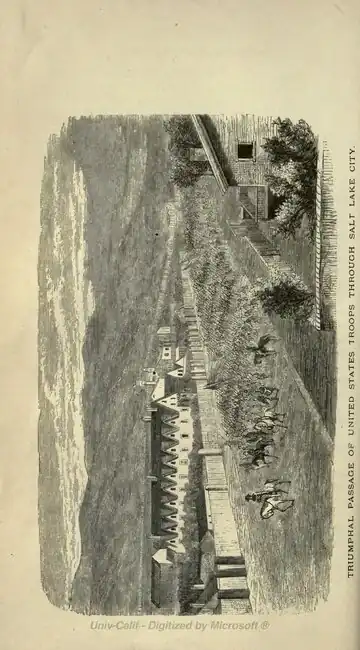
(Upload an image to replace this placeholder.)
- ↑ This Mormon "Du dah" is a remarkable composition, but it is too lengthy to be given entire. Two verses, however, will suffice to show the breathings of the Tabernacle, and the extent of the enthusiasm which then prevailed. After partaking of the Sacrament of the Lord's Supper, such a song as the following seems hardly in harmony with the place and occasion:
....
"Old Sam has sent, I understand,
Du dah!
A Missouri ass to rule our land,
Du dah! Du dah day!
But if he comes, we'll have some fun,
Du dah!
To see him and his juries run,
Du dah! Du dah day!Chorus—Then let us be on hand,
By Brigham Young to stand,
And if our enemies do appear,
We'll sweep them from the land."Old Squaw-killer Harney is on the way,
Du dah!
The Mormon people for to slay,
Du dah! Du dah day!
Now if he comes, the truth I'll tell,
Du dah!
Our boys will drive him down to hell,
Du dah! Du dah day!"ChorusFrom such lyrical effusions as these, sung during "divine worship" in the Tabernacle, the elevated tone of the sermons can be imagined. It is due to the better taught of the people to add that they had no alternative but to submit to the infliction.
- ↑ Tabernacle, September 6, 1857.
- ↑ Ibid., August 30th, 1857.
- ↑ "Resolutions adopted and signed," December 21st, 1857.
- ↑ How mutable are human affairs! Five years later, that same Colonel Johnston was himself designated "a rebel," and became one of the most distinguished generals in the Confederate army. The Colonel Johnston of Utah became the General Albert Sidney Johnston of Shiloh!
- ↑ Bishop L. D. Young, Tabernacle, December 13, 1857.
- ↑ Tabernacle, September 20th, 1857.
- ↑ Some writers have essayed to represent that Col. Kane was a Mormon, and they state that he was baptized at Council Bluffs in 1847. The Colonel himself, however, has not seen fit to confess such a relationship with the Saints, and it can be of little consequence to the world whether he was so or not. There is no doubt in the Author's mind that Col. Kane acted, in 1847, on the Missouri River, and in 1858, at Salt Lake City, in the interest of the Mormons, just as Mr. Buchanan states, "from motives of pure philanthropy." The Colonel was very sick when with the Mormons in 1847, and but for the excellent nursing and care that he then received he would probably have died. The debt of gratitude for those services he has sought to fully repay, and no man stands higher in Brigham Young's favour to-day than General Thomas L. Kane. This fact alone is sufficient to set at rest all questions of the Colonel's Mormonism. Had the Colonel been a Mormon, Brigham would have treated him with less respect. To the Prophet, adhesion to the faith inevitably entails servile obedience. Instead of courting Gen. Kane, as he now does, he would have commanded him.