The Rocky Mountain Saints/Chapter 32
- FOUNDING OF THE FRONTIER CITIES.
- Brigham's First and Last Revelation
- The Departure of the Pioneers
- The Discovery of Salt Lake Valley
- The Return to the Missouri River.
On the banks of the Missouri, the exiles were in Indian Territory. The renowned chief of the Pottowattamies, Pied Riche, surnamed Le Clerc, gave them a kindly welcome on the east of the river, and Big Elk was as gracious on the west. The red men were liberal, extending to them the free use of their unoccupied lands, and liberty to cut all the timber they required, with which was thrown in an expression of genuine sympathy for their misfortunes. With a vivid remembrance of their recent troubles in Nauvoo, and their flight from the abodes of the "pale-faces" in the depth of winter, this warmth of human feeling made a deep impression upon the Mormons, and during their stay among the savages they returned to them manifold the favours that they received.
On the eastern side of the river, camps were formed wherever the land was good and favoured farming, and settlements sprang up near the streams and groves of timber. The main settlement was called Kanesville, in honour of Colonel Kane, and was the foundation of what is now Council Bluffs City, Iowa.
The main body of the emigrants crossed the river, and located six miles north of what is now Omaha, Nebraska. There they built up "Winter Quarters," a city of some seven hundred log-huts and "dug-outs," in the midst of which was the "Tabernacle of the congregation," where the disciples assembled for worship and instruction.
Mount Pisgah, Garden Grove, Kanesville, and Winter 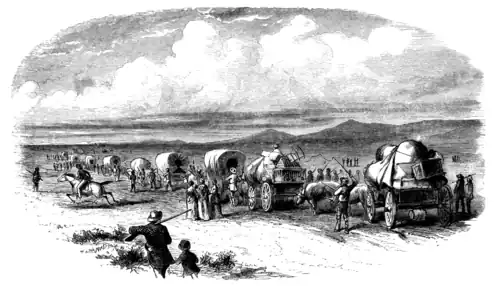
THE PIONEERS.
On the 14th of January, 1847, Brigham Young issued, from his head quarters, "The Word and Will of the Lord concerning the Camp of Israel in their journeyings to the West." As it is the only occasion on which Brigham has given to the Saints a written revelation, it deserves a place in history. It reads thus:
"Let all the people of the Church of Jesus Christ of Latter-day Saints, and those who journey with them, be organized into companies, with a covenant and a promise to keep all the commandments and statutes of the Lord our God. Let the companies be organized with captains of hundreds, and captains of fifties, and captains of tens, with a president and counsellor at their head, under direction of the Twelve Apostles: and this shall be our covenant, that we will walk in all the ordinances of the Lord.
"Let each company provide itself with all the teams, wagons, provisions, and all other necessaries for the journey, that they can. When the companies are organized, let them go to with all their might, to prepare for those who are to tarry. Let each company, with their captains and presidents, decide how many can go next spring; then choose out a sufficient number of able-bodied and expert men to take teams, seed, and farming utensils to go as pioneers to prepare for putting in the spring crops. Let each company bear an equal proportion, according to the dividend of their property, in taking the poor, the widows, and the fatherless, and the families of those who have gone with the army, that the cries of the widow and the fatherless come not up into the ears of the Lord against his people.
"Let each company prepare houses, and fields for raising grain for those who are to remain behind this season; and this is the will of the Lord concerning this people.
"Let every man use all his influence and property to remove this people to the place where the Lord shall locate a stake of Zion: and if ye do this with a pure heart, with all faithfulness, ye shall be blessed in your flocks, and in your herds, and in your fields, and in your houses, and in your families. . . .
"Seek ye, and keep all your pledges one with another, and covet not that which is thy brother's. Keep yourselves from evil; take not the name of the Lord thy God in vain; for I am the Lord your God, even the God of your fathers—the God of Abraham, Isaac, and of Jacob. I am he who led the children of Israel out of the land of Egypt, and my arm is stretched out in the last days to save my people Israel. . . .
"Have I not delivered you from your enemies only in that I have left a witness of my name? Now, therefore, hearken! oh, ye people of my Church, and ye Elders listen together. You have received my kingdom: Be diligent in keeping all my commandments, lest judgment come upon you, and your faith fail you, and your enemies triumph over you. Amen, and Amen."
With the Saints this document found peculiar favour. It was to them "the Lord" again, after a long silence, manifesting himself as in the days of Joseph, and it foreshadowed that his presence would go with them in their journey over the desert, and that under his direction they would reach the promised land. This is the first time that this document has been given to the public, and the student of Mormon revelations will remark a striking difference between the last revelation of Joseph Smith on polygamy, and the first of Brigham Young on emigration. Both are stamped with the characteristics of the men, and their peculiar situations at the moment. It is difficult to perceive the same authorship in both, yet both are claimed as emanations from Jesus Christ.
Accepting the phenomenal manifestation of "revelation" in past ages, as well as that claimed by the modern spiritualists, there is nothing in Brigham's revelation, nor in those of Joseph Smith, that is incomprehensible, except the boldness of the assertion that they are "revelations" from "the Lord;" and sincerity may even be accorded to that assumption, granting that it is only a piece of folly arising from ignorance of latent powers of the human mind which develop in certain conditions or surroundings. The world has abounded with notable instances of remarkable men and women who have believed themselves to be the recipients of some divine mission in politics or in religion, and who in one department or the other have performed prodigies of valour or miracles of faith, which, without the impressions claimed to be "revelations," would never have been performed. If Joseph had kept out "Thus saith the Lord," and the assumption of sanctity, from his revelation on polygamy, the reader would never have suspected that document to have had any other origin than Joseph Smith in the deep distress and trouble in which he was at that time. Leaving out of Brigham's revelation the few words about "the Lord," it is just such a document as any commander of an expedition passing through an unexplored country infested with Indians would have given to his soldiers, and where it bears marks of difference from such military orders, it is the difference between addressing a promiscuous multitude instead of a disciplined army.
"The Lord's" style of revelation to Brigham is a great improvement upon "the Lord's" style of revelation to Joseph. It is just as much better English in Brigham's case than in that of Joseph, as Willard Richards's literary education was superior to that o William Clayton! "The Lord's" English in the Book of Mormon, while Oliver Cowdery was Joseph's scribe, and Joseph was tenacious in clinging to his unaltered inspirations, is a remarkable specimen of English composition; but as Joseph gathered around him better scribes, and concluded that "the Lord's" revelations could be somewhat improved, they became more readable.
The annual conference of the Church was held at Winter Quarters on the 6th of April, 1847, and the people assembled from all parts of the country and prepared for moving West. On the 14th of that month a party of one hundred and forty-three picked men, with three women, two children, and seventy-three wagons, drawn by horses and oxen, left the Missouri river for the Rocky Mountains, under the leadership of Brigham Young.
As soon as the pioneers got out from camp and had bidden adieu to their families, they were organized into companies, as directed in the revelation, and put in fighting trim, lest they should be forced to try hostilities with the Indians. Every one carried his gun loaded, but uncapped, in his hand, walked by the side of his wagon, and was forbidden to leave it unless ordered to do so. Brigham was general, and his accustomed caution was an excellent supplement to his revelation.
The Indians sometimes sallied out as the pioneers passed their villages, but when the brethren "received them in half moon phalanx," the red-skins preferred presents to lead, and allowed the emigrants, after a brief "pow-wow," to pass on Nothing of special interest occurred on the journey of the pioneers beyond what has been common to all travel over the plains; still, it is never to be forgotten that the Saints claim to have "made the roads, bridged the streams, and killed the snakes."
Before reaching Salt Lake City the pioneers met with the renowned "Jim" Bridger, who did anything but encourage them with hopes of finding a fruitful land in Salt Lake Basin, and, with the usual liberality of the West, "Jim" was prepared to give a thousand dollars for the first ear of corn that Brigham could raise there.
Jim had lived in wigwams with squaws for half a long lifetime, far away from the abodes of the "pale-faces," and up to that hour he had not heard of the wonders of the modern gospel. Brigham knew what faith was going to do—his kind of faith—and he prophesied liberally to Jim about what he and his squaws would yet live to see. Jim could not comprehend how that the summer-parched soil, with a rainless sky overhead, was going to sustain any body of civilized people, as those now approaching from the East, and advised the Mormons to travel on. He had "trapped" all over the country for a score of years, and knew every green sward that dotted the banks of the rivers, and had counted the verdure-clothed springs that were few and far between, and small even then. But the more that the future of Zion was doubtful in Jim's mind, the more Brigham abounded in grace and prophesied. Jim had never seen the heavens dropping rain—"only very occasionally!" Brigham had studied irrigation. Jim was looking for favours from above. Brigham was counting on the labours of below.
Before the pioneers reached Salt Lake Valley they were met by elder Brannan, who had sailed from New York, in the Brooklyn, to San Francisco. He had made the journey overland to report to Brigham that California was a rich country and a glorious place for the future gathering of the Saints. But Brigham did not like the report. He preferred the desert. A choice and rich land would attract the Gentiles, and the Saints would soon be overwhelmed and rooted out, as they had been in Missouri and Illinois. He wanted to locate where there 
MAP OF SALT LAKE VALLEY.
On the 22nd of July the apostle Orson Pratt and a few others reached the rim of the Salt Lake Basin, and the next day they rode over a portion of the valley, exploring for a camping-ground near wood and water. They returned to the camp of the pioneers, and reported that they had found the place that Joseph had spoken of where the Church could be located, and where the Saints could increase and multiply without molestation.
On the morning of the 24th of July, 1847, when Brigham Young and the body of the pioneers first got a glimpse of the Great Basin, there was a universal exclamation—"The Land of Promise! The Land of Promise!—held in reserve by the hand of God for the resting-place of His Saints!" Thus writes the historian. After a tedious journey over unmade roads, a distance of 1,100 miles, and passing through so many difficulties by the way, it would have been strange indeed had the weary travellers gazed upon the beautiful scenery of Salt Lake Valley without admiration and "ecstacies of joy." From the mouth of the canon through which the pioneers entered the valley, the view is ravishing. In the distant west the Great Salt Lake lies glistening like a sheet of silver, and in every direction that the eye can travel lofty mountains bound the horizon.
Brigham was sick when he reached the Valley, but he was no less enthusiastic than the others, and was fully satisfied that they had reached the Zion of the Mountains, that had been the theme of ancient prediction.
On the banks of a small stream southwest of the Tabernacle block, the pioneers made their first encampment, and, as soon as their horses and cattle were unhitched and cared for, the Valley of Great Salt Lake was consecrated to the Lord.
In the same hour the ploughs were taken from the wagons and the earth was upturned to receive the seed for the autumn crops, upon which so much depended for the support of the coming emigration. While a portion of the pioneers were thus engaged, others were constructing a dam, by which the waters of the creek could be controlled, and irrigation would be secure for the dry and hitherto barren soil. No rain was anticipated, but "providentially" a thunder-storm burst upon them, which was accepted as an omen of the favour of "the Lord." The thunders and lightnings of Sinai, and the smiting of the rock in Horeb while the chosen people travelled through the desert of Zin, were not more assuring to the wanderers of the presence of the great Hebrew lawgiver than was the thunder-storm of the 24th of July, 1847 to "modern Israel."
The following day was the first of the week, and the Sabbath was to be hallowed as a perpetual institution in Zion. Brigham, sick and peevish, invited those present who could not keep the Sabbath as a day of rest and worship, to "leave, and go their own way among the ungodly."
Exploring expeditions were sent out in every direction to gain a knowledge of the surrounding country. One party found on the west side of Jordan about a hundred goats, sheep, and antelopes playing about the hills, and before they returned they made their first acquaintance with the Utah Indians. On the north side of where Salt Lake City now stands, a party ascended a high peak of the mountain, from which they overlooked the whole valley. Subsequently on this summit they hoisted the national flag, and named the mountain Ensign Peak. Brigham is credited, in Gentile traditions, with having ascended this mountain and conversed with some angel who made important revelations to him, and traced the laying out of the Temple block. The orthodox are silent on this subject, which is a pretty certain contradiction of the story. If true, it would have been told.
On the 28th, the Temple block was selected—a plot of forty acres; and a city, two miles square, was laid off in lots of eight rods by twenty, exclusive of streets, and the blocks of eight rods each, making ten acres to the block. The streets were laid out towards the cardinal points of the compass, eight rods wide, with a sidewalk of twenty feet. The houses were directed to be built in the centre of the lot, twenty feet from the front line, and shade trees were ordered to be planted in all the streets. By a foolish economy of land, the Temple block was trimmed from forty to ten acres.
After the apostles, the pioneers, and members of the Battalion had selected their inheritances in this New Zion, and had put in their autumn crops, most of them returned to the Missouri river to prepare their families for emigrating in the coming spring. On their return journey the party were exceedingly short of rations, and had to rely almost entirely upon their rifles for supplies. They endured much suffering. The Indians harassed them, and on the way stole from them fifty horses and mules. There was, however, no death among the brethren, though many of them were sick when they first started from the Missouri on the exploring expedition. On the last day of October they arrived at Winter Quarters, after an absence of eight months, and were received with great joy.