The Rocky Mountain Saints/Chapter 21
- THE PROPHET'S POLITICAL LIFE BEGINS.
- New Men gather round him
- A Reorganization of the "Quorum of Apostles"
- Another Temple to be erected
- "The Lord" commands the Saints to build a "Boarding-House"
- Kings are invited to the aid of Zion.
In Nauvoo the Prophet saw himself and his people in circumstances totally different from those in Missouri. He had scattered the Mormons in that State in order that they might become the possessors of the land surrounding the "New Jerusalem," and that they might preserve it as "an everlasting inheritance for the Saints." In Illinois he had now to concentrate them. Other circumstances demanded other tactics. He had sent off the preaching apostles to England; he now drew around him politicians. From this time an entirely different class of men became prominent in Mormon history and fluttered around the Prophet.
A Whig Senator and a Whig Representative had introduced the memorial to Congress. The Democratic Association in Quincy had rendered the exiles some services when they came fleeing from Missouri. Both Whigs and Democrats realized the strength of a united vote, and that Joseph could command it, and they sought to gratify his wishes. Thus in apparent triumph he became enmeshed in that whirlpool which was destined to engulph him.
Release from the long imprisonment in Missouri, and from the terrible anxieties that preceded that confinement, brought fully back to Joseph his natural buoyancy of feeling. He appreciated the kindly reception of the Saints in Illinois, and the general sympathy extended everywhere to the Mormons, on account of their recent sufferings, inspired him with the hope of a brighter future. With the devotion of his brethren and sisters to him in the hour of their greatest trials, and the alacrity with which they rallied again at his call, he was greatly touched, and, as new men of considerable talent and social standing in the world were gathering around him, and Saints were flocking to his standard from Europe, he naturally appreciated his position.
Among the prominent men who were attracted towards Mormonism and sought alliance with Joseph at this time was one Dr. John C. Bennett, who was destined to occupy a distinguished position in the Prophet's history. Some others also about this time joined the Church, no doubt honestly hoping that it might realize their spiritual requirements, and there were others who joined from more interested motives. Among the politicians who sought his early acquaintance and political influence in Illinois was Senator Stephen A. Douglas, whose name for many years was held in reverence by the Saints.
In all his intercourse the Prophet was confiding, frank and open. He realized that he was the tallest tree in the forest, and was never afraid of being overtopped. He gave to every man the fullest scope for the development of talent or usefulness, and the heavens were never slow in sanctioning and approving of his preferments.
In a very short time Dr. Bennett was a very useful man, and soon became the mouth-piece of the Prophet. Under the nom de plume of "Joab, a general in Israel," he told Missouri of her evil deeds, of her wrongs to the Saints, and the retribution that awaited her.
A very lengthy revelation was received by Joseph on the 19th of January, 1841, placing every one in his proper position, reorganizing the Quorum of the Twelve Apostles, and extending a kindly word to every prominent man. Many of the first apostles had "fallen away," and it was necessary to commence again and fill up the quorum. "The Lord" made the following selection:
"I give unto you my servant Brigham Young to be a President over the Twelve travelling council, which twelve hold the keys to open up the authority of my kingdom upon the four corners of the earth, and after that to send my word to every creature; they are Heber C. Kimball, Parley P. Pratt, Orson Pratt, Orson Hyde, William Smith, John Taylor, John E. Page, Wilford Woodruff, Willard Richards, George A. Smith; David Patten I have taken unto myself; behold his priesthood no man taketh from him; but verily I say unto you, another may be appointed unto the same calling."
Colonel Lyman Wight was elected to fill this vacancy. The members of the quorum were afterwards thus flatteringly designated by W. W. Phelps:
"Brigham Young, the Lion of the Lord; Parley P. Pratt, the Archer of Paradise; Orson Hyde, the Olive Branch of Israel; Willard Richards, the Keeper of the Rolls; John Taylor, the Champion of Right; William Smith, the Patriarchal Jacob's Staff; Wilford Woodruff, the Banner of the Gospel; George A. Smith, the Entablature of Truth; Orson Pratt, the Gauge of Philosophy; John E. Page, the Sun Dial; and Lyman Wight, the Wild Ram of the Mountains."
This new revelation extended to forty-six paragraphs, and in the light of subsequent as well as of preceding events it is very interesting. It is a marvellous revelation. It heals up the wounds of the Jackson county Saints and declares for their future guidance that whatever "the Lord" may command them to do and their enemies may prevent them from doing, "the "Lord" will accept the unfinished work at their hands the same as if it had been accomplished. Another Temple was ordered to be erected "to the name of the Lord;" and, for the convenience of travellers visiting Nauvoo, "the Lord" also commanded" a boarding-house to be built!"
"And now I say unto you, as pertaining to my boarding-house which I have commanded you to build for the boarding of strangers, let it be unto my name, and let my name be named upon it, and let my servant Joseph and his house have place therein from generation to generation; for this anointing have I put upon his head, that his blessing shall also be put upon the head of his posterity after him; and as I said unto Abraham concerning the kindreds of the earth, even so I say unto my servant Joseph, In thee and in thy seed shall the kindreds of the earth be blessed. Therefore let my servant Joseph, and his seed after him, have place in that house from generation to generation, for ever and for ever, saith the Lord, and let the name of that house be called the Nauvoo House, and let it be a delightful habitation for man, and a resting-place for the weary traveller that he may contemplate the glory of Zion and the glory of this the corner-stone thereof, that he may receive also the counsel from those whom I have set to be plants of renown, etc."
This revelation excludes all "dead-heads" and speculators. The lowest amount of stock was to be $50, the highest to any one man $5,000, and none of it was to be handed over till the money was paid down in full, and the whole was to be kept by the posterity of the purchasers, and "not to be sold by them, from generation to generation." These stock purchasers were also required to be believers in the Book of Mormon. Some prominent men were commanded by name to take stock in it. Dr. Isaac Galland, who was designated as "a notorious horse-thief and counterfeiter in his early life,"[1] is instructed to "put stock into that house," for "I, the Lord, love him for the work he hath done, and will forgive all his sins." All the prominent moneyed men are similarly kindly instructed for the benefit of themselves and their seed after them," from generation to generation."
Robert B. Thompson is called to help Joseph to write a proclamation after this fashion:
"Awake! O kings of the earth! Come ye! oh, come ye, with your gold and your silver, to the help of my people, to the house of the daughter of Zion."
To this work "My servant John C. Bennett " is also called to assist Joseph "in sending my word to the kings of the people of the earth, and [to] stand by you, even to you, my servant Joseph Smith, in the hour of affliction, and his reward shall not fail if he receive counsel." Robert D. Foster is next instructed to "build a house for my servant Joseph, according to the contract which he has made with him," and to "repent" and quit grumbling, and "hearken unto the counsel of my servants, Joseph, Hyrum, and William Law," and "it shall be well with him for ever and for ever. Even so. Amen."
To make room for the elevation of a new man at this time, Joseph retired his brother Hyrum from the Presidency of the Church, but still preserved him in rank almost equal to his own. This same revelation instructed that—
"My servant William [Law] be appointed, ordained, and anointed as a counsellor unto my servant Joseph, in the room of my servant Hyrum; that my servant Hyrum may take the office of priesthood and patriarch, which was appointed unto him by his father, by blessing and also by right," etc., etc.
"My servant William" at this time was a wealthy merchant, and an influential man among the Mormons; but, unfortunately for the Prophet, he proved to be unprepared for the richer developments of the patriarchal relations that were "to burst from the heavens" upon the Church, and in course of time he became one of Joseph's fiercest opponents.
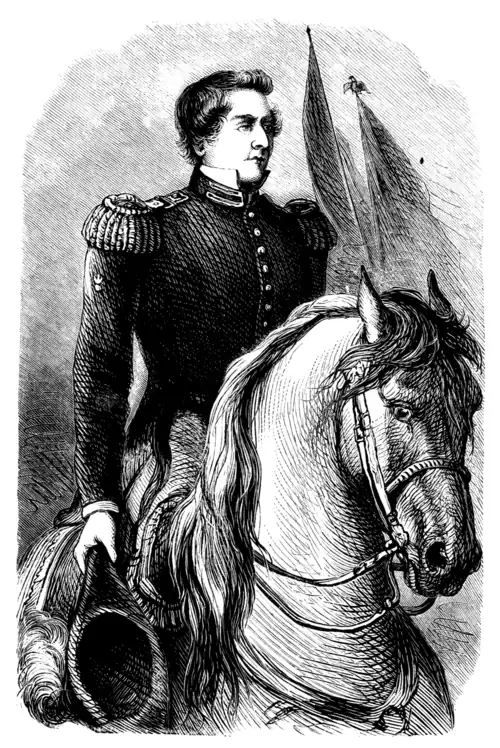
LIEUTENANT-GENERAL JOSEPH SMITH.
[Prophet, Seer, and Revelator.]
- ↑ "Mysteries and Crimes of Mormonism," p. 61.