The Rocky Mountain Saints/Chapter 12
- THE PROPHET BECOMES A BANKER.
- Apostates and Capitalists bring him to Grief
- Sidney Rigdon's Interesting View of a "Circulating Medium"
- He assures Mr. Jones that the Bank-notes were never intended for Redemption
- The Kirtland Safety Society Bank repudiated
- Joseph and Sidney fly to Missouri
- Pursued by Armed Men
- Extraordinary Escapes
- "The Lord" protects them.
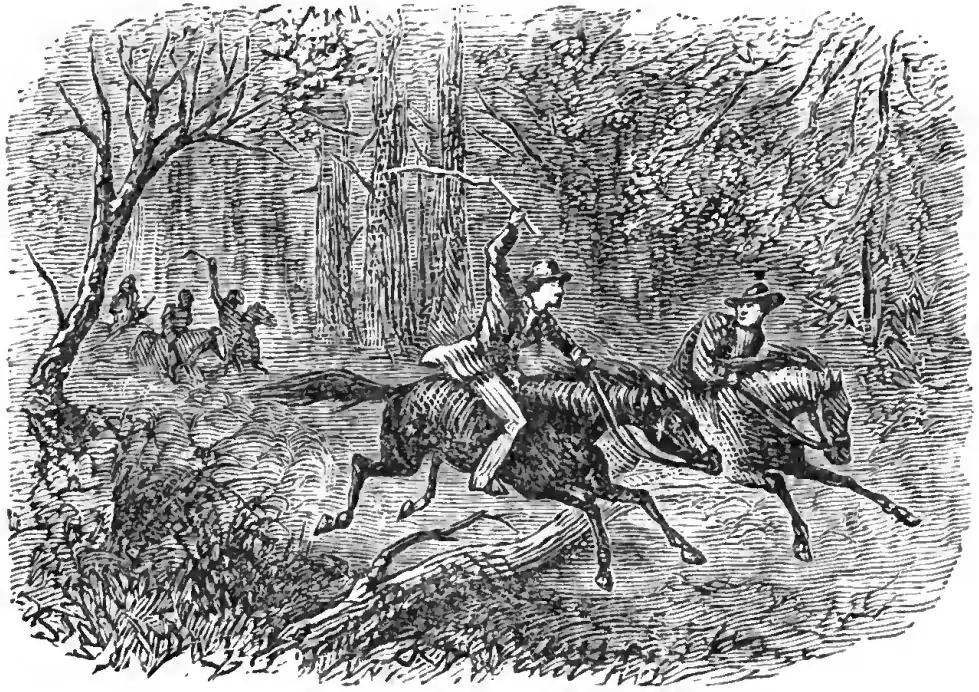
Some time preceding the apostacy, the Prophet had added to his responsibilities that of being the cashier of a Safety Society Bank, of which his counsellor Sidney Rigdon was President. In connection with this some very hard stories are told about Joseph and the leading men, and Joseph is in turn as severe against the "apostates" and the Gentiles who conspired to break his bank and get him into trouble. The bank was not a success; indeed, it was altogether a failure, and Joseph and Sidney were obliged, through the operations of "apostates" and bankers, to leave very hurriedly for Missouri—"between two days." The evening of the 12th of January, 1838, found them on the wing; and Brigham had left precipitately three weeks before that. The necessity for flight was somewhat pressing, as the historian states that the cashier and president made about sixty miles the first night, and "their enemies" continued the pursuit for about two hundred miles. The pursuers were often close upon the fugitives, and sometimes passed them on the road. On one occasion they stopped with them all night in the same road-side inn, with only a thin partition between the two parties, and once they even overtook and examined them without recognizing their features. For these wonderful escapes "the Lord" is duly credited. He protected His servants, and blinded their pursuers.
This banking episode in Kirtland clearly shows the confidence which the "outside world" placed in the integrity of the Mormon leader at that early period of his life. The notes of the Safety Society Bank were received with greater confidence than most of the bank paper then in circulation in the West. The banks in Ohio, Pennsylvania, Indiana, and Illinois no longer paid in specie, but were doing a "suspended business.' The Safety Society paper obtained a wide circulation; for, however fanatical and deluded the people might be considered, their honesty had up to this time never been questioned.
"The names of Joseph Smith as cashier and Sidney Rigdon as president were signed to the beautifully engraved bank-notes. As these men professed to be prophets of the Lord, having daily communion with angels, with Christ, and even with God himself, no one supposed that they would lend themselves to a fraudulent issue of bank paper. Those who saw the notes to which their names were attached supposed the bank to be simply a savings institution in which the Saints could deposit their earnings, while they would be invested so as to pay interest, and that the notes represented actual money in bank, or the paper of good men."[1]
This kindly supposition was further extended, and the Safety Society Bank paper became a favourite medium of circulation with Saint and sinner. Bankers took it freely, and the people preferred it because it was "safe," while so much other paper at that period was of very doubtful character. The outfitting of the Eastern Saints for Zion in the west, the purchasing of cattle, wagons, farming and mechanical tools, and everything needed for a new home, afforded the paper, under such a favourable reception, an extensive circulation. But a crisis came which the Mormon historian charges to the wiles of the devil aided by "apostates," the bankers being the direct instruments. Joseph accused the bankers of having combined to crush him, and the bankers claimed that they only wanted to be assured of the ability of the Safety Society Bank to meet its liabilities before they received too much of its paper, which was surely not a very unreasonable precaution.
The Pittsburg bankers deputed a Mr. Jones, one of their number, to visit Kirtland, and with a well-packed satchel he found himself in due time in the presence of the inspired bankers. Mr. Jones's recital of that interview is very touching.— He first enquired about the success of "the Lord's cause," and how it prospered everywhere, and evinced considerable interest in the Latter-Day religion in general. This he claims was a matter of courtesy, but it was unfortunate, for on opening the satchel and producing huge bundles of the Safety Society Bank paper, the whole proceeding was regarded by brother Rigdon, the President, as "the march of a wolf in sheep's clothing," which opinion Sidney unhesitatingly announced to the astonished Jones. Brother Rigdon must have very largely mingled humour with his severity, for he is reported to have told the Pittsburg banker that the paper had been put out as a circulating medium for the accommodation of the "people," that it would be an injury to them for the paper to come home and be redeemed, that it could only benefit them by remaining out. The bank redeemed nothing. Mr. Jones pleaded for a deviation from the rule in his case, and pledged himself never to return with Safety Society paper, if only this time he could get the cash or convertible paper of other banks. Sidney was, however, faithful to the programme of the bank, exasperating Mr. Jones with the information that they "had never asked him or anyone else to take the paper," and referring him to that important epoch' when the profession to which Mr. Jones belonged were scourged and driven out of the Temple at Jerusalem. Mr. Jones returned to Pittsburg, and when the bankers heard the above report from their representative, no more of the Safety Society Bank paper was taken. Silence was maintained for a time, and, acting out the saying "dog eat dog," much of the unredeemed paper was put out, but at the same time much of it was forced back into the hands of the bankers by those who received it from them.
That Joseph Smith and Sidney Rigdon contemplated in that experiment a deliberate swindle, is very inharmonious with their life and programme at that period. The large number of Saints who were looking to them for direction, suggested the bank as a protective measure against the frequent losses by the failures of that period; and with the credit of a good name, which is admitted on all sides to have existed, the Prophet established the Kirtland Bank. Had not trouble arisen among themselves, and the usual amount of detraction ensued, which weakened the confidence of the Saints, and led them to present their own bank paper for redemption, it is very probable that Mr. Jones would have got his money. But this precautionary combination of bankers at Pittsburg, coming as it did at an untoward moment, killed the Prophet's institution. As some one must be abused, it is very natural that the responsibility of that inevitable fiasco should be relegated to the shoulders of his Satanic Majesty. It was well known to the Saints that he was the guilty party, and was trying to break up "the kingdom."
All these troubles were spoken of by Joseph as "persecution." Of his flight from Kirtland he writes:
"A new year dawned upon the Church at Kirtland in all the bitterness of the spirit of Apostate Mobocracy, which continued to rage and grow hotter and hotter, until Elder Rigdon and myself were obliged to flee from its deadly influence, as did the apostles and prophets of old, and as Jesus said, 'When they persecute you in one city, flee ye to another;' and on the evening of the 12th of January, about 10 o'clock, we left Kirtland on horseback, to escape mob violence which was about to burst, upon us, under the colour of legal process to cover their hellish designs, and save themselves from the just judgment of the law. The weather was extremely cold, and we were obliged to secrete ourselves sometimes, to elude the grasp of our pursuers, who continued their race more than two hundred miles from Kirtland, armed with pistols, etc., seeking our lives."
After this, the Prophet never returned to Kirtland, but he appointed an agent for the settlement of his own unfinished business in Ohio. In different parts of his autobiography he publishes cards from business men expressive of their satisfaction at the manner in which the agent had adjusted the accounts. The Prophet disclaimed any responsibility for the failure of the bank, and charged one of the brethren with dishonesty, which produced this result. He was evidently proud of a good commercial name.
Before this period, and when all was pleasant in Ohio, it was announced that "the Lord" had accepted the Saints there and had established his name in Kirtland for the salvation of the nations. But this honour was short-lived. Kirtland was soon abandoned for ever. Joseph and Sidney as fugitives took their families with them to Missouri, and overtook Brigham Young and his family before they reached the promised land. The experience of the prophets and apostles had been anything but pleasant in the East; it was destined to be worse in the West. They arrived in Far West on the 12th of March, 1838, and in less than a month they had to cut off from the Church two of the most important witnessess of the Book of Mormon.
- ↑ Extract from a letter by a Pittsburg banker to the Author.