The New International Encyclopædia/Telautograph
|
| TELAUTOGRAPH |
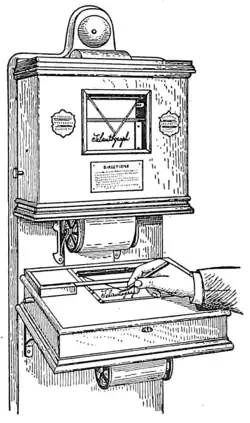
TELAUTOGRAPH (from Gk. Τῆλε, tēle, afar + αὐτός, autos, self + γράφειν, graphein, to write). An instrument invented by Elisha Gray for electrically reproducing at a distance handwriting, drawings, figures, and the like. A transmitter and receiver are associated together for use at each station, and are connected by two line wires with a similar set at the distant station or with a central exchange. Power corresponding to the amount used in two ordinary incandescent lamps is taken at each end from the electric lighting circuit. The motion of a pencil in writing is resolved into two component motions by connecting to the pencil points two light levers, hinged at their junction to the pencil. The motion of these rods is communicated to two rotary shafts, to which are attached arms, carrying at their outer ends contact rollers, which move to and fro upon the surfaces of two arc-shaped plates, upon which is wound resistance wire, forming part of the power circuit. The motion communicated to the rollers by the pencil serves to cut resistance in or out of two circuits, and thus two independent, variable currents are obtained, which depend for their strength upon the position of the pencil on its writing surface. At the receiver are two strong electro-magnets, each one having one of its poles inclosed by the other, forming two annular spaces, across which the magnetic fields are uniform and constant. In these annular spaces are suspended two light coils of copper wire attached to bell-crank devices and light rods to a set of shafts and levers, similar to those at the transmitter. The pull of each magnetic field upon these suspended coils is opposed by a retractile spring, and the pen at the receiver is thus caused to take a position in its writing field exactly corresponding to that of the transmitter pencil.
.jpg)
|
| TELAUTOGRAPH WITH CASE REMOVED SHOWING MECHANISM. |
The switching on of the transmitter by means of a switch at the transmitter end automatically brings fresh paper to the writing surface from a roll beneath the transmitter, throws the receiver at the distant end into operating position, shifting its paper and raising the pen from the ink-well ready to write. When the transmitter is switched off no current is consumed at either end. A small switch placed beneath the writing surface at the transmitter is opened and closed by the pressure of the pencil thereon, and serves to control by means of induced vibratory currents and a suitable relay, the receiving pen, causing it to be raised from the paper or lowered to it, in unison with the movements of the transmitting pencil. The ink is automatically supplied to the receiver pen, and when not in use the pen rests with its tip immersed in the ink, and thus is always ready for service. The writing field is 2 inches by 5 inches, thus affording space for three lines of ordinary writing, each 5 inches long. Upon this field the writing is done and when filled a simple movement of the switch at the transmitter brings fresh paper into service at both ends of the line. A small push button serves to operate a call bell, by which all signaling is done.
The instrument is used by the United States Army in transmitting messages from the range-finding stations in the coast defenses to the high-power guns, telephones having been found unsatisfactory for this service, because disabled by the unavoidable shock. In commercial work the telautograph can be conveniently employed, as it makes a double record of each message, one for the sender and one for the person addressed.