The New International Encyclopædia/Diamond (precious stone)
DIAMOND (OF., Fr. diamant, It., Sp. diamante, from Lat. adamas, adamant, diamond, from Gk. ἀδάμας, adamas, adamant, from ἀ, a priv. + δαμᾶν, daman, Skt. dam, to subdue). A precious stone composed of pure carbon, remarkable for hardness, lustre, and flash of color. It crystallizes in the isometric system, usually in octahedrons, or in combinations of several forms, including the octahedron, cube, rhombic dodecahedron, trisoctahedron, and hexoctahedron; the faces and edges of the crystals frequently are curved. It has a very perfect cleavage, by which the primary form of the octahedron may be derived. The diamond is not acted upon by acids or alkalies, but if heated to a high temperature in the presence of oxygen it burns to carbon dioxide. Its brilliant lustre and display of prismatic colors are due to the property of refracting and dispersing the light-rays, a property possessed in the highest degree by colorless stones. The specific gravity of the diamond is 3.52; its hardness, which is assumed to be 10 on the mineral scale, exceeds that of any other known substance. By friction it becomes phosphorescent and positively electric. The diamond has a great variety of natural colorings; white, yellow, and brown specimens are the most common, but pure white and fine shades of brown and yellow are quite rare and command high prices. Red in rich, deep tints is perhaps the most prized of all colors, while blue and green are also highly valued owing to their beauty and rarity. The amorphous steel-gray to black diamond, known as ‘bort’ or ‘carbonado,’ which is unsuitable for gems, is extensively used on the cutting edge of drills for tunneling and prospecting.
Occurrence. Previous to the discovery of the Brazilian mines in 1727, diamonds were found chiefly in India and Borneo. In India they have been obtained near Kadapa, Karnul, and Bellari in Madras Presidency; near Nagpur, in the Central Provinces; and at Panna, in Bundelkhand. The famous Golconda was a market in Madras Presidency where the diamonds were collected from the mines. Formerly the diamond-mining industry gave employment to a large number of people, but, owing to the gradual exhaustion of the deposits and the crude methods of working, it has steadily declined. The diamond-mines of Borneo, which supply about 3000 carats annually, are located in the western part of the island near Pontianak. The Brazilian diamonds come from a small district within the States of Bahia, Minas Geraes, Goyaz, and Matto Grosso, being found for the most part in placers. Diamantina, Bagagem, and Abaete in Minas Geraes are the principal localities for gem-stones, and Lençoes, Sincorá, and Santo Ignacio for carbonados. The alluvial deposits consist of waterworn quartz pebbles, and ferruginous clay, carrying rutile, hematite, ilmenite, and other minerals besides the diamonds. In one locality (Bagagem) the stones are found in a weathered, decomposed phyllite; they are also known to occur elsewhere in conglomerate. The total output of the Brazilian mines up to the year 1899 has been estimated by one authority at 13,105,000 carats. The most valuable specimen from this source is the “Southern Star,” found in 1854, which weighed 254 carats in the rough, and 124 carats after cutting. The South African diamond-fields yield about 98 per cent. of the total product. Their discovery in 1867 came from the purchase of a stone that had been picked up by the children of a Boer farmer, and which was subsequently sold in Paris for $2500. The diamonds are found in both river diggings and dry diggings. River diggings occur along the Vaal River from Potchefstroom down to the confluence with the Orange, and up the latter river as far as Hopetown. Mining is conducted in a similar manner to gold-washing, the operations usually being on a limited scale. The dry diggings are in Griqualand West, on the borders of the Orange River Colony, about 640 miles northeast of Cape Town. They comprise a number of small areas of circular or oval form, ranging in diameter up to one-fourth of a mile. Originally the areas were divided into small claims, each owned and operated independently, but they are now worked by a single company, the De Beers Consolidated Mines, Limited, whose headquarters are at Kimberley. The mines are opened on a large scale, and yield enormous profits. It is stated that the output from 1867 to 1897 was over 33,000,000 carats, or about 7½ tons, valued after cutting at $450,000,000. In the fiscal year 1901 the De Beers Company received $23,144,225 from sales of rough diamonds. The South African diamonds in the average do not equal the Brazilian for purity, although some of the most valuable stones, remarkable for quality as well as for size, have been found in these mines. Other countries where diamonds are known to occur are the United States, British Guiana, Russia, China, Sumatra, and Australia. In the United States there are no deposits, so far as discovered, of sufficient value to warrant mining operations, the stones being found only occasionally in alluvial materials and drift. More than fifty specimens have been identified, of which the largest, weighing nearly 24 carats, was found at Manchester, Va., in 1855. Their occurrence is generally confined to the regions of the southern Appalachians, the Great Lakes, and to the Coast and Sierra Nevada ranges of California and Oregon. The diamond-fields of British Guiana are about 250 miles up the Mazaruni River, and, while new, they give some promise of future importance. New South Wales produces about 25,000 carats annually from alluvial washings near Mudgee, and on the Macquarie River. In Russia, diamonds occur on the western slopes of the Urals, and are obtained in the washing of sands and gravels for gold.
Origin of Diamonds. The problem as to the origin of the diamond, once a favorite subject of speculation, has been studied recently by scientists with some success. In this connection, the South African fields are most significant. As previously stated, the deposits are circular or oval in form, and it has been found that they are inclosed by a wall of carbonaceous shale. For a considerable distance below the surface, the deposits consist of a yellowish, friable material called by the miners ‘yellow ground,’ but when, with depth, the limit of atmospheric weathering has been reached, they pass into a partially serpentinized olivine-pyroxene rock of igneous character, known as ‘blue ground.’ These facts indicate that the deposits occupy the vents or pipes of ancient volcanoes, and it is therefore probable that the presence of the diamond is connected with volcanic activity, the stones either having been brought up from the interior of the earth, or having been formed in place under the influence of the molten rock in contact with the carbonaceous shale. The French geologist De Launay has argued that the diamonds have come up from below. This view seems to be supported by the fact that their occurrence is apparently independent of the inclosing rock, whether this be the carbonaceous shale found at the surface or the underlying diabase and quartzite. The conditions necessary for the crystallization of carbon in the form of diamond would seem to be intense heat and great pressure, such as exist during the formation of igneous rocks. Successful attempts to reproduce these conditions artificially have been carried out by Professor Moissan of Paris, and also by the English chemist Professor Crookes. The method employed consists in heating pure prepared carbon and iron in an electric furnace. By sudden cooling of the molten iron, the surface contracts and exerts a powerful pressure upon the interior mass. When cold, the iron is dissolved in acid, and small black particles remain which exhibit the properties of genuine diamonds.
Value. The value of gem diamonds cannot be determined by absolute standards. Weight, cut, brilliancy, color, and perfection of the stones are factors that must be considered in estimating the value, which is, moreover, subject to fluctuation. Colorless stones bring higher prices than off-colored stones, but if decided tints of red, blue, or green are present they may increase the value abnormally. The value ordinarily increases in a ratio increasing with the weight, but this rule does not hold good for the largest stones, the prices of which cannot be fixed. Diamonds in the rough generally average $8 to $15 the carat for the run of the mine.
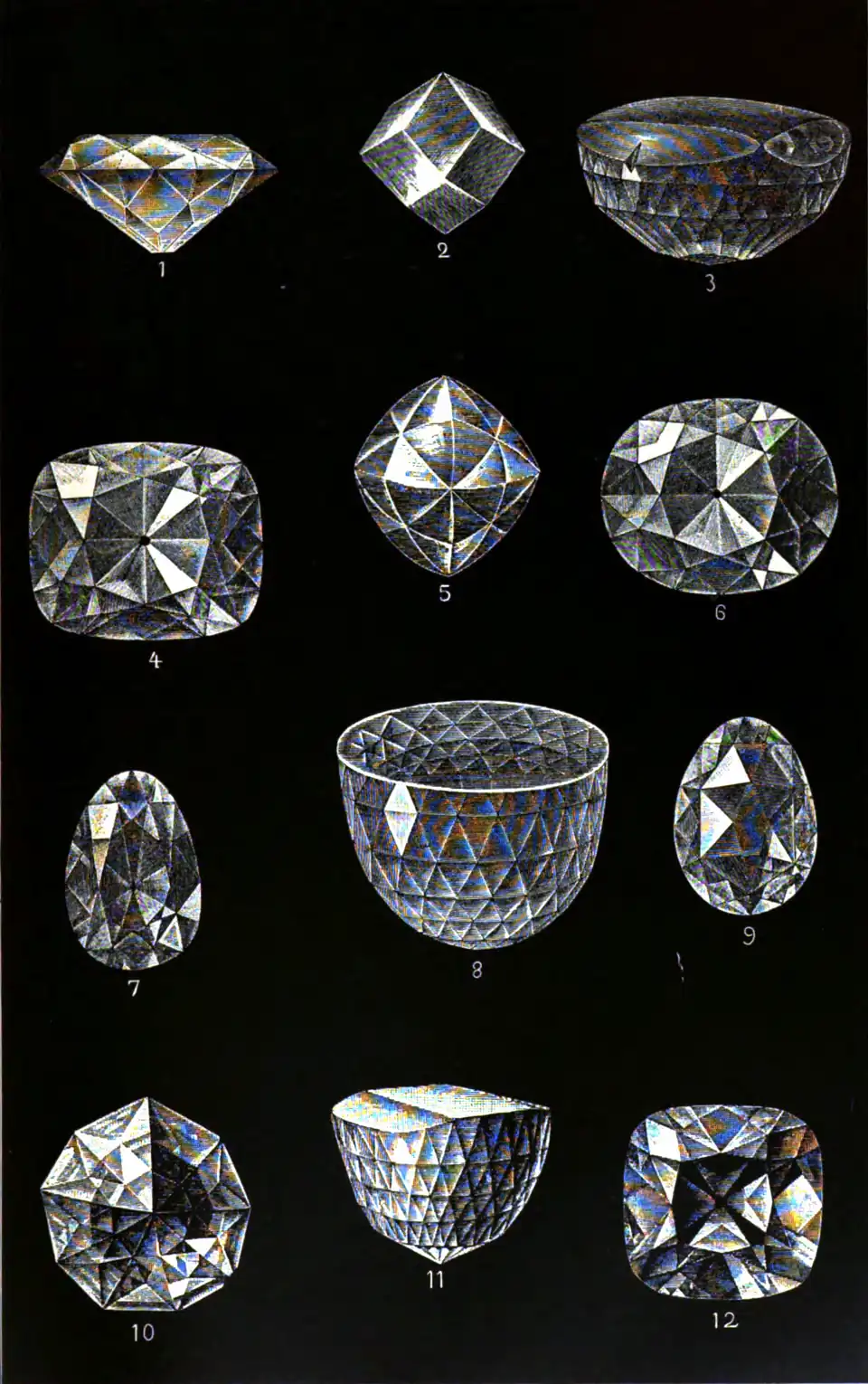
Remarkable Diamonds. The most valuable gems, among which there are some exceeding 100 carats in weight, are generally owned by royal families or are treasured by governments as State jewels. One of the largest is the Orloff, owned by the Czar of Russia, which weighs 195 carats, and is cut in rose form. Its origin is doubtful; according to one account, it was stolen from a Brahman temple in India, while another indicates that it was owned by Nadir Shah of Persia, and came after his death into the hands of an Armenian merchant. In 1772 it was purchased by the Empress Catharine II., at a price said to have been $450,000, besides an annuity of $4,000 and a Russian title. The Koh-i-nûr, weighing 102¾ carats, and owned by the royal family of England, was found, according to legend, in India long before the Christian Era. After having been handed down through a long line of Indian princes, it was seized during the British invasion of the Punjab, and carried to England. The stone is said to have weighed originally 794 carats, having been reduced to its present size by repeated cutting. The Regent or Pitt diamond in the Louvre in Paris, weighs 136 carats, and is valued at $2,500,000. It is perhaps the finest of large brilliants. The Hope diamond, weighing 44¼ carats, is a beautiful blue stone, valued at $125,000. A light green diamond of 48½ carats, in the Green Vault at Dresden, and a red diamond of 10 carats, among the crown jewels of Russia, are unique specimens. Among the most valuable stones found in recent times are the Victoria, weighing 180 carats, which was purchased by the Nizam of Hyderabad; the De Beers, weighing 225 carats; and the Tiffany, weighing 125 carats.
|
| DIAMOND-CUTTING |
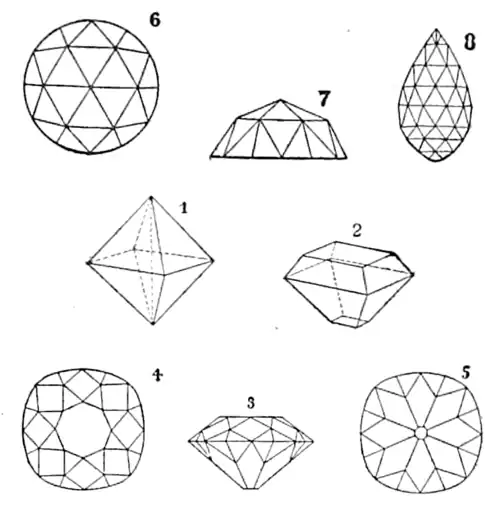
| Figs. 1–5—the Brilliant: 1 and 2, fundamental form; 3, 4, 5, side, top, and back views of the cutting. Figs. 6 and 7, top and side views of the Rose cutting. Fig. 8, view of the Briolette cutting. |
Diamond-Cutting. The art of diamond-cutting was not developed until the middle of the fifteenth century, although crude methods of polishing were in use long before that time. About 1470 a guild of lapidaries was established at Bruges, under the direction of Louis de Berquem, who is thought to have been the first to devise a regular plan for the arrangement of facets, so as to increase the color effects in gems. Other guilds were soon founded in Antwerp and Amsterdam, and these cities rapidly gained pre-eminence in the industry, a position they still maintain. London, the market for rough stones, is a small competitor, while Paris and New York are unimportant, except for the sale of gems.
In diamond-cutting, the operations are performed with the single object of producing the most valuable gem from a crude stone. The apparatus used is simple, but its manipulation requires both skill and experience. In the first place, the stone must be examined carefully to determine its shape, color, and the possible presence of flaws, as these features will govern the operation of cutting. If the shape is such that it cannot be reduced readily to one of the usual forms, the stone may be divided into two or more parts by taking advantage of the natural cleavage. The diamond is cemented to a wooden holder and a steel blade is applied in a direction parallel to an octahedral face. A sharp blow upon the back of the blade is sufficient to accomplish the cleaving. The next process (bruting) brings out the facets. Two rough stones, fixed at the end of holders, are held in either hand of the operator, who presses them against each other, at the same time giving them a rubbing motion. The friction wears away the surfaces gradually until they coincide in position to two of the facets. The diamonds are then cemented in new positions, and the operation is continued. The waste particles of dust are collected and used in the final process of polishing. For this the apparatus consists of a small disk of spongy cast-iron, turning on a vertical spindle at a speed of 2000 to 3000 revolutions per minute. The stone, imbedded in the apex of a metallic (lead-tin) cone is held by a clamp against the surface of the disk, which is smeared from time to time with a mixture of olive oil and diamonddust. This operation requires constant attention, as the stone may be permanently damaged by over-heating.
Of the several forms in which diamonds are cut, the brilliant is the favorite. It is derived from the fundamental octahedron and requires, when perfect, 58 facets. In the middle is an octagonal facet called the ‘table,’ which is surrounded by 32 smaller facets, reaching to the line of union (girdle) between the upper and lower portions. On the lower portion there are 24 facets symmetrically arranged around the ‘culet.’ The rose form is used for thin stones. It consists of a number of triangular facets, the apices of which meet in the crown, and whose bases are supported by a second row of facets extending to the girdle. The lower part is perfectly flat. In the briolette the stone is cut into triangular facets, but the form is pear-shaped and there is no girdle.
Bibliography. Kunz, Gems and Precious Stones (New York, 1900); Streeter, Precious Stones and Gems (London, 1894); Streeter. The Great Diamonds of the World (London. 1882); Church, Precious Stones (London, 1883); De Launay, Les diamants du Cap (Paris, 1897); Beaumont, Report on a Journey to the Diamond Fields of Minas Geraes (London, 1899); Claremont, “The Cutting and Polishing of Precious Stones,” The Mineral Industry, vol. viii. (New York, 1900). For methods of distinguishing diamonds, consult Claremont, “The Identification of Gems,” The Mineral Industry, vol. vii. (New York, 1899). See Gems; Carbon.
| DIAMONDS |
|
| REMARKABLE DIAMONDS. |
| 1 and 4. SOUTHERN STAR. 2 and 5. NATURAL CRYSTAL FORMS. 3 and 6. KOH-I-NUR—Old and new cuttings. 7. GREEN DIAMOND, In Green Vault, at Dresden. 8. GREAT MOGUL. 9. SANCY. 10. FLORENTINE. 11. ORLOFF. 12. REGENT, or PITT. |