The Handbook of Palestine/Part 6
Succession of Rocks.—The succession of rocks in descending order hitherto recognized in Palestine is as follows:
V. Quaternary: Post-Glacial and Pleistocene;
IV. Cainozoic: Pliocene, probably Miocene, Eocene;
| III. Mesozoic: | (2) Cretaceous | Upper: Senonian, Turonian, Cenomanian; |
| Lower; | ||
| (1) Jurassic; |

II. Palaeozoic: Cambrian probably (Hull considered it Carboniferous);
I. Pre-Cambrian.
I. Pre-Cambrian Rocks: These oldest rocks are found in the east side of the Ghor, from the Lisan Peninsula, near the south end of the Dead Sea, southward.
They consist of crystalline schists, gneiss and granite. Grey granite may be seen forming a dark rugged foothill in the east wall of the Ghor just north of Wadi Hesi at the south end of the Dead Sea.
The above rocks are cut by red and pink granite and felsites. In addition to the felsite, which is an old volcanic rock, there are occasional masses of volcanic agglomerate, containing, besides blocks of felsite, some of granite. Such a mass occurs at the base of Jebel Labrush near al-Safieh.
These ancient rocks formed the floor of an old continent that suffered heavy erosion before being submerged in a later pre-Cambrian and Cambrian sea. As its waters encroached on the old land, boulders accumulated on the shore, over which, as the waters deepened, sands were deposited. This has given rise to the formation of conglomerate and sandstone, which may be seen on Wadi Hesi. Shoulders of rock protruding through the terrace deposits, that join the Lisan peninsula to the east, are also of conglomerate.
II. Cambrian: As depth increased, beds of lime carbonate, the remains of the animal life of the sea, were laid down; and these have been preserved as a dark dolomite which overlies the sandstone of Wadi Hesi. From the fossil remains found in it, it is considered to be of Cambrian age.
For succeeding geological ages the district as a whole would appear to have been land since, except for some Jurassic limestone on Mount Hermon and in the Lebanon; no rock formations are met with until we come to the Cretaceous, and the first of these is a Shallow water formation.
III. The Mesozoic series:
(a) LOWER CRETACEOUS.
Along the east coast of the Dead Sea is a uniform sandstone, to whose variegated hues much of the admired colour effects of the "Mountains of Moab" are due. It extends southward above the old rocks almost to the Gulf of Akaba. On the west side of the Ghor it does not appear until the Gulf of Akaba is approached (except perhaps under Jebel Usdum). This great sandstone formation is spoken of as the Nubian sandstone, as it is supposed to be the same as this Egyptian rock.
(b) UPPER CRETACEOUS.
Following the deposition of the sandstone, this country, in common with a large part of eastern Asia, northern Africa and southern and middle Europe, was more deeply submerged, and there was deposited the great thickness of limestones which form the greater part of Palestine, namely, the plateau country east of the Ghor and the hill-country of western Palestine,
These rocks may be subdivided, in descending order, as follows:
Senonian: About 800 feet of soft white limestone and chalk with numerous flint bands. A few beds show incipient crystallization; one bed has limestone concretions up to six feet in diameter.
Turonian; About 700 feet of hard limestone and dolomite with flint at certain horizons; some bands of oolitic limestone and marl; the hard bands are crystallized in places to marble: the upper beds weather reddish or somewhat variegated.
Cenomanian: About 1100 feet of hard yellowish limestone and dolomite with bands of soft marl and chalk.
While from a little distance these subdivisions may usually be broadly distinguished, especially the soft, white Senonian, on the spot the line of demarcation is often difficult to pick out without the aid of fossils, and fossils are not plentiful except in certain-beds, and even here the forms are often obscure. In the environs of Jerusalem fossils may be obtained. At the base of the Senonian about Nebi Musa and Mar Saba is a highly fossiliferous horizon. Below it at Nebi Musa and on the new Jericho road near by is the well-known black bituminous limestone, "Moses stone" or "Dead Sea" stone, or "stink-stone." It weathers light grey, but the fresh fracture is brown in the less bituminous and jet black in the highly bituminous beds. Below this bituminous limestone is a spotted brown one made up largely of fish remains and foraminifera.
The dark flint is characteristic, especially if the Senonian beds occur as nodules and bands. The latter are found between the beds of the formation and are continuous over long stretches. They sometimes attain a thickness of two feet. As they resist weathering, they stand out conspicuously from the soft limestones. The flint is formed by the solution and redeposition of silica from sponge and other animal remains in the rocks.
It is interesting to note that in Cretaceous times the conditions in Palestine and in England were similar. Both were deeply under water, in both immense deposits of lime carbonate were laid down, in both the latest beds are chalks characterized by richness in flints.
The distribution of these rocks is easily understood when the structure is noted. The hill-country is formed by the folding of the rocks into an arch or anticline. Off the highest part of the arch the soft Senonian beds have been removed by denudation, uncovering the harder Turonian limestones and marbles. Thus, coming from the Coastal Plain, the first beds met are the Senonian chalks and limestones; then, when the beds rise up in the limb of the arch, the Turonian is exposed, and these beds form the backbone of the hills. Beyond Jerusalem, on the gently dropping eastern slope, the white Senonian is again seen, in many places disturbed so that the flint bands are frilled, curled and crumpled; the lower harder beds of the Turonian and Cenomanian form the rock terraces and wall of the Ghor (except just north of the Dead Sea, where the Senonian descends to the Jordan Valley), and the walls of the deeper wadis.
At a few points, as on Mount Carmel, basalt is found in the Turonian but not in the Senonian, suggesting some volcanic activity in the Cretaceous between these two periods.
IV. and V. Tertiary and Quaternary Series:
(a) EOCENE.
At a number of points in Samaria and northwards there occurs a limestone which, from its nummulitic fossils, is evidently of Eocene age. The most southerly occurrence is on the hills about Nablus. Fossils may be collected on Mount Gerizim.
(b) LATE TERTIARY AND RECENT.
It was probably soon after these Eocene limestones were formed that the land was upraised from the sea and began to take on its present aspect, for no widespread miocene or later marine deposits have been found. Before commenting upon its recent history, which is somewhat complicated and not fully worked out, it will be well to mention the remaining rocks and other records upon which such a discussion must be based.
(c) MARINE.
Along the Coastal Plain, from below Gaza northward, there are at intervals exposures of a yellowish, reddish, or brownish weathering sandstone with a lime carbonate cement. It is sometimes fairly hard, but it is generally porous and soft. It is a comparatively recent formation though sufficiently consolidated to show jointing. Its exact age is as yet uncertain, but it is probably Pliocene or early Pleistocene.
Younger than this are the sands, gravels and shell-beds that mark an encroachment of the Mediterranean to an elevation of 220 feet above its present level. These sea-beds are well exposed between Jaffa and Ramleh. Near the latter they are represented by a calcareous conglomerate—the old beach. They are, no doubt, middle or late Pleistocene.
The recent alluvium and sand-dunes may hide other marine formations, just as they cover much of these just mentioned.
(d) LACUSTRINE AND FLUVIATILE.
The highest terraces of the Ghor, marking the extreme limits of the lake, consist of gravel or shingle, at an elevation a little above that. of the Mediterranean. Such are the terraces about Safed, around Lake of Huleh, in the Araba valley, at Ain al-Weibeh, and on Samrat al-Fiddan.
The lowermost beds at the mouths of the larger wadis consist of boulders and sand, bearing evidence of the eroding power of these streams when the climate became moist enough to furnish water in excess of the loss by evaporation, and the Dead Sea began to rise and fill the Ghor.
The material that forms the main terraces of the Ghor, so well exhibited along the Jordan and along the coast of the Lisan peninsula, is quite different. While some clay beds occur near the bottom, it consists almost entirely of finely laminated marl, gypsum and salt. Over a considerable thickness the laminae average no more than ⅛ in., and they are sometimes as fine as paper, but even the thinnest are continuous. They are the precipitates deposited after the climate had again become dry and the waters of the lake were being evaporated.
A pair of laminae of marl, gypsum and salt no doubt represent the deposits of one year, so that by counting these an accurate estimate of the length of time occupied in their formation could be obtained.
At several horizons in the Dead Sea formation large concretions of gypsum are forming, with long crystals of gypsum radiating from the centre. In these gypsum horizons nodules and also thin bands of light flour sulphur occur. Sulphur also forms coatings on the gypsum. One of these horizons is about forty feet above the Jordan, and a second about 120 feet above. The sulphur occurs in the same way and at similar horizons down to the south end of the Dead Sea.
Into the Dead Sea formation the Jordan has cut its channel. One of its flood plains is 20 feet above the summer level of the river and one 40 feet. Yellowish or reddish weathering stratified clays, deposited by the Jordan, occasionally veneer the lowest terrace of Dead Sea formation, or cover lower levels of it to a height of 70 feet.
(e) VOLCANIC ROCKS.
Masses of basalt are found capping the plateau of Moab, and sending streams down the gorges and slopes toward the Dead Sea; the dark lava showing up conspicuously against the light colours of the limestone or sandstone. It may be observed near Wadi Mojeb (Arnon), the Plain of Zara, Wadi Zerka, and on the north-east corner of the Dead Sea, where it plunges beneath its waters.
Above Lake Tiberias the basaltic lavas occur on the west side of the Jordan; the lake has basalt on all sides of it. The most important mass of basalt on the west is Jebel Safed. At Jebel Jish, 5 miles north-west of Safed, an extinct crater may be recognized.
In all these volcanic outpourings only basaltic rocks have been met with. It will be noted also that, except about Tiberias, volcanic activity has been confined to the east side of the Ghor.
Vulcanism extended over a considerable period and up to very recent, but not historical time (the nearest historically active volcano is near Medina). That it extended over a considerable period is shown by the successive lava flows and the erosion of an older before the outpouring of a succeeding one. That it continued until very recently is shown by the freshness of the cones, by the lava flows, constituting the most recent feature in the topography, and by the hot springs that are still active in these volcanic centres, while some of the springs in the Ghor may derive their comparatively low temperatures from the rock temperature at their source or from chemical change in the gypsum of other salts. The very hot springs are associated with the volcanic centres and undoubtedly are connected with vulcanism. They afford evidence that volcanic heat has not yet disappeared. In fact, volcanic activity might again be renewed. The great earthquake of 1837 which destroyed Tiberias, killing thousands, is a further reminder that the district has not yet settled down to quiet life.
The Ghor.—The Ghor is a great fault or dislocation in the earth's crust, along which the west side has relatively sunk. This fault may be seen in the Araba valley on its east side, where Cretaceous limestone is brought into contact with the old Pre-Cambrian rocks. At the south-east end of the Dead Sea these old rocks are still exposed. Along the east side of the Dead Sea the lower Cretaceous sandstone forms the base of the exposed formations, while on the west the upper Cretaceous limestones occupy this position. This discrepancy in the level of the same horizon on the two sides of the Ghor amounts to 5000 feet at Mount Hor and about 1000 feet along the shore of the Dead Sea. The actual fissure is not visible from the Dead Sea northwards, as it is covered by the sea or its deposits; but the east wall of the Ghor is the fault scarp, for it cannot be the result of erosion, since there has been no glacier in this valley, neither has there been a river flowing into the sea, as is shown by the rock-bed in the Akaba Valley at the watershed 660 feet above sea-level or 1952 feet above the Dead Sea. Indeed, the scarp itself shows that it is not river-eroded, for there are no interlobes but a straight wall between the tributary streams. The evidence for this fissure is conclusive, but the simple fissure and the sinking of the west side do not suffice to explain the complete trough. For the deepest portion of the trough is not where such sinking has been greatest, but where it is only 1000 feet; indeed, where it is greatest is the highest point in the trough. Nor is there any sign of warping. The full explanation would appear to be that this is one of the rare instances in which a trough has been formed by a sinking in of a strip of the earth’s crust between two parallel faults (dislocations). The floor of the Ghor has dropped down. This would account for its deepest portion (over 2600 feet below sea-level) being in its centre. It would also answer the question as to what has become of the materials that once united the walls of the Ghor.
The formation of the Ghor commenced at the close of the Tertiary or beginning of the Pleistocene, and reached practically its present state before there set in the moist period, that produced glacial conditions in northern Europe. The climate must have been much the same as at present, for the old cañons of the Zerka and the Mojeb are very similar in size, shape and depth to their present ones. When the moist or Pluvial period came and the level of the old Dead Sea rose, they filled in their old canons with gravel.
During this Pluvial period, which no doubt was contemporaneous with the glacial period in Europe, the Dead Sea, as we have seen, rose to a height of about 1400 feet above its present level, forming a fresh-water lake from forty miles south of the Dead Sea to north of Lake Huleh, nearly 200 miles long. The beach deposits, rock terraces and cliffs show that it maintained this level for some time.
Following the Pluvial period came a period so dry that the waters of this great Jordan lake evaporated until only a remnant was left, a Dead Sea smaller than it is at present. During its desiccation various salts were precipitated, forming the thick deposits of marl, gypsum and salt that are now so marked a feature in the detailed topography of the Ghor. The long sloping terraces indicate even and continued lowering of the lake, the steep gradients pauses in the process of evaporation. A number of fresh-water shells, of which a considerable portion are existing species, are found in these deposits.
The salts in the water were derived from the salts released by the weathering of the rocks and brought in by the streams, or supplied by the thermal springs and volcanic emanations. The present water of the Dead Sea represents the remaining "mother liquor" of Jordan lake, with such additional salts as have been brought in since it reached its present stage, less the salts (mostly common salt and gypsum) that have been and still are being precipitated on the floor of the Dead Sea.
Since Kitchener's survey in 1883–4 the sea has risen 18 or 20 feet. This is positive evidence that the climate has been growing moister, but it is of course possible that this may be of short duration or subject to periodic changes of moisture and drought.
The water of the lagoon south of the Lisan peninsula is only slightly over 30 feet deep, and the channel between the Lisan and the west shore only 29 feet deep. It is quite probable that within historical times the south end has been dry land, and physically possible that tradition is correct when it fixes the sites of Sodom and Gomorrah beneath the oily waters of the Dead Sea.
The Ghor is still in a youthful condition. Its walls are still precipitous; tributaries have succeeded in excavating only narrow cañons, down which they plunge in waterfalls. Faulting of the Dead Sea deposits and the earthquakes which still occasionally disturb the district give warning that the fissuring and faulting and deepening of the Ghor may still be proceeding, and that its dark sides may once more glow with streams of molten lava and the green plateau of Damascus again be lighted up by a wide crescent of volcanic fire.
§ 2. Mineral Resources.
Sand.—The coast-line is bordered by dunes, much of the sand of which is suitable for glass making. Figures given by Dr. R. Sabath show that the total oxide of iron and alumina vary from ·42 to 1·5%; very pure limestones exist, and soda products may soon become available from utilization of Dead Sea salts. These sands also provide an unlimited supply for building purposes.
Limestone.—The limestone beds of Cenomanian and Turonian age furnish the principal building stones of Jerusalem and other towns.
They are known under the general names of mizzi, a hard limestone, and kakulé, a soft limestone.
The various divisions of the mizzi building stones appear to be somewhat confused by masons. They are
(i) mizzi ahmar—a red-flecked marble;
mizzi yasini—well bedded red and grey limestone.
(ii) mizzi Yahudi—thick bedded dark grey or yellow limestone traversed by veinlets of calcite;
(iii) meleké—a hippurite marble;
(iv) mizzi helu—a white compact splintery limestone with chalcedonic nodules of Turonian age;
(v) kakulé—a soft whitish limestone which quarries in slabs and is used for lintels, etc.
Higher up in the series occur phosphatic beds of Danian age, which form a hard but rather sombre building stone of a brown to black colour. In places the beds are entirely altered to apatite and provide beautiful green and red building stones, such as the mizzi akhdar of Beit Suhar. They are usually described as marbles, but are harder and more durable. In Galilee, where basalt is the prevalent rock, this is utilized both for road making and building purposes.
In the hilly parts of Samaria and Judaea as well as the southern part of Trans-jordania surface rocks are mostly limestone, which provides good material for burning to fat limes. Dolomite limestone and marl beds also occur, and, though the latter are often associated with gypsum, much of the material could probably be used for the manufacture of Portland Cement.
Thin bedded clays also occur in the Jordan valley and could be utilized for pottery, etc.
Phosphatic Deposits.—Immediately overlying the top flint beds of the Campanian division of the Senonian formation are the beds containing bones, coprolites, etc., of phosphatic composition. These beds are very widespread both in Palestine and Trans-jordania. They have never been properly surveyed. Hence the information available only deals with a few scattered localities. Blanckenhorn examined samples from Nebi Musa and found 30%, tri-calcic phosphate in beds 20 feet thick. It is, however, believed that much richer beds than these occur in Palestine. In Trans-jordania more careful examination has been made; and at Abu Tara three beds 10 metres, 7 metres, 3 metres in thickness occur, carrying an average of 51% tri-calcium phosphate. At Kharbet Botin the plateau contains beds 3 metres thick with 54·6% tri-calcic phosphate, Most of these deposits are close to the surface, and could very easily be quarried.
Bitumen.—Above the bone-beds there occurs in many parts of Palestine a shaly or bedded bituminous limestone, containing 10 to 30% of oil and bitumen, The best known localities are at Nebi Musa, al-Salt, Wadi al-Ouneitra, Safed, the Yarmuk valley, Bethlehem, Wadi Mahawit, etc.
Some of the material is poor in quality, but much of it would make excellent material for road asphalt. Some deposits are shaly, but those which Blanckenhorn examined contained less than 2% of argillaceous material. In composition some varieties resemble the Val de Travers asphalt, and could be similarly utilized. The richer qualities are often used as fuel; the rock, once set on fire by means of brushwood, will continue to burn.
Several attempts have been made to utilize the material by distillation, the yield of oil being 8% or more, there being also a valuable proportion of combustible gas and bituminous tarry matter.
In addition to the bituminous limestone, bitumen sufficiently pure to mine occurs in various parts of the country.
Petroleum.—Besides the above occurrences of bitumen, which are examples of inspissated oil, there occur gas emanations and sepages of oil in several parts of the country, but more particularly in the southern part of the Dead Sea region. The dolomite at Ain-Gedi and Masʾada drips oily bitumen, and the sandstone on the east shore of the Dead Sea and at Jebel Usdum is bituminous.
The consensus of expert opinion is that oil occurs in southern Palestine, but that only drilling will decide as to what are the commercial aspects of the problem. It is generally agreed that sunken blocks of the Ghor are petroleum-bearing, and that oil will be obtained by drilling into the Senonian-Turonian beds. The greater prospects of oil occurring in large quantities in the anticlinal flexures to the west are at present the principal attraction.
The Standard Oil Company is now prospecting over the area granted by pre-war concessions around Kharnub, and is optimistic as to the final outcome of its efforts.
Dead Sea Salts.—One of the greatest mineral assets of Palestine is the salt of the Dead Sea (cf. § 1 above). The average percentage of salts in the strong brine is at least 25%, of which 34% is sodium chloride, 4% to 7% potassium chloride, and up to 1% or more magnesium bromide.
The volume of the Dead Sea is somewhere in the region of 120,000,000,000 cubic metres; hence the area contains roughly 30,000,000,000 tons of mixed salts, of which possibly 1,500,000,000 tons are potassium chloride. Palestine is thus the richest country in the world for potash resources. These also occur under the most favourable conditions. The salts occur as a strong brine, immediately ready for evaporation and crystallization for the production of pure salts by the natural heat of the sun.
With the advent of cheap transport and abundant supplies of electricity, other manufactures, such as electrolytic production of alkali, are possible. The salt deposits of Jebel Usdum also appear to be of considerable extent.
Metallic Minerals.—Palestine is not rich in metallic minerals, as the following notes indicate:
Copper: Copper ores were worked by the ancients in the older Palaeozoic rocks south of the Dead Sea in the neighbourhood of Fenan. The metal was also extracted or smelted on the spot. The present state of deposits is unknown. Copper ores are also said to exist in the vicinity of Mt. Carmel.
Iron Ores are known to occur in small quantities in many localities throughout Palestine, but there is no information of deposits of any considerable extent.
Gold has been reported, but the localities given seem unlikely, and authentic occurrences are yet to be discovered.
The country has been so little prospected for metallic minerals, particularly in the south and north-east, that our present knowledge of the subject cannot be accepted as an indication of its resources; and it is possible that farther exploration may reveal valuable deposits of ore.
§ 3. Mammalia.
Palestine exhibits a remarkable range of climate, elevation and topography. Fauna and flora in consequence present a strange assembly of European, Asiatic and African types, of tropical, sub-tropical and temperate character. Few groups have as yet been exhaustively studied, and much material of recent collection awaits detailed examination. In these circumstances, the present notes can only be offered as a preliminary outline of a very intriguing field of research.
The mammalian fauna of Palestine is remarkable for the number of larger animals which are on the verge, or have recently passed the verge, of extinction, a result due in part to modern firearms, in part to the destruction of the forests.
Among those which have become rare or extinct in the last few decades are the roe deer (Cervus capreolus), the fallow deer (C. dama), the leopard (Felis pardus), and the Syrian bear (Ursus syriacus). The gazelle (Gazella dorcas) and the Syrian ibex (Capra beden) are also much scarcer than formerly.
Several carnivorous mammals are still far from rare, such as the jungle cat (Felis chaus), the wild cat (F. bubastis Ehrenbg.), the striped hyaena (Hyaena striata), the mongoose (Herpestes ichneumon), the wolf (Vulpes portali), the jackal (Canis aureus), and one or two races of fox.
Among the smaller animals may be mentioned several species of hare, the porcupine (Acanthion leucurus), spiny mice (Acomys), the dwarf hamster (Cricetulus migratorius), many gerbils and jerboas in the south of the country, a vole (Microtus syriacus: Brants), several species of dormouse and of shrews, a race of the European hedgehog and of the desert hedgehog Evinaceus auritus), and a score of bats. The most interesting of the bats is Rousettus (Cynonycteris) aegyptiacus, a fruit-bat which is very destructive to figs and other ripe fruit, and spends the day in caves.
The smaller animals of Palestine are still very imperfectly known. The full list would be a long one, because desert rodents and hedgehogs occur side by side with such northern forms as the voles, the European hedgehogs and the dwarf hamster.
The European house mouse (Mus musculus) and various races of the black rat (Rattus vattus) have been imported, and are abundant in the towns.
Among types recently described, Nesokia bacheri Nhrng, a big, rat-like rodent from the southern shore of the Dead Sea, is killed by the Beduin in large numbers. Procavia Schmitzi Matsch, a hyrax-like animal, is found in the mountains surrounding Lake Huleh.
§ 4. Birds.[2]
The geographical position of Palestine accounts for the very large number of migratory birds which have been recorded. While the country can boast of only about one hundred resident species, at least two hundred migrants, some of which may breed locally in small numbers, have been described on indubitable authority.
(w.v.—winter visitor.s.v.—summer visitor.)
1. Turdus viscivorus. Missel thrush; occasional w.v.
2. Turdus philomelus. Song thrush; very common w.v.
3. Turdus pilaris. Fieldfare; occasional w.v.
4. Turdus merula. Blackbird; common w.v. and locally common resident.
5. Monticola solitarius. Blue thrush; common w.v. and locally common resident.
6. Monticola saxatilis. Rock thrush; uncommon migrant, common in some years.
7. Oenanthe oenanthe. Common wheatear; common migrant.
8. Oenanthe isabellina. Isabelline wheatear; common migrant and locally common resident.
| 9. Oenanthe hispanica. | Black-throated wheatear. | |
| Black-eared wheatear. |
Very common s.v. in both forms; the former is the more common.
10. Oenanthe deserti. Desert wheatear; uncommon resident.
11. Oenanthe finschi. Arabian wheatear; common w.v. and resident in the south.
12. Oenanthe pleschanka. Eastern pied wheatear; once recorded from Rafa.
13. Oenanthe moesta. Tristram's wheatear: rare resident.
14. Oenanthe lugens. Pied wheatear; locally common resident.
15. Oenanthe monacha. Hooded wheatear; rare resident.
16. Oenanthe leucopyga. White rumped wheatear; uncommon resident near Dead Sea.
17. Cercomela melanuva. Blackstart; not uncommon near the Dead Sea.
18. Saxicola rubetra. Whinchat; uncommon migrant.
19. Saxicola torquata. Stonechat; common w.v.
20. Phoenicurus phoenicurus. Common redstart; common migrant.
21. Phoenicurus p. mesoleuca. Ehrenberg’s redstart; common migrant.
22. Phoenicurus ochruros. Black redstart; common w.v.
23. Luscinia luscinia. Sprosser nightingale; migrant.
24. Luscinia megarhyncha. Nightingale; migrant (Tristram states that it breeds in Palestine).
25. Luscinia s. suecica. Bluethroat; fairly common w.v.
26. Luscinia s. volgae. White-spotted bluethroat; w.v. less common than the last.
27. Erithacus rubecula. Robin; common w.v.
28. Prunella modularis. Hedge sparrow; fairly common w.v.
29. Sylvia communis. Whitethroat; common migrant and s.v.
30. Sylvia curruca. Lesser whitethroat; common migrant. (Perhaps breeds.)
31. Sylvia cantillans. Subalpine warbler; uncommon migrant and s.v.
32. Sylvia conspicillata. Spectacled warbler; fairly common resident.
33. Sylvia melanothorax. Palestine warbler (one pair obtained by Tristram near the Dead Sea).
34. Sylvia melanocephala. Sardinian warbler; fairly common resident.
35. Sylvia melanocephala momus. Bowman’s warbler; common resident.
36. Sylvia hortensis. Orphean warbler; common migrant and s.v.
37. Sylvia ruppelli. Ruppell’s warbler; uncommon migrant.
38. Sylvia atricapilla. Blackcap; common w.v. (a few remain to breed).
39. Sylvia borin. Garden warbler; common migrant (Tristram states that it breeds in Palestine).
40. Sylvia nisoria. Barred warbler; rare migrant.
41. Sylvia nana. Desert warbler; only recorded from south end of Dead Sea.
42. Agrobates galactotes. Rufous warbler; very common s.v.
43. Scotocerca inquieta. Scrub warbler; uncommon resident.
44. Prinia gracilis. Graceful warbler; common resident.
45. Cisticola cisticola. Fantailed warbler; locally common resident.
46. Phylloscopus superciliosus. Yellow-browed warbler (one obtained by Tristram at Jericho in 1864).
47. Phylloscopus collybita. Chifchaff; common w.v.
48. Phylloscopus trochilus. Willow warbler; common migrant.
49. Phylloscopus sibilatrix. Wood warbler; common migrant in the plains.
50. Phylloscopus bonellii. Bonelli’s warbler; common migrant and uncommon s.v.
51. Hypolais olivetorum. Olivetree warbler; common migrant (a few remain to breed).
52. Hypolais languida. Upchir’s warbler; common s.v.: in the hills.
53. Hypolais pallida. Olivaceous warbler; common s.v. in the plains and Jordan valley.
54. Acrocephalus scirpaceus. Reed warbler; common migrant.
55. Acrocephalus palustris. Marsh warbler; migrant.
56. Acrocephalus arundinacea. Great reed warbler; common s.v.
57. Acrocephalus stentoreus. Clamorous reed warbler; common s.v. in Huleh marshes.
58. Acrocephalus schoenicola. Sedge warbler; uncommon migrant.
59. Lusciniola melanopogon. Moustached warbler; common in Beisan marshes in winter; possibly resident.
60. Locustella fluviatilis. River warbler; uncommon s.v.
61. Locustella luscinioides. Savi’s warbler; scarce s.v.
62. Cettia cettii. Cetti’s warbler; possibly resident.
63. Crateropus squamiceps. Palestine bush babbler; common near Jericho.
64. Parus major. Great tit; common resident.
65. Troglodytes troglodytes. Wren; rare w.v.
66. Motacilla alba. White wagtail; common w.v. and rare resident.
67. Motacilla vidua. White-winged wagtail (obtained by Dr. Herschell in the Jordan valley).
68. Motacilla cinerea. Grey wagtail; uncommon w.v.
69. Motacilla flava. Blueheaded yellow wagtail; very common migrant in the plains.
70. Motacilla melanocephala. Blackheaded wagtail; uncommon migrant.
71. Anthus pratensis. Meadow pipit; common w.v.
72. Anthus trivialis. Tree pipit; common w.v.
73. Anthus cervinus. Redthroated pipit; common w.v.
74. Anthus spinoletus. Water pipit; uncommon w.v.
75. Anthus campestris. Tawny pipit; common migrant and scarce resident.
76. Anthus sordidus. Brown rock pipit; common s.v. in the hills; said to winter in the plains and Jordan valley.
77. Pycnonotus xanthopygius. Palestine bulbul; common resident.
78. Oriolus galbula. Golden oriole; common spring migrant.
79. Lanius excubitor elegans. Pallid shrike; common resident round Gaza and southward.
80. Lanius e. aucheri. Finsch’s shrike; common resident in the Jordan valley.
81. Lanius minor. Lesser grey shrike; irregular s.v. to the plains.
82. Lanius senator. Woodchat shrike; common s.v.
83. Lanius nubicus. Masked shrike; common s.v.
84. Lanius collurio. Red-backed shrike; common migrant and locally common s.v.
85. Muscicapa striata. Spotted flycatcher; common s.v.
86. Muscicapa hypoleuca. Pied flycatcher; uncommon migrant.
87. Muscicapa albicollis. Collared flycatcher; uncommon migrant.
88. Hirundo rustica. Common swallow; common s.v.
89. Hirundo r. transitiva. Palestine swallow; common resident.
90. Hirundo daurica. Red-rumped swallow; common s.v.
91. Delichon urbica. House martin; uncommon migrant.
92. Riparia riparia. Sand martin; fairly common migrant (a few breed).
93. Riparia rupestris. Crag swallow; fairly common resident.
94. Riparia obsoleta. Pale crag swallow; resident in Dead Sea basin.
95. Cinnyris osea. Palestine sunbird; common resident in the Jordan valley and spreads over the rest of the country in winter.
96. Carduelis carduelis. Goldfinch very common resident.
97. Acanthis cannabina. Linnet; common resident.
98. Serinus canarius. Serin; common w.v.
99. Spinus spinus. Siskin; rare w.v.
100. Chloris chloris. Greenfinch; common resident.
101. Coccothraustes coccothraustes. Hawfinch; occasional visitor.
102. Passer domesticus. Sparrow; very common resident.
103. Passer hispaniolensis. Spanish sparrow; common resident and w.v.
104. Passer moabiticus. Dead Sea sparrow; resident near Dead Sea.
105. Petronia petronia. Rock sparrow; common s.v.
106. Fringilla coelebs. Chaffinch; common w.v.
107. Carpodacus sinaiticus. Sinai rosenfinch; rare resident between Beersheba and the Dead Sea.
108. Erythrospiza githaginea. Desert bullfinch; uncommon resident in the extreme south.
109. Rhodospiza obsoleta. Persian desert bullfinch; uncommon w.v.
110. Emberiza melanocephala. Blackheaded bunting; common s.v.
111. Emberiza calandra. Common bunting; common resident.
112. Emberiza hortulana. Ortolan bunting; common migrant.
113. Emberiza striolata. Striped bunting; uncommon resident near the Dead Sea.
114. Emberiza cia. Meadow bunting; fairly common w.v.
115. Emberiza caesia. Cretzschmaer's bunting; common s.v.
116. Sturnus vulgaris. Starling; common w.v.
117. Sturnus unicolor. Sardinian starling; scarce w.v.
118. Pastor roseus. Rose-coloured starling; irregular visitor, usually following locusts.
119. Amydrus tristrami. Tristram’s grakle; resident near Dead Sea.
120. Garrulus atricapillus. Syrian jay; common resident.
121. Corvus monedula. Jackdaw; common w.v. and locally resident.
122. Corvus frugilegus. Rook; common w.v.
123. Corvus cornix. Hooded crow; common resident.
124. Corvus affinis. Fantail raven; resident near Dead Sea.
125. Corvus corax. Raven; common resident.
126. Corvus c. umbrinus. Brown-necked raven; common resident in the south.
127. Alaemon alaudipes. Bifasciated lark; resident in the southern desert.
128. Galerita cristata. Crested lark; very common resident.
129. Alauda arvensis. Skylark; very common w.v.
130. Lullula arborea. Woodlark; common w.v., possibly breeds.
131. Ammomanes deserti. Desert lark; common resident in desert parts of the country.
132. Calandrella brachydactyla. Short-toed lark; fairly common s.v.
133. Calandrella minor. Lesser short-toed lark; fairly common in deserts; resident.
134. Melanocorypha calandra. Calandra lark; common resident in northern Palestine.
135. Melanocorypha bimaculata. Eastern calandra lark; common resident on the coastal plain.
136. Apus apus. Common swift; common s.v.
137. Apus melba. Alpine swift; common s.v.
138. Apus affinis. White-rumped swift; locally common s.v.
139. Caprimulgus europaeus. Common nightjar; common migrant.
140. Caprimulgus ruficollis. Red-necked nightjar; once recorded from Jerusalem.
141. Caprimulgus tamaricis. Probably resident near Dead Sea.
142. Dryobates syriacus. Syrian woodpecker; common resident.
143. Yunx torquilla. Wryneck; common migrant and a few winter in the Jordan valley.
144. Alcedo arthis. Common kingfisher; common w.v.
145. Ceryle rudis. Pied kingfisher; common resident.
146. Halcyon smyrnensis. Smyrna kingfisher; common resident.
147. Coracias garrula. Roller; common migrant and s.v.
148. Merops apiaster. Common bee-eater; very common s.v.
149. Merops persicus. Blue-checked bee-eater; uncommon s.v.
150. Merops viridis. Green bee-eater; possibly migrant.
151. Upupa epops. Hoopoe; common s.v.
152. Cuculus canorus. Cuckoo; common migrant.
153. Clamator glandarius. Great spotted cuckoo; common migrant and scarce resident.
154. Tyto alba. Barn owl; common resident.
155. Ketupa zeylonensis. Brown fish owl; resident in a few wadis.
156. Asio otus. Longeared owl (Tristram found this bird in Galilee).
157. Asio flammens. Shorteared owl; migrant.
158. Otus scops. Scops owl; common s.v.
159. Bubo ascalaphus. Egyptian eagle owl; resident in the southern desert.
160. Bubo ignavus. Eagle owl; resident.
161. Athene glaux. Southern little owl; very common resident.
162. Gypaetus barbatus. Bearded vulture (found by Tristram near the Dead Sea).
163. Vultur monachus. Black vulture; occasional.
164. Gyps fulvus. Griffon vulture; very common resident.
165. Neophron perenopterus. Egyptian vulture; very common s.v.
166. Circus aeruginosus. Marsh harrier; very common w.v. (a few are said to breed).
167. Circus pygargus. Montagu’s harrier; scarce migrant.
168. Circus cyaneus. Hen harrier; fairly common resident. .
169. Circus macrourus. Pallid harrier; common resident.
170. Buteo vulgaris. Common buzzard; common migrant.
171. Buteo ferox. Longlegged buzzard; common resident.
172. Pernis apivorus. Honey buzzard; migrant.
173. Aquila chrysaetus. Golden eagle; w.v.
174. Aquila heliaca. Imperial eagle; fairly common resident.
175. Aquila clanga. Spotted eagle; scarce resident.
176. Aquila rapax. Tawny eagle; scarce resident.
177. Aquila fasciata. Bonelli’s eagle; common resident.
178. Hieraetus pennatus. Booted eagle; uncommon migrant.
179. Circaetus gallicus. Short-toed eagle; very common s.v.
180. Accipiter nisus. Sparrow hawk; common w.v.
181. Milvus milvus. Red kite; common w.v.
182. Milvus migrans. Black kite; common resident.
183. Milvus m. aegypticus Egyptian kite; occasional in the south.
184. Elanus coeruleus. Black-shouldered kite; occasional.
185. Falco peregrinus. Peregrine; fairly common resident.
186. Falco biarmicus. Lanner falcon; common migrant, locally resident.
187. Falco subbuteo. Hobby ; fairly common s.v.
188. Falco eleanorae. Eleanora falcon; rare s.v.
189. Falco columbarius. Merlin; common w.yv.
190. Falco vespertinus. Wed-footed falcon; rare s.v.
191. Falco tinnunculus. Kestrel; very common resident.
192. Falco naumanni. Lesser kestrel; common s.v.
193. Pandion haliaetus. Osprey; common w.v.
194. Phalacrocorax carbo. Cormorant; common w.v.
195. Phalacrocorax pygmaeus. Little cormorant; common w.v. (perhaps breeds in Huleh marshes).
196. Pelecanus onocrotalus. Rosy pelican; fairly common w.v.
197. Pelecanus crispus. Dalmatian pelican; fairly common w.v.
198. Plotus levaillantii. African darter; w.v., to Huleh.
199. Ardea cinerea. Grey heron; very common migrant.
200. Ardea purpurea. Purple heron ; common resident.
201. Egretta alba. Great white heron; rare w.v.
202. Egretta garzetta. Little egret; uncommon resident.
203. Bubulcus ibis. Buffbacked heron; uncommon w.v.
204. Ardeola ralloides. Squacco heron; common migrant (possibly breeds).
205. Nycticorvax nycticorax. Night heron; uncommon migrant.
206. Ixobrychus minutus. Little bittern; common resident.
207. Botaurus stellaris. Bittern; common resident.
208. Ciconia ciconia. White stork; very common migrant.
209. Ciconia nigra. Black stork; uncommon migrant.
210. Platalea leucorodia. Spoonbill; rare w.v.
211. Plegadis falcinellus. Glossy ibis; occasional w.v.
212. Phoenicopterus ruber. Flamingo; uncommon w.v.
| 213. Anser cinereus. Grey goose; | occasional w.v. |
| 214. Anser segetum. Bean goose; | |
| 215. Anser albifrons. White-fronted goose; |
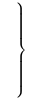
216. Branta leucopsis. Barnacle goose; fairly common
217. Cygnus olor. Mute swan; occasional w.v.
218. Cygnus musicus. Whooper swan; occasional w.v.
219. Alopochen aegyptiaca. Egyptian goose; occasional w.v.
220. Tadorna tadorna. Common shell-duck; uncommon w.v.
221. Tadorna casarca. Ruddy shell-duck; uncommon resident.
222. Anas platyrhyncha. Mallard; common w.v.
223. Anas strepera. Gadwall; common w.v.
224. Anas angustirostris. Marbled duck; fairly common resident.
225. Anas acuta. Pintail duck; common w.v.
226. Anas querquedula. Garganey; fairly common migrant.
227. Anas crecca. Teal; very common w.v.
228. Anas penelope. Wigeon; uncommon w.v.
229. Spatula clypeata. Shoveller; fairly common w.v.
230. Nyroca ferina. Pochard; fairly common w.v.
231. Nyroca fuligula. Tufted duck; very common w.v.
232. Nyroca nyroca, White-eyed duck; common w.v.
233. Oedemia nigra. Scoter; occasional w.v.
234. Erismatura leucocephala. White-headed duck; said to be resident.
235. Mergus serrator. Merganser; common w.v.
236. Mergus albellus. Simew (obtained by Tristram).
237. Columba palumbus. Wood pigeon; common migrant.
238. Columba oenas. Stock dove; common w.v.
239. Columba livia. Rock dove; common resident.
240. Streptopelia turtur. Turtle dove; very common s.v.
241. Streptopelia decaocto. Collared turtle dove; common resident in the Jordan valley.
242. Streptopelia senegalensis. Palm dove; resident in Jerusalem.
243. Pterocles orientalis. Black-bellied sandgrouse; resident in the southern desert.
244. Pterocles alchata. Pintailed sandgrouse; common resident in the south.
245. Pterocles senegallus. Senegal sandgrouse; very common resident in the south.
246. Pterocles exustus. Singed sandgrouse; common resident in the south.
247. Alectoris graeca. Chucar; common resident.
248. Ammoperdrix heyi. Hey’s partridge; common resident near Jericho.
249. Francolinus vulgaris. Francolin; common resident in marshes.
250. Coturnix coturnix. Quail; very common migrant.
251. Rallus aquaticus. Water-rail; uncommon resident.
252. Porzana porzana. Spotted crake; common migrant
253. Crex crex. Landrail; common migrant.
254. Porphyrio caeruleus. Purple gallinule; occurs in Huleh marshes.
255. Gallinula chloropus. Moorhen; common resident.
256. Fulica atra. Coot; common w.v.
257. Megalornis grus. Crane; fairly common w.v.
258. Anthropoides virgo. Demoiselle crane; fairly common w.v.
259. Otis tarda. Great bustard; possibly migrant.
260. Otis tetrax. Little bustard; possibly resident.
261. Burhinus oedicnemus. Stone curlew; common resident. .
262. Glareola pratincola. Pratincole; common s.v.
263. Cursorius gallicus. Courser; common s.v. in the south.
264. Charadrius apricarius. Golden plover; fairly common w.v.
265. Charadrius helveticus. Grey plover; not uncommon w.v. on the coast.
266. Charadrius geoffroyi. Geoffroy’s plover; common migrant.
267. Charadrius hiaticula. Ringed plover; common w.v.
208. Charadrius curonica. Lesser ringed plover; common w.v. (perhaps breeds).
269. Charadrius alexandrinus. Kentish plover; common resident.
270. Charadrius morinellus. Dotterel; common w.v.
271. Hoplopterus spinosus. Spur-winged plover; fairly common resident.
272. Vanellus vanellus. Lapwing; very common w.v.
273. Recurvirosta avocetta. Avocet; uncommon w.v.
274. Himantopus himantopus. Stilt; fairly common s.v.
275. Scolopax rusticola. Woodcock; common w.v.
276. Gallinago gallinago. Snipe; very common w.v.
277. Gallinago gallinula. Jacksnipe; very common w.v.
278. Erolia alpina. Dunlin; very common w.v.
279. Erolia ferruginea. Curlew sandpiper; common migrant.
280. Erolia minuta. Little stint; very common w.v.
281. Philomachus pugnax. Ruff; common migrant.
282. Calidris arenaria. Sanderling; fairly common w.v.
283. Limicola falcinellus. Broad-billed sandpiper; uncommon migrant.
284. Totanus hypoleucos. Common sandpiper; common migrant (probably breeds).
285. Totanus ochropus. Green sandpiper; common w.v.
286. Totanus stagnatalis. Marsh sandpiper; fairly common migrant.
287. Totanus glareola. Wood sandpiper; uncommon migrant.
288. Totanus calidris. Redshank; common w.v.
289. Totanus fuscus. Spotted redshank; rare migrant.
290. Totanus canescens. Greenshank; uncommon migrant.
291. Limosa limosa. Black-tailed godwit; uncommon w.v.
292. Numenius arquatus. Curlew; fairly common w.v.
293. Numenius phaeopus. Whimbrel; rare w.v.
294. Sterna fluviatilis. Common tern; common s.v.
295. Sterna minuta. Little tern; uncommon w.v.
| 296. Sterna media. Allied tern; | rare w.v. |
| 297. Sterna anglica. Gull-billed tern; | |
| 298. Sterna caspia. Caspian tern; | |
| 299. Sterna bergii. Swift tern; |
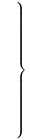
300. Hydrochelidon hybrida. Whiskered tern; fairly common resident.
301. Hydrochelidon nigra. Black tern; uncommon s.v.
302. Hydrochelidon leucoptera. Whitewinged black tern; fairly common migrant.
303. Larus ridibundus. Black-headed gull; common w.v.
304. Larus melanocephalus. Adriatic gull; possible common w.v.
305. Larus ichthyaetus. Great black-headed gull; common w.v. on sea of Galilee.
306. Larus canus. Common gull; fairly common w.v.
307. Larus gelastes. Slender-billed gull; uncommon w.v.
308. Larus cachinans. Yellow-legged herring gull; common w.v.
309. Larus argentatus. Herring gull; uncommon w.v.
310. Larus fuscus. Lesser black-backed gull; common w.v.
311. Puffinus anglorum. Manx shearwater; one specimen found by Tristram.
312. Puffinus kuhlii. Mediterranean shearwater; sometimes seen near shore.
313. Podiceps cristatus. Great crested grebe ever common w.v. (probably breeds on Huleh).
314. Podiceps nigricollis. Eared grebe; common s.v.
315. Podiceps griseigena. Red-necked grebe; rare w.v.
316. Podiceps fluviatilis. Little grebe; common resident.
§ 5. Reptilia.
Venomous snakes are of comparatively rare occurrence in Palestine and the number of species is small. Viperine types are seldom found in densely populated areas, their habitat being characteristically the true desert or stony and unfrequented hills. In habit they are almost exclusively nocturnal and viviparous. A collector of standing states that, of hundreds of ophidia secured during a period of twenty-one years, he has only obtained in the Jaffa district four viperine specimens (Daboia xanthina and Vipera confluenta), apparently driven from the hills by military operations. He had similarly been unable to obtain a single viperine snake from the vicinity of Jerusalem.
On the other hand, the valuable services rendered by the colubrine snakes, as destroyers of field mice, locusts and other insect pests, have been repeatedly advanced in pleas for the protection of this group.
Ophidia.
1. Typhlops syriacus. Syrian blind snake; so-called from its rudimentary eyes. This snake is found everywhere in Palestine and feeds largely on insects.
2. Onychocephalus simoni. Only known to occur in the Jaffa and Haifa areas; feeds on insects.
3. Micrelaps mulleri. Generally found in the hills, butalso in the Jaffa area.
4. Rhyncocalamus melanocephalus. A small, black-headed snake of very general occurrence; feeds on worms and insects.
5. Ablabes modestus. One variety (A. m. inornata: Jan.) is only recorded from Jerusalem. A. m. decemelineata, however, has been reported from Jerusalem, Plain of Sharon and Lake Huleh; A. m. quadrilineata occurs throughout Galilee, Phoenicia and Jerusalem.
6. Lytorhynchus diadema. A brownish-yellow snake with darker rhomboidal spots on the back, only known to occur in the Jaffa district.
7. Periops parallelus. This colubrine snake is recognizable by the small scutella between the inferior edge of the eye and the superior labial scuta; only found in the hills.
8. Zamenis caudaelineatus. In rocky hills.
9. Z. carbonarius. A black coluber which devoured enormous numbers of locusts during invasions of this insect pest.
10. Z. gemonensis var. Asiana. Of general occurrence. During the winter hundreds of specimens may be found rolled up together in a single burrow.
11. Z. dahlii. A grey-green snake of general occurrence. Black ‘ocelli’ with white margins are found on the neck.
12. Z. ravergievi. A hill type characterized by a zigzag line following the length of the back, in which each sinus is marked by a prominent spot.
13. Tropidonotus tesselatus v. hydrus. Found in all rivers, pools and ponds. Destructive to fish.
14. T. natrix. A less common water-snake than the above, with similar habits.
15. Coelopeltis lacertina. A big coluber of general occurrence which destroys large numbers of field mice.
16. Psammophis moniliger: v. hierosolymitana. From Jerusalem, Jaffa and Haifa.
17. Tarbophis vivax: v. syriaca. Of general occurrence. This species and Typhlops syriacus are the only colubrine snakes of nocturnal habit.
18. Eryx jaculus. Occurs in sandy areas on the plain of Sharon. Simulates a viperine type by the small size of the cephalic scutella, and the number of rows of escutcheons between eye and oral fissure.
19. Naja haje. Confined to the desert south of Beersheba and very rarely found.
20. Vipera euphratica. Found near Jericho.
21. Daboia xanthina. Commonly found near human habitations, and is responsible for some loss of live stock in stables; fairly common in the south.
22. Vipera confluenta. Rarely found in the Jaffa area.
23. Cerastes hasselquistii. Occasionally found round the Dead Sea and in the Wadi Araba. In Syria it is of very common occurrence and is the only viper known to that country.
24. Echis arenicola. Occurs from the Wadi Faraʾa to the Dead Sea in the Jordan valley.
Lacertidae.
25. Psammosaurus scineus. A huge lizard attaining a length of a metre. Of common occurrence in sandy places. Feeds on birds, smaller reptiles, gerboas, rats and locusts. Eaten by the Arabs and employed locally for medicinal purposes.
26. Lacerta viridis. This green lizard is only found among herbage on the hills.
27. L. judaica. Occurs in towns and frequents ruins and broken walls.
28. L. agilis. In the Jerusalem area and round the Dead Sea.
29. Ophiops elegans. Of general occurrence; characterized by the absence of eyelids.
30. Acanthodactylis syriacus. Of general occurrence in sandy plains; exhibits fringed toes.
31. Podarcus pardalis. A coastal type of general occurrence.
32. Pseudopus apus. A gigantic lizard of general but rare occurrence; distinguished by a deep neck and body fold.
33. Ablepharus panonicus. In the Haifa area.
34. Eumeces schneideri. Common in sandy plains.
35. Euprepes fellowsi. Of general occurrence.
36. Ophiomorus miliaris. Common in Galilee.
37. Gongylus ocellatus. Abundant everywhere; distinguished by regular, black and white, transverse bars.
38. Seps monodactylus. Abundant in marshes.
39. Sphenops capistratus. Found in the Jaffa area; passes rapidly through sand at considerable depths below the surface.
40. Platyodactylus hasselquistii. Chiefly in towns. Of nocturnal habit, catching moths and insects attracted by artificial light; utters a characteristic clicking sound.
41. Platydactylus mauritanicus. Occurs only in caves and rock crevices.
42. Stellio vulgaris. A spiny gecko of common occurrence on walls, ruins, etc.; partial to locusts.
43. Chamaeleo vulgaris. Occurs everywhere; attains an abnormal size at Jericho.
§ 6. Fishes.
Varieties.—A large variety of edible fish occurs in the coastal and lacustrine waters of Palestine. Both the tunny and sardine, among other migratory types, visit the coast at regular seasons, and the question of developing a very primitive fishing industry is receiving attention. The following species figure in the catch brought to the local markets at Haifa, Jaffa and Gaza:
| Arabic name. | Scientific name. |
| Ataut. | Lichia glauca, Lacepede. |
| Buri. | Mugil cephalus, Cuvier. |
| Bursh. | Raja sp. |
| Dawakir. | Epinephelus aeneus, Geoffroy. |
| Dhahaban. | Mugil auratus, Risso. |
| Farriden. | Pagellus erythrinus, L. |
| Geragh. | Pristipoma Bennettii. |
| Intias. | |
| Isfirna. | Sphyraena vulgaris, L. |
| Kelb el Bahr. | Phoca vitulina. |
| Labat. | Cirrhosa umbrina, L. |
| Lukus. | Serranus sp. |
| Marmir. | Pagellus mormyrus, L. |
| Muskar. | Sciaena aquila, Cuvier. |
| Salbieh. | Lichia vadigo, Risso. |
| Salfooh. | Rhinobatus cemiculus, Geoffroy. |
| Samak Musa. | Solea vulgaris, Risso. |
| Saraghis. | Sargus sp. |
| Sardyna. | Clupea sardina, Cuvier. |
| Sultan Ibrahim. | Mullus surmuletus, L. |
| Tarakhol. | Caranx fusus, Geoff. S. Hillaire. |
| Tobara. | Mugil capito, Cuvier. |
| Turgollos. | Carvanx rhonchus, Geoff. S. Hillaire. |
Industry.—The fishing industry employs only 649 men and 117 boats, of which 115 men and 26 boats are found on the Lake of Tiberias. As no harbour exists on the whole coast-line, craft are limited to open rowing boats which can be launched from the beach, and these in no case exceed three tons in measurement. Failing even slipways, the difficulties of landing prohibit fishing in any but the finest weather, while the size of boat places trawling out of the question. An Ottoman Public Debt tax of 20% ad valorem on the catch led to a deliberate policy of limiting production with a view to maintaining what were practically famine prices. This impost was consequently repealed by decree in August, 1920; while the common practice of dynamiting and poisoning were prohibited by the "Protection of Fisheries Ordinance" promulgated in the same year. The first requirement of the industry having been definitely established as safe harbourage for fishing craft, the coastline was examined in detail, sites selected which lent themselves to economic development, and plans prepared for works at Gaza, Jaffa and Haifa. An endeavour was then made to interest foreign capital in the manifest opening for profitable investment. All species of edible fish commonly brought to the market were collected and identified: a daily record of the varieties, size and weight of fish landed at the three principal ports permitted the construction of charts showing periodicity of migratory types, spawning and maturity seasons; while the establishment of meteorological stations at three points on the coast enables the fishery service to complete a review of the conditions in which any company attempting a development of fishing on modern commercial lines would be called upon to work. Consolidated and amended fishery regulations are being based upon the results of this investigation.
§ 7. Insects.
The following species represent a preliminary examination of insects of economic importance in Palestine, including forms of both noxious and beneficial character. The field of economic entomology is, as yet, almost untouched, with the exception of a detailed investigation of the scale insects by visiting entomologists from Egypt. Recent official appointments, however, should result in an early addition to the present limited fund of information.
Lepidoptera.
Carcharodus altheae. Hb.
Daphnis nerii. L.
Euprepia oerizent. Ld.
Ocnogyna loewii. Z.
Pericyma squalens. Led.
Hydrilla muculifera. Stgr.
Sesamia cretica. Led.
Thalpochares ostvina. Hb.
Dasycorsa modesta. Stgr.
Ptychopoda calunetaria. Stgr.
Mecyna polygonalis, Hb., var. gilvata. Fabr.
Scythris temperatella. Ld.
Lozopera mauritanica. Wlgshm.
Diptera.
Mintho isis. Wied.
Bibio hortulanus. L.
Ceratitis capitata. Wied.
Ophyra leucostoma.
Lasioptera sp. nov.
Culicoides newsteadi. Austen.
Bombilius medius. L.
Coleoptera.
Sitodrepa panicea. L.
Agabus nebulosus. Forsk.
Agabus biguttatus. Oliv.
Philhydrus quadripunctatus. Hbst.
Dryops auriculatus. Geoffr.
Crypticus maculosus. Fairm.
Sisyphus schaefert. L.
Onthophagus cruciatus. Menetries.
Aphodius fimetarius. L.
Hydrophilus cavaboides. L.
Aulonogyrus concinnus. Kl.
Cossyphus rugosulus. Peyron.
Tenebrio obscurus. L.
Anoxia orientalis. Cast.
Aethiessa flovalis. F.
Oedemera virescens. L.
Cyphosoma euphratica. Lap. et Gory.
Acmaeodera despecta. Bdi.
Acmaeodera Goryi. Brulle.
Dasytes delagranget. Pic.
Scobicia chevriert. Villa.
Ptinus latro. Fabr.
Pholicodes conicollis. Desbr.
Rhabdorrynchus anchusae. Chevr.
Lixus constrictus. Bohem.
Hypera variabilis. Hbst.
Tychius fuscolineatus. Luc.
Larinus longirosivis. Gyllenh.
Baris traegavdhi. Auriv.
Hypebaeus scitulus. Er.
Malachius flabellatus. Friv.
Stenodera puncticollis. Chevr.
Stenodera oculifera. Ab.
Stenodera„ Caucasica. Erch.
Teratolytta dives. Brulle.
Lydus algiricus. L.
Lydus suturalis. Reiche.
Halosimus luteus. Waltl.
Mylabris ledereri, var. onerata.
Mylabris floralis, Pall.
Exosoma thoracica. Redtnb.
Chrysomela polita. L.
Chrysomela„ regalis. Oliv.
Cassida bella. Fald.
Gynandrophthalma limbata. Stev.
Omophlus syriacus. Muls., var. versicolor. Kirsch.
Phytoecia virgula. Charp.
Agapanthia violacea. Fabr.
Agapanthia cardui. L.
Plagionotus bobelayei. Brulle.
Niphona picticornis. Muls.
Calathus fuscipes. Goeze.
Cicindela lunulata. Fisch.
Bembidium 4-guttatum. F.
Hymenoptera.
Dielis collaris. F.
Acroricnus syriacus. Mocs.
Tricholabioides pedunculata. Kl.
Anthidium variegatum. F.
Cervatina tibialis. Mor.
Cervatina„ parvula. Sur.
Eucera grisea. F.
Trichofoenus pyrenaicus. Guerin.
Sycofaga sycomori. L.
Hemiptera.
Scantius aegyptius. L.
Pasiva basiptera. Stal.
Geocorts lineola Ramb, var. distincta. Fieb.
Anisops producta. Fieb.
Velta rivulorum F. v., ventralis. Put.
Prionotylus brevicornis, Muls.
Enoplops cornutus. H. S.
Stagonosomus bipunctatus, var. consimilis. Costa.
Amaurocoris curtus. Brulle.
Coranus angulatus. Stal.
Sciocoris helferi. Fieb.
Eurygaster integriceps. Put.
Ploiaria domestica. Scop.
Holotrichus luctuosus. Mauls. et Mayet.
Nemausus simplex. Horv.
Stenocephalus albipes. Fabr.
Sehirus bicolor. L.
Patapius spinosus. Rossi.
Plinthisus hungaricus. Horv.
Sehivus dubius Scop. v. melanoptera, H. S.
Eremocoris verbasci. F.
Notonecta glauca. L.
Lethaeus nitidus. Dougl. et Scott.
Prostemma aeneicolle. Stein.
Orthoptera.
Festella festat. G. Tos.
Xiphidion fuscum. F.
Platycleis tesselata. Charp.
Dociostaurus genei. Ocsk.
Dociostaurus„ anatolicus. Kr.
Pyrgomorpha granosa. St.
Platypterna pruinosa. Br.-Watt.
Morphaeris fasciata, ab. sulcata. Thnbg.
idem.
Pseudoneuroptera.
Hemianax ephippiger. Burm.
Lestes barbarus. Fabr.
Neuroptera.
Ascalphus syriacus. M‘Lach. philopleri.
Degeeriella socialis. Giebel.
Degeeriella„ decipiens. Nitzsch.
Colpocephalum subaequale. Burm.
Philopterus ocellatus. Scop.
Laemobothrion titian. P.
Laemobothrion„ tinnunculi. Linn.
Philopterus lari. O. Fabr.
Menacanthus ovatus. Piag.
§ 8. Animal, Insect and Vegetable Pests.
The animal and insect pests of common occurrence in Palestine include field mice, locusts, scales, ticks, a group of borers and fruit flies. A plague of mice and rats, affecting all edible crops, waxes and wanes apparently in proportion to the activities of the rodents' natural enemies, of which a tick is the most important. The identity and life-history of the latter interesting parasite is at the moment under examination. Attempts to initiate epidemic disease among field mice, by means of such preparations as the Liverpool Virus, have met locally with the same lack of success as in other countries. Various approved formulae for poison pastes are consequently being tested for possible adoption in a poisoning campaign.
The migratory locust, which invades Palestine at lengthy intervals, has been referred to the species Acridium migratorium, and apparently comes from the Nubian desert, reaching this territory during the months of March and April. No record of the local occurrence of a second species, Calopterius staticus, which inflicts much damage in Anatolia, has been obtainable. The most recent invasion of locusts took place in 1915, with a resultant loss of practically the entire season's work. To obviate, if possible, a repetition of this disaster, a campaign has been organized, combining the various methods of control, such as trenching, poisoning and the use of flame projectors.
More insidious, but none the less real, is the danger of an uncontrolled spread of scale insects, which constitute a menace to an important orange industry. The black scale (Aspidiotus aonidum), which inflicts much damage in Egypt, only occurs locally in Phoenicia and Galilee. A fumigation campaign has consequently been undertaken in the hope of extirpating this species before it spreads to the Jaffa district where the bulk of orange groves occur. Local outbreaks of the Cottony cushion scale (Icerya Purchasi) are being successfully treated with colonies of the parasitic lady-bird (Chilocorus bipustulatis), which has been artificially propagated for the purpose.
One of the most serious pests of cereal crops in Palestine is found in a moth (Scythris temperatella), the larva of which has destroyed large areas of growing wheat. Early planting and a full rotation of crops afford the only apparent means of control. Peach, olive and melon flies cause considerable damage, but in most cases are parasitized, and this fact gives promise of a useful weapon for employment against this group of pests.
A number of parasitic weeds, including several types of Dodder (Cuscuta monogyna), Broom rape (Orobanche lavandulacea) and Trixago (T. apule), assume an economic importance. The primitive method of cultivation and thrashing still obtaining throughout the country foster the dissemination of such parasites, which can only be controlled by better agricultural practice.
§ 9. Game Preservation.
A Game Preservation Commission has recently recommended the amendment and consolidation of sections of the Ottoman Code with reference to the protection of game and the control of vermin.
Regulations recommended for proclamation under a draft empowering Ordinance will prohibit the destruction at all times of ibex, eagles, vultures, kestrels, owls, storks, cranes, hoopoes, bee-eaters and spur-wing plovers; and will afford a close-season from the 1st February to the 31st August for all species of partridge, francolin, sand-grouse, hares and gazelle.
The collection and sale of eggs of all game birds will be prohibited. Rewards would be offered for the destruction of vermin as scheduled in the regulations. Game licences would be issued by Governors to residents in the district approved by District Game Commissions, and sale licences to licensed and resident butchers. All "closed forest areas" will constitute game reserves or sanctuaries.
§ 10. Flora.
The wealth of the Palestinian flora is attributable to the same causes which have endowed the country with an extraordinary variety of bird and animal life. Geographical position, variety of soil and range of climate, rainfall and elevation account for the singular richness and interest of the vegetation.
The geographical characteristics of Palestine enable the flora of the country to be divided into three distinct groups. The coast-land belongs to the region of the Mediterranean flora, similar to the flora of Cyprus, Cilicia, Spain, Greece, Sicily and North Africa.
The hill-country produces a typical oriental vegetation of the steppes; while in the depression of the Jordan valley with its intense heat, we find a sub-tropical flora resembling that of the Sudan and Abyssinia.
For the prevalent orders and for lists of the principal trees and shrubs of Palestine, see Part V., § 9.
The classical work of the plants of the country is Dr. G. Post’s Flora of Syria and Palestine, published in Beirut.