The Caribou Eskimos/Part 1/Chapter 5
Objects of Eskimo clothing. That Eskimo clothing for climatic reasons first and foremost serves as a protection against the cold is so obvious that it needs no further explanation, and for the same natural reasons it is more complete than is usually found among other primitive people. Out at the coast, spring and summer boots are of sealskin and a few Qaernermiut — without doubt following the example of the Aivilingmiut — have adopted frocks of the same material; otherwise the clothing is of deerskin only, thus combining extreme lightness of weight and relatively great strength with very little conductive power for heat. The greatest drawback about deerskin is that the hair breaks so easily and therefore the skin is always "moulting". The best skins for clothing are obtained at the end of summer and the beginning of autumn. The thin-haired skins are used for under-frocks and for outer-frocks in spring; very dark skins, on which are small tufts of light, unmoulted hair, are considered to be especially handsome. Skins with thicker hair are used for outerfrocks in the coldest period. The heavy winter skins are not used at all for clothing. The white belly, skin [pukᴇq] is used for decoration in the form of fringes, edging and insertion, whereas the glossy, close-haired skin of the legs is the best material for boot-legs and mittens, as the hair does not fall off so easily as a result of moisture; the extremely tough forehead skin is used for boot soles.
Among the Caribou Eskimos I have not seen marmot skin — mentioned by Turquetil as a dress material[1] — used for this purpose; but there are marmot frocks in the Thule collection from both the Netsilik and the Copper Eskimos, so that it is very probable that it has occassionally been used on the Barren Grounds. Hare skin is warmer than caribou skin, but not nearly so hard-wearing. Sealskin and, in particular, bearskin turn the water better; but the former is cold and the latter very heavy. Musk-ox skin is also extremely heavy and the long hair collects a lot of dirt. Dogskin, which is neither so light nor so warm as caribou, is excluded from use as a dress material owing to the aversion of the Eskimos to it.
Despite the warm clothing of the Eskimos, it is not surprising that they are able to endure great cold. They are made accustomed to it from infancy, when the mothers pull them quite naked out of the frock pouch in order to answer the calls of nature, no matter how low the temperature may be. When the children are a little older, they often run about in summer, naked, or at any rate barefoot, in only few degrees above freezing point. In such a temperature I have more than once seen my three-year-old "foster sister" at Hikoligjuaq tumbling about naked in the tent for hours.
The modesty of the Eskimos is different to that of the "civilised" world. They feel a great, unreflected sexual pleasure — in the same manner as they feel an unreflected pleasure in eating — and it never occurs to anyone to conceal it. A reference to sexual subjects is viewed according to circumstances, either as any other objective utterance or as a jest, whereas a half-veiled obscenity would under any circumstances be incomprehensible to them. On the other hand it is probable that a certain form of modesty, a shyness of exposing themselves wholly or certain parts of the body, especially the genitalia of course, is in profound conformity with the female psyche; it is too much in line with ordinary erotic tactics to leave any room for doubt about this.[2] Such a primitive feeling of modesty, which in reality unconsciously serves to stimulate sexual desire, may very well be imagined to have produced the cover for genitalia, in the form of a simple triangular apron, etc., which is used when the Eskimos have permanent winter houses in which otherwise they live naked. It may be however, that fear of magical influence has also been contributory.[3]
Among the Caribou Eskimos, however, modesty is much more highly developed. The women are so very shy of exposing themselves, even the upper part of the body, that after some attempts I had to abandon any thought of subjecting them to anthropometrical examination and, when sitting on the platform, where they often remove their boots, they always take great care to hide their naked feet. This higher development of the tendency to modesty cannot, however, have had any effect on the clothing. On the contrary, it is obviously something quite secondary, for it is limited to a definite geographical area, being exclusively met with among the Central tribes, who for the greater part of the year live in snow houses where, as a rule, the temperature does not invite the display of great disrobing scenes. In this as in other respects children are looked upon as a sort of sexless individuals — a view that is not entirely foreign to us, by the way — and, even after they have received their first set of clothes, they may often be seen playing about naked in the tent for hours at a time. when the weather permits. But I have never seen children older than four or five years running about without clothes.
It is in the general character and material of the clothing that the geographical surroundings are reflected. Cut and ornamentation
Image missingFig. 60.
Shaman's staff. (Sketch by the author.)
are historically determined.[4] The dress of the Caribou Eskimos may be characterised by a greater or smaller amount of decoration, bead embroidery, insertion of white patches, edgings of very short-haired, dark and white skin,[5] and, among the Qaernermiut formerly, the red web of the guillemot, and, finally, fringes along the edges as well as tassels of unhaired or white, hairy skin and strings of beads ending in the teeth of caribou or musk-ox. On the other hand, it is not now the custom to sew on animal teeth as fringes, as observed by Ellis on Bibby Island.[6] Embroidery with caribou hair is unknown.
With regard to ornamentation there is a slight difference between the various tribes. Beyond comparison the Qaernermiut are "the dandies of the Eskimo nation".[7] Both in cut and make their dress possesses an elegance which places them far above those of the Pâdlimiut, although the principles of making up are just the same. The Pâdlimiut, who in the first place are more well-to-do and, secondly, have long had opportunities of buying cloth and beads, are on the other hand more inclined to ornament their dress with bead embroidery.
The aim of embroidery is not social superiority for the wearer. Even the shamans do not distinguish themselves by any other peculiarity than their shaman's belt, which, like their staff (fig. 60), is necessary to the performance of their rites. It seems, however, as if a shaman may sometimes receive orders from his familiar spirits to decorate his dress in a particular manner. The shaman's frock from Iglulik figured by Boas[8] is an example of this.
Religious considerations may also have something to say as regards the dress of ordinary people, as the amulets,[9] sing. [pit·oqut], may be sewn on to the inner frock, especially across the shoulders. Image missingFig. 61.Amulets. What is more, they have there given rise to the development of a peculiar ornament. As a rule, amulets are taken from the animal kingdom, but may be parts of plants or inanimate objects. This is not the place for an examination of their religious significance; but as examples of the objects which may be placed on the dress as amulets I may mention the following which have belonged to a middle-aged Pâdlimio at Hikoligjuaq and are now in the Thule collection in the National Museum (P 28: 253; fig. 61): two ermine summer skins, the heads of which are let into unhaired deerskin; two hawk feet and four small skin pouches, said to contain wolverine glands, although from the seam of two of them projects the point of a claw. The man had had more amulets than these but lost them in a kayak accident. Fig. 62 is a sketch of a collection of amulets belonging to a young Pâdlimio woman, the wife of a shaman.
Among the Pâdlimiut at Eskimo Point there was a boy of about twelve years who wore a girl's frock. The Eskimos said that a boy who was called by a name with which he had been named after a woman had to do so (whereas it meant nothing if he merely had such a name among those by which he was not called). In the opposite case a girl must wear a boy's frock, and this she must continue to do until marriage. I ought to add that nothing homosexual was observable in the manner of the boy in question. At Hikoligjuaq I saw another Pâdlimio boy whose hood was decorated with a small, conical projection and two bead-embroidered pieces of red cloth (fig. 63). These represented the uvula and the red eyelids of the ptarmigan, and it was said that he had to wear these ornaments "because his name was Oruluk". Presumably some religious idea, about which I could glean nothing,[10] was behind this.
When several infants die in the same family, the next child to Image missingFig. 62.Amulets. (Sketch by the author). be born must have a dress on which the hair on one side runs downward and on the other side upward, or which consists of half deerskin, half sealskin. This makes the child unrecognisable to the evil powers, and it is allowed to live in peace. This custom is known among the Qaernermiut and probably among the other tribes too.
Storing of clothing. A rich man, that is to say a skilful hunter, may have several sets of clothing for himself and his family; two sets are usual, however, one from the previous year, for daily use. and a new set for special occasions. The difficulty of getting things made always keeps the number of sets within very modest limits and, in addition, a good hunter must always provide less fortunate relations with skins; for as the Eskimos are at a lower stage of civilisation than we are, there is no such thing as any one among them Image missingFig. 63.Hood ornaments representing uvula and eyelids of ptarmigan. (Sketch by the author). lacking the wherewithal to cover his body.
Clothing not in actual use is kept in large bags of skin. A clothing bag [poerᴀq] from the Pâdlimiut, Eskimo Point, consists of a piece of unhaired deerskin, folded and sewn with T-shaped seams (P 28: 172). The opening is at the middle and can be drawn together. Dimensions about 75 by 52 cm. From Baker Lake there is a bag (P. 28: 171; fig. 64 a), presumably for the same purpose, of unhaired caribou skin, seamed along one side and provided at each end with a skin handle. The opening is drawn together by means of a running cord. The bag is decorated with a broad stripe painted with red ochre.. Dimensions about 106 by 66 cm. A third bag (P 28: 168; fig. 64 c), from Chesterfield Inlet, from the Caribou or Netsilik Eskimos, is composed of several fish skins sewn together with the scale side outwards. It is oval in outline and very flat, with the opening at the middle. Size about 90 by 64 cm at bottom. A bag made of hairy deerskin folded at the bottom and seamed at both sides comes from the Hauneqtôrmiut (P 28: 170).
The Caribou Eskimos are not very particular about keeping their clothing clean. They attach more importance to its being whole — which the climate undoubtedly demands — although their skin stockings, for instance, are often holed. It is said, however, that he who has holes in his soles or in the fork of his trousers cannot find goose eggs! In one respect they are almost painfully careful, especially in winter: in keeping their clothes dry, rightly understanding that dry. furs are the first and fundamental condition of comfort in the Arctic. Image missingFig. 64.Skin bags. Before an Eskimo creeps into an inhabited, i. e. warm, snow house, he removes his outer frock and carefully beats it free of snow and rime. Outer trousers and footwear are likewise beaten, as of course the bed skins too, when on journeys they have lain on the sledge the whole day.
The snow-beater [tiluktu·t] is of wood with a straight, blunt edge and a curved back, which continues without interruption into the handle. At the rear end of the handle there is a beak-like projection on the same side as the edge. A specimen (P 28: 68; fig. 65 c) from the Pâdlimiut at Hikoligjuaq has a length of 49 cm, greatest breadth 5.7 cm and thickness 1.9 cm. Another specimen (P 28: 70; fig. 65a) from the same locality is merely a natural branch of a tree, bound at the handle with a strip of unhaired deerskin. Length 40.5 cm. On Image missingFig. 65.Snow-beaters. a third specimen (P 28: 69) from the Pâdlimiut at Eskimo Point, there is on the back a drilled hollow as for fire-drilling. Length 40.5 cm. In the collection from the Hauneqtôrmiut there is an implement (P 28: 71; fig. 65 b) which is of antler, it is true, but from its form must rather be regarded as a snow-beater. The antler is split, thus forming a flat and a rounded side, and it is thickest at the rear end, where a branch forms a beak-like projection. Length 38.5 cm.
When in use, all skin clothing readily becomes damp, because there can be no evaporation through it. It is therefore important that the frock hangs so loosely that there is a constant current of air up under it and out at the neck opening. Clad entirely in Eskimo fashion, a man can become saturated in perspiration through running alongside the sledge or pursuing an animal; but owing to this circulation of air he is dry again immediately. Fortunately, the Caribou Eskimos have not yet learned the fatal combination of European underclothing and outer clothing of skin, for which most West Greenlanders have to pay dearly in the form of rheumatism in their old age. Footwear cannot be made self-drying in the same manner as the clothing, and damp — and consequently cold — feet is one of the most unpleasant Arctic experiences for one who has been unable to get dry for a shorter or longer period. For this reason the Eskimos are as far as possible provided with several pairs of skin stockings and other footwear so that they may change now and then. Mittens also readily become wet and cold.
In summer, of course, drying is a matter of no difficulty. In winter the blubber lamp is an invaluable advantage and, in this respect, is far superior to any primus stove, whose own combustion product is vapour. The Coast Eskimos, who have blubber lamps, have a drying rack consisting of a round wooden ring with a coarse, irregular network of sinew thread, similar in shape to those of the Iglulik and Netsilik groups. The drying rack is placed above the blubber lamp on supports consisting of three sticks, one of which is placed upright in the snow of the side platform, whilst the other two, which form a right-angle to each other, are pushed horizontally into the walls of the snow house and tied to the upper end of the upright one. Footwear and mittens are laid on the drying rack and, in the course of a night, everything is dry and comfortable again.
The inland group, who do not use the blubber lamp, cannot do their drying in this manner. In reality this is a greater drawback than the unheated snow houses. For a time one may manage by putting stockings and mittens under the sleeping blanket or in dry snow, but, when this no longer helps, there is nothing else to do than to lay the wet articles aside and use new ones. In winter the Pâdlimiut manage in this uneconomical manner.
When wet skin dries, it becomes stiff and cold. Deerskin assumes a brown, almost black colour; but by rubbing it thoroughly with the hands it soon becomes soft and flexible again. Hairy sealskin is treated in the same manner. Unhaired sealskin when dried becomes even harder than deerskin, almost like a board, and it is impossible to get it soft with the hands alone. Therefore the Greenlanders use a scraper to do this, whereas the women of the Aivilingmiut and other Central tribes laboriously chew the skin into a state of pliability. Among the Coast Pâdlimiut, who use sealskin boots themselves, even this primitive method of softening is said to be unknown.
Men's clothing. The male dress of the Central Eskimos is without doubt the warmest and most practical arctic clothing in existence. The ordinary Eskimo style is that the body of the frock consists of two skins, one which forms the front and one the back, the sleeves being formed of a third skin.[11] In this respect the frock of the Caribou Eskimo is no exception.
Whereas the Greenland frock is short and close-fitting — a Godthaab dandy makes it as tight as possible — the frocks worn on the  Fig. 66.Man's under frock.
Barren Grounds are so full that they permit of an unhindered circulation of air, while at the same time their length prevents the cold air-current from becoming unpleasant. The most simple form of frock is worn principally in the south, that is to say always by the Pâdlimiut. It is slit up the sides from the bottom, thus forming two broad flaps, the front one reaching to the middle of the thighs, the back one being a trifle longer. The bottom edge is trimmed with a fringe cut out of strips of deerskin, of which the upper edge is left uncut. These serve as decoration and at the same time prevent the edges of the frock from curling — even if Amundsen's drastic statements about this are undeniably mildly exaggerated.[12] The Pâdlimiut, who are not so handy with the needle as the other tribes, as a rule only trim the slits with fringe.
Fig. 66.Man's under frock.
Barren Grounds are so full that they permit of an unhindered circulation of air, while at the same time their length prevents the cold air-current from becoming unpleasant. The most simple form of frock is worn principally in the south, that is to say always by the Pâdlimiut. It is slit up the sides from the bottom, thus forming two broad flaps, the front one reaching to the middle of the thighs, the back one being a trifle longer. The bottom edge is trimmed with a fringe cut out of strips of deerskin, of which the upper edge is left uncut. These serve as decoration and at the same time prevent the edges of the frock from curling — even if Amundsen's drastic statements about this are undeniably mildly exaggerated.[12] The Pâdlimiut, who are not so handy with the needle as the other tribes, as a rule only trim the slits with fringe.
The Qaernermiut know how to make their frocks sit much better than the Pâdlimiut. Their frocks never stick out like the latter's, the point of the hood is bigger, and sometimes the front flap is made fairly short and the back flap long, to the back of the knees or even lower, the style thus approaching that used at Back River. This seems to have been even more extreme a few years ago than it is now. Klutschak reports that the back flap is so long "dass sie den sonst am Boden hängenden Theil aufbinden müssen",[13] and this is borne out by the frock illustrated by Boas.[14]
An under frock [atige], of short-haired skin with the hair inwards, is worn next to the body. When the weather is warm enough, it is
 Fig. 67.Boy with amulets sewn to the back of the frock. Eskimo Point.
worn without any outer frock and is therefore usually ornamented in various ways. This ornamentation may be limited to one or two narrow stripes of dark, very short-haired skin along the natural openings of the frock: along the bottom edge, at the wrists and round the hood; it is often trimmed with handsome bead embroidery, however.
Fig. 67.Boy with amulets sewn to the back of the frock. Eskimo Point.
worn without any outer frock and is therefore usually ornamented in various ways. This ornamentation may be limited to one or two narrow stripes of dark, very short-haired skin along the natural openings of the frock: along the bottom edge, at the wrists and round the hood; it is often trimmed with handsome bead embroidery, however.
An under frock (P 28: 6; fig. 66) from the Pâdlimiut at Eskimo Point is of very simple cut. It is of the usual shape with short, wide flaps. The front skin ends at the top in two short branches which continue slightly over the shoulders. The back skin and the hood [nahᴀq] form one piece, if one disregards a strip around the opening of the hood. The hood is sewn on to the front skin by a plain seam without forming the peculiar "hood yoke" which among many other Eskimos serves to hold it better in place.[15] On the side slits and along the bottom edge of the back flap there are fringes of skin, and there are also edgings of printed cotton. The edges of the sleeves are trimmed with red cloth which again has bead borders: blue, yellow, white and green stripes uppermost and green, white, red, white and green below; between them is a zig-zag line of white beads. Round the hood opening is an edging of dark blue cloth with white, green, white, green and white bead stripes along one edge and white, red, white, dark blue and light blue stripes along the other edge. Image missingFig. 68.Pâdlimio with bead-embroidered under frock. Hikoligjuaq. (Sketch by the author). From the cloth emerge two free0ended, half-round flaps, joined together at the back with a red strip of cloth embroidered with white beads. The two flaps are embroidered with semi-circular, concentric stripes of white, green, red and blue beads, whilst in the centre field there are white transversal stripes intersected by red. Two loops of light blue beads hang from the point of the hood.
The strangest ornament, however, is on the back where, sewn across the shoulders, is a broad piece of blue cloth, edged with rows of beads in green, yellow, white, blue, white, red and white. In the centre field there is a circular disc of yellow, blue, white and red beads, and on each side of it two red and a green, white-edged, vertical stripes. From both lower corners of this back decoration, and from the middle of its lower edge, hang strings of beads which are intersected by white, red, black and light-blue and, at the bottom, end with the front teeth of caribou. Whereas dress ornamentation is otherwise always to be found at openings in the garment or emphasises its main seams, this back ornament is something special. If the back of the under frock has the branched cut which usually marks the outer frock, the ornament runs over the seams regardless of their presence. There can hardly be any doubt that this is a derivation of the amulets which, as fig. 67 shows, are placed just at this spot.
On the under frock there is sometimes another ornament which has nothing to do with edges or seams, viz. two long pieces of cloth, rounded at the bottom, furnished with bead embroidery, placed on Image missingFig. 69.Men's summer dress (a) and winter dress (b). the front of the frock[16] (fig. 68). They are copied from the white insertions on the spring outer frocks. The breast and back decorations mentioned are to be found almost exclusively among the Pâdlimiut; but owing to their expensiveness they are not very common, and they will soon become even more rare, because the Eskimos can no longer obtain the milk white porcelain beads, and the clear, white glass beads are not in fashion.
In the Thule collection there is another under frock of the same cut as that described, (P 28: 5) from the Pâdlimiut at Eskimo Point. It has fringes only on the slits, which are edged with red cloth. Over the slits there are blue and white stripes of beads, at the wrists white and red stripes and light blue triangles. Around the hood opening. there is bead embroidery which, at the outer edge, consists of white triangles on a black background, then a white stripe, yellow triangles on red and, finally, white and blue stripes. In the middle of the back there is a small, semi-circular piece of blue cloth with two strips. hanging loose, on which are white, blue and yellow stripes of beads.

From the Pâdlimiut at Hikoligjuaq there is an under frock (P 28: 4; fig. 69 a) of the cut which otherwise distinguishes the outer frock, i. e. the front continues to the back in two rectangular branches down over the shoulders, and the back of the hood consists of a separate piece which drops in be-tween two branches of the back skin of the body. There are fringes at the bottom and edgings of white and dark. deerskin, but no other decoration.
The outer frock [qulit·ᴀq] corresponds exactly to the under frock in shape but has, as just stated, a slightly more complicated cut than these usually have. As many seams mean just as many openings for the wind, the winter frock proper has no insertions and no other decoration than the fringes, as fig. 69 b shows — a frock from the Pâdlimiut at Eskimo Point (P 28: 1). It has, as sometimes happens, a draw-cord around the hood opening so that this may be closed up for the wind.
The Qaernermiut excel in elegant spring frocks of dark, shorthaired deerskin with many white borders and insertions. The white, rectangular insertions on the back (fig. 70) are said to have originally been characteristic of this tribe, but now they are also seen among the Back River Eskimos, the Aivilingmiut and others. More rare are the two large insertions of white skin, rounded at the lower edge and placed on the breast, the same which have been the prototypes of the sewn-on pieces of cloth on some under frocks. Tassels of white skin at the point of the hood and between the shoulders are falling, out of use, because the whites in the country do not appreciate their characteristic decorative value and ridicule them.
On a Qaernermiut outer frock in the collection of the Expedition (P 28: 2; fig. 71 a) there are, on the back, six white insertions arranged in two transversal rows, and both on the point of the hood and on the middle of the back there is a tassel of white deerskin with the hair. Along the bottom edge and round the hood opening there are double, white borders and, along the former, a fringe as well. On each side of the hood there are also two white, vertical insertions. This frock is not slit up the sides; the front, however, is cut rounded at the bottom, and the back forms a long flap. Significantly enough, this is from the Ahiarmiut band at Lake Taherjualugjuaq near the border of the Back River area, where the frocks are of similar shape. From Baker Lake there is a Qaernermio frock of more ordinary appearance, with wide flaps of almost equal length (P 28: 3; fig. 71 b). On the front there are two large, white insertions, edged with narrow, dark stripes.
In driving snow and severe frost the frock is held about the waist by a belt [taphik]. Fig. 24 shows a Pâdlimiut belt from Eskimo Point (P 28: 249), consisting of a babiche thong 135 cm long, on one end of which is a 5.7 cm toggle of antler fitted in a sling. The other end forms a double spliced loop. A bone dagger, for dispatching caribou which are caught in pitfalls, is attached to it. The shamans have special belts which they use during their incantations. These belts are compactly trimmed with strips of cloth, pieces of skin and the like, which they receive in the course of time from their clients; for presents, it is believed, give strength. At Eskimo Point I one day saw a man who had become a shaman during his absence from the settlement. As yet he had no belt; but on his arrival all the women went down to the sledge on which he had remained seated and fastened a patch of cloth to the thong of his bag. Miniature implements of antler, which the shamans of the Netsilik tribes fasten to their belts, are not used among the Caribou Eskimos.
The Caribou Eskimos wear trousers of deerskin, both an under and an outer pair, the former with the hair inwards, the latter with the hair-side out, but otherwise exactly similar in cut. The trousers never reach below the knee and, in the most simple form, consist of four pieces which are sewn together by means of a seam at each side and a middle seam back and front. At the back in the waist band there is a draw-cord of plaited sinew, one end of which is rolled up into a sort of toggle, which fits in the loop of the other end. By means of this cord the trousers are drawn together about the waist above the hips. In this they differ from the earlier Greenland trousers which. possibly on account of the stiff seal and bear skin, hung on Trochanter major.
The simple pattern is to be found in a pair of narrow outer trousers [qalerugʒuk] from the Pâdlimiut at Eqalulingnaoq south of Hikoligjuaq (P 28: 13; fig. 69b). At the back of each leg near the leg opening a horizontal gusset, with the point inwards, has been let in and, under it, a rectangular piece. Owing to the natural pattern of the skin this makes a white transversal stripe. Length about 86 cm, width of leg 21 cm.
Trousers like these are used in the southern part of the Barren Grounds. Wide knee breeches [qᴀrli·k] as among the Eskimos at Back River, but still more pronounced in form, are more rare among the Pâdlimiut but common among the northern groups, especially the Qaernermiut. They reach down to or a little above the knee and stick out to the side like a highlander's kilt, so they permit of unhampered movement. For long journeys they are much more comfortable than the narrow trousers, even when the cold is intense. When sitting on the sledge the outer fulness is folded under the leg to prevent the wind from blowing up it. The typical cut is to be seen in a pair of under breeches from the Qaernermiut at Baker Lake (P 28: 15; fig. 71b). Image missingFig. 72..Man's under breeches. They are just like those described, if the legs are imagined cut off close under the fork and substituted by a pair of other legs, widening out downwards, and fitted with a seam down the inner side of each. In the fork are two gussets. At the leg openings there is a wide border of white, hairy deerskin and, above it, three narrow borders of black, white and black unhaired skin in the order named. Length about 81 cm, width of leg 38 cm. From the Pâdlimiut at Eskimo Point there is a similar pair of under breeches (P 28: 16; fig. 69 a) which, however, owing to a scarcity of skins, is composed of several pieces of skin sewn together.
On a pair of under trousers (P 28: 17; fig. 72) from the Harvaqtôrmiut, lower Kazan River, there is at the bottom of each leg a broad border of white, hairy skin, four bands of dark, hairy skin and three white bands of unhaired skin. The seam between the leg and the waist is emphasised by a stripe of dark, hairy skin, from which on the outer side hang four fringes of white, unhaired skin and two broader bands of violet velvet. It is otherwise the Back River tribes especially who wear fringes on the sides of their trousers.
The wide outer trousers correspond exactly to the under trousers except of course that they have the hair-side out. On a specimen (P 28: 14; fig. 73 a) from the Harvaqtôrmiut, Baker Lake, there are a broad and a narrow edging of white skin at the bottom. "Hose", i. e. trousers and stockings in one piece [at·ᴀrtᴀ·q] are made of deerskin with the hair inside and are sometimes worn by the Pâdlimiut in winter in combination with the narrow outer trousers. The Qaernermiut never use "hose".
The winter footwear is exceedingly warm. It consists of stockings, over these short socks, then boots and, lastly, shoes with double soles, all of hairy deerskin. In summer they only use stockings, boots of Image missingFig. 73.Man's outer breeches (a) and woman's do. (b). unhaired skin and sometimes socks. The boots are never stuffed with hay as in Greenland and Alaska.
The winter stockings, dualis [alᴇrtik], are of thin-haired deerskin with the hair inwards and reach up over the knee in order to correspond to the short, wide trousers. The leg consists of one piece of skin with a seam down the shin and medially along the top of the foot. The sole is a separate piece. One pair (P 28: 256), about 62 cm long, from the Pâdlimiut at Hikoligjuaq, have an edging at the top with the hair out. For home use inside the tent the Pâdlimiut wear short stockings of unhaired deerskin together with boots of the same material. A pair from Hikoligjuaq (P 28: 30) have soles with the hair-side out. The cut of these stockings is just the same as of the boots: leg, upper and sole; but they are sewn with an overcast stitch, which is not the case with boots of unhaired skin. In summer, stockings of duffel are often worn now.
In winter, many wear between stocking and boot a short sock of thin-haired skin or, nowadays, sometimes duffel. There are two kinds, according to the cut. One form, [ikenrojäk], consists of two symmetrical pieces sewn together with a seam down the middle, whilst the other kind, [pinerᴀq], while having a median seam, also has a Image missingFig. 74.Shoes (a–b), socks (c), and boots (d–f). separate sole. The length of leg varies according to taste. The height of a set (P 28: 38) from the Pâdlimiut, Eqalulingnaoq south of Hikoligjuaq, is only about 17 cm, of another set (P 28: 37; fig. 74 e) from the same place about 22 cm. A child's set (P 28: 39) from Eskimo Point is about 12 cm high.
There are several kinds of boots, all of which are different according to their purpose, both with regard to material and to form. They are the only articles of clothing of which some are regularly made of sealskin. Apart from the very long-legged boots, which are used when the snow thaws, they reach to the knee, where they are tied with a running cord; for as the leg is always wider than, for instance, that of the Greenland boots, it cannot keep up solely by its grip of the leg of the wearer. A simple style of boot consists of leg, sewn together with a seam down the shin, upper and sole.
Winter boots are always of deerskin and, as a rule, have the hair-side out. On a pair of this kind (P 28: 28; fig. 71a) from Baker Lake, dualis [kamikpak], the cut is complicated by the fact that the leg consists of belts sewn together by horizontal seams, thus making a wide and a narrow white stripe round the leg and a narrow stripe on the one side; furthermore, the median seam, apparently out of regard for the pattern, is placed behind down the calf. At toe and heel the sole is crimped. Length about 67 cm. There is another pair (P 28: 29; fig. 71b) from the same place, intended for less cold weather. On these the leg is composed of three vertical bands of caribou leg skin with gussets let in at the instep. Length about 50 cm. Such boots are called [niɔqut], from [nio], leg. From the Pâdlimiut at Eskimo Point there is a pair of winter boots (P 28: 27; fig. 69 b), the legs of which are divided transversally, the top consisting of thick deerskin with the hair out, whereas the lower part, like the foot, is of more thin-haired skin with the hair inwards. Length about 50 cm. A pair of boots of sealskin (P 28: 33; fig. 74d), with the hair out, from Chesterfield Inlet, are for spring wear. These are not common among the Caribou Eskimos and have possibly been bought of one of the Aivilingmiut living there.
In spring, when the snow is deep and wet, long-legged boots [ipᴇrautik] are often used; inland they are made of unhaired deerskin, whereas at the coast the material is unhaired skin of the fjord seal with soles of bearded seal skin. These boots are always sewn with a double stich, the outer seam being a blind one. A pair from the Pâdlimiut at Eskimo Point is of black, unhaired sealskin (P 28: 31). They are very wide at the top and about 59 cm long, but the cut is the ordinary one. On each side of the instep there is a loop for the boot lace. This lace runs across the foot, is taken round behind the heel and tied again in front over the instep. Thus the method of tying is the same as in Greenland with this difference, that there the loops are placed right forward alongside the joints of the toes. From the same place there is another pair of long sealskin boots (P 28: 32; fig. 74e), the tops of which continue into long points. Length 83 cm.
Towards the end of summer the coast bands use boots of unhaired sealskin of ordinary shape [kamik]. Inland, similar boots of unhaired deerskin are worn, but these are very poor footwear. On the wet tundra they become saturated with water immediately; nor are they strong, though the soles are made of the throat or forehead skin. This kind of boot is also sewn with a double stitch. Finally for indoor use the Pâdlimiut have a sort of boot, dualis [natɔrqatik] which, like the summer boots, is of unhaired deerskin, but furnished with an extra sole of hairy skin. A pair from Hikoligjuaq (P 28: 30; fig. 69 a) is about 35 cm long.
A pair of deerskin shoes [tuktoqut], with the hair inwards, is worn over the winter boots. The Qaernermiut also have shoes of sealskin for summer wear [itigam·ajäk]. The cut of both these is the same as that of the boots, except that the leg is often so short that it does not meet in front, but forms a quarter-piece, and they also have an extra sole with the hair downwards and running towards the heel. The sole is crimped at heel and toe. Round the opening is a tuck with two laces of plaited sinew. The laces emerge at the back by the heel, are each led through its loop on the side of the instep and are tied after being wound once or twice round the leg. On a pair of shoes (P 28: 42) from the Pâdlimiut, Eskimo Point, the edges of the quarterpiece meet above the upper. From the Qaernermiut there is another pair (P 28: 40; fig. 74 a) on which this is not the case. A pair of Qaernermiut shoes (P 28: 44) of unhaired caribou skin are of a type sometimes used in spring. Between the upper and the sole there is an insertion of black, unhaired sealskin. Fig. 74b shows another pair (P 28: 43) from the Qaernermiut, Chesterfield Inlet.
When the shoes are exposed to heavy wear on journeys, a sandal [na’mautalik] is sometimes tied under the sole.[17]
The hands are protected by deerskin mittens, [poaluk], which in winter have the hair on the outside. Each mitten consists of three pieces, one of which forms the back, whilst the palm side is divided into two from side to side, the distal piece also forming the underside of the thumb, the proximal piece the outer side of the thumb. In the Thule collection there are several mittens of this style from the Caribou Eskimos (P 28: 21, 22, 23, and 24; fig. 75). On a pair from the Pâdlimiut at Hikoligjuaq (P 28: 25; fig. 75), the hair on the distal part of the palm turns inwards and the opening is edged with two white stripes. These mittens are of thin-haired skin and intended for spring wear. When building snow huts the Pâdlimiut are said to sometimes wear especially long-wristed mittens [aitqᴀ·rmᴀq]; but I have never seen these.
When hunting in winter a glove is sometimes worn on the right hand with a compartment for each finger, [adgᴀq], i. e. finger. In the Image missingFig. 75.Mittens. collection there is a specimen (P 28: 26) from the Pâdlimiut at Hikoligjuaq, made out of strips with the hair-side inwards. These gloves are apparently the result of European influence.
There are no pockets in Eskimo clothing. Small possessions such as pipe and tobacco, clasp-knife, etc. are carried in bags which are carried on a cord over the shoulder outside the frock or round the neck on the bare breast. In the latter case the bag is of linen or cotton, in the former of cloth, folded over once and sewn up the sides; it may either be drawn together at the top or closed by means of a flap. Formerly these bags were of deerskin.
The Caribou Eskimos have no special hunting dress of waterproof sealskin or gutskin. In spring, when the light reflected from the snow is exceedingly strong, they wear snow goggles [igʒᴀ·q] when on journeys and when hunting. They are made of wood in two different forms. The most common type consists of a narrow, curved piece of wood in which two narrow slits are cut for the eyes; the inner side is hollowed out and there is a cut to fit the nose. In the collection there are specimens of this type from the Qaernermiut and the Pâdlimiut (P 28: 64 and 65; fig. 86 f). From the latter tribe, Eskimo Point, there are also specimens of the other pattern, which consists of two separate, semi-spherical eye-pieces joined by sinew thread or thong (P 28: 66 and 67; fig. 86 g).
Eye shades are not used at all inland. Among the Pâdlimiut at Eskimo Point it was said, however, that the women — who do not wear snow goggles — wear eye shades of deerskin. I have not seen these myself.
In the eighteenth century Eskimos were seen at Bibby Island with caps of the neckskin of a musk-ox, the long hair of which served as mosquito veil). When the Caribou Eskimos use mosquito veils nowa- days they are made of ordinary tarlatan.
Those Eskimos who have for some time lived in contact with the whites, such as those employed by the H. B. C., have in some cases made changes in their clothing. This, however, is never the case with the clothing worn on long journeys, but only that which they wear round about the trading post. In the collection there is, for instance, a deerskin outer-frock from Baker Lake (P 28: 12). It is furnished with a hood but has no slits in the sides and opens down the front like an ordinary jacket. Similar coats are sometimes worn by the whites and are common as winter coats among the Chipewyan. In the collection from Chesterfield Inlet there is also a cap of caribou calf skin with a peak and earflaps for tying under the chin (P 28: 45). The same type is used by the Eskimos in Labrador and, as twọ of the H. B C.'s men were born on the Labrador coast, it is perhaps to them that this type is to be attributed.
In summer nearly all Caribou Eskimos now wear ready-made clothing; only the boots are of their own fabrication, though farthest south Chipewyan moccasins are also sometimes worn in dry weather. The Pâdlimiut have the habit of allowing their shirt to hang down outside the trousers, in the same manner as their own fur frocks hang. Rejected parts of the R. C. M. P. uniform are in very great demand. Among the Pâdlimiut one sometimes sees the so-called “ca- pots", which were actually introduced by the H. B. C. for trading with the Indians. These are open coats of heavy, white duffel with dark blue hoods and red trimming. Clad in one of these garments, with a gay sash about the waist, an Eskimo can effectively compete with any family christmas tree.
WOMEN'S CLOTHING. Although in principle and cut the dress of the women differs only slightly from that of the men, the shape is rather different. The frocks have an enormous, wide hood which is so long that when thrown back it reaches down over the loins. It attains its greatest dimensions, at any rate as to breadth, among the Pâdlimiut. The back of the frock is enlarged so much. that there is room for an infant child to be inside it. This enlargement is to be seen on the frocks of all women, even if they have no babies and, indeed, even if they are not yet married. The shoulders Image missingFig. 76.Woman's inner frock: front. are extremely wide so that they hang out over the upper arms; this shape makes it possible for the child to be brought round to the breast without being taken out of the frock. The front terminates below in a rather narrow, rounded flap, which reaches half way to the knees, whilst the back ends in a wide flap that is so long that it hangs down to the ankles. This flapping back-skirt imparts to the women's dress a certain appearance of dignity; among the Pâdlimiut it is slightly broader and ends more squarely than among the Qaernermiut, whilst the front flap of the former is also broader and shorter. The Qaernermiut women's frock is practically the same as that of the Aivilingmiut, which again has slightly bigger flaps than that of the Netsilik group, and among the Copper Eskimos the flaps are still less in size. The inner frock is sometimes extravagantly trimmed with beads — a frock of this kind is valued at about sixty dollars — whereas the spring outer frock of the Qaernermiut is prettily decorated with insertion, borders and fringing of white, hairy skin.
In the Thule collection there is an inner frock (P 28: 11; figg. 76–77) which has belonged to a young Pâdlimio girl at Eskimo Point. The cut of this frock is the same as that of the outer frock (see fig. 79) with this difference, that on the back there are no hood-yokes between the ascending branches of the back skin. As is usual among the Pâdlimiut, this frock is not fringed, but only edged with red cloth. The breast is covered with a square piece of the same stuff, a form of decoration that undoubtedly has been derived from the two white insertions on the outer frock. This is confirmed by the character of the bead patterns which are sewn on. The middle line is marked by a number of circular discs of white beads, diminishing in Image missingFig. 77.Woman's inner frock: back. diameter as they ascend and, at the top, replaced by three white bone buttons. On each side of the middle line there is a field with two borders of white, blue and white beads, connected at the bottom with white cross stripes. Between the borders runs a white zig-zag line and a blue and yellow longitudinal stripe. From the lower edge of the breast cloth hang strings of beads which are intersected into bands of white, red and black and end in caribou front teeth.
Each shoulder is covered with a semi-circular piece of blue cloth with a star-like figure in white and blue beads, surrounded by borders in light and dark blue, green, white, red and black. From the edge hang strings of beads in white, red and blue; ending in caribou teeth just like the fringe on the epaulettes of a naval officer. The hood opening is edged with blue and, outside this, with red cloth and stripes of beads in red, white, light and dark biue. On the distal part of it hang strings of beads in white, red, black, yellow and blue, each of which ends in a loop instead of a tooth. Down the middle line of the hood there is a bead-embroidered stripe which is terminated with a piece of black cloth, on which a flower is sewn in beads in a similar double-curve style to that now worn by the sub-arctic Indians. The length of the frock, measured down the front, is 74 cm, down the back (excluding the hood) 106 cm, the hood 72 cm.
The embroidered middle stripe on the hood of this frock corresponds to a stripe of dark, unhaired skin which the Qaernermiut women formerly had at the same place on their inner frocks, but which is not seen now.
The style of the outer frock will be seen from fig. 78 which shows a frock from the Pâdlimiut, Eskimo Point (P 28: 7; fig. 79).
 Fig. 78.Cut of woman's outer frock: front, back, and hood (side view).
The front, not counting the edgings, is formed of a single piece of skin with deep cuts where the sleeves are fastened on, but above these widening out to the broad shoulders. which are continued a little way down. the back. The back skin has a branched form similar to that of the men's frock, whereas the enormous hood is more complicated than these. It consists of a small gusset at the opening and continuing a little way towards the rear; outside this are two wide side pieces and a larger or smaller middle piece, oval in shape. Whereas the middle piece in a man's hood joins on to the back skin, if it does not actually form a continuation of it, a change has been made in the cut of the women's hood, obviously as a consequence of its colossal size. The side pieces, which principally determine its length, meet under the middle piece, and the basal part of the hood. consists of five separate small pieces. The rearmost of these seems to be a kind of detached part of the middle piece and, in two wedge-shaped hood-yokes, reaches down into the back of the frock. Between these hood-yokes and the branches of the back skin there are two square insertions which give the back the desired width.
Fig. 78.Cut of woman's outer frock: front, back, and hood (side view).
The front, not counting the edgings, is formed of a single piece of skin with deep cuts where the sleeves are fastened on, but above these widening out to the broad shoulders. which are continued a little way down. the back. The back skin has a branched form similar to that of the men's frock, whereas the enormous hood is more complicated than these. It consists of a small gusset at the opening and continuing a little way towards the rear; outside this are two wide side pieces and a larger or smaller middle piece, oval in shape. Whereas the middle piece in a man's hood joins on to the back skin, if it does not actually form a continuation of it, a change has been made in the cut of the women's hood, obviously as a consequence of its colossal size. The side pieces, which principally determine its length, meet under the middle piece, and the basal part of the hood. consists of five separate small pieces. The rearmost of these seems to be a kind of detached part of the middle piece and, in two wedge-shaped hood-yokes, reaches down into the back of the frock. Between these hood-yokes and the branches of the back skin there are two square insertions which give the back the desired width.
On the frock described the sleeves are made of several pieces; they have two white longitudinal stripes and a white transversal stripe on the inner side. At the bottom the frock is furnished with fringes and edged with white skin and with blue and red cloth, separated by a white strip of skin. Round the hood opening there is a white edging, and the insertions in the back-pouch are also white. At the neck is a skin strap to which is fastened the waistband which Image missingFig. 79.Woman's winter dress. prevents the child from sliding out of the bottom of the frock. Near the point of the hood and on each side of its opening hangs a red cloth ribbon. Length in front 76 cm, down the back (excluding the hood) 120 cm; hood 81 cm.
From the Pâdlimiut at Eqalulingnaoq south of Hikoligjuaq there is a woman's outer frock (P 28: 8) which is interesting in that, similarly to what is the case with the inner frocks, there are no hood-yokes at the back. The hood is made of irregular pieces put together. Fig. 80 b shows the back of a woman's spring frock (P 28: 9) from the Qaernermiut at Baker Lake. On the breast there are two square insertions of white skin, with two dark borders and white fringes at the bottom. Along the lower edge, which is also furnished with fringing, at the neck and sleeve openings, about the shoulders and on the back-pouch, there are also white edgings. Length in front 78 cm, back (excluding the hood) 105 cm; hood 52 cm. On a similar spring frock from the same tribe (P 28: 10; fig. 80 a) there are long fringes of white, hairy skin at the shoulders.
In order that the child may not fall out of the back-pouch, the frock is bound round the waist by a waistband. It is of skin and at each end has a large button of wood or, more rarely, of musk-ox horn. These buttons are pushed under one or two skin straps which are placed on the front of the frock below the neck opening. The belt shown on fig. 81 (P 28: 254) belonged to a female Pâdlimio shaman from Hikoligjuaq. It is therefore, like the belts of the male shamans, thickly trimmed with rags of cloth of various colours, some small Image missingFig. 80.Women's spring frocks. pieces of skin representing bear paws — one of her familiar spirits was a — bear a few strings of beads, a twig, etc.
From the Pâdlimiut at Hikoligjuaq there are also in the collection two pairs of belt buttons [qakoavik]. One pair (P 28: 47; fig. 81b) is of musk-ox horn, in the form of round discs with elongated holes; diameter 5.5 cm, thickness 1.5 cm. The other pair (P 28: 48; fig. 81 c) is of wood cut in different shapes, one button being a cone-base with a bent line-hole through the back, the other one being shaped like an oblong hexagon which is thickest along the shortest diagonal. The greatest diameter of the first is 7.2 cm, the length of the latter is 8.4 cm.
When the Pâdlimiut women move among the tents, or on short excursions in summer, they do not wear an outer frock but an ordinary wollen shawl, which is folded along the diagonal and thrown over the shoulders (fig. 82). Among the other tribes, whose women mostly wear printed calico dresses in summer, the shawl is worn over the head as among the sub-arctic Indians. According to what they themselves tell, the shawls of the Pâdlimiut have their prototype in Image missingFig. 81.Belt of female shaman (a) and belt buttons (b–c). a sort of deerskin cloak [ulikät·ᴀq] which was used in former days. It consisted of a single skin, which was cured but not sewn. The truth of this tradition is confirmed by the fact that cloaks are known to the Eskimos at Mackenzie River and in northern Alaska.[18] It is further related about the people at Wager Inlet in the eighteenth century: "The Eskemaux had Dog Skins, and white Bear Skins hanging over their Shoulders to keep off the Rain".[19] But it cannot be said whether these have been more than purely makeshift coverings.
The women never wear more than one pair of trousers [qᴀrli·k], which have the hair side outwards. They reach high above the waist and, below, cover the knees. The Pâdlimiut women are said to make their trousers slightly wider than the Qaernermiut. The front side consists of a body and two leg-pieces, the back of two pieces sewn down the middle as on men's trousers. Between the front and back. pieces there are two narrow insertions along the outer leg seams. On a specimen (P 28: 19; fig. 73b) from the Pâdlimiut at Hikoligjuaq the body part is formed of the head skin of a caribou; the ears are still on near the waistband. The side pieces are of caribou leg skin. The end of each leg piece and the rearmost insertion form white stripes.
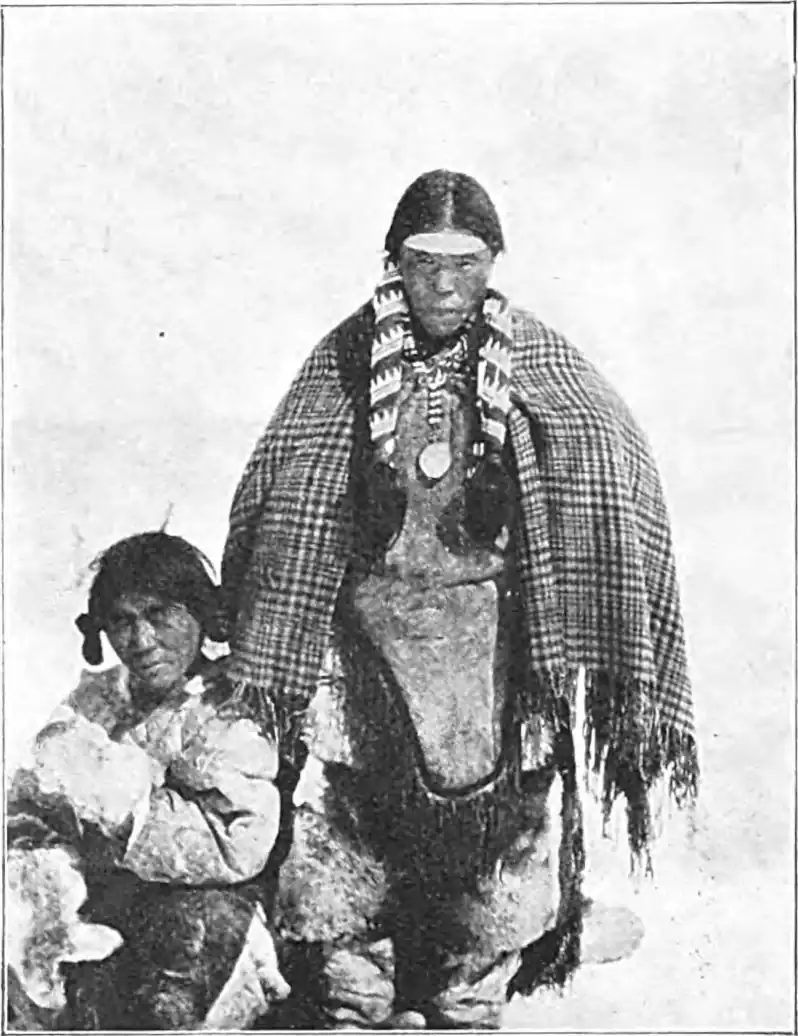 Fig. 82.Pâdlimiut women, one of them wearing brow band, beaded hair sticks, woollen shawl, and breast ornament made of a watch case.
Length about 77 cm. On a similar pair (P 28: 18) from the Pâdlimiut, Eskimo Point, there is a waistband with the hair inwards and, on the front, two straps, and on the back one strap, for tying.
Fig. 82.Pâdlimiut women, one of them wearing brow band, beaded hair sticks, woollen shawl, and breast ornament made of a watch case.
Length about 77 cm. On a similar pair (P 28: 18) from the Pâdlimiut, Eskimo Point, there is a waistband with the hair inwards and, on the front, two straps, and on the back one strap, for tying.
When the women are not actually on a journey in cold weather they wear ordinary stockings and boots like those of the men, only rather shorter and always with the hair side inwards. A pair of woman's stockings (P 28: 35 c–d) from the Pâdlimiut, Eskimo Point, have a peculiar cut, the legs consisting of two laterally sewn pieces, of which the front also forms the upper. This corresponds to the cut of the long "legging boots". The length is about 17–22 cm. A pair of boots for everyday wear from the same place (P 28: 35 a–b: fig. 74 f) consists of a leg with the seam along the shin, an upper and a sole, in the edge of which are sewn two lace straps so that the boots can be laced about the heel as with men's boots. Under the sole proper there is an extra sole with the hair side outwards. Length about 29 cm.
On journeys in cold weather the women wear a peculiar boot, which stretches right up over the lower part of the trousers and ends in a point, which is fastened to a cord round the waist. These boots consists of a lower part which is quite like an ordinary, short boot. and an upper part which is apparently derived from the legging, sewn fast to the boot.[20] Fig. 83 shows the style of a "legging boot" of this kind from the Pâdlimiut, Hikoligjuaq (P 28: 34; fig. 79). The lower part, which reaches to the middle of the calf, consists of a sole and an extra sole with the hair side out, and a leg which, like the leg of the pair of stockings described above, consists of two laterally joined pieces, of which the front forms the upper. The upper part of the boot is widened out at the knee into a bag on the outer side of the leg. This part consists of a front piece at the bottom, a broader back piece, and finally a third piece which has an angular incision in both the upper and the lower edge and forms the extension.
 Fig. 83.Cut of legging part of woman's winter boot.
Over this part is a zig-zag shaped, narrow piece of skin which forms a belt right round the leg and, above it, other two small, triangular gussets, one on each side of a large, irregular rhombic piece which forms the point in which the boot at the top ends. The specimen described here is edged with red cloth and, over the bag at the knee, there is, at two places on each boot, a loosely hanging strip of the same stuff. Length about 99 cm, breadth over the extra width 36 cm.
Fig. 83.Cut of legging part of woman's winter boot.
Over this part is a zig-zag shaped, narrow piece of skin which forms a belt right round the leg and, above it, other two small, triangular gussets, one on each side of a large, irregular rhombic piece which forms the point in which the boot at the top ends. The specimen described here is edged with red cloth and, over the bag at the knee, there is, at two places on each boot, a loosely hanging strip of the same stuff. Length about 99 cm, breadth over the extra width 36 cm.
This extension on the boot has no practical purpose whatever beyond that the women now and then may use them for storing small objects. We know that there are two old reports which state that infant children have been carried in the boots. This is never the case, at any rate now, and my enquiry on this point always aroused uncontrolled merriment.
Shoes are never worn by women. Their mittens are exactly the same as those of the men.
Sometimes the women use bags [nägviut] for keeping small possessions. From the Pâdlimiut at Hikoligjuaq there is, in the Thule collection, a bag of this kind (P 28: 173; fig. 84), which both in shape and decoration shows such close connection with certain Indian bags, which are to be found right from the Laurentian lakes to the plateaux in British Columbia, that it is probably an imported article, possibly from the Cree. The bag is of black cloth and widest at the bottom, where it ends in five double corners, split at the points. The hank is a woollen cord of red and green. On the extreme edge it is bound with black material and, inside this, two rows of white beads. At the top are eight double rows of black and white beads, and from these run a double row of white beads, with typical double-curves, into each corner. Each corner ends in a reddish woollen tassel with an opaque bead and a light-blue bead above it. Image missingFig. 84.Cloth bag with double-curve ornamentation. The specimen is old and a part of the embroidery destroyed. Length without the tassels 51 cm.
Children's dress. As long as the children are quite small they are carried on their mothers' back inside the inner frock, and their sole garment is then, at the beginning, a cap of caribou calf skin or of cloth, lined with skin. The cap fits closely about the head like a bonnet and is tied under the chin; it may either consist of two pieces. sewn together medially, or of two side. pieces and a neck piece. The cloth caps are often edged with bead embroidery.
When the child grows so much that it begins to wave its arms about, it is clad in a small and very short vest of caribou calf skin; but not until it is able to crawl about and is no longer carried in the back-pouch does it receive its first dress, the cut of which is the same for boys and girls. It is retained until the child is five or six years old and is a combination suit, [atäjulik], the appearance of which will be seen from fig. 85, showing a specimen from the Pâdlimiut at Hikoligjuaq (P. 28: 20). The whole front is of one piece of skin, whereas the back at two places is divided transversally. The fork is slit up — and I have often wondered that the children never seemed to take any harm when playing about in the snow, their posteriors blue with cold. The sleeves have a seam along the underside. The suit is fastened at the front by means of a babiche cord. There is no hood, as children at that age always wear a loose cap of the same shape as those the infants wear, but furnished along the lower edge with long, loosely hanging fringes of hairy skin, which cover the interval between cap and dress. They also wear boots and mittens, which at times are sewn on to the dress.
Later on the combination suit is discarded in favour of garments which resemble those of the grown-ups in cut and appearance. A girl's frock, however, has a short back flap and a short hood. The long hood is assumed when the first menstruation arrives, which is a joyful event which is at once announced all over the camp, and a sign that the girl has now grown up and is ready for marriage.
In very cold weather children wear over their shoulders a tippet [nᴀqxiᴀq] of long, loosely hanging strips of hairy deerskin, and under the chin in the hood opening is placed a small piece of long-haired deerskin, which takes the rime that is formed by breathing.
Cleanliness. It would be treating the truth with carelessness to deny, out of feelings of friendship for these Eskimos, that they are exceedingly uncleanly. In fact, this is a very mild expression. Of course, the difficulty of procuring water has a great deal to do with it, but not everything. On journeys with the Pâdlimiut I have, for example, time after time seen that they have placed cooked meat on the ground, where sand and withered leaves adhered to it, although there were ever so many clean stones on which they might have laid the meat.
Most Caribou Eskimos have this great advantage over the coast dwellers, that they do not use blubber, which among the latter soils both person and implements. In so far the Qaernermiut may be said to be cleaner than the Aivilingmiut.[21] But as a matter of fact the Qaernermiut — judged by the low standard of the Caribou Eskimos — are the most cleanly within the whole group, even though they do not come up to the natives at Back River, whose appearance struck even the first explorers as being "singularly clean".[22] The Pâdlimiut are without doubt the most dirty Eskimos I have seen.[23] As far as the women are concerned this is contributed to by the constant smoke from the heather fires, which blackens their faces and hands. They never bathe and only few know how to swim; those who can swim dog fashion. In summer the children sometimes paddle in the small lakes, but this is only for fun. Only very seldom are face and hands washed, and then it is with fresh water, urine never being used for washing purposes. After a meal the palm of the hand and the fingers are scraped with the knife, after which the fat thus scraped off Image missingFig. 85.Child's combination suit. (plus an abundance of dirt!) is licked off the knifeblade. The hands are thereupon wiped on a bird skin.
There is hardly one Caribou Eskimo that is not infested with lice: Pediculus vestimenti, P. capitis or both.[24] Phthirius pubis and fleas on the other hand are unknown. Some Eskimos have a scratching stick [kumɳut]. As will be seen from a specimen from the Pâdlimiut, Eskimo Point, it consists of a wooden stick, at the fore end of which is placed crosswise a small trapeziform and fine-toothed plate of antler (P 28: 61: fig. 86a). Length 38.4 cm; width of plate 4.7 cm. "Lice traps" as used by the Polar Eskimos are unknown.
The Caribou Eskimos are just as uncleanly with their property as with their persons. Cooking pots, meat trays, soup ladles, etc. are never washed, but at the most are wiped by running the finger along the edge. My foster mother at Hikoligjuaq regularly cleaned my spoon by licking it; this, however, is an unusual honour. It goes without saying that the dogs are allowed to eat the leavings from the dishes without the latter being washed afterwards.
Hairdressing. Nowadays the comb, [idläjutit], is always imported, but was formerly made of musk-ox horn, antler or, at the coast, of ivory. Etched patterns and figures on the combs[25] here seem. to be principally the result of outside influence. From the Qaernermiut at Baker Lake there is a comb of musk-ox horn with ten teeth and nearly rectangular (P 28: 59; fig. 86 b). Length 7.4 cm; width 3.1 cm. An antler comb (P 28: 60) from the Pâdlimiut, Eskimo Point, has nine teeth; at the back there is a hole for suspending. Length 7.5 cm; width 4 cm.
Some men allow their hair to grow long, in which case it is parted Image missingFig. 86.Back scratcher (a), comb (b), tattooing implements (c–e), and snow goggles (f–g). down the middle, or they only cut it over the forehead to prevent it hanging down in the eyes. Men with long hair sometimes wear a narrow brow band of cloth, trimmed with beads. On a specimen (P 28: 56; fig. 87 b) from the Qaernermiut at Baker Lake there are two outer rows of white beads and, between them, two rows of alternate white and dark blue; width 1.1 cm. Other men bob their hair all round so that it hangs like a thick skull-cap over the forehead, ears and neck. On the whole this form of hairdressing is presumably the most common. A very few cut their hair quite close. Whatever form they may adopt, many of them cut a large, quite short-haired tonsure on the crown of the head. This is a custom as to which the Eskimos cannot now give any reasonable explanation. They simply say that it is "for coolness" or "in order not to become lazy".[26] Nowadays it is particularly among the less civilised Pâdlimiut that the tonsure is met with; formerly, however, it seems to have been just as common among the Qaernermiut.[27]
Image missingFig. 87.Woman's brow band (a), man's do. (b), breast ornament (c), ear ornaments (d–e), and hair sticks (f–h).
Women, and girls who are old enough to have long hair, part it in the middle and braid it into a plait at each ear. As a rule the plait is rolled up and tied with a ribbon of cloth or skin so that it extends just below the ear (fig. 100). In another form of hair dressing which is also used by both adult women and girls, the hair is not braided, but each tuft is bound round a slender, slightly fusiform wooden stick [maɳɔq] and wound with alternate dark and white strips of skin or vari-coloured cloths. These wound hairsticks are called [tu·dlik]. Importance is attached to a small tuft of hair extending below the stick; if this cannot be obtained naturally, the women think nothing of tying on a tuft cut off from another part. This is to be seen, for instance, on two hairsticks in the expedition's collection from the Pâdlimiut, Eskimo Point (P 28: 51; fig. 87 h). The cloth winding of the hairstick is often prettily decorated with beads. On a pair from the Pâdlimiut, Hikoligjuaq (P 28: 50; fig. 17 f), there is at the top of each a small cap of unhaired skin, and from this runs, twisted spirally round the stick, a strip of black cloth which is tied at the bottom by two strings. The strip of cloth is covered with bead embroidery, arranged in rows, the first two white, followed by a strip of red cloth, then four white, twice two white, two purple and, finally, two more white rows. Length 29 cm.
On another, still prettier pair from the Pâdlimiut, Hikoligjuaq (P 28: 49; fig. 87 g), the strips of cloth are throughout the whole of their length sewn together of black on top and red underneath. On the black background there are inverted triangles of white beads. whilst along the upper edge of the red strip there are a white, a black, two white, a blue and two white rows of beads. To the cloth at the top are sewn loose-ended strings of beads, each one ending with the front tooth of a caribou. The strings are intersected into. various colours, viz. white, black, white, red, then white and black alternatively three times, and, finally, white and red. Length 34 cm.
From the same place there is a pair of hairsticks for a very little girl (P 28: 52). They are only 12.6 cm long and wound with an unembroidered red and white strip of cloth; from their upper end hang a few strings of red, white and black beads.
Naturally, it is mostly the younger women who attach importance to their coiffure and wear handsome hairsticks. Old women often go about with their hair sticking out in all directions.
Tattooing. Men are never tattooed. Of the 62 Caribou Eskimo men whom I subjected to anthropometrical examination not one bore marks of tattooing, whereas one or two Aivilik, Iglulik and Netsilik men had some simple figure or other on one shoulder. On the other hand, the women are richly tattooed on the face but never, it seems, on the body, arms or legs except on rare occasions a few lines on the wrist.[28] Strangely enough, tattooing has survived least among the Pâdlimiut, who in most other respects are the most primitive. Thus not one of the women at Eskimo Point and on Sentry Island were tattooed, and only inland does one meet with tattooed Pâdlimiut women. Among the Qaernermiut practically every grownup woman is tattooed.
The Coast Pâdlimiut formerly produced the tattoo patterns by sewing under the skin with a needle and a human hair smeared with soot. A hair was used instead of sinew thread because it was thinner. Image missingFig. 88.Old Qaernermio woman showing tattoo pattern. (Sketch by the author). The method used by the Qaernermiut and the Inland Pâdlimiut (as well as the Aivilingmiut) is, on the other hand, a genuine prick tattooing.[29] It is carried out by pricking a hole. in the skin with a fine awl of steel, or preferably copper, after which the soot is introduced into the wound with al sharp wooden needle. A set of tattooing instruments (P 28: 62; fig. 86 c–e) from the Qaernermiut consists of an awl, 8.6 cm long, with a fine steel point inserted in a wooden handle which at the head is wound with sinew thread; a very sharp wooden needle, 7.1 cm. long, which, like the awl, is called [kakigʒut]; and, finally, a holder for the soot [kakinᴇq], shaped like a small spoon of thick, unhaired. sealskin, 6.7 cm long. Tattooing is not performed until after marriage.[30] Young girls and children are never tattooed.
The pattern varies within very narrow limits[31] (fig. 88). On the brow is placed a figure [qaug·a·rutit] in the shape of an acute angle with the point on the bridge of the nose and with concave legs; these are always drawn with double lines. On each cheek, from the nostril to the middle of the ear, runs a fusiform figure, dualis [uluägutik], which is likewise drawn with double lines, between which there is often a row of dots. A number of curved double lines are spread fan- wise from the lower lip over the chin, also with dots in the spaces between. The chin pattern is called [tablorut]. From Chesterfield Inlet Hawkes, without stating the tribe, figures a tattoo pattern to which I have seen nothing to correspond.[32]
Ornaments. Most af the ornaments of the Caribou Eskimos belong in some way or other to their dress and in this case have been described in the foregoing. There are, however, ornaments in the proper sense of the word, and Grosse is wrong in stating: "Bei den Eskimos kann man weder von einem Hals- noch von einem Hüftnoch von einem Armschmucke reden, sondern nur von einem Kleiderschmucke".[33] Neck and arm ornaments are in fact very common among the Eskimos.
The women often wear a brow band [qaurut] consisting of a brass fillet which is widest in the middle and narrows off to both sides. It reaches almost to the ears and is fastened at the back of the neck with a thong. The brass is hammered out of old telescopes. It is practically only seen now among the Pâdlimiut, but seems to have been the fashion a few years ago among other Caribou Eskimos too.[34] It has also been commonly used by the Aivilik women,[35] but rarely now. It may consist of the brass fillet alone, like a specimen (P 28: 54) from the Pâdlimiut at Hikoligjuaq, 16.6 by 3.4 cm; it may also be decorated with beads. On a brow band from the Pâdlimiut, Eskimo Point (P 28: 53; fig. 87 a), red strips of cloth, about 10 cm long, are sewn on the neck-thong nearest the brass fillet, with intermittent, double rows of beads in white, green and white, and, from a small piece of skin there, hang eight strings of beads on one side, and nine on the other, intersected with white, blue, white, red, twice white and blue and, finally, red, ending in a white or light-blue loop. The strings are about 29 cm long.
Sometimes both men and women wear ear ornaments [hiuᵛterut], consisting of several strings of beads knotted together at the top. Frequently only one ear is ornamented in this manner. From the Pâdlimiut at Eqalulingnaoq south of Hikoligjuaq there is a pair of ear ornaments for a young man (P 28: 56; fig. 87 e). One consists of seven, the other of eight strings of beads, each ending with the front tooth of a caribou and, at the top, gathered by a piece of skin to which are fastened two bands of thin babiche. The strings are intersected with twice white and red, twice white and blue and, at the bottom, once white and red. A Pâdlimio woman at Eskimo Point has worn a similar pair of ear ornaments (P 28: 57; fig. 87 d). Each one consists of three rather long loops of white, blue and red beads, fastened together at the top in one large, light-blue bead.
Necklaces seem to be unknown, at any rate nowadays, whereas they occur among the Netsilik tribes. Some women have bracelets of beads. From the Hauneqtôrmiut there is a small breast ornament (P 28: 63; fig. 87 c) consisting of a rectangular piece of polished red sandstone, rounded at the back, with a hole for suspension; 3.6 by 0.9 by 0.4 cm. The shape has probably been derived from a whetting stone; it is well known that the Eskimo whetting stones formerly had a hole for suspension. More strange is a breast ornament used by a few well-to-do Pâdlimiut women. It consists of an ordinary cheap watch which has been taken to pieces, the happy owner wearing the case, the dial and the works all separately. In addition, they now have large numbers of cheap finger rings.
- ↑ Turquetil 1926; 428.
- ↑ Psychologically explained by the intimate connection between the sexual instinct and the instincts of self-display and self-abasement by women. (McDougall 1924; 83). Westermarck (1893; 209 seqq, 230) has previously referred to the significance of coquetry as a means of sexual excitement.
- ↑ Cf. Birket-Smith 1924: 411.
- ↑ Jean Bruhnes says of the garments (1925; I 51); "Échappant à la double servitude de renouvellement incessant et de la localisation, ils échappent dans une certaine mesure à l'étroite tyrannic des conditions naturelles immédiates". Cf. Hatt 1914 b; 1 seq.
- ↑ The æsthetic value of differently coloured skins has, strangely enough, not occurred to Grosse (1894; 97), who otherwise emphasises — in reality too strongly — that the ornaments of the Eskimos are "Kleiderschmuck".
- ↑ Ellis 1750; 256.
- ↑ Gilder, s. a.; 178.
- ↑ Boas 1907; Pl. ix, cf. p. 509.
- ↑ In dealing with this subject I retain the current term "amulets", although according to their intention they might properly be called fetishes. — Kai Donner (1916–20 b; 11 seqq.) has shown that the placing of fringes and tassels on the dress of Siberian tribes has, or has had, magical signifiance; it is not for me to decide whether something of the same kind applies to the Eskimos.
- ↑ There must be a connection between the ptarmigan and the name Oruluk, "the troublesome". This appears from the fact that a woman from Ponds Inlet, who was married to an Iglulik Eskimo, really had the name of "the little ptarmigan chicken", but was called Oruluk (Cf. Knud Rasmussen 1925–26; I 368).
- ↑ Hatt 1914 b; 75 seqq.
- ↑ Amundsen 1907; 256.
- ↑ Klutschak 1881; 228.
- ↑ Boas 1907; 103 fig. 150. This specimen shows the value of exactly determining the locality. As matters are now on the Barren Grounds, its shape decidedly points towards Back River, whereas its decoration is just as typical of the Pâdlimiut; but nothing seems to especially indicate the Qaernermiut.
- ↑ Hatt 1914 b; 79 seq.
- ↑ Compare the frock figured by Boas (1907; 103) already referred to.
- ↑ Hatt (1914 b; 168 and 1916 a; 202) draws attention to the following statement in Dobbs (1744; 42): ". . . they have also a kind of Boots or Stockings of Beavers Skin well oiled, with the Fur inwards, and above them they have an oiled Skin laced about their Feet". This information is ascribed to a half-breed Canadian and refers to the Indians west of Hudson Bay. Hatt, however, is of the opinion that if there is anything in the statement at all, it must apply to the Eskimos. This is scarcely correct. Beaver skin is never used at all by the Eskimos in these regions, which lie to the north of the arctic limit of the beaver, and it is not very probable that a fur trader such as the Canadian in question should confuse beaver skin and other fur. Furthermore, Dobbs says just before the statement quoted, that the same natives "rub all the Fur of their Beaver Coats, and then put them on". Nor are coats of unhaired skin ever used by the Hudson Bay Eskimos, but were formerly common among the Indians. It therefore seems most probable that the statement applies to the Chipewyan, whose area once stretched much further north than it does now.
- ↑ Murdoch 1892; 111, 121 seq. Nelson 1899; 28, 34.
- ↑ Drage 1749; II 266.
- ↑ Cf. Hatt 1914 b; 192. Boas also figures this legging as a separate piece (1907; 106 fig. 153). Loose leggings are never used, and it is probable that the figured specimen is not one either, as Boas in the narrative writes: "When the foot part of the stocking (i. e. the boot) is worn out, it is removed and a new one sewed on." On the other hand, loose leggings are worn on Baffin Land.
- ↑ Boas 1907; 8.
- ↑ Back 1836; 385. King 1836; II 9.
- ↑ Only the Arviligjuarmiut at Pelly Bay can compete with them. But in Knud Rasmussen's opinion they are both surpassed by the Netsilingmiut proper, who in that case must be dirty indeed.
- ↑ On the expedition I formed a very intimate acquaintance with P. vestimenti, whereas I was never subjected to attacks of P. capitis. This, however, was hardly because it is scarcer.
- ↑ Cf. Boas 1907; 107.
- ↑ Petitot (1887; 146) gives the following poetical explanation from the Mackenzie Eskimos (repeated literally by Richet; XXXXI 141), that is to allow the warmth from our common father, the sun, to penetrate to the heart. The fact, that to the Eskimo mind the sun is a woman, alone shows how much weight can be attached to this in every way un-Eskimo explanation.
- ↑ Klutschak 1881; 228. Boas 1907; 466.
- ↑ In contrast, the Netsilik women especially are often very much tattooed on arms and legs. It is more a proof of the imagination of Gilder than of the decorative abilities of the Eskimos when he writes (s. a. 250) that he found "Ionic columns. Corinthian capitals, together with Gothic structures of every kind".
- ↑ Cf. Gilder s. a.; 250. Hanbury 1904; 66.
- ↑ Cf. Gilder s. a.; 250.
- ↑ Cf. Boas 1907; 108 fig. 157 a.
- ↑ Hawkes 1916; 106 fig. 31 e.
- ↑ Grosse 1894; 97, cf. p. 85.
- ↑ Hanbury 1904; 66. Boas 1907; 107.
- ↑ Hall 1879; 129, 219 fig. Parry 1824; 498. They were also known earlier on the coast of Labrador, cf. Curtis 1774: 383.