The Amazing Emperor Heliogabalus/Chapter VI
CHAPTER VI
Antonine's Dealings with Alexander
Lampridius has given us, in his life of Alexander Severus, a mass of undigested information concerning the character and daily life of Mamaea's son. The narrative is as much concerned to prove the virtues of Alexander as it is to represent the degradation of his predecessor. Somehow the panegyric misses fire; Lampridius has produced a spasmodic and unenlightened discourse on trivialities, together with a haphazard essay on his hero's moral qualities. He assures us that Alexander had a regal presence, great flashing eyes, a penetrating gaze, a manly appearance, and the stature and health of a soldier. Now, the practice of idealising the appearance of royalty is not unknown, even in these days. Unfortunately, this description is in no way borne out by the portraits still extant. Alexander, in the Vatican bust, has certainly the appearance of strength, but it is such as is possessed by a lusty coal-heaver, with a bull neck and a thick skull; the undecided features of the face, the weak mouth and chin, the low forehead, half hidden by the hair, all betoken mild-mannered vacuity rather than manliness, while the eyes, so far from flashing, seem, in the phrase of Duruy, to "stare without seeing." It is the figure neither of a Roman nor of a ruler of men, but just that possessed by the family to which he belonged, though cast in an effete and much-used mould; it is the face of a half-caste Phoenician, such as he chanced to be. Alexander was an absolutely perfect tool for the purposes of his grandmother's scheme, and, in consequence, Lampridius records the series of omens portending his royal nativity. The entire menagerie of Egypt seemed to proclaim him king. Surely, argued Maesa, such evidences of suitability would convince the truly religious Antonine; and so, primed with her proofs, the lady repaired to carry out her scheme. But, as we have said, the Emperor was used to her wiles; she had tried cajoling him before and had failed; this time it was on the score of religion, on the necessity that he should devote his full energies to the furthering of his great and all-embracing scheme, that she attacked him. It is a pitiful sight for us, who know the results, to watch the guile of the serpent prostituting innocence for its own gain. Maesa must at this time have been close on fifty years of age, and we are assured on all hands that she was in close alliance with her daughter Mamaea, who had long since conceived a holy horror, not only of the sins of her nephew, but also for the person of the sinner. So strongly was she convinced of her righteousness, that she had already thought it her bounden duty, as well as her special privilege, to attempt the corruption of the guards, and to support the plots, all and sundry, which disaffected functionaries might attempt against the person of the; Emperor.
Now, venality is a vice not confined to the modern world; then, as now, it was possible to find men who considered that their usefulness was underestimated, and that their position inadequately represented their merits. The record of at least three such personages and their attempts has come down to us: the first was that instituted by Pomponius Bassus and his colleague Silius Messala, who had adopted Mamaea's line of argument as to the inadvisability of allowing Antonine's mistaken religious policy to continue; the second, that of Seius Carus, who in 221 attempted the corruption of the Alban Legion in either his own or Alexianus' interest—and in both of these plots we are led to infer that Julia Mamaea had a considerable finger.
The question of Seius Carus is one of considerable interest from this point of view. The gentleman was wealthy and of the patrician order, which facts did not prevent him, according to Dion, from spending his money freely amongst the soldiery, obviously with an ulterior motive. Unfortunately for him, he hit upon the wrong legion, the body which was now quartered near Rome and had joined Antonine so readily at Apamea in 218. In the year 220 this legion had set up an inscription to Antonine's Victoria Aeterna, which monument had expressed the greatest possible devotion to the reigning Emperor, and gave the lie direct to those stones of Dion and Lamprldius, which assert that, as early as the winter of 218, the soldiers cordially hated Antonine, and placed all their hopes on Alexianus. Lampridius gives a very poor reason for this—because, forsooth, they could not stand the thought that he was as ready as they themselves were to receive pleasure through all the cavities of his body. Dion relates Seius' trial, but ignoring the fact of the plot, which he had just mentioned, he informs us that the gentleman suffered for a crime which was absolutely unknown to the imperial, as indeed to any other legal system, unless it be the ecclesiastical—"on account of his worth and abilities." Unfortunately, Dion does not point out why the millions of other men in the Empire, equally worthy and equally able, were allowed a greater longevity, though it is certainly a point which might be considered with some show of interest. But to return to the imperial ladies. As we have said, they were spending much time searching out disaffected subjects, and repeating stories not conducive either to peace or tranquillity; further, they were making use of Antonine's most foolish resolve to cut down military expenditure at the price of a possible unpopularity, by giving a decided preference to the civil element in the population, a proceeding which, as we have remarked on more than one occasion, was not only foolish but under the circumstances criminally wrong. Despite the manifold and splendid qualities which soldiers possessed, it must be confessed that they were as eager for gain as the average Hebrew grocer, and almost as ready to accept coins from no matter what tainted source they might come. "Money," as Vespasian had said, "has no smell," a sentiment with which most men were in entire agreement.
This is a very fair view of the state of politics about the month of June, in the year of our Lord 221. at which time the Dowager-Empress propounded her scheme; an attempt, she said, to transfer the odium of Antonine's neglect in secular matters to other shoulders, and so to set the boy free to carry out his great policy for the advancement of religious unity throughout the world. Maesa certainly agreed with her grandson's point of view, or said she did, which came to the same thing. The work which he had proposed was great and important, and it had been neglected for the good of the state. Now, to neglect the great God angered him to whom the family owed their position. To neglect the affairs of state angered the people, and gave rise to disturbances; of this Antonine had had recent examples. Surely it would be advisable to appoint a coadjutor in the affairs of state, and, for obvious reasons, one of his own family, some one who would naturally have no other desire than to serve Antonine; there was a relative ready and willing. Why did he not adopt Alexianus? Perhaps the boy was insignificant! Well, so much the better; but at any rate he might be used to advantage. All this was most plausible, and may have blinded the Emperor for the moment, but we can easily understand, from what we know of Antonine's nature, that even if he saw through the very specious pleas here put forward, he would quite enjoy meeting his grandmother on her own ground. He had done it before, and had played the game successfully.
But the suggestion seems to have really appealed to his sense of the fitting; he was hard pressed; he was more anxious for the fate of his God than for the fate of the Empire (a crime for which other sovereigns have suffered similar fates at the hands of infuriated populaces), besides which, Dion tells us that Antonine loved his cousin, stupid and namby-pamby as he undoubtedly was.
And there was yet another side to the suggestion which commended itself to the Emperor's favourable consideration. In his present position Alexianus was a distinct menace to the government. Since Antonine's mistake about Vesta and Severa, his cousin had been used as a lever wherewith to raise popular indignation. There had been two plots, as we have pointed out, to dethrone Antonine; and, presumably, as Julia Mamaea was behind both, to replace him by Alexianus. Why not take the boy into his own keeping, adopt him as Maesa suggested, and, by taking their tool from their hands in response to their own appeal, neutralise the influence of both aunt and grandmother at one swoop? He could then train him in his own way. Alexianus was young—Herodian says about twelve years old—and ought, if he were a natural child, to be easily won by kindness, friendship, and joy. This information of Herodian's as to age is, for a wonder, corroborated by several reliable sources; 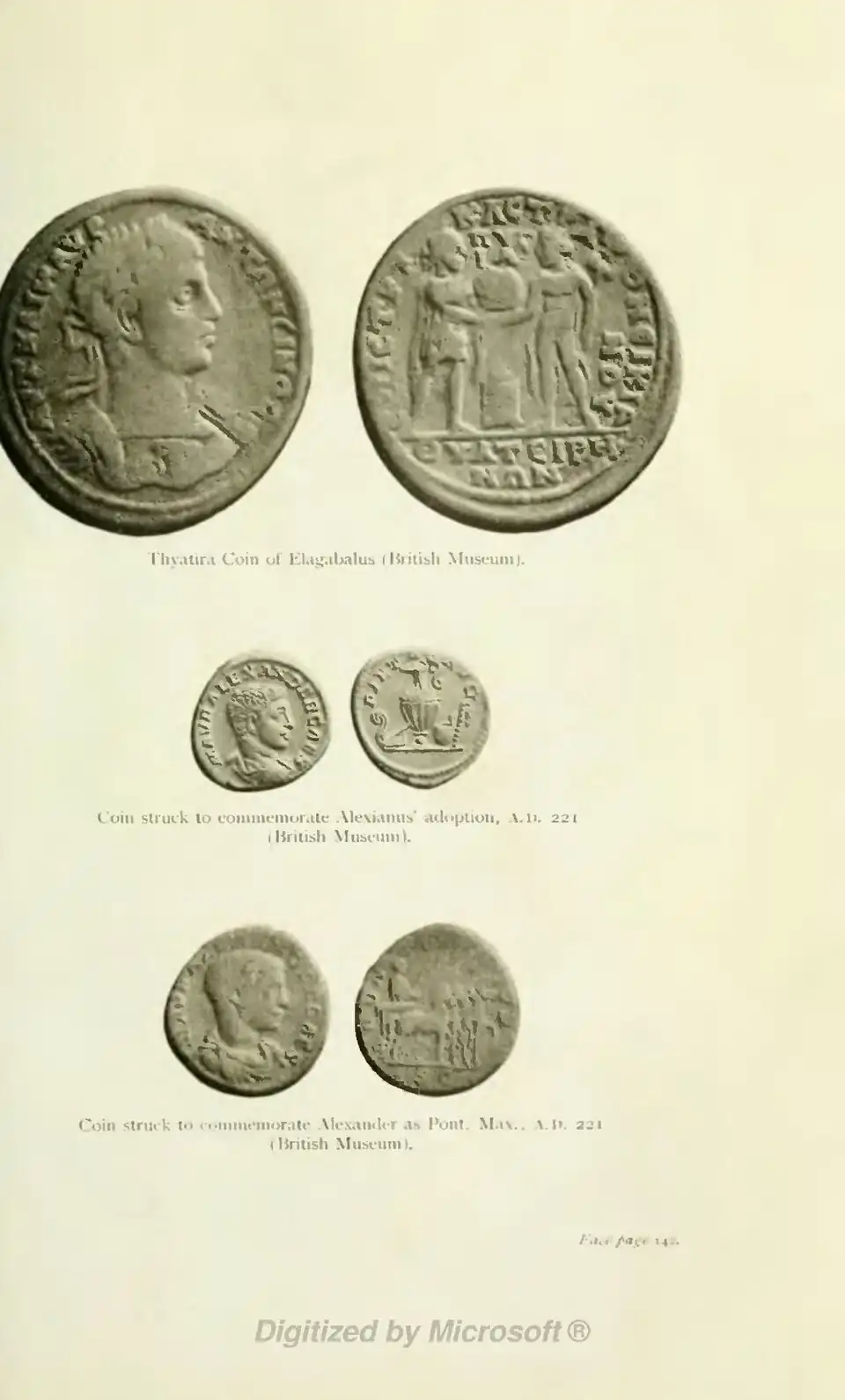 not that Herodian knew he was right even in this case, because he puts the adoption in the year 220 instead of 221, which would have made Alexianus about eleven instead of over twelve years old, as he states.
This is the only rational view to take of the Emperor's apparent gullibility, as Antonine was far too quick-witted not to have scented trouble in any scheme, however specious, to which his aunt was party. He had already heard of her dealings with the soldiers, and of the money that she was spending with a purpose: obviously he saw in the adoption a loophole for his own escape, and at the same time for her undoing. His friends may have warned him to look out for rocks ahead. They knew that the boy was dealing with two able and crafty women made desperate by their continual disappointments; if so, he must have refused to listen to them, for some time early in July Antonine took his cousin Alexianus to the Senate, and there, in the presence of the women, this boy of sixteen summers went through the ceremony of adopting the child of twelve. He then solemnly declared his intention of training his son himself, fitting him for the business of Empire early, in order that he might be free from solicitudes about a successor. Now, this was by no means Mamaea's plan, and caused endless friction in the working.
Antonine obviously thought that some explanation of his decision was needed, and had the audacity to tell the assembled fathers that he was acting on the commands of the great God, who had designated Alexianus as the successor to the name and Empire of Severus,—this on the basis of a bastardy almost as probable as his own.
The name Alexander, which was then imposed upon Alexianus, is accounted for both by Lampridius and Dion by two equally untrue and mutually contradictory stories. Lampridius says that the boy was born in the temple of Alexander at Area, on the birthday of Alexander of Macedon, 18th June 208; as a matter of fact he was not born until the 1st October of that year, and it was highly improbable that a woman in the social position of Mamaea would allow an accident of the kind to happen in so public and unprepared a position. Dion accounts for the new name by relating the miraculous return from the dead of the Macedonian king, and his spectral journey through Thrace, where he buried a wooden horse which has not since been found,—neither has the consonance of the story been established, for that matter. The real reason for the change of name was perfectly simple; it was in memory of the devotion which Caracalla, his putative father, had always testified towards King Alexander of Macedon.
The ages of the two principal figures in this ceremony form the peg on which Lampridius hangs not a few jeers. Perhaps it was absurd, but far more unnatural things had been extolled: witness Septimius' adoption of the defunct Marcus Aurelius as his father, which was certainly an even less possible performance in the natural order of generation. If Lampridius jeered later, no one did so at the time; in fact, we are led to infer that all men were pleased. The soldiers, because Mamaea had made it worth their while to adopt that attitude; the Senate, because they expected consideration from a little milksop brought up entirely at his mother's apron-strings; the people, because it was the occasion for Antonine's fourth congiary. Singularly enough, there is again no mention made of a donative, or distribution of money to the soldiers, which seems unfortunate.
It is difficult to ascertain the exact date of the adoption. Herodian's statement of the year 220 is easily refuted, both by epigraphic and numismatic evidence. These give, as near as posible, 10th July in the year 221, by means of the following deductions:—(1st) The fasti of a priestly college, probably the Sodales Antoniniani, dated either 2nd or 10th July in that year, describe Alexianus as "Marcus Aurelius Alexander Nobilissimus Caesar," and either Imperii consors or heres, on which discrepancy of words hangs a future tale: (2nd) the earliest Alexandrian coins which call Alexianus Caesar are dated  , or subsequent to 29th August 221; (3rd) there is an inscription found amongst those of the 7th Cohort of the Vigiles, which was set up on 1st June of that year, and commemorates the Imperatores Antoninus et Alexander. The earliest date is therefore 1st June, the latest the end of July or beginning of August. The probabilities lie between the two, as the early police inscription has been accounted for on the grounds that, along with her money, Mamaea had circulated a report of the adoption before it took place. The numismatic evidence points to a middle date, because, as far as we can judge, the Alexandrian mint was most expedite in issuing its coins, and here, if the adoption took place early in June, they would seem to have allowed a month or so to elapse between the time they got the news and the first issue of the coins. Other mints also issued their first coins, calling Alexander Caesar, towards the end of 221.
The one official decree is that of the Sodales. It is defective in its designation, and has caused much disagreement both as to Alexander's position once he was adopted, as well as about the date of the ceremony itself. At any rate, until more definite information comes to hand, we are forced to be content with the generally received date, somewhere about 10th July. The next question is as to the position of Alexander after that date, in the year
221. Certainly Maesa and Mamaea intended to have him "Imperii consors." As far as we can judge, both from the statement in the Senate and from his subsequent proceedings in the state, Antonine's intention was to adopt an "Imperii heres"; now, this was a very different matter, and entirely nullified the major part of the plan of the schemers. Antonine certainly did defeat their plot in part by refusing to give Alexander any governmental powers. This Is certain from the fact that on no coin does Alexander appear with the Imperial insignia (the laurel wreath) before the month of March 222, though the titles which he received at his adoption—Augustus, Imperator, and Caesar—are frequently used before that date, because Antonine never had the least objection to other people using titles, so long as he kept the power. Maesa and Mamaea must have been wild with rage at having gained so little; they had shaken hands repeatedly, and congratulated themselves so often because Samson had at last delivered himself bound into their hands and henceforth they were in permanent possession of the administration, that it must have been a very disagreeable awakening when they found that their plan had not succeeded.
If we can believe anything that Lampridius says, we would judge that Maesa was now genuinely frightened. She thought that Antonine's religious mistake had created a real wave of bad feeling in the city, and that, if anything should happen to the reigning Emperor, her position would be gone for good and all. Now, the last thing that she had a mind to do was to return to provincial obscurity. With a patience and determination worthy of a better cause, she set to work to gain for herself, and incidentally for Alexander also, what had not accrued when the adoption took place. As far as we can judge from the coins, Maesa had only managed at that time to obtain his association with Antonine as Pontifex Maximus, thereby lessening the Emperor's authority over the Roman cults, for which he had shown so little respect. One thing was, however, satisfactory: Alexander was "out"; people knew about him in Rome; he was the heir designate, and, as such, a most useful lever in the hands of the unscrupulous.
It was certainly not long before Antonine found that his success had not been as unqualified as he had imagined. Alexander was Caesar by decree of the Senate; Severus by some utterly unconstitutional decree of the army; Antonini filius and Severi Nepos; but here it began and ended. The boy was utterly unresponsive to the affection that Antonine was anxious to lavish upon him; utterly incapable, so the Emperor said, of any sort of training for the position he was destined to occupy. Undoubtedly a great mistake had been made, the boy was a born prig, and the Emperor had given his case away by adopting him at all, by putting him into a position in which his popularity was bound to increase amongst those who did not know him personally. In fact, Antonine arrived at the conclusion before the wine harvest that he had played his aunt's game and not his own, and in consequence he became moody and uncomfortable.
Lampridius' contrast of the two characters is, as we have said, a caricature drawn for the laudation of the younger, the reprobation of the elder. If only a part is true, it must have been very annoying for the Emperor of seventeen to be saddled, through his own stupidity, with a nincompoop of twelve, a boy who quoted proverbs to a purpose, and the maxims of a detestable crowd of female relatives at every turn. Of course, Lampridius' likeness of his little hero is stocked with fulsome adulation. One would think, on reading it, that there was at least one person in the world who did not deceive himself when he said that he was without sin, and therefore ready to cast the first stone. The account of his first meeting with the Senate is simply ludicrous; no child, however disgusting, could have displayed the unction and greasiness which is recorded as having slipped off his tongue. Were he one-half as nasty as Lampridius asserts, we can well imagine that the whole devil in Antonine was striving to get hold of his cousin's prejudices, trying to persuade him to run, dance, play, to wake him up from the self-satisfaction which so ill became his years. All of this, we are told, Antonine did, under the generic terms of corrupting his morals, which is after all the sum total of Antonine's enormities.
But here Mamaea stepped in. She had spoilt her son's youth, as many another parent has done both before and since, and was not going to stand by and see her work dissipated, blown to the winds. Not that she need have feared. The Bassiani developed young; Alexander's character was moulded, and he had no desire to change, to live his life as a man, instead of as a vegetable, or enjoy the gifts which the gods had given to men. Antonine had thought that something might be done for the cousin he pitied, by turning him loose; he found it was no good, and soon lost patience. He then realised the trend of affairs; he saw the growing influence of the women, the stupidity of the boy, and chafed more each day under both. The nonconformist conscience, which was Alexander's chief attraction, and is still his only title to fame, annoyed the Emperor continually. Friction arose at every turn. It was Antonine striving to minimise the influence of the women, and the women striving to destroy the influence of Antonine, together with his crew of wretched favourites. Neither did the elderly Annia Faustina tend to mend matters. She as well as Alexander had been a mistake, and so the Emperor resolved to get rid of both his troubles at one swoop. To do this, however, he had to quarrel openly with his relatives, and by a coup d'état regain paramount authority in the state. The question was, would he be strong enough? Would a boy of seventeen, surrounded by friends who, however agreeable as sportsmen, however able in the histrionic art were anything but trained politicians, have much chance of regaining what statecraft, diplomacy, and guile had filched from him at a moment when he was comparatively helpless?
His first act was to follow the same tactics that he had adopted on 10th July. He sent to the Senate ordering the fathers to withdraw the title of Caesar which he had conferred on Alexander and which they had confirmed. That august assembly, we are told, preserved a discreet silence, not quite knowing whom to please, or which way the strongest cat was going to jump. Here, after all that the author has said about Alexander's popularity and the general hatred testified towards Antonine, occurs a strange statement. Lampridius says they were silent because, "according to certain persons, Alexander was popular with the army." This, as we see, is a much-qualified expression of opinion when compared with those in the foregoing sections, and put in conjunction with the Senate's reluctance to commit itself one way or another, it is certainly significant, and points to the fact that the real hatred towards the Emperor had yet to be worked up, like the similar hatred towards the aristocracy in this country. Another significant fact concerning the Emperor's honest and straightforward intentions towards his cousin is, that right up to the last he seems to have had command of the boy's person, and never took any decisive measure, either openly or secretly—in the usual Antonine fashion—for removing him to another sphere of usefulness in realms celestial, despite the plots formed against his own life, of which, before now, he had had ample proof.
It is probable that about this time Antonine made several official appointments which were considered thoroughly bad by the older politicians. Names are not mentioned, but we can well believe that the Emperor had grown suspicious of his old advisers ever since he had seen them paying court to the young Caesar and his mother. We are told that he put men into offices, especially those about the palace, who, from a personal and too intimate relation, he felt he could rely on. As ever, such appointments are a gross mistake. As mere friends such men would have tended to his undoing; as officials they tended to revolution.
Following up his command to the Senate, Antonine sent messengers to the army. These demanded that the soldiery should relieve Alexander of the title of Severus, or Caesar, or whatever designation they had taken upon themselves to confer on the boy, while the same messengers were ordered to deface the statues and inscriptions in the camp, as the custom was to treat those of dethroned tyrants. Now, this was unwise, without so much as by your leave, or with your leave, because the property belonged to the regiments, and not to the Emperor.
Next in order comes the record of an attempt made by Antonine to assassinate his cousin. It is a story which requires careful examination, because Herodian never mentions it at all, and Dion only refers to it casually in the following words: "Much as Sardanapalus loved his cousin, when he began to suspect everybody and learnt that the general feeling was veering towards Alexander, he dared to change his resolution, and did all in his power to get rid of him. He tried one day to have him assassinated, and not only did not succeed, but nearly lost his own life in the attempt." Lampridius is, of course, much more explicit. This we might expect, because he lived so much later and had a century of vilification to work upon as well as Dion's official story. From him we learn that Antonine sent men to assassinate Alexander, and also sent letters to the boy's governors (all of whom, be it remembered, were of Mamaea's appointment and consequently were working for her, not for Antonine) with promises of wealth and honours if they would only kill their charge in any way they thought best, either in the bath, by poison, or the sword.
This policy of bovine artfulness accomplished, Antonine went to his gardens in the suburbs (ad spem veterem) for an afternoon's exercise in chariot-driving, certainly without any sufficient guard. At this juncture Lampridius stops his fantastic story of the most futile attempt at assassination ever recorded, in order to utter a few sententious platitudes, which, however, cut both ways. He remarks with a verisimilitude of sincerity, that "the wicked can do nothing against the innocent." Now this is a maxim which is not always regarded as a truism, even on the Stock Exchange, but it was a convenient way of accounting for the incomprehensible ending to this absurd allegation.
Lampridius then continues that the promulgation of these orders, as carried to the soldiers, did not increase the popularity of the Emperor, at any rate amongst that party who were in Mamaea's pay; besides which, fratricide was by no means a popular, even when it was a fashionable crime. The result of these two supposed epistles when communicated to the soldiers (by whom or why is unfortunately not mentioned) was to rouse them to the highest pitch of anger. Quite spontaneously they ran, some to the palace, where Alexander was living with his mother, and some to the gardens, where, also by some unexplained power of divination, they knew they would find Antonine; their intention being to carry out Mamaea's wishes on the person of the Emperor without further delay. Soaemias, we are told, followed them on foot with the design Page:The Amazing Emperor Heliogabalus.djvu/200 Page:The Amazing Emperor Heliogabalus.djvu/201 Page:The Amazing Emperor Heliogabalus.djvu/202 Page:The Amazing Emperor Heliogabalus.djvu/203 Page:The Amazing Emperor Heliogabalus.djvu/204 Page:The Amazing Emperor Heliogabalus.djvu/205 Page:The Amazing Emperor Heliogabalus.djvu/206 Page:The Amazing Emperor Heliogabalus.djvu/207 Page:The Amazing Emperor Heliogabalus.djvu/208 Page:The Amazing Emperor Heliogabalus.djvu/209 Page:The Amazing Emperor Heliogabalus.djvu/210 Page:The Amazing Emperor Heliogabalus.djvu/211 Page:The Amazing Emperor Heliogabalus.djvu/212 Page:The Amazing Emperor Heliogabalus.djvu/213 Page:The Amazing Emperor Heliogabalus.djvu/214 Page:The Amazing Emperor Heliogabalus.djvu/215 Page:The Amazing Emperor Heliogabalus.djvu/216 The incident of the latrinae, mentioned by Lampridius, suggests a murder similar in circumstance to that of Caracalla. What would have been easier than for one of Mamaea's party to seize the boy, alone and unprotected in the latrinae? The Emperor once gone, the obvious thing would be for the conspirators to remove as quickly as possible all those persons who might make things difficult for his successor. Of these, Soaemias would certainly be the most troublesome. Hot and passionate, devoted to her son and to his memory, if she had lived, Rome would have resounded with the noise of the crime. It was obviously necessary to close her mouth with expedition. Why Eutychianus did not suffer the same fate is quite incomprehensible. The only theory that has been suggested is that neither Maesa nor Mamaea felt themselves capable of undertaking the whole administration alone; they felt that they must have at least one man who knew the ropes at their back.
To account for the treatment of Antonine's body at the hands of the mob is certainly difficult. We know that he had done nothing which could have rendered him obnoxious to the populace. To ascribe it to intolerance of his psychopathic condition shows, not only ignorance of Roman susceptibilities, but also a foolish ante-dating of popular prejudice. We certainly have no record of this Emperor's sepulchre; and to dismiss as mere fable the one point on which the authors all agree is equally impossible. The probable solution lies in the fact that Mamaea's money, which had caused the murder, invented this scheme for disgracing her nephew's memory, and thus averted trouble from herself. It would raise a popular tumult, or at any rate a disgust for the idol of the masses, if they could have Antonine's body dragged through the city publicly, as the perpetrator of unmentionable crimes, concerning which the populace knew nothing. Suffice it to say that it did the work. Antonine had the stigma of all crimes imputed to his memory; and Alexander the good arose superior to all human frailties. Then and not till then, Rome began to be shocked. Men whose fortunes Antonine had made by his liberality, the Senate, whom he had snubbed so unmercifully, the army to whose donatives he had not attended properly, all these found it advisable to adopt the views of the new administration; their education in ingratitude was complete. Instead of the generous, fearless, affectionate boy whom the populace had known, there emerged the sceptred butcher ill with satyriasis; the taciturn tyrant, hideous and debauched, the unclean priest, devising in the crypts of a palace infamies so monstrous that to describe them new words had to be coined. It was Mamaea's work, and for 1800 years no one has had the audacity to look below the surface and unmask the deception.