Stokes on Memory/Addenda
ADDENDA TO THE NINETEENTH EDITION.
This little book, "Stokes on Memory," has produced a marked effect upon public opinion, in favour of Mnemonics, which the extensive adoption of my educational appliances has greatly augmented. Thousands of grateful adults, and tens of thousands of happy children, bear ready and practical testimony to the advantage they have derived from my labours. My works are literally to be found in the palace and in the lowly cottage, in the college and in the village school, and the results arising from them have been so singularly successful as to appear almost fabulous. For a few pence advantages may be secured through my books, which by no other means can be obtained for many pounds; and an ordinary teacher equipped with weapons which he may wield in a few minutes, may conquer difficulties which otherwise would baffle him for years; thus equipped, teachers innumerable—honest men and honest women, declare that they dare no longer "teach," or rather profess to teach upon the ordinary plan—that it is comparatively a farce, a swindle, and a barbarity.
Most earnestly I invite investigation and co-operation. I can generally obtain the latter, in one form or another, when I can secure the former, but that is the difficulty. It is very suggestive of
THE MAN WITH THE SOVEREIGNS.
One day there stood on London Bridge, we're told,
A man who offered sovereigns of pure gold
To all the passing throng his voice could reach,
For the small charge "One Penny each."
"Here you are, Gents" (as an apology
For these strange words, such was his phraseology),
"A sovereign for a penny, a sovereign for a penny;
I'm sent here by a lord to ascertain how many
Will risk a copper for the chance of gold,
When you, and not a sovereign might be 'sold.'
Come, buy my sovereigns, do not go by me,
No better sovereigns in this world could be.
Some men have lied, and others through relying
On what was said, sham sovereigns have been buying,
I'm not a 'gilty' trader, gentleman:
Invest a penny in a sovereign, then.
My noble lord has bet one hundred guineas
That all the gents, philosophers, or ninnies
Who pass this way within a solid hour
Will not invest through my persuasive power."
Thus the man bawled till he was hoarse and tired.
And patience and his hour had expired;
Then pocketing his sovereigns off he went,
And not one penny had the people spent.
Whether philosophers or ninnies they,
Is just the thing I don't pretend to say;
Perhaps philosophers—if so, 'tis wise
To clutch a penny and let slip a prize.
If they were ninnies, we may learn that never
Is it philosophy to be too clever.
This story, therefore, whether false or true,
Presents a moral to be borne in view:
That oft it happens that the wisest men
Pass by great facts presented for their ken;
And make their boast, instinctively they knew
That which they heard was "too good to be true!"
W. S.
AN OLD MAN'S MEMORY.
An old man sat, one winter's night,
Beside a blazing fire,
And a goodly group sat near to him,
Sat listening to their sire;
Who, while he pressed their mother's hand.
As in the days of yore,
Told of the things which used to be,
But which will be no more.
He seemed to be a boy again;
Unchildishly a child,
His was not "second infancy,"
But Memory run wild.
He mentioned all the toys he had,
Played many a game again,
And named a score of play-fellows
Long since old tottering men.
In Memory he went to school,
And again he got the cane;
And his glee would almost make one think
He quite enjoyed the pain.
Again he ran away from school,
And again was taken back,
And in passing stayed to pity
All those who schooling lack.
Then he spoke of robbing orchards
(But praised honesty withal),
And explained how from an apple-tree
He had an awkward fall.
How he failed to get the apples,
But got seriously hurt,
Fruit of attempted pilfering,
Which he said was his "desert."
Then he told how Railway travelling,
Was treated as a joke,
And the people said the steam scheme,
Would be sure to end in "smoke."
And he told how farmer Greenfield
Asked how much he'd have to pay,
If he "Telegraphed to London,
A waggon-load of hay!"
And he said how few wrote letters
Before the Penny Post;
That where we now send hundreds,
They sent two or three, at most.
The old man from his Memory
Right many a lesson taught;
And he gave his children many truths.
Which he had dearly bought.
And his children in their after life
Have oft re-heard a word
Vibrating in their Memory
Which that winter's night they heard;
And their father's Memory-treasured truths
Have saved them many pains,
Have brought them many pleasures,
Have secured them many gains.
His Memory is dear to them;
They speak of him with pride,
And in effect he's living,
Though long ago he died.
A good old man with Memory
Full, vigorous, and clear,
Commands without command, respect,—
Is one we must revere I
W. S.
Part of an Engraving from Stokes's
"Syllable-ized Pictorial Alpharet."

C upon the SEA is placed.
See pp. 21 to 25.
IN WORDS OF ONE SYLLABLE.
FOOD.
Live not to eat, but eat to live;
This is a rule which health will give.
A TALE OF A DOG.
A FACT.
A poor dog broke its leg one day;
A kind man set it right;
And soon it brought a friend, a dog,
In just the same sad plight.
BEAR IN MIND.
Bear this well in mind, that few can bear in mind;
If you trust to their word you may rue it:
So see that they do that which ought to be done;
Or, the best thing of all is to do it!
Bear in Mind,—
Bear in mind you ought to be kind,
And should not be "a Bear" in mind!
Bear in Mind,—
Bear in mind that you will find
It would be most sad to be bare in mind!
As half in sun and half in shade,
This world moves on its course so free,
Oh, may the side where shines the sun,
Be all, dear child, that thou shalt see!
The names of the objects I employ are given in the following Explanatory Rhyme, which children learn very pleasantly and very rapidly, by singing it, to the tune of "So early in the morning." The entire table to "twelve times twelve" is represented in fifty-seven simple and attractive pictures, which are systematically arranged. To each picture I have assigned a name, and the names I have strung to-gether in twelve couplets, which go to the child's tune, "Here we go round the mulberry-tree."
(FOR THE CHILD.)
A tree means 1, from one trunk springs.
A bird means 2, it has two wings.
A boat iS 3, three sails are shown.
Animals 4, four legs they own.
A man means 5, five fingers he.
A house means 6, six windows see.
A church means 7, not windows less.
A lady 8, see eight-flounced dress.
A bridge is 9, nine lamps are found.
A boy means 0, see hoop so round.
FIRST, LEARN THESE WELL, then you'll be able
To learn and use with speed the Table.
Observe the Number of each Square,
Note how the Pictures run, with care.
If you forget, you'll save much time
By learning, when you need, the Rhyme.
Dear Boys and Girls in days gone by,
About their "Table" used to sigh;
And oft it was a task of tears,
Which lasted many irksome years,
But you can learn with smiles and jokes
The Picture Plan of your friend stokes!
 |
 | |
 |
 |
 |
This globe for rapidly teaching Geography, though designed by me many years ago was not published till the early part of 1868, its manufacture having been unsuccessfully attempted by several firms. I at length had the good fortune to make the acquaintance of the eminent draughtsmen, engravers, and printers, Messrs. John Emslie & Sons, 47, Gray's Inn Road, London, by whom the Globe has been beautifully engraved in copper plate, coloured, and wholly manufactured, with the most artistic skill. I originally announced the Globe at 2s. 6d. or to be sent free for thirty-six stamps, but believing it to be one of the requirements of the age, I ultimately decided upon producing it at 1s. or free for fourteen stamps. It is really unequalled as a marvel of cheapness, and the thousands which are being sold prove that the public appreciate its merits. It is liked by old and young, its extreme simplicity being one of its great recommendations. It is twenty-four inches in circumference, being at the scale of about a thousand miles to the inch.
An outline of the human face and head is seen upon the globe Noticing or what portion of the face or head the various geographical places are located, fixes their relative positions easily and indelibly upon the Memory, and renders the study of geography not only interesting, but fascinating. A child will, as an amusement, teach himself more geography in a couple of hours with this globe, than the most indefatigable schoolmaster could thrash into him in a twelvemonth. With the Mnemonical Globe beating a child will be found of no service, as he will not object to "take pains!" Even adults, who have either never known much of geography, or who have let their geographical knowledge evaporate, will find that they can fix in Memory the position of places upon the globe by this plan with remarkable ease and speed. Those who study the Mnemonical Globe will find that occasionally a little playful pleasantry with the geographical names will enliven the proceedings, and will produce and strengthen mental impressions. Picturing the meaning conveyed by the sound of a name, in conjunction with its given locality upon the face or head, is by no means an unamusing or unprofitable performance; in fact, quite the reverse. A little verbal distortion or substitution is also within the scope of Mnemonical licence. The following Mnemonical observations may serve by way of elucidation.
Europe on the centre of the forehead, you're up.
On the upper part of the right ear is Mexico.
Before the right ear is Jamaica.
The right eye is in the Atlantic Ocean.
Between the eyebrows we have the Great Desert,
Timbuctoo, and the River Niger.
In the left eye we have new beer (Nubia), which has
made it red see (Red Sea).
The front portion of the left ear has been struck by a
mad ras-cal (Madras), and just below it there
is a seal on (Ceylon).
Above the left ear is the bit of China (Thibet, China).
South America is on the right cheek bone.
A guinea (Guinea) is on the bridge of the nose.
St. Helena is nearly in the face's centre.
A smile would almost extend from the middle of the
Atlantic to Cape Colony.
Gough, the orator, made good use of his mouth
(Gough Island is in the mouth), and so ou to
any extent.
Strange thought but true, henceforth to you
And many more beholders,
Each man shall ATLAS seem to be,
With the World upon his shoulders!
I give on the opposite page an engraving from my little book, "The Divine Origin of Mnemonics," and suggest to all Biblical Students a careful perusal of the work itself.
Explanation of Engraving.
The White Veil, worn in the Synagogue during prayer. At each of the four corners of the Veil hangs a string with five knots, suggestive of the Five Books of Moses.
1. Phylactery for arm and hand.
2. Phylactery as seen on the inside of left arm and hand.
3. Phylactery as seen on the outside of left arm and hand.
4. Phylactery for the forehead, seen sideways.
5. Knot which goes at the back of the head.
6. Knot and Phylactery, seen frontways.
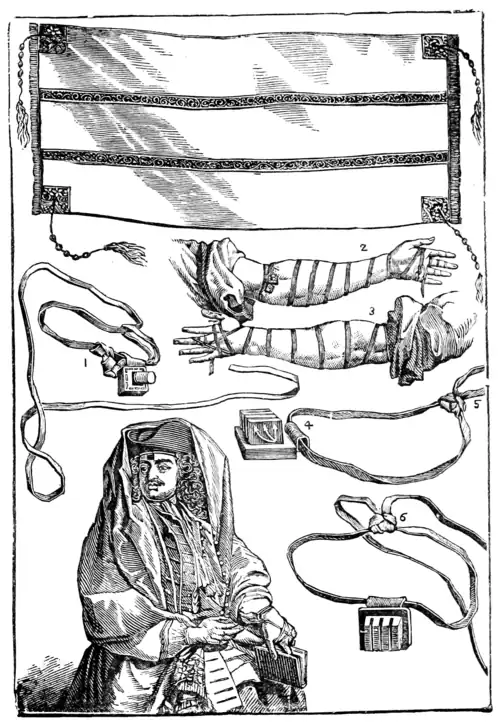
Photographed on Wood and Engraved by Angerers, Son, Fru wirth & Co., London, from a steel engraving, 12 x 8 in. in Picard's "Religious Ceremonies and Customers," published in French at Amsterdam, in 1723.
MEMORY PICTURES
OF THE
LIFE OF CHRIST,
WITH MNEMONIC PLAN AND EXPLANATION.
BY WILLIAM STOKES.
TEACHER OF MEMORY, of the Royal Polytechnic Institution, &c.
One Hundred Original Drawings,
BY WILLIAM BROUGH,
Illustrating in Mnemonic Groups, Mimpriss's 100 Graduated
Lessons, developing in the order of time, according
to Greswell, & continuous History of
OUR LORD'S LIFE AND MINISTRY;
HARMONIZED FROM
THE FOUR EVANGELISTS.
STOKES ON MEMORY.
S cience fall stature has not yet attained;
T hought is e'en yet an infant in Time's cradle;
O n-moving man Truth's summit has not gained;
K ings get not knowledge with a golden ladle.
E ach who'd gain Wisdom must make friend of Thought,
S uccess in mind-work never can be bought.
O f this convinced, with patience onward plod,
N earer to reach the image of your God.
M ake each new truth a stepping-stone to heaven,
E 'en shall it prove a stride in league boots seven.
M ake Memory serve you Wisdom to retain,
O r pay the penalty—strive on in vain.
R emember, Memory giving power to mind,
Y ields by its culture good to all mankind!
W. S.
The increased interest manifested in my System and in my various Works, has involved an amount of correspondence which has been remarkably heavy, and has often baffled both myself and my assistants. This has, fortunately, led to my invention of the
By which an entirely novel method of correspondence has commenced, which bids fair to become very extensively, if not universally adopted. It consists of a peculiar arrangement of words and sentences so contrived, that an almost endless variety of fresh combinations can be produced, by simply underlining the words required in the communication. The words are classified and located in such a manner, as to make an instantaneous, and indelible impression upon the Memory, so that they can be seen mentally, and can be used with the utmost readiness. The application of the method is quicker than shorthand, and it can be read as easily as ordinary print. By means of the Typogram, ten or more communications can be despatched in the time usually required for writing one, and it is often easier to send a Typogram, than to give instructions respecting a letter to a second party. It is novel in its shape as well as in its application. It requires no envelope, it can contain an inclosure, and it cannot be opened without detection. Its cost is little more than ordinary note paper.
The Typogram is equally adapted for business firms, and for private individuals. It may be used by persons in every grade of life, and for the most varied and opposite purposes. It asks questions, gives replies, makes requests, and supplies information. Its tendency is to promote friendly communication, business despatch, and commercial prosperity.
My terms to Institutions, etc., for a Public Lecture or Entertainment on Memory, with Diagrams, Illustrations by Pupils, Hints for Aiding the Memory, etc., are Five Guineas, and incidental expenses. For a Lecture or Entertainment to Schools, Two Guineas, and incidental expenses.
For a Drawing Room Lecture or Entertainment, Two Guineas, and incidental expenses. The Drawing Room Lectures and Entertainments are given at private residences, to families, and invited friends; are easily arranged, and are often preferred to public demonstrations.
As I frequently have engagements to lecture and teach in different parts of the Kingdom, it is desirable that those ladies and gentlemen who wish to take oral lessons, should WRITE TO ME, informing me of the fact, so that I may have an opportunity of apprising them, should I be visiting their district.
Those who go to London expressly to receive my lessons, should, if convenient, arrange to be there at least three clear days, so as not to take the lessons when fatigued with travelling; and in order that they may not simply acquire the System, but may apply it practically under my supervision.
I occasionally have a vacancy for one or two pupils as boarders, and I sometimes arrange for young gentlemen to travel with me, while studying and applying my System.
To meet the requirements of many who cannot take oral lessons, I have made special arrangements for giving
In these lessons I endeavour to make everything as easy as possible, and I try to adapt my mode of teaching to suit each correspondent. I do not profess to teach as easily, as quickly, or as thoroughly by letter as by word of mouth, but I do the best I can under the circumstances, and pupils taught thus have expressed great satisfaction.
My terms for teaching by correspondence are Five Guineas for one pupil, and One Guinea for each additional pupil taught by me at the same time, with the understanding that those instructed shall not communicate the method to others. For a class of Twelve or more pupils taught by correspondence, my Fee is One Guinea each.
A pupil wishing to communicate my System, can do so if the person about to be taught sends me One Guinea. I then write to the sender of the Fee inclosing a printed receipt, and I post a letter and a set of lesson papers to the pupil volunteering the instruction. Should an opportunity occur, any person learning thus, or by correspondence, can take a Course of Class Lessons of me either in London or elsewhere, without any additional payment.
I particularly invite my pupils to
ANOTHER COURSE OF LESSONS,
as I am now introducing a portion of my
I make no charge for the extra instruction, and I hope that many will avail themselves of the invitation, as "Practice makes Perfect."
The new productions consist of the following, each with Companion Mnemonical Key:—
1. Leading Dates from Collier's British History.
2. Battles.
3. British Colonies and Dependencies.
4. Distances from London of the most important Commercial Cities.
5. Astronomical Distances and Magnitudes.
The above, which are extremely easy to learn, may be had by pupils for Five Shillings, or by post for sixty-two stamps; or by non-pupils, with instructions by post or otherwise, for Twenty-Six Shillings. Each set of Mnemonical Keys, and the instructions accompanying them, to be for the use of one learner only. Other Keys are now ready.
To fix in Memory the following dates, with the aid of the New Mnemonics, is an amusement of about twenty or thirty minutes. LEADING DATES.
OF THE
HISTORY OF THE BRITISH EMPIRE,
BY
WILLIAM FRANCIS COLLIER, LL.D.,
Trinity College, Dublin,
AUTHOR OF "GREAT EVENTS OF HISTORY," "HISTORY OF
ENGLISH LITERATURE," ETC.
Printed for Mr. William Stokes, Teacher of Memory,
Royal Polytechnic Institution.
Residence: 15, Margaret Street, Cavendish Square, London, W
| Landing of Julius Cæsar | b.c. | 55 |
| Return of the Romans in the reign of Claudius | a.d. | 43 |
| Death of Boadicea | 61 | |
| Agricola begins his government | 78 | |
| Agricola builds his walls | 79 | |
| Adrian's Wall built | 120 | |
| Antonine's Wall built | 138 | |
| Death of Severus at York | 211 | |
| Britain independent | 288 | |
| Roman rule restored | 300 | |
| Martyrdom of St. Alban | 303 | |
| Romans leave Britain | 410 | |
| Landing of Jutes | 449 | |
| Heptarchy established | 582 | |
| Landing of Augustine | 596 | |
| Cambridge University founded by Sebert | 644 | |
| First Landing of Danes | 787 | |
| Egbert crowned | 827 | |
| Alfred made King | 871 | |
| Oxford University founded by Alfred | 886 | |
| Massacre of Danes | 1002 | |
| Court held at York | 1069 | |
| Malcolm III. pays homage | 1072 | |
| Siege of Gerberoi | 1077 | |
| Domesday-book compiled | 1080–1086 | |
| Mowbray rebels | 1095 | |
| First Crusade | 1096 | |
| Prince William drowned | 1120 | |
| Maud lands | 1139 | |
| Prince Henry lands | 1152 | |
| Council of Clarendon | 1164 | |
| Becket murdered | 1170 | |
| Ireland conquered | 1172 | |
| Third Crusade | 1190–92 | |
| Interdict | 1208–1214 | |
| Magna Charta | 1215 | |
| Mad Parliament | 1258 | |
| House of Commons founded | 1265 | |
| Wales conquered | 1282 | |
| Baliol King of Scotland | 1292 | |
| Robert Bruce crowned | 1306 | |
| Ordainers | 1310 | |
| French War begins | 1338 | |
| Calais taken | 1347 | |
| Poitou and Guienne acquired | 1360 | |
| Treaty of Bretigny | 1360 | |
| Poitou and Guienne lost | 1375 | |
| Tyler's Rebellion | 1381 | |
| Wonderful Parliament | 1388 | |
| Martyrdom of Sautre | 1401 | |
| Siege of Rouen | 1419 | |
| Treaty of Troyes | 1420 | |
| James I. of Scotland released | 1423 | |
| Joan of Arc burned | 1431 | |
| Cade's rebellion | 1450 | |
| All French possessions except Calais lost | 1451 |
A BRADFORD LYRIC.
His name is known throughout the land
As Education's friend,
He shouts, "For Education I
A helping hand would lend."
His fellow-townsmen hear with pride
The mention of his name,
And England's heart with gratitude
Rejoices at his fame.
His words are deemed of sterling worth,
The leading Journals each
Present in full for eager eyes
His latest "able speech."
The friends of Education cry,
"Of him we well may boast,
We're proud to have him on our side,
He's in himself a host."
A veteran teacher, laurel crowned,
A pilgrimage had planned
To see this famous man at home,
And shake him by the hand.
To show him novel teaching aids
But little known, which would
If but adopted, cause a change
For Education's good.
Heeding Association's laws,
Its aid he well evokes,
And thus, on simple principles,
The "Memory he STOKES!"
The day long-wished at length arrived;
He saw this speaker famed;
The teacher's wish at once was guessed,
As soon as he was named.
Forthwith the speaker speaks again,
"Brother, co-worker true,
I'm glad to see you; is there aught
That I can say or do
"That may assist you in your plans
To benefit our Nation
By spreading far and wide your aids
For rapid Education?
"Don't over estimate my power,
'Tis little, but I'm right
In saying I feel in duty bound
To help with all my mite."
"Thanks," said the teacher "now is turned
Upon us England's eye,
And many an ear the whole world o'er
Is waiting your reply."
No—thus the able speaker spoke,
"Your name is known to me;
Of your quick teaching I have heard,
But I, as an M.P.,
"Have not the time to ascertain
How anybody teaches,
My time is fully taken up,
With Education Speeches."
The teacher said "Of speeches
We have surely had enough,
We want efficient action,
So pray spend less breath on 'stuff.' "
"Work for this boon for England,
But little it will cost her!"
The able speaker said, "Your scheme
Bring not to me to FO(R)STER."
I wrote the above in February, 1868, after an interview with W. E. F., Esq., M.P.; the interview having been sought, as I stated at the time, not only of my own accord, but at the suggestion of several friends of education in London and elsewhere, and in compliance with the wish of many of Mr. F's. constituents. From the frequency with which similar replies have been given by gentlemen rejoicing in the title of M.P., it might almost be inferred that M.P., meant Man Protected from Matters Practical and was synonymous with Mere Prater. We fortunately however often meet with an M. P. E., a Most Praiseworthy Exception!
I received the following reply to an application I made, expressing my desire to introduce my system of teaching at the Marlborough Institution, Dublin.
"2nd April, 1868.
"Sir,—In reply to your letter of the 30th ultimo, we are to inform you that the commissioners of National Education do not require the services of any gentleman, unconnected with their own establishment to give lectures on any subject to the pupils attending their schools, or to the teachers in training.
We are, sir,
Your obedient servants,
JAMES KELLY,
W. H. NEWELL,
Secretaries.
WILLIAM STOKES, Esq.,
15 Margaret Street, Cavendish Square, London, W.
The Irish Commissioners of National Education are evidently under the delusion that, "the gentlemen of their own establishment" have arrived at the highest possible point of intelligence, and teaching power, but it may be profitable to themselves and beneficial to the Irish Nation, for them to learn that the very modest opinion at which they have arrived is decidedly erroneous.have a number of other letters from various Educational Committees, Councils, and other Bodies, similarly expressive of an earnest desire to investigate anything which may tend to promote Educational Science.
Judging from these official documents we might reasonably come to the conclusion that:—
A Committee or Council is several men,
Perhaps not so many, or far more than ten,
Who combine all their efforts, and stick to a plan
For doing unitedly less than one man!
W. S.
Now this state of things would be extremely funny, if it were not that it is very sad. Hundreds of thousands suffer through the lethargic few. My earnestness has been treated hydropathically by a great many; but the "cold water" they have thrown upon my efforts has had an invigorating influence upon me, and some have already found themselves "in hot water" as the result. It is well that it should be so. If the wrong men are in the right place, the right men must do their work in the wrong place, and the activity and laudable indignation of the irresponsible, will utimately force the responsible to the fulfilment of their duty.
He who his arm will not out-stretch
To save one drowning, is a murderous wretch.
Struggling Mnemonics drifts on learning's wave,
Those who should rescue, do not try to save.
Speak out who can! Say boldly what you think
Of those who wilfully would let it sink.
W. S.
Surely the time has come when this well-tried System, which saves money, time, and trouble to a marvellous extent, and which is valuable in so many other respects, ought to be taken up heartily by those who have the intelligence to perceive its merits. In addition to my published works, I have many other inventions which I have not yet made known, but which would be valuable to the whole of the civilized community, and nothing would afford me greater pleasure than to issue them, were they likely to be sufficiently appreciated to warrant my undertaking their production. Were I to relinquish lecturing and teaching, and to give my undivided attention to their completion, and to the superintendence of their engraving, printing, and manufacture, I should be fully occupied for several years, and irrespective of my time, the cost of their production would involve an expenditure of many thousands of pounds. The entire bestowal of my time in this manner is not at all necessary, as I can publish at convenient intervals if desirable, but the Works should not be lost.
As my educational appliances comprise the means for the most economic and beneficial teaching, I urge those who supply funds for schools, or who pay for the instruction of their own children, to purchase my aids, and to insist upon their being used. I send teachers to charity schools, ragged schools, etc., at my own expense, and supply the requisite apparatus for teaching, gratuitously, to the utmost of my I ability, and I am anxious to receive
Error, though rock-like planted,
Shall from its place be hurled:
Truth is the mighty lever
With which we'll move the world!
W. S.
SONNET.
To a Sympathetic Reader in a Distant Land.
I know not who or where you be,
But yet we feel true sympathy;
We feel for one another—
(Although we've ne'er each other seen,
Nor e'en in the same country been)—
As brother feels for brother.
The billows huge may toss and foam
Between you and my sea-girt home,
But busy winds and wafted spray
Are nought to us, friend far away.
Our thoughts may still united be
In spite of interflowing sea!
What do you think? What do you say?
What will you do, friend far away?
W. S.
The importance of prompt and energetic exertion on the part of my friends can scarcely be over estimated. I strongly recommend the immediate purchase of my Guinea Sorted Packet of Mnemonical Works, etc., to all those who approve of my productions, and who wish their approval to assume a practical form. To a great many the investment would be nothing; while the benefits conferred upon their friends and others by giving, lending, or even by simply showing and recommending the different books and inventions would be very great. Some who could not afford to do this could easily dispose of the greater part of the Guinea's worth among their friends, by selling them at the ordinary published or postal prices, and as each packet contains postal value to the amount of £1 10s. 3d.; the Guinea investment might prove an absolute source of profit. This arrangement affords admirable means for increasing the usefulness of those who may adopt the following
SOLILOQUY.
How little in the world's grand schemes
I now can take a part;
Though if I had it in my power,
I would with all my heart.
I would that I'd more talent;
I would that I'd more time;
I would that I'd more money;
I would that I'd,—but I'm
Encouraging but vain desires,
I'll henceforth try the plan,
Of wishing less for what I've not,
And doing what I can!
W. S.
My Guinea Sorted Packet of Mnemonical Works, etc., sent carriage free to any part of the Kingdom upon receipt of stamps or post office order for twenty-one shillings, contains the following:—
| Price by post | |||
| s. | d. | ||
| 1 Syllable-ized Pictorial Alphabet | toned | 2 | 8 |
| 1 Syllable-ized„ Pictorial„ Alphabet„ | plain | 1 | 2 |
| 1 Book Rapid Reading and Rhymes | 1 | 2 | |
| 1 Sheet Rapid„ Reading„ Rhymes„ | 1 | 2 | |
| 1 Book Pictorial Multiplication Table | 1 | 2 | |
| 3 Sheet Pictorial„ Multiplication„ Table„ | 3 | 6 | |
| 1 Historical Chronometer | 1 | 2 | |
| 6 Mnemonical Time Economizers | 1 | 6 | |
| 1 Divine Origin of Mnemonics | 1 | 2 | |
| 1 Life of Christ with Memory Pictures | 1 | 2 | |
| 1 Song "Memory," Sweet Visions of the Past | 1 | 7 | |
| 1 Lithographic Likeness 9 in × 7 in | 1 | 2 | |
| 50 Typograms for Rapid Correspondence | 1 | 2 | |
| 6 Stokes on Memory | 7 | 0 | |
| 3 Capital Mnemonical Globes | 3 | 6 | |
| Total value for One Guinea | £1 | 10 | 3 |
∵ Post office orders to be made payable to Mr. William Stokes, at Vere Street, London, W.
Cheques to be crossed "London and County Bank, Oxford Street."
All who are engaged in practical tuition should render me as much assistance as possible.
1st. To save themselves unnecessary trouble
2nd. To do justice to their pupils.
3rd. To strengthen me in the development of my Mnemonical Aids.
Teachers will find that a Guinea Pictorial Multiplication Table will save its cost over and over again; and a Mnemonical Globe should not simply be in every school, but if possible should be in the possession of every pupil. In many schools the pupils cannot afford to pay my fee; in such cases I am prepared to make special arrangements for teaching, upon terms which may reasonably mect their requirements. I can also, if desired, give quarterly, or term lessons, either personally, or by deputy, at colleges and schools, in addition to the ordinary instruction.
Many of those instructors who are desirous to do all they can for the advancement of their pupils, will doubtless give this subject proper consideration, and will see that they keep pace with the times, or perhaps that they get a little in advance of them. I thank my scholastic friends very warmly for their kindness and appreciation, but many of their breth ren are still indulging in "forty winks" of rather long duration, and it is by no means uncommon to hear the expression of such little incoherences as those embodied in the sentiments of
THE DISGUSTED SCHOOLMASTER.
Oh pray have you heard of this awful disaster,
For every schoolmistress and every schoolmaster?
There's a fellow named Stokes, a most horrible man,
Who has given his brain to concocting a plan
For teaching by steam, or by something akin to it;
At least so I've heard, but I haven't looked into it.
If it's true we shall find our profession has sped away,
For this fellow is trying to take all our bread away.
It must be all humbug—they say he is able
To teach in an hour, by pictures, "The Table."
But I don't take that in—no, I'm not quite so green as that;
Whenever was such a thing heard of or seen as that?
It must be most perplexing—I've heard that he sings,
"A bird stands for two, on account of its wings; "
And he talks of thought shelves, and of memory pegs;
And calls animals four, on account of their legs.
As he says an idea in the memory lingers,
He calls a man five, on account of his fingers.
He says "link thought with thought" and at last gets so thoughty,
That he calls a boy nought, as he's known to be naughty.
But I think he's right there; in my school one young
rascal
Says I stand for four, as the boys me an ass call.
This just goes to show the man's theory's all trash,
And proves that its practice will lead to a hash.
But I'm really annoyed to hear he's succeeding;
I am told in an hour he'll teach a dunce reading.
He's some new-fangled method to teach babes their letters, And he makes stupid people compete with their betters.
In fact I've been told that a man of mean powers He transforms to a marvel in two or three hours.
Yet his plan must be "bosh," or more would adopt it—
But I think it's a pity that no one has stopped it.
I think he's a nuisance—a regular pest,
For he wanted to know if his method I'd test.
Of course I said "No," that I didn't approve of it,
And that from my house he might soon make a move of it!
I think he seemed mad, for something he said
About putting geography outside one's head.
In fact the whole thing seemed to me quite a mystery:
He'd some boys crammed with dates—walking volumes of history.
His plan I don't know, but I think in a word it is
One of the greatest of modern absurdities.
He will do us great harm—there can't be a doubt of it:
If we teach with such speed we shall not get much out of it.
But he says that his plan is a boon for all teachers,
Which he tries to prove one of its principal features.
He tried to persuade me, but only in vain,
That if men were taught more, they'd more wish to obtain.
My advice to all teachers is this,—" As you're paid
To re-teach things forgotten, don't help till you're made!"
W. S.
The importance of having thorough control over the Memory is practically pointed out on all sides. Almost every newspaper adds either distressing or curious evidence of mishaps, disasters, calamities, losses, inconveniences, annoyances, perplexities, disappointments, vexations, blunders, and bungles, arising from forgetfulness. "Remarkable Instances of Forgetfulness ss" would make an interesting little book. I wrote the following
IMPROMPTU
upon reading the report in the Daily Telegraph, June 9th, of the description of the taking of Magdala, given on Monday, June 8th, 1868, at the meeting of the Royal Geographical Society, at Burlington House, by Mr. Markham, Secretary of the Society, and Geographer to the Abyssinian Expedition. He says:—"There was a regular crowd at the gate, as at the door of a theatre, but they had forgotten powder-bags, and had forgotten axes. So they climbed up."
Say not respecting Magdala
That I quite in the dark am;
Or that in my account of it,
I much beyond the mark (h) ам.
The British crowd with eagerness,
And their shouts grow loud and louder;
They curse, but cannot blast the gate,
For they've forgot their powder!
I hope that the suggestions given, and the testimony added, will prove sufficient to change the opinion of those who may previously have thought that anything said as to How to Aid Memory was of as little practical worth as the popular theory of
HOW TO CATCH SPARROWS!
When a rosy-cheeked urchin of four or five years,
I kept my eyes open, and ditto my ears,
And I took much delight, as most little ones do,
In hearing a "story," a fib or thing true.
Even tragical stories with pleasure I heard,
Such as that so well known of the poor little bird;
The narration of which I almost put a sob in,
For the late much lamented, ill-fated "Cock Robin."
And it harrowed my feelings to look at a sparrow,
Which always suggested the vile bow and arrow,—
Those horrible weapons which scarcely I need
Remind you were used for the murderous deed;
That deed which in summer alone should be told,
As its tendency is to turn all one's blood cold.
But in spite of all this, much real interest I took
In sparrows, because in some sensible book,
It said, "Waste not your crumbs, for remember, that they,
Might make a small sparrow quite happy all day."
My crumbs therefore I saved, from the window I threw them,
And the sparrows came daily; I fancied I knew them,
And one day I inquired how I ought to contrive,
To secure a young sparrow, to "catch him alive."
I'd an indirect answer, a kind of half-laugh,
And "Remember you cannot catch old birds with chaff
But to catch any bird, mind, you never can fail,
If you first of all sprinkle some salt on his tail."
Though a child, the suggestion I thought quite absurd,
As the salting seemed harder than catching the bird.
Now people unused to Mnemonical Art,
From Mnemonical hints with aversion oft start,
They think, though quite falsely, they cannot avail
Any more than the salting & little bird's tail!
W. S.
But, as I have repeatedly urged, the subject of Memory and its cultivation is worthy of our most ferious consideration. There may be some, comparatively few, who are of opinion that their Memory is too good to be capable of improvement, but however great may be their power, they are under a delusion. The vast majority of mankind, however, are conscious of defective Memory, would gladly improve it, but despair of improvement. With very many, hopeless consciousness of defective Memory rests perpetually like a dead weight on the soul, exerting a most painfully retarding and depressing influence; but to all who suffer thus I say
TAKE HEART!
Oh! hast thou aspiration high,
Yet feel'st thou bowed down,
As though the very God above
Looked on thee with a frown?
Would'st thou press on for truth and light,
Would'st thou no learning lack,
Yet feel'st thy weakness like a chain
Which ever holds thee back?
Remember, that for each effect
There ever is a cause;
Look up to God, and trust in Him,
Look down, and heed His laws.
Know this, thou hast a gift from God
To trade with in life's mart;
Then study how to use it best,
Look upward, and take heart!
In things which appertain to thought
'Tis Memory gives us power!
Observe God's laws which Memory rule
And thou'lt gain strength this hour.
The fetters which enthral thy scope
At once shall loosèd be,
And like an eagle thou shalt soar,
Strong, vigorous, and free.
W. S.
Mr. Stokes sincerely thanks the Press for Critiques, and all who have kindly given him Testimonials, or who have otherwise assisted him; and at the same time begs to intimate that he will be most happy to receive Testimonials from those pupils who have not yet sent them.
Many who have expressed their warmest appreciation of his System to their friends, have omitted making any written acknowledgment, as it is the general impression that its merits are so thoroughly established, that no further testimony is requisite.
Mr. Stokes has had long and most successful experience in the Cultivation of the Memory. He was identified with the Royal Colosseum from June, 1861, till February, 1863, during the greater portion of which time he gave from three to twelve Lectures or Entertainments weekly; since which period he has been connected with the Royal Polytechnic Institution. His first lecture at the Crystal Palace was delivered on Monday, February 6th, 1865. He has also Lectured extensively to various Institutions, Associations, Societies, Clubs, Congregations, Colleges, Schools, &c., in London, and in different parts of the country.
On Thursday, February 11th, 1864, Mr. Stokes had the honour of delivering a Lecture illustrative of his System of Memory, in Her Majesty's New School-rooms, Whippingham, Osborne, this being the first Lecture given in those Rooms, which were opened by Her Majesty on the previous Friday. The chair was occupied by the Rev. George Prothero, and a vote of satisfaction was proposed by the Rev. G. H. D. Mathias, seconded by the Rev. Thomas F. Fenn, and carried unanimously. Classes were immediately formed, and some of the gratifying results may be seen from Testimonials which follow.
References are also kindly permitted by many of the nobility, who have received Lessons of Mr. Stokes.
QUOTATIONS FROM CRITIQUES OF THE PRESS, TESTIMONIALS, etc.
"Royal Polytechnic.—One of the very best, however, and most useful of all the entertainments, is Mr. Stokes's Lecture on Memory, which is really an able and scientific discourse, given in such a way as all feel pleased with, and few forget." —From the Times, Tuesday, Dec. 27th, 1864.
"The audience, having been instructed by Mr. Stokes, succeeded to their evident gratification."—Daily Telegraph
"Instructive Lectures."—Morning Star.
"Mr. Stokes's pupils exhibited a power of Memory which was very remarkable."—Standard.
"The audience enthusiastically applauded each succeeding proof of the soundness of Mr. Stokes's System."—Morning Herald.
"Well worthy the attention of all who appreciate intel-lectual studies."—Era.
"Mr. Stokes has obtained a world-wide celebrity in the art of training the Memory."—Sunday Times.
"Mr. Stokes is certainly at the head of all Mnemonical professors."
Quarterly Journal of Education, May, 1867.
By permission of the Rev. the Vice-Chancellor, and the Right Worshipful the Mayor, Mr. Stokes delivered his first illustrative lecture on Memory, at Oxford, by invitation, in the Clarendon Assembly Room, on Wednesday evening, October 23rd, 1867. The Rev. James E. Thorold Rogers, M.A., Professor of Political Economy, in the chair. A vote expressive of satisfaction was carried unanimously.
From the "Oxford Chronicle," Saturday, November 16th, 1867.
"Mr. Stokes on Memory.—On Friday evening, November Sih, Mr. Stokes, of the Royal Polytechnic Institution, London, who has become remarkably popular in Oxford, delivered his second public lecture 'On Memory and its Cultivation,' in the Clarence Assembly Rooms, to an unusually numerous audience. The Rev. H. W. Bellairs, Her Majesty's Inspector of Schools, presided, and there were present several Professors of the University, Principals of Schools, Clergymen, and others interested in educational science, and a large number of Undergraduates. The platform was crowded with illustrators."
From the TIMES, Tuesday, March 17th, 1868.
University Intelligence.
"Oxford, March 16th.
"A Lecture on 'Memory and its Cultivation,' was given this evening, in the lecture-room of Christ Church, by Mr. William Stokes, of the Royal Polytechnic Institution. The chair was taken by the Venerable Archdeacon Clerke.
From the Morning Post, Wednesday, March 17th, 1868.
University Intelligence.
"Christ Church, Oxford,
"Tuesday.
"Last night a Lecture was delivered in the lecture-room at Christ Church, under the sanction of the Very Rev. the Dean, ' On Memory,' by Mr. William Stokes, of the Royal Polytechnic, London, whose teaching of Mnemonics was so successful last term at Oxford. The principal feature of the present Lecture was the introduction of several of Mr. Stokes's most recent inventions for assisting the memory. As explained by him, they are very simple; and judging from the testimony of those professors and undergraduates who have practically tested them, and from the astonishing achievements of his pupils, Mr. Stokes's inventions, together with his System of Teaching, fully merit the popularity they have gained at the University. The Venerable Archdeacon Clerke, subdean, presided, and took occasion to compliment both the lecturer and his pupils upon the success of he demonstration."
From the "Oxford Chronicle," March 28th, 1868.
"Mr. Stokes at the Town Hall.—Seldom is there such a large attendance as was seen at Mr. Stokes's Lecture on Memory, at the Town Hall on Tuesday evening, which was truly worthy of its title of a 'Mnemonical Entertainment.' Mr. Stokes's introductory address was marked by great fluency of speech, and appropriateness of illustration, and riveted the attention of his hearers, who at his will indulged in smiles, or were absorbed in cogitation. His 'wonderful boys,' from London, acquitted themselves admirably, and the display of memory by his Oxford pupils was most creditable, and as amateurs, was in some respects more surprising than the almost incredible performances of his more experienced little companions. The hints given for the improvement of the memory by association, and the explanation of Mr. Stokes's new plan of teaching geography rapidly with his Mnemonical Globe, were very interesting, and the audience spent a very pleasant and profitable evening."
From the "Oxford Times," December 19th, 1868.
"Stokes on Memory.—On Friday evening last, Mr. William Stokes, Teacher of Memory, of the Royal Polytechnic Institution, London, delivered a lecture at St. Edmund Hall, explanatory of his system of Mnemonics. Various illustrations of the results produced by Mr. Stokes' plan were given by some pupils who accompanied him. The power of memory they exhibited was certainly wonderful. At the close of the lecture, the Rev. E. Moore, M.A., Principal, expressed his entire satisfaction with the illustrations, and thanked Mr. Stokes for the very pleasant hour they had spent with him, the undergraduates testifying by applause the feeling of satisfaction they shared with the principal."
From "Chambers's Journal," No. 144, Saturday, September 29th, 1866.
Referring to an illustrative Lecture on Memory, by Mr. Stokes, at the Polytechnic, etc., in an article entitled "The Triumph of the Unicorn."
"If ever there was a Sadducee of the Sadducees in that Mnemonical Lecturer's lecture-room, it was I. I listened, but with a sceptic's smile. I heard him say that the small boys upon the platform had been only a little while under his teaching, and that if I came next week I should probably find an entirely new set; any other boy of the present audience, or adult, whether male or female, could be taught, he said, in a few lessons the same wondrous feats. 'Could I be taught?' inquired I satirically. [The audience at once took me for a confederate.]
" 'Certainly,' said he, if I would favour him with a call at his private residence.
. . . . . . . .
"I attended at this gentleman's house on the following Tuesday. Before introducing me to his class, he obtained my promise not to teach 'the System' to anybody else. I gave it him very willingly, for it did not seem to me likely that I should be in a position to damage his interests in that way. His classes consist of ladies and gentlemen, with a few children. The object of most of these persons, as in my own case, is merely the improvement of their Memories; but not a few of ample means and good position, but whose education happens to have been neglected, come to be instructed in private in the very rudiments of information. The Magician can teach the Multiplication Table to any one short of a born idiot in a few minutes, and that in such a way that it is never forgotten. His plan combines quickness and durability in a most uncommon degree. For all 'cram' purposes—for getting up any kind of knowledge at short notice—it is indeed incomparable. I am, as I expected to be, the dunce of the company, the least satisfactory of his pupils; and yet, after my three lessons, of one hour each, I feel myself quite capable of becoming a teacher of Mnemonics—although not of breaking my word. [The moral faculties are not injured by the process.] I am in possession of all the dates of the accessions of our monarchs, the arrangement and names of the phrenological organs, etc.; in short, of every sort of information to which I have chosen to turn my mind since its recent education. If I wish to remember the date of my wife's birthday, or the order of the hieroglyphics upon a Chinese tea-chest, those objects are secured by the same machinery.
. . . . . . . .
"For the classification of ideas, the order of 'heads' in a sermon, or of 'points' in a speech, he may be relied upon never to break down. He seems to be a particular favourite with the clergy and all the good people who admire preaching. The former come to the Magician to learn how to deliver sermons, the latter how to retain them when delivered.
"I think I owed the amende honorable to the science of Mnemonics, and I have not hesitated to pay it. I don't like owning myself in the wrong at all better than my neighbours; but in the present case it seems to me that not only gratitude demands the confession, but the well-being of a large class of my fellow-creatures. I cannot imagine any person whom 'the System' would not benefit, while to some especially the careless—it would be scarcely less than the acquisition of another sense. A month ago I was not only an unbeliever in Mnemonics, but an arch-heretic; I am now one of the band of the faithful."
From the Athenæum, Saturday, July 11th, 1868.
From the "Christian World," Friday, Aug. 17th, 1866.
"One of the most pleasant of the varied entertainments supplied by the Polytechnic for its numerous patrons is the lecture of Mr. Stokes upon Memory. 'Practice makes perfect,' and this accomplished lecturer forcibly illustrates how an abstruse subject may be rendered clear and attractive by one who is experienced in ministering to the comprehension and taste of the public. Having marched his little troop of 'wonderful boys' upon the platform, he proceeded, on a recentoccasion when we had the gratification of being present, to give a popularised metaphysical disquisition upon Memory with as much energy and freshness as though he had but just taken up the subject, instead of speaking upon it for the ten-thousandth time. A few words upon his lecture may not, perhaps, be unacceptable to our readers. Mr. Stokes lays great stress upon the fact that what is called 'bearing in mind' is usually a perplexing and laborious effort, involving a large expenditure of mental energy, which might be economized greatly to our comfort and advantage. According to his theory, this bearing in mind,' while listening to a sermon or lecture, or whilst reading, distracts attention, as our thoughts are apt to revert to the ideas which preceded, instead of concentrating upon the required point. In public speaking, this effort of 'bearing in mind' is still more distracting, as not only that which has been said, but that which is about to be said, thrusts itself forward, and effectually interferes with that which is being said, and which ought to receive undivided attention. There are many public speakers who will fully endorse this view. To say that there is an infallible remedy for this seems almost too good to be true; but Mr. Stokes and his 'wonderful boys' seem to place this remedy beyond the bounds of scepticism. The audience are invited to suggest the topics of an imaginary discourse or speech, and when about a couple of dozen leading ideas have been named, the boys, without having seen the ideas in writing, repeat them throughout from memory, can say them backwards, can tell the number of any idea, or give the idea which corresponds with any number. Mr. Stokes explains how this power may be applied:—A lady may recollect fifty things that she wishes to buy, and important topics in conversation, without the use of written notes; thoughts which flit before the mind, which being lost cannot be recovered; sentiments in a particular speech or sermon, the taking down of which has been made an impossibility to the shorthand writer, and a great variety of other applications. By means of this remedy for forgetfulness, figures seem to be converted into playthings. The boys go through which flit before the mind, which being lost cannot be recovered; sentiments in a particular speech or sermon, the taking down of which has been made an impossibility to the shorthand writer, and a great variety of other applications. By means of this remedy for forgetfulness, figures seem to be converted into playthings. The boys go through a multiplicity of exercises with a large diagram of figures which, under ordinary circumstances, it would be almost irrational to imagine could ever be committed to memory. Historical facts are also as easily dealt with. On the occasion to which we have alluded, a young man was questioned from a closely-written scroll of historical facts and dates. The scroll was unwound and handed about so as to interlace the audience, who put numerous questions from various parts of it in rapid succession. The replies were instantaneous and invariably correct. The scroll measured seventy-two yards, and Mr. Stokes said that the illustrator could easily learn a fresh scroll of equal length in a few hours. A very large and formidable diagram of he 'Astronomical Distances and Magnitudes,' was repeated by one of the boys in a surprising manner. He not only gave the distance or diameter of a planet, but could repeat the diagram from memory throughout, backwards or forwards without the slightest slip. Anybody seeing these illustrations will readily give credence to the testimony of those who affirm that they have applied Mr. Stokes's System with satisfactory results to the remembrance of ledger numbers, and other affairs of commercial life. Instantly giving the name of the day of the week, of any date of the year, is a startling feat, which the boys appear greatly to delight in. Years ago we heard Mr. Stokes himself repeat from memory Southey's wonderful description of, 'How the Water comes down at Lodore;' while we were in a state of bewilderment at his having gone through it accurately, and with such evident ease, he called upon his pupils to say it backwards, an impossibility to ordinary mortals, with which they complacently complied. 'The Far-Famed Fairy-tale of Fenella,' a long and very difficult piece of alliterative composition, was another illustration which the boys appeared greatly to enjoy. Mr. Stokes also blindfolded a boy and placed him in a chair with his back to a large blackboard. He then requested his audience to dictate figures at random, which he chalked down as they were called out, until the board was covered. He then desired a lad to read the figures to the blindfolded boy, and proceeded to explain how he arrived at some of his results. He had not uttered many sentences, however, when the blindfolded pupil said, 'Ready, sir,' and gained a good round of applause by repeating all the figures correctly which had been dictated. The audience looked at the boy, and looked at each other, and there appeared to be but one opinion—that the power of memory exemplified was very wonderful. Signing to the audience for a cessation of applause, Mr. Stokes asked if they would like the figures to be said backwards; and he had no sooner given the word, than the boy started off from the last figure, and went on to the first, as correctly as before. We have no space to mention all the illustrations we witnessed. We are glad of the opportunity of congratulating Mr. Stokes upon what he has done with poor, dull brains that were long past mending, in the view of many teachers; and we wish him success in a work which promises to become more and more popular, at least in his hands. We need scarcely say that all our readers have it in their power to check what we have written by a visit to the Polytechnic where he daily lectures."
"The answers given, clearly proved that Mr.
Stokes's System can be easily imparted and readily acquired."
"The Cambridge Independent Press,"
September 15th, 1866.
"Croydon Literary Institution.—Mr. Stokes's lecture was a most admirable one."
"Croydon Journal," May 31st, 1866.
"Young Men's Christian Association, Aldersgate Street.—The audience seemed much interested in what Mr. Stokes said and did."
"City Press," March 31st, 1866.
"Memory.—Thirty gentlemen formed themselves into a class for inviting Mr. William Stokes of the Polytechnic, London, to this city to teach his System of Mnemonics. The three lectures which form his course of instruction were given in the Established Church Normal College on the evenings of Tuesday, Wednesday, and Thursday, to the entire satisfaction of every gentleman present; and immediately before the class separated, a vote of thanks to Mr. Stokes was proposed, seconded, and unanimously agreed to, for the clear and interesting manner in which he demonstrated the almost universal application of the System, and how that to the public speaker, to the student preparing for examination, as well as to the man of business, it is invaluable."
"North British Daily Mail," Glasgow, Saturday,
November 10th, 1866.
"Morning Journal," Glasgow, Friday,
November 16th, 1866.
"Lecture on Mnemonics.—Last night Mr. William Stokes, from the Royal Polytechnic Institution, London, delivered a lecture on Mnemonics, or the System of Memory, in the Upper Queen Street Hall. The room was crowded to excess, and many persons had to be refused admittance. The feats of memory performed were truly wonderful."
"The Scotsman," Edinburgh, Friday, January 11th. 1867.
"Mr. Stokes's system greatly aids natural memory."
"Edinburgh Daily Review," Friday, Jan. 11th, 1867.
"Mr. Stokes is a public speaker of more than ordinary ease and self-possession, which arises, it is to be presumed. from his principles of Memory, for which he is so famed."
"Glasgow Advertiser," December 11th, 1866.
"Royal Artillery Institution.—On Wednesday even-ing, the 13th inst., a very interesting lecture on 'Memory and its Cultivation,' was delivered in the Theatre of the Institution, by Professor Stokes, of the Royal Polytechnic Institution. A number of little boys, instructed by the lecturer, gave illustrations of his method of training the memory. Notwithstanding the inclemency of the evening, there was a large attendance of officers of the regiment, officers of Royal Engineers, etc., and ladies of Woolwich and the neighbourhood, who by their plaudits, manifested unmistakably their surprise and satisfaction. Mr. Stokes claims for his system the merit of its adaptation to every phase of thought and study, which the evidence he produced seems to justify. In proof of its adaptation to extemporaneous speaking, he gave an impromptu address upon twelve unconnected topics suggested by the audience; he also explained some of his recent inventions for smoothing the path of learning, and exhibited several diagrams of his pictorial plan of rapidly teaching the multiplication table."
"Kentish Independent," Woolwich, Sept. 23rd, 1867.
On Tuesday, June 4th, 1867, Mr. Stokes gave a Demonstration at the Wesleyan Training College, Horseferry Road, Westminster. The late Rev. John Scott, Principal, who occupied the chair, kindly sent the following Testimonial:—
"The performances of Mr. Stokes's pupils have greatly pleased and surprised me; and I think a System which can produce such results deserves to be extensively known.
"JOHN SCOTT."
On Wednesday evening, July 3rd, 1867, Mr. Stokes delivered a lecture on Memory to a large audience, at the Sunday School Union, 56, Old Bailey; Thomas Brain, Esq., in the chair. At the close of lecture a resolution to the effect "That Mr. Stokes's System of Memory and Aids to Rapid Teaching are worthy of the attention of all interested in Education," was proposed by Mr. Hassell, of the Home and Colonial School Society, seconded, and carried unanimously, accompanied with thanks.
On Friday evening, September 6th, 1867, Mr. Stokes gave an illustrative lecture on Memory at the Mechanics' Hall, Tudor Street, Sheffield, his worship the Mayor, John Webster, Esq., in the chair; and on Monday, September 30th, Mr. Stokes delivered another illustrative lecture in the same hall, the Rev. Dr. Sale, vicar, in the chair.
On Thursday evening, January 23rd, 1868, Mr. Stokes delivered his first lecture in Bradford, at the Mechanics' Institution, M. W. Thompson, Esq., M.P., in the chair.On Wednesay evening, April 8th, 1868, Mr. Stokes delivered his first lecture in Halifax, at the Mechanics' Institution, F. H. Bowman, Esq., F.R.A.S., F.C.S., in the chair.
On Friday evening, July 10th 1868, Mr. Stokes gave his first entertainment in Huddersfield, at the Gymnasium Hall.
At each of these lectures the greatest satisfaction was expressed, as was also the case at several other lectures, and entertainments given by Mr. Stokes in these towns and in the surrounding neighbourhood. Mr. Stokes's numerous lessons have also been very highly appreciated.
Mr. Stokes has taught with very satisfactory results at the New Mechanics' Hall, Leeds. Reference kindly permitted to pupils.
Mr. Stokes has lectured at the Rev. C. H. Spurgeon's Metropolitan Tabernacle College. Some of the students have taken lessons of Mr. Stokes, and have given their names as private referees.
Mr. Stokes has lectured and taught at Cheshunt College, with considerable success. Reference kindly permitted to students who have acquired the power of Reporting Sermons and Lectures from Memory, and of Preaching without Notes, etc.
Mr. Stokes has lectured at the Spa Saloon, Scarborough, and has given lessons in the town. Miss Stephen, Principal of the School for Young Ladies, Denmark House, Prince of Wales' Terrace, Scarborough, had a lecture, and formed a class in August, 1868, and has kindly consented to be a referee.
"Spa Saloon.—Two boys who had been under Mr. Stokes's tuition gave proof of almost superhuman power of memory."—Scarborough Gazette, August 20th, 1868.
"Scarborough.—Mechanics' Hall.—An interesting entertainment was given in this room on Tuesday evening, illustrative of acquired memory, by Mr. William Stokes, under the patronage of the Worshipful the Mayor (R. Champley, Esq.). The "Magician of Memory" was assisted by several pupils in some extraordinary performances, and gave great satisfaction."—The Era, August 23rd, 1868. "Brighton, Nov. 4th, 1859.
"I am able to speak in high terms of Mr. Stokes's System of Memory for its simplicity and general utility. As a medical man, I can say that it does not overtax the brain; and I have great pleasure in recommending it to those desirous of educational advancement.
"JOHN CORDY BURROWS, F.R.C.S.E.,
"Mayor of Brighton."
"I have taken lessons in Mnemonics of Mr. Wm. Stokes, Russell Square, Brighton, and find that the system he teaches is remarkable for its simplicity, readiness of acquisition, and moreover appears to me to be wholly in con. formity with the laws of nature, as shown in the ordinary operations of the mental faculties.
"The System of Mr. Wm. Stokes, if generally adopted, would be of the greatest practical utility in the affairs of every-day life.
"JAMES WHITE, M.P.
"Brighton, 9th October, 1860."
"I listened with much interest to three Lectures on Memory, delivered by Mr Stokes to ten clergymen in my study. Mr. Stokes's System is very ingeniously arranged, and seems well suited to assist the Memory of listeners as well as speakers.
"D. D. STEWART, M.A.,
- "Incumbent of All Saints',
- "Maidstone.
- "Incumbent of All Saints',
"Maidstone Parsonage,
- "April, 1863."
"Having attended the above Lectures, we can express our entire approval of Mr. Stokes's System. It is simple in its construction,—may be mastered by moderate attention,—and may be safely used to retain any number of unconnected ideas or facts. We wish it all the success which it justly deserves.
"G. M. GOULD, M. A., Head Master of the Grammar School, Maidstone.
"H. W. Dearden, MA., Incumbent of St. Paul's, Maidstone.
"Wm. Alfred Hill, M.A., Incumbent of St. Peter's, Maidstone.
"Edwd. B. Heawood, M. A., Rector of Allington.
"William F. Cobb, М.А., Rector of Nettlestead.
"J. H. Etheridge, M.A., Curate of St. Paul's, Maidstone.
"Howell Howell, Curate of Holy Trinity, Maidstone.
"George H. Stanton, M.A., Curate of All Saints', Maidstone.
"J. C. Egan, M.D., M.R.I.A., Assistant Curate, South Hackney, N.E."
From DR. F. R. LEES, author of "Illustrated History of Alcohol," "Alliance Prize Essay," &c., &c.
"This is to certify that, at the request of Mr. William Stokes, at the conclusion of a Lecture delivered by me in the Town Hall, Brighton, between three and four years ago, I catechised him upon the matter introduced, and he replied from Memory, with a degree of accuracy which appeared to me to be very extraordinary; and further, that upon being made acquainted by Mr. Stokes with the means by which he obtained these results, I found them to be both simple and philosophical, and available for general adoption.
F. R. LEES, F.S.A. Edin.
"Meanwood, Leeds,
- "May 8th, 1883."
From Rev. George Protero, of Her Majesty's Church, Whippingham, Isle of Wight.
"Whippingham Rectory, Isle of Wight,
"February 13th, 1864.
My dear Sir,—The able Lecture you aenvered in Her Majesty's New School Rooms, Whippingham, and the practical illustrations which you gave us, convincingly demonstrated the power and general applicability of your System of Memory. Speaking from my own experience, I consider your method to be very valuable, and that, when known, it will be very generally adopted.
"I am, my dear Sir,
- "Yours faithfully,
- "GEORGE PROTHERO.
"Wm. Stokes, Esq."
"A simple plan of operation, by which any person of ordinary capacity may readily accomplish far more than ordinary tasks."
Rev. G. H. D. Mathias, M.A., East Cowes, Isle of Wight.
"Feb. 29th, 1864.
"The short time in which it may be acquired is very remarkable. We can already perform many of the great Feats of Memory which occasioned much surprise at your lecture in Her Majesty's School Rooms, Whippingham, on the 11th instant."
Rev. Thomas F. Fenn, Curate of Wootton, Isle of Wight.
"Its uses are as various and extensive as the occupations of life and the pursuits of the intellect, to all of which it is rapidly applicable."
Rev. John Ingle, M.A., Head Master, Mount Radford School, Exeter
From Sir Stafford H. Northcote, Bart, C.В., М.Р.
"Pynes, Exeter, October 25, 1864.
"My dear Sir,—I have felt much interest in your system of Mnemonics, which is at once very ingenious and very simple. Its principles are easily mastered, and it is evidently capable of indefinite application. The advantages of cultivating the Memory are obvious enough; the danger against which we have to guard is, that of sacrificing other and higher qualities of the mind to that which has been called our beast of burden. Your System, founded as it is upon an intelligent appreciation of the laws of association, appears to me more likely to quicken than to deaden other mental powers, especially those of attention and invention. I am, I own, less struck with the feats which you teach your pupils to perform, than with the power which the mind acquires of following and retaining a chain of reasoning with ease and certainty, and of reproducing the arguments which have been presented to it, either in the order in which they were originally arranged, or in any other.
"Your manner of teaching is very pleasant; and I shall certainly recommend any of my friends who have the opportunity, to put themselves under your tuition.
"Believe me, yours faithfully,
- "STAFFORD H. NORTHCOTE.
"W. Stokes, Esq."
Public Illustrations by Sir Stafford H. Northcote, Bart, C.B., M.P.
On the evening of Monday, October 31st, 1864, Mr. Stokes delivered a Lecture on Memory, for the Exeter Literary Society, at the Athenæum, Exeter, on which occasion Sir Stafford H. Northcote, Bart., C.B., M.P., who occupied the chair, bore important personal testimony to the efficiency of Mr. Stokes's System, and very kindly gave a variety of Practical Illustrations, to the great satisfaction of the audience. (Fully reported in the local papers.)
Mr. Stokes had the honour of giving a Course of Private Lessons to His Worship the Mayor of Leicester (Alfred Burgess, Esq.), and to many ladies and gentlemen, who have kindly given their names as Referees. He also held several large Classes at the Great Hall, at which satis-faction was expressed. (1865).
A vote of satisfaction was unanimously passed at the termination of a Course of Lessons given by Mr. Stokes to a large Class of ladies and gentlemen held at the Rev. W Barber's, St. John's Parsonage, Leicester, in July, 1865, among whom were the following clergymen:—
| Rev. Wm. Barber, M.A. | Rev. James Bonser, B.A. |
| Rev.„ T. Jones, M.Α. | Rev.„ M. W.Moggridge, B.A. |
| Rev.„ E. Badeley, B.A. | Rev.„ Arthur Pertwee, B.A. |
| Rev.„ Charles R. Ball, M.A. | Rev.„ J. Spittal, M.A. |
Mr. Stokes has lectured and taught at Rugby. His Introductory Lecture was delivered on Tuesday, May 23rd, 1865, in the Assembly Room, Town Hall. The Rev. John Moultrie, M. A., Rector of Rugby and Canon of Worcester, in the Chair.
On the evening of Thursday, October 26th, 1865, Mr. Stokes delivered an illustrative lecture on Memory, at Windsor, the Rev. H. J. Ellison, M.A., Vicar, in the chair. A vote of satisfaction was carried unanimously.
Mr. Stokes has taught at Clewer House School, Wind-sor. References kindly permitted to the Principal, W. R. Harris, Esq., Mayor of Windsor, 1865.
"Before I had the pleasure of meeting with you, I had never dared to preach without notes; since, I have laid them aside, greatly to my advantage."
Rev. W. Lionel Green, Middleton, Teesdale, Darlington.
"Glasgow, November, 1866.
"We, the undersigned, would be wanting in common courtesy, did we not express to Mr. Stokes the great satisfaction we have had in being made acquainted with his admirable method of teaching the Multiplication Table, and at the same time thank him for the gentlemanly and generous manner in which he has brought its merits under our notice.
"The method is both novel and ingenious, and by it the table is rendered attractive, is easily and quickly mastered, and is permanently retained.
"To demonstrate its real worth, at the suggestion of Mr. Stokes, we applied a test as severe as the circumstances and our professional experience as teachers would warrant.
"Three boys were chosen from the Infant Department of the Normal School, between the ages of seven and eight, and entirely ignorant of the table, and given in charge to Mr. STOKES. A week was allowed him to accomplish the task of teaching the table. The boys called on Mr. Stokes on three successive mornings, and were under lesson for half an hour each time. At the close of the third lesson they were subjected to a strict examination, and were found to have acquired the table perfectly, no amount of cross-questioning being able to put them out.
"This result is so creditable to Mr. Stokes, and so valuable a product of his System of Memory, that it is no more than simple justice to him to let the fact be known.
"We hope this testimony will have some weight with our professional brethren, in leading them to make inquiries regarding a system which may be turned to such good account in their every-day work.
"Joseph Douglas, Rector, Established Church Normal Training College.
"Thomas Morrison, Rector, Free Church Normal Training College.
"James Macaulay, Established Church Normal School.
"John Stevenson, Established Church Normal School.
"William Kirkland, Established Church Normal School.
"Archibald M'taggart, M.A., Martyr's School.
"John Robertson, Milton Schools.
"Robert Ness, St. Matthew's Sessional School.
"Q. Pringle, LL.B., St. George's School.
"George L. M'Pherson, Port-Dundas School.
"William Craig, Glasgow Institution.
"John Donald, St. Rollox Schools.
"Robert Lewis, St. Paul's Balfour School.
"Thomas Powell, Freeland School.
"John Dickie, President, Glasgow Branch Educational Institute of Scotland."
"THOS. B. HENDERSON, M.D.
"294, Bath Crescent, Glasgow,
"February 18th, 1867."
"131, Armfield Street, Glasgow,
"31st December, 1866.
"My dear Sir,—I cannot refrain from expressing the great benefit I have derived from your System of Memory. I find it of incalculable service in fixing in the mind trains of thought, while it furnishes the certain means of recalling the same without difficulty. Yesterday was the first time that I applied your System to my pulpit work, and I have the greatest pleasure in stating that I was enabled by it to go from point to point, from the commencement to the close, with the greatest ease, and without missing a single link. I consider your System invaluable to the student in the acquisition of historical, scientific, and all other kinds of knowledge; and nothing could be more fitted to promote the rapid progress of University and Theological Students than the introduction of your System into our Chartered Universities and Theological Halls.
"Believe me, ever yours faithfully,
"ALEXANDER BRUTON.
"Minister, Blackfriars United Presbyterian Church."
"At the conclusion of my Service yesterday morning, Mr. Stokes reproduced to me my Sermon, from Memory alone, with such readiness and with such extraordinary accuracy of arrangement and detail, that I was astonished. I could not have been anything like so accurate myself.
"GEORGE DAWSON, M.A.,
Of Birmingham.
"Glasgow,
"February, 25th, 1867.
"The College, Hackney,
"London, N.E., May 31st, 1867.
"We, the undersigned, eight students of the College, Hackney, have much pleasure in certifying that Mr. William Stokes, Teacher of Memory, of the Royal Polytechnic Institution, has given a Course of Three Lessons in his System of Memory to us here; and that he imparted to us the Art of Speaking without Notes in the First Lesson of the Series.
| "We cordially recommend | Mr. Stokes's System. |
| "William Attwell. | "Joseph Halsey. |
| "Thomas Betts. | "E. S. Jackson. |
| "John Blackburn. | "G. W. Joyce. |
| "Eben. Evans. | "William A. Mills". |
"221, Strand, W.C. "June 11th, 1867. "After receiving a course of three lessons, I was elated to find that I could commit to memory a Five Act Drama in one-third the time I had hitherto found necessary to effect the same object. "WALTER CHANDLER." (Late of the Theatre Royal, Coventry.)
"4th July, 1867.
"I have learnt Mr. Stokes's System of Mnemonics, and can strongly recommend it as an aid to the acquisition of ancient and modern languages. "W. HALL, "Author of the Greek Roots, &c. Son of the late Mr. H. Hall, author of the French Roots, the Latin Roots, and other Educational Works."
From Lieutenant-Colonel Arthur Stevens, Madras Staff Corps, 32nd Regiment M.N.I. "23, Regency Square, Brighton, "12th June, 1867.
"My dear Mr. Stokes,—I have been advocating your System here. With its assistance, in about three hours I have committed the heads of the manœuvres (62 in number) of a battalion to memory, from whence I trust they will never fade.
"Your System is admirable for young officers and sergeants to keep the drills in their heads.
"With kind regards, yours truly,
"ARTHUR STEVENS."
From Admiral Duntze.
"Woolwich Common, S.E.
"July 1st, 1867.
"My dear Sir,—In compliance with your request to me to give you my opinion of your System of Mnemonics, I send you the following in the form of a Testimonial.
"Believe me, very faithfully yours,
"J.A. DUNTZE.
"I have had a practical knowledge of Mr. Stokes' System of Memory for about two years, and can confidently speak in its favour. Previous to my acquaintance with his method, I had examined three other systems, one of which I learned several years ago, and found of great use to me in fixing dates and figures. This the three systems are adapted to do, but only one of them is applicable to other subjects,—that one Grey's Memoria Technica'!
"My personal experience of Mr. Stokes's method, and my obsevation of the applications of it made by others, have convinced me that his System of Mnemonics is of almost unlimited range, and of inestimable worth. I have myself applied the method in a variety of ways with marked success, and am sure its use cannot fail to improve any memory.
"From what I had heard and seen of the results of the method, I was induced, two years ago, to give my son the advantage of learning it, and attended the course of lessons with him, that I might be enabled to superintend and assist him in his studies, rather than from the expectation of deriving much benefit myself. I was most "agreeably disappointed," and so pleased was I with Mr. Stokes's teaching that I arranged with him to take mv son as a private pupil and boarder, for a few weeks last year, with fruits that were, and are, very satisfactory.
"I am gratified to find other parents have since made a similar arrangement, for I feel confident they will join me in recommending our example to be followed.
"Mr. Stokes, is an earnest, thorough teacher, with remarkable readiness and ability.
"J. A. DUNTZE."
"It secures the best results without burdensome toil."
Rev. E. R. Talbot, M.A., Broomhall Park, Sheffield,
September 25th, 1867.
From Rev. J. Burbidge, Incumbent of St. Stephen's Church, Sheffield.
"Sheffield, September 26th, 1867.
"I am very pleased to add my testimony to the value of Mr. Stokes's System of Memory. I received three Lessons from him, and consider I gained many times over the value of the fee I paid for them. From what I learned, and what I have myself been able to accomplish, I am quite satisfied that with ordinary attention and application, the System may be easily mastered and very extensively applied. As a mental training for youth, I am sure it is of the utmost importance. I may add to this, that Mr. Stokes has given me a most correct outline of two of my sermons, and applying the System for a similar purpose myself, I have been very successful.
"For students at school or college, and for public speakers anxious to keep to the point, the three lessons will be found invaluable.
"J. BURBIDGE."
From H. M. Shera, Esq., M.A., Head Master of Wesley College, Sheffield.
"Wesley College, Sheffield, Oct. 9th, 1867.
"Mr. Stokes has taught two classes of boys in my presence; and after listening to six lessons, I do not hesitate to state my conviction that his System of Memory, if fully carried out, must greatly benefit his pupils.
"His suggestions on thought-linking are excellent, an by his System of prompters, the leading features of Sermons, Speeches, Arguments, etc., etc., may be easily and permanently retained in the Memory.
"H. M. SHERA, M.A."
From the Rev. John H. James, Governor and Chaplain,
Wesley College, Sheffield.
"Oct. 9th, 1867.
"I have much pleasure in confirming Mr. Shera's testimony. Mr. Stokes's power as a teacher of Mnemonics is very great. Valuable as his treatises and lectures are, it is in the Class that the true excellence of his System is developed.
"JOHN H. JAMES."
From the Rev. James E. Thorold Rogers, M.A., late Professor of Political Economy, Magdalen Hall, Oxford.
"Oxford, November 29th, 1867.
"My dear Sir,—I am ready to bear testimony to the success of the method which you have developed for creating and sustaining an Artificial Memory. I have not only seen the evidence of its value in the case of those adults who have availed themselves of your service, but in the use which my own children have made of the instruction which you have afforded them.
"Your method, in my opinion, is simple, intelligible, and coherent, and I am glad that you have been induced to visit this place.
"Yours faithfully,
"JAMES E. THOROLD ROGERS.
"W. Stokes, Esq."
From the Rev. Richard H. Hill, D.C.L., Head Master,
Magdalen College School, Oxford.
"November 22nd, 1867.
"I had heard of Mr. Stokes, the Lecturer on Memory, from (ex) Professor Rogers, and satisfied myself, by attending a public Lecture, that very surprising results attended his System.
"Afterwards he was good enough to attend at full school time, and add to the proofs formerly given of the genuineness of his professions. On this a class was formed to receive instructions in the rules of the Art, consisting of Professor Donkin, Mr. Daman, our Mathematical Master, twenty-four boys of various ages, and myself. At the close of three Lectures there was scarcely one of us who could not have repeated by heart any reasonable number of figures, however oddly combined, if a few minutes was allowed to consider their order. Mr. Stokes's System applies to numbers so readily that the merest child can without effort learn and retain by its aid dates and distances which a lifetime otherwise could scarcely master. It is also applicable to the repetition of passages by heart, the retention of lectures, speeches, and sermons in the memory and the like. In this, the ordinary rules of the Art will furnish a kind of backbone along which the various parts of a composition will naturally lie, and these, joined with good but not remarkable abilities, would enable a man to repeat and retain what he may have heard or read at a great length. Mr. Stokes supplements his peculiar System with many useful hints which would be of universal application in matters of Memory. Professor Donkin, Mr Daman, and myself, all feel our capabilities much enlarged by the instruction we have received; and I think I may say that it would not take much time or labour to produce from it a power of reporting without notes, and an almost complete independence of Arithmetical Tables.
"R. H. HILL."
From William F. Donkin, Esq., M.A., Professor of Astronomy, University College, Oxford.
"34, Broad Street, Oxford,
"November 27th, 1867.
"Dear Sir,—Having learnt from you the principles of your Mnemonic System, I have taken some pains to test the applicability of the method to cases of the kind most likely to be useful to myself; and I am glad to assure you that the result has been very satisfactory to me.
"I may mention as an instance, that I have found no difficulty in learning by heart the logarithms (to 7 figures) of the first hundred numbers. I have also tried applications of other kinds with equal success.
"I think the System will satisfy the reasonable expectations of any one who is willing to bestow a moderate amount of pains and attention on acquiring familiarity with the practice of it.
"I remain, dear sir, yours truly,
"A very great assistance, not only to the development of the Memory, but also of the intellectual powers generally."
Rev. S. L. Warren, M.A., Wadham College, Oxford.
From the Rev. Thomas A. Nash, M.A., Curate of St. Aldate's, Oxford.
"December 10th, 1867.
Dear Mr. Stokes,—I have already derived benefit from your System of Memory, and believe that it will be of increased use in my preparations for the pulpit.
"One of the strongest proofs of the usefulness of your system was given in your own reproduction of a sermon I delivered a few Sundays since. I do not think there was one line of thought left out, and these were all clothed in my own language.
"Wishing you every success, believe me,
"Faithfully yours,
"THOMAS A. NASH."
From the Rev. George Rawlinson, M.Α.
"Broad Street, Oxford, October 5th, 1868.
"Dear Sir,—I have pleasure in bearing testimony to the excellence of your System of Artificial Memory, and to the pains which you take with your pupils. I find that my children who attended your class are able to remember with great ease all the important dates belonging to that portion of history which they have studied; and I have no doubt that they thus obtain a far firmer grasp of the facts than they would otherwise have done. I regard your System as a great help to the student of History, who by its aid may readily acquire, and retain, an exact knowledge of even the most complex Chronology. The System may also be applied with advantage to numbers generally, and to other things.
"I am, dear Sir, yours faithfully,
"GEORGE RAWLINSON, Μ.Α.,
"Camden Professor of Ancient History in the University of Oxford.
"Christ Church, Oxford,
"November 15th, 1868.
"My dear Mr. Stokes,—I write to thank you for the care you have taken in imparting to me your System of Memory. I used to have to take a great deal of time and pains to remember facts or dates in history, whether singly or in connection; but now, owing to your method, I can fix them almost immediately, and can retain them with ease. I have also applied your plan to the remembrance of ideas in English and in Greek, and to learning by heart, with as much success as to history and dates. Hoping that you will succeed in extending your system everywhere,
'I remain, very faithfully yours,
"A. CROMWELL WHITE."
"Christ Church School, Oxford,
"November 20th, 1868.
"Mr. Stokes, of the Royal Polytechnic Institution, London, gave two astonishing demonstrations of his system of Memory in this school, and I fancy the great powers displayed by his pupils at first occasioned the impression that such results were not to be obtained by ordinary learners. Mr. Stokes has since, however, taught the whole of the boys here, and his lessons have created more surprise than his demonstrations. The simplicity of Mr. Stokes's system is hardly to be imagined, and those who listen to his suggestions would pay themselves no compliment were they to say they could not immediately and subsequently turn them to practical account. My boys only received their third lesson this morning, and have, as usual, been giving attention to their ordinary work; but I am sure that I could select more than a score who, by the scientific use of their natural Memory, could at this moment afford surprising proofs of the good they have acquired; and I believe that all the boys will pursue their studies, not only with additional power, but with fresh energy and increased hope. From my childhood I have been acquainted with Mnemonics, and I have derived good from even imperfect aids; but I must confess I was very doubtful of many of the benefits enthusiastically attributed by many of Mr. Stokes's pupils to his particular plan. The culture of the Memory I find, however, is a science in Mr. Stokes's hands, and most heartily do I wish him success in its dissemination. I can confidently add the testimony that my own Memory has been improved by Mr. Stokes's training. I think that almost every honest man must acknowledge that his Memory is at least in some points defective, and I cannot imagine any that Mr. Stokes's method would not benefit. To all interested in education I especially commend it, and I shall endeavour to manifest my approval of Mr. Stokes's system practically, by rendering its constant use a special feature of Christ Church School.
"REV. WILLIAM PRICE, М.А.,
"Head Master of Christ Church Cathedral School, Oxon."
The following Testimonial is from Mr. Samuel Mc Burney, who took lessons of me by Correspondence: and who has since represented me very ably in the Isle of Man; having lectured publicly upon my System, and taught very successfully under my guidance. At the time of his writing the Testimonial I had not had the pleasure of seeing him—only his photograph.
W. S.
"Athol House, Douglas, Isle of Man,
"3rd June, 1868.
" Mr. Stokes,
"Dear Sir,—I cannot well enumerate all the benefits which I have derived from your System, not only in improving the Memory, but as an incentive to study; and as a means of developing all the powers of the mind. Suffice it to say, that a memory formerly remarkable for nothing but its want of retention, has become a wonder to those unacquainted with your modus operandi. I have done, and shall do all in my power to promote your System. I have much pleasure in sending you my father's testimony to the efficiency of your method.
"I remain, dear sir, yours very truly,
"SAMUEL MCBURNEY."
"Athol House, Douglas, Isle of Man,
"June 3rd, 1868.
"Mr. Stokes,
"Sir,—I regard it equally as a courtesy and a duty to express my admiration of your Mnemonic System. I have taught mnemonically for a long series of years; but the success that has attended my son's exhibition of your System, both in public and among the pupils of my establishment, convinces me of its superiority to anything I have either studied or seen exemplified. Several of my pupils, by no means notable for good memories, have by your method learned hundreds of dates within a few days, in so correct and intelligent a manner that to me it seems actually marvellous. It is a very important feature of your System that it is of value, not only for dates and other figures, but for the retention of facts and thoughts. For your credit, therefore, and for the public good, I cannot withhold my humble testimony to the ease and effectiveness with which your Artificial Memory is imparted and impressed.
"I am, Sir, yours respectfully,
"ISAIAH MCBURNEY, LL.D. F.S.A. Scot."
"Mr. William Stokes, after a public lecture to our Young Men's Christian Association, at Kingsland, formed a class of nearly a dozen persons, of which I and two of my sons, looking forward to professional life, formed a part.
"I am happy to bear my testimony to the pleasing and successful method adopted by Mr. Stokes for the purpose of aiding and strengthening the power of Memory. I heartily advise all who have the opportunity to place themselves under his instruction.
"In this commendation I know all who were associated with me concur.
"THOMAS AVELING,
"Minister of Kingsland Congregational Church.
"Kingsland, London, N., June 28th, 1868."
From Miss Webb, Principal of Ladies' School, Huddersfield.
"Ebor Mount, Huddersfield,
"August 8th, 1868.
"Miss Webb has much pleasure in stating that Mr.Stokes has given a Course of Memory Lessons at her house to a class of fourteen, and that she and her pupils and friends, comprising the class, have been much interested with the valuable information imparted, which becomes increasingly useful in proportion as it is applied."
From Miss Gapper, Principal of the School for Young Gentlemen, Haines Hill, Taunton.
"December 7th, 1868.
"Dear Mr. Stokes,—Of your excellent and very simple system I can scarcely speak too highly, and am daily thankful with the vast help it affords to all, especially to those boys who have defective memories. It enables them to do marvels with it in their school-work. This they can prove if called upon unexpectedly at any moment. I advise parents and teachers, and indeed all who can, to take lessons of you, as your method confers so much power and would save so much toil, both to the children and themselves; and to exercise the memory without it appears to me an irrational waste of time.
"Wishing you all success in your arduous warfare against doubt and prejudice,
"I remain,
"Faithfully yours,
"E. F. H. GAPPER."
"The Rectory, Witney, Oxon,<right>"December 14th, 1868.
"Dear Sir,—I do not like your visit to Witney to pass away without expressing to you the satisfaction and advantage that I have derived from it. After seeing the results of your system, as exhibited by some of your pupils, I did not hesitate to enrol myself among your scholars, together with two of my daughters. My only regret now is, that my sons were not at home to profit by your instruction also. My children and some of my younger parishioners, who have had more time than I have had, have already, within a few days, acquired a power of learning by heart, and committing facts to Memory, which at once proves the simplicity and extraordinary effectiveness of your system. For my own part, I find myself, at a period of life when the Memory begins naturally to fail, in possession not only of a new power, but of one which my own fault alone can prevent me from developing into a Memory far more powerful than I have ever possessed before. I have already found your system extremely useful, and quite hope that if I meet you again I shall have cause to thank you for an assistance which must be an unfailing and increasing advantage to me in the various
portions of my parochial and ministerial work.
"Believe me, dear Sir, very faithfully yours,
"F. M. CUNNINGHAM, M.A.,
"Rector of Witney, Oxon.
"Kensington Palace, January 5th, 1869.
"Dear Sir,—I am very happy to add my testimony to that of many others, as to the value of your system, and to acknowledge the complete success which has attended its introduction into the education of my children. Their progress since my governess has taught them by your plan, has been much more rapid than it was previously, and the knowledge gained is remembered with greater accuracy. The children delight in the method, and the facility with which it is acquired enables the youngest to profit by it.
"Wishing you much success in the work you are engaged in,
"I remain, dear Sir, faithfully yours,
"MARIA H. SAYER.
"W. Stokes, Esq."
"I can conscientiously recommend your lessons on Memory. I consider the System the best in existence, and, if intelligently applied, really valuable."
Wm. Olding, Esq., Principal of Camden House Schools, Brighton.
"Admirably calculated to develop and aid a dull intellect, as well as to render considerable assistance to a ready mind."
Rev. G. H. Connor, M.A., Vicar of Newport, Isle of Wight.
"Of great value in learning dates and languages."
Rev. J. J. Spear, M.A., late Chaplain of Parkhurst Reformatory, Isle of Wight.
"I can safely affirm that, in intellectual matters, the most profitable hour I ever spent, was in learning your wonderful and easy System."
Rev. John Webster, B.A., Cantab
"Your System is perfection of association."
Wm. Pettit, Esq., M.R.C.P., Principal of Scotsford House School, Brighton.
"It strengthens the power of application."
Miss Thompson, Principal of Ladies' School, 7, Vernon Terrace Brighton.
"Young persons would find it invaluable in preparing for Examinations."
Henry C. Malden, Esq., M.A. Principal of Windlesham House School, Furze Hill Road, Brighton.
"Based upon the soundest principles of mental philosophy."
David Lyell, Esq., M.A., L.L.B., of the University of London. [Now Dr.]
"Simple and ingenious."
Rev. H. Brass, M.A., F.G.S., St. Mark's, Brighton.
"Your instruction was interesting, clear, and practical."
James R. Crabb, Esq., Principal of Spring Hill House School, Southampton.
"While it imparts artificial means of recollection, it at the same time strengthens and improves the natural memory."
John Lenton Pulling, Esq., LL.B., London.
[Now LL.D.]
"My son, Mr. Edward White, who has taken Lessons of Mr. Stokes, considers the System valuable and applicable to languages and mathematics."
Dr. Charles White, Principal of Hove Lodge School, Brighton.
"I strongly recommend Mr. Stokes's System for the ready and accurate acquirement of chronology."
Andrew Bell, Esq., Author, Translator, &c., and Original Editor of "Haydn's Dictionary of Dates."
"I have applied your System of Artificial Memory to the learning of history, geography, and languages, and have found it generally useful."
Charles A. Pinhorn, Esq., Trinity College, Dublin.
"At my examination, I found your System of Mnemonics of considerable utility."
James Horan, Esq., [Now B.A.] London University.
"I have tested the System practically, and have found it answer well."
Rev. John B. Figgis, A.B., Minister of North Street Chapel, Brighton.
"I have much pleasure in bearing testimony to the use-fulness and efficiency of Mr. Stokes's System of Mnemo-nics, especially in remembering sermons, dates, etc."
Rev. John Brass, B.A., Oxon, Lindfield.
"I have much pleasure in stating that I think Mr Stokes's System of Artificial Memory to be both simple and ingenious, and likely to be of much use to any one who thoroughly masters and applies it."
Rev. A. D. Wagner, M.A., Incumbent of St. Paul's, Brighton.
"Having a very bad memory for names, I learnt, for the sake of carrying in my head, a plan of my Parish in the order the Parishioners live; and I have found your System also particularly useful for learning poetry and dates."
Rev. G. W. Phipps, M.A., Rector of Husband-Bosworth, Leicestershire.
"Mr. Stokes, of London, teaches a very fine System of Mnemonics, which is based on the principle of a combination of the faculties; the larger aids the smaller, and one remembered fact suggests another. He has produced very satisfactory results from this method."
From a Lecture on Memory, by L. N. Fowler, Phrenologist, 308, Broadway, New York, U.S.A.
"I have pleasure in testifying to the advantages of Mr. Stokes's System of Mnemonics, as improving and aiding the natural memory."
Dr. George Granville Bantock, M.D., Chester.
"Miss Ripley presents her compliments to Mr. Stokes, and will be happy to have her name placed upon the list of referees."
Miss Ripley, Principal of Ladies' School, Sussex Square, Brighton.
"Mrs. Marsh is very glad to have had the opportunity of taking Lessons from Mr. Stokes, as she finds his System of great use to her in a variety of ways; and she is sure it will become more and more serviceable."
"It is particularly useful in the remembrance of abstract ideas and technicalities, and gives a clue to consecutive thinking."
Dr. Charles J. White, M.D., L.R.C.P.E., M.R.C.S., &c., Surgeon, Peninsular and Oriental Company.
"My pupils are delighted with it, and find they can use it to great advantage. It is far superior to anything of the kind with which I am acquainted."
Miss Gilbertson, Principal of Ladies' School, 33, Brunswick Square, Brighton.
"We are much pleased with your admirable System."
Misses Edgar, Principals of Ladies' School, St. Leonard's-on-Sea.
"I have found it exceedingly useful."
F. R. Cheshire, Esq., M.C.P., Principal of Camden House School, Camden Terrace, Camden Town, NW London, N.W.
"I can thoroughly and heartily recommend his System.'
Rev. Robert Maguire, M.A., Incumbent of Clerkenwell London.
"I am delighted with your Lessons."
C. J. Bond, Esq., Professor of Music, Brighton.
"It is the champion of thought against rote."
Rev. Theophilus Lessey, Pastor of the Independent Church, Arundel Square, Islington.
"It is a great assistance."
Misses Burton & Dixon, Principals of the Blackheath and Greenwich Ladies' College.
"I am much pleased with your system, and shall arrange for its perpetual use in this school."
Miss Voules, Principal of the School for Young Ladies, Gloucester Villa, King's Road, Windsor.
"I have more than ordinary pleasure in adding my testimony to the great value of your System of Memory."
Hyde Pullen, Esq., Principal of Hanover House School, Ryde, Isle of Wight.
"Your System possesses many and great advantages peculiarly its own."
Rev. Charles Mackenzie, M.A., of Pembroke College, Oxford, Prebendary of St. Paul's, etc., etc.
"Scarcely any limit to its application."
Rev. P. Reginald Egerton, B.C.L., late Fellow of New College, Oxford, Head Master of All Saints' School, Bloxham, Banbury.
"After three Lessons given by Mr. Stokes to a class held at my house, I was able, with little spare time for practice, to perform with ease the feats of Memory which I had witnessed at the Polytechnic."
Rev. Edward Parry, M.A., Rector of Acton, Middlesex.
"I have no hesitation in testifying to the immediate benefit I received from one Lesson from you in your System of Mnemonics. I put it to proof, with gratifying results to myself, on the Sunday following, in using it for preaching two sermons without notes."
Rev. George G. Morton, M.A., Curate of Acton, Middlesex.
"I find it saves me a great deal of trouble; it is of constant use, and every day it becomes more beneficial to me."
Rev. Henry Bedford, B.C.L., Emmanuel College, Cambridge.
"I have applied your System of Mnemonics to three different university examinations, to extempore speaking, and to Mr. Pitman's short hand, and in all these things I have found it useful."
Rev. S. W. Darwin Fox, B.A., of Wadham College, Oxford.
Mr. Stokes has lectured and taught at Trinity College, Cambridge, with great success, and has most gratifying Testimonials, etc., some of which are published in "Stokes's Rapid Writing," and elsewhere.
From Mr. George Wingfield, Accountant. "17, Elliott Road, North Brixton, S.W.
"June 10th, 1873.
"I took lessons of Mr. Stokes about twelve years ago, and he speedily developed my Memory to such a degree that I was able to take a leading part in his Public illus-trations before large and critical audiences. I have had frequent opportunities of seeing the beneficial effects of Mr. Stokes's teaching upon others, and I believe it is im-possible to give his System a fair trial without satisfactory results. I have found it invaluable for business, study, and education. Were it possible for me to part with this System, which has become part of my nature, I would not do so for a very considerable amount. I think the Guinea I paid for instruction in it, was the best investment I ever made. Some of Mr. Stokes's Memory Aids are now being used in the instruction of my children, with both pleasure and profit.
"GEO. WINGFIELD."
"St. John's Wood Collegiate School, "Winchester House, "Winchester Road, Eton Park, N.W.
"June 27th, 1873.
"Mr. Stokes lectured and taught in this School some years ago, and again recently. His Mnemonical System supplies extended means for applying the Natural laws of Association and Suggestion and increases both the capacity and the tenacity of the Memory.
"Some of my pupils have given illustrations before their friends of the power they have acquired under Mr. Stokes' training, and have applied his System successfully to examination work.
It is only fair to Mr. Stokes to add, that while I have encouraged the use of his System, our varied and comprehensive curriculum has not allowed us to do him full justice.
"FRED BERRIDGE, F.K.G.S., F.R.S.,
"Head Master."
"Earlswood House, Hackney, N. E.
"July 31st, 1873.
"My dear Sir,—It affords me great pleasure to state that your system of Mnemonics has been of great assistance to me in my professional capacity; and I trust that many others may be induced to avail themselves of your valuable aid.
"E. G. ALABONE, M.D., M.R.C.S.Eng., L.M., F.S.A." "W. Stokes, Esq."
"My dear Sir,—I have very great pleasure in giving my unqualified testimony in favour of your System of Memory. "I took Lessons of you about five years ago, and in preparing for Nautical Examinations, etc., I have found your suggestions most helpful. For thought-splicing, your System cannot be excelled.
I am, I believe, the youngest Ship Master in the Merchant Service, having been appointed immediately after I was 21 years of age-21 years being the earliest time al-lowed by the Board of Trade; and I gladly acknowledge the assistance I derived from your tuition. I consider it saved me two years' work, or rather enabled me to do the work in two years' less time than I otherwise should have taken.
"JOSEPH W. PORTOR,
"Barque, Gnat,' Hull.
"August 12th, 1873."
"W. Stokes, Esq.,
"Royal Polytechnic Institution, London.
There is an increasing demand for Stokes-ian Schools. Recent testimonials from Benjamin Lomax, Esq., of London University, Principal of Arnold House School, 27, Sussex Square, Brighton, and others, afford abundant evidence of the advantages of the System for School work.
EXTRACTS FROM LETTERS FROM CORRESPONDENCE PUPILS.
In addition to the numerous Testimonials which have been kindly sent to Mr. Stokes by his Correspondence Pupils, he has a great many private letters showing the progress of the writers, and expressive of their satisfaction. The following are a few extracts.
"Dear Sir,—The first Lesson came safely to hand, yesterday, by return of post. I have mastered it thoroughly, and shall be obliged if you will send me the second Lesson."
"Thanks for the second Lesson. I have learned all you requested, and have applied the System independently with considerable success."
"I have gone carefully over your instructions in the third Lesson, and am very pleased with the System. I do not think I shall experience any difficulty in carrying out your suggestions, but will avail myself of your kind offer of assistance, should I require it."
"I have not met with anything in the Lessons to puzzle me yet."
"I am obliged for your special explanations in reply to my questions. I quite understand now, but must confess that till your letter came I felt in an impenetrable fog."
"Thanks for your kind inquiry as to my progress. I have been away from home, and since my return have been very busy, so have not yet learned all you sent me; but I understand the System so far, and have found it useful many times. I will try to resume my study of your papers as soon as possible, and will let you know when I am ready for more."
"I have learned the papers, and shall be glad to have some more."
"I have succeeded in getting through all your exercises thoroughly, and have enjoyed them very much."
"The lessons have been a source of amusement and pleasure far beyond my expectations."
"I found your System of great use at my recent examination."
"I can report a sermon from Memory capitally by carrying out your suggestions."
"I remember what I read very much better now than before I took your Lessons."
"I can remember names by your System very easily."
"I have not told my friends I have been taking your Lessons, and they are astonished at the change in my Memory."
"I had to take the chair at a Public Meeting last week. and found your suggestions very useful."
"I have learned several hundred dates by your Mnemonics already, and I feel sure I could master any reasonable number without further assistance."
"Lady——beneficial to the Memory, but very interesting." thinks Mr. Stokes's Lessons are not only
"Captain——has already found Mr. Stokes's suggestions of service in his Military studies, and will be glad to receive whatever Mr. Stokes may wish to send next."
"The Rev.——is greatly obliged to Mr. Stokes, for the assistance afforded him in extemporaneous preaching and impromptu speaking."
"Miss——will thank Mr. Stokes to forward her another Memory Lesson, she learned the last one very easily, and thinks the System becomes more and more interesting as she progresses."
"You are quite right. I should hardly have thought you would have discovered the fact you name from seeing my photograph. I hesitated in sending to you at first, as I thought it would be a great disadvantage not to be able to see you; but you appear to understand me as thoroughly as can be wished."
"I enclose you some practical applications that I have made of your System. I have found them help me very much."
"I am greatly obliged to you for dividing the Lessons so as not to give me more at a time than I could manage with my poor brain, and I am thankful for the vigour you have imparted to my Memory."
"I fear I have been a very slow and patience-taxing pupil but as you have succeeded with me, I think you may rely upon succeeding with anybody."
"As I had suffered severely from fever, I thought you might find mine an exceptional case, and fail with me; but I can remember better now than I could at any other period of my life."
"I thought that India had taken all my brain power out of me; but you have evidently found some left, and have enabled me to use it."
"I did not take proper care of myself, and my Memory lost its power. Your lessons have done me real good, and I shall always feel grateful to you."
"Before I took your Lessons my Memory was so bad that I should have been sorry for anybody to have known my pitiable condition; but I can remember well now, and my mind seems to have fresh vigour."
"A gentleman dissuaded me from learning your System for a long time, and he laughed at all Mnemonics. After having had the benefit of your Lessons, I feel a certain amount of contempt or dislike for him, his advice having been greatly to my disadvantage."
"My brother and I are ready for some more papers. His Memory is naturally very good, while mine is quite the reverse, as we told you; but we are both astonishing our friends with our Mnemonic performances, I am happy to say."
"Dear Mr. Stokes,—I see from an advertisement that you are to be in this town during next week. The Lessons you gave me by Correspondence, three years ago, have been very useful to me, and I think I know your System very well; but as you were good enough to say in one of your letters that I could attend any of your public Classes that might be convenient to me, without further payment, I shall avail myself of this opportunity of testing my proficiency and seeing if I can get any fresh ideas. I hope your Classes will be well attended."
"I hope to be in London on Thursday next, and if possible shall call to see you and add more fully my thanks for your attention, and shall go to the Polytechnic to hear your Lecture and to see your "Wonderful Boys." I think I could assist, if you wanted an "Old Boy" as an illustrator. I really feel surprised that at my age—not far from three-score years and ten—you should so have improved my Memory."
"Paris.
"Probably you have wondered why I did not write to you; and you will no doubt be surprised to see I am in Paris. I left England unexpectedly with some friends, and have not had much time to devote to Memory,' but at length have done all you wished. If you will send me another Lesson within a week from now, to this address, I will study it while travelling in France and Germany, and when ready, will send you another address, for more papers."
"Australta.
"Be sure you send by return mail, please, as we are looking anxiously forward to the pleasure of receiving the next Lesson."
"New York.
"You have certainly done my Memory great good. If ever you decide to come to America, be sure you let me know. I shall be glad to see you; and I shall post my friends well up in the fact that you intend to take the ferry over."
"Please send me some more papers. The children as well as myself have learned the last you forwarded; and they are applying your System to their ordinary lessons."
"Your Lessons have certainly been useful to my elder sons. Please send me the books marked on the enclosed list of your works, for the use of the younger children."
"The members of the Class desire me to thank you for your kindness in giving special suggestions to suit their varied defects and requirements."
"I hardly know how to thank you enough for the good your Lessons have done me."
"We are sorry you cannot accept our invitation: we should really be delighted if you could spend a few days with us—we should like to see our teacher."
"Dear Mr. Stokes,—I am much obliged to you for the care you have bestowed upon me in giving me my Lessons. I feel much indebted to you for your key, and I beg you will accept a key from me. I send it you by rail—a tur-key!"
∵ The gentleman who sent this turkey also sent a salmon some time afterwards.
"I am really much obliged for the pains you have taken with me. My friend, whose name and address I enclose, is so surprised at my improvement that he wishes to take Lessons. I enclose you his fee—Post Office Order payable at Vere Street. If you will forward his papers I will assist him, and you may rely upon my always doing my best to get you pupils."
Several Correspondence Pupils have introduced Mr. Stokes to the towns in which they reside, to teach their relations and friends. Mr. Carlson, a Swedish gentleman who took Correspondence Lessons in Liverpool, assisted in arranging for Mr. Stokes to go there, and before receiving further instructions gave very remarkable illustrations of Memory in public. He stated at one of Mr. Stokes's demonstrations at the Royal Institution, Liverpool, that he had found the System invaluable in acquiring the English language, and in numerous practical matters.
Page:Memory (IA b28134473).pdf/242 Page:Memory (IA b28134473).pdf/243 Page:Memory (IA b28134473).pdf/244 Page:Memory (IA b28134473).pdf/245 Page:Memory (IA b28134473).pdf/246
- ↑ Third Edition with many new Rhymes.