South-Indian Images of Gods and Goddesses/Chapter 7

CHAPTER VII.
MISCELLANEOUS DEITIES.
I
NAVAGRAHAS. Of the miscellaneous gods found in South-Indian temples, mention may be made of the Navagrahas or "the nine Planets" headed by the Sun. They are installed within the enclosed verandah round the central shrine of a temple with or without a special structure erected over them. The Sun stands in the centre and the others are fixed round him, each in a specified direction. The Planets are highly respected and scrupulously worshipped by the people, as they are believed to influence the destinies of human beings.
II
SUN. The worship of the Sun in India has been as old as the Vēdas. Dr. Bhandarkar refers to a special class of sun-worshippers in the North called Magas whom he identifies with the Magi of ancient Persia.[1] In the South, there does not appear to be any such class exclusively devoted to the Sun. The worship is common to all. Āditya-grihas (Sun-shrines) are mentioned in inscriptions of the eighth and ninth centuries of the Christian era, in the northern districts of the Presidency; in later times temples of Traipurushadēva are found dedicated to Sun, Siva and Vishnu, with much prominence given to the first as indicated by the sculptures. Evidence of the building of separate Sun-temples in Southern India, earlier than the twelfth century A.D., has not yet been found. The only temple thus far known to be dedicated to the Sun and his attendant Planets exclusively, is the one at Sūriyanārkōyil in the Tanjore district.[2]
The image of the Sun-god, according to the Āgamas, is always to be placed in the centre of the Planets, looking eastward. Round, red, and decorated with red flowers, he must be clothed in garments of variegated colours with flags on his car. The car must have one wheel, drawn by seven horses and be driven by the charioteer Aruna who is repre- sented without legs. The Sun is supposed to be a Kshatriya (sometimes, a Brahmana) born of the sage Kasyapa. He is the lord of the Kalinga country, 1 wears a mail armour (kavacha) and robes in the northern fashion. 3 According to the Matsya- Purana, he is represented seated (or standing) on a lotus seat, holding lotus flowers in his hands and is ever engaged in going round and round the mountain Meru (fig. 143). His banner is the lion. This is the description of the Sun as the chief of Planets. But within the flaming Orb is recognized the god Narayana (Vishnu) whose body is golden, who assumes the forms of Brahma in the morning, Mahesvara (Siva) * in the midday and Vishnu in the evening. In this composite form he is seated on a lotus pedestal with crocodile ear-rings ( makara-kundala) and a crown and exhibits in his hands the conch and discus and all the characteristic weapons of the Trimurti. An illustration from Chidambaram (fig. 144) evi- dently represents Surya as composed of Brahma, Mahesvara and Vishnu, though the symbols held in the hands do not clearly indicate the same. On the pedestal are shown seven horses driven by Aruna, who, though believed to be without legs, is here represented with them.
Surya is also supposed to be the manifest form of the three Vedas, 4 the sole supporter of universal space, resplendent in his car, surrounded by his consorts, Planets and the celestial damsels. Twelve different forms of the Sun (and sometimes thirty-two) are described, one having red light, another white light and so on. Hemadri says that on the right and left sides of the Sun respectively, are represented the attendant gods Danda-Pingala and Ati-Pingala worshipping him, with pen and paper in their hands. His sons Revanta, 5 Yama and the two Manus and his four wives Rajni, Svarna, Chhaya and Suvarchasa also stand on either side of him. It may be noted
1 It may be noted thai a famous temple of the Sun is at Konarir in ths Kalinga country.
2 Varahamihira's description of the images of the Sun is given by Dr. Hhan- darkar on page 54 of his treatise on V'aisknavism, Saivism t etc. It is inferred from this that the dress worn by him must be non- Indian in its origin. Tht Avyanga which is also stated to encircle the Sun round his waist is identified with the Aivyaonghen of the Avesta language and is taken to signify the kusti worn by the Parsees of the present day.
3 In the Frayogaratf.a the Sun is invoked along with the gods Agni and Rudra. The former is described as the presiding deity of the Sun-god while the latter is the chief source of his energy.
4 The seven horses of the Sun are accordingly interpreted to be the seven metres (chhandas) of the Vedas.
5 In inscriptions Revanta is quoted as the model of a superior horseman. 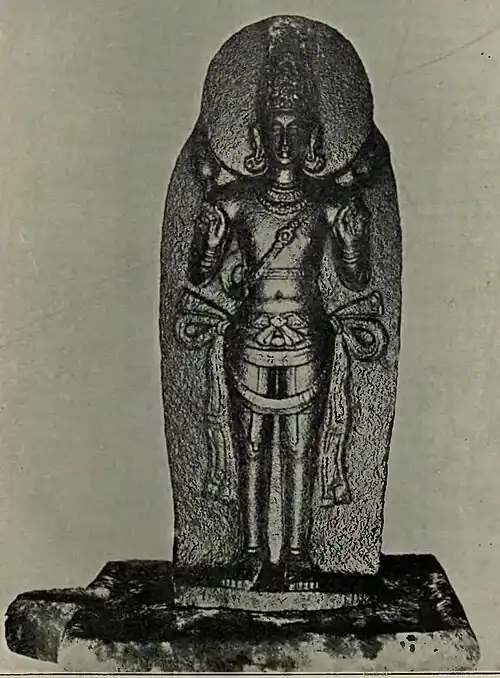
Fig. 143.—Sūrya; Kumbakōnam.

Fig. 144.—Sūrya; Chidambaram.
connected with his worship as in the case of the Sakti goddesses. It is stated to be a circle bounded one after another, by a triangle, a circle, a square and two circles of eight and sixteen radii respectively.
III
The Moon is regarded as one of the Planets surrounding Other the Sun and going round and round the mountain Meru. He planets - is born of the Sea and of sage Atri and is supposed to be of the Vaisya caste. He is said to have only face and hands but no body. He turns towards the Sun, holds white lotuses in his two hands (or sometimes a club and the boon-confer- ring hand) and rides on a two-wheeled 1 chariot drawn by ten horses. Kuja (Mars) is a Kshatriya of AvantI, the son of the Earth and of sage Bharadvaja, wears red garments and a crown and has four arms in which are seen the weapons, club and sakti and the postures varada and abhaya. He faces the Sun and rides on a ram. Budha (Mercury), the son of the Moon, is a Vaisya of the Magadha country born in the lineage of Atri. He has four arms, a yellow body, and the lion vehicle. He shows in his hands the shield, club, varada and the sword and faces the Sun. Brihaspati (Jupiter) is a Brahmana, born of Angiras. He comes from the Sindhu country and has either four or two arms, holding, in the latter case, the book and the rosary. He also faces the Sun. Sukra (Venus), likewise, is a Brahmana born of Bhrigu and a native of Bhojakata. Accord- ing to Hemadri he is seated in a golden chariot drawn by eight horses or in a silver chariot yoked to ten horses. He has two hands in one of which he holds a nidhi " treasure " and, in the other, a book. According to other authorities he has four arms in which are seen the staff, rosary, water-pot and the varada. Sani or Sanaischara (Saturn) is a Sudra of the Saurashtra country, and a descendant of Kasyapa, also facing the Sun. He is supposed to be born of the Sun, to have blue garments and to ride on a vulture or in an iron chariot drawn by eight horses. He is represented with two or four hands and stands on a lotus pedestal, but is more often found seated with four hands, his weapons being the arrow, trident and the bow. Rahu and Ketu, the ascending and the descending nodes, are also represented as images (fig. 145). The former is described as a Sudra of Paithan with a fearful face, black clothes and four arms, holding the sword, trident and the shield. He rides on a black lion and faces the Sun. Ketu is
1 Some authorities say that the chariot is to be three- wheeled. 
Fig. 145.—Rāhu and Kētu; Chidambaram.
lineage of Jaimini. He has an ugly face, rides on a vulture and exhibits in his two arms the club and the varada posture.
IV
The next group of gods, frequently depicted though not as DIKI-AI.AKAS. frequently worshipped as the Planets, are the Dikpalakas, " the eight lords of the quarters." These are mostly found represented on the central panel of the ceiling in the Mahd- mandapa of a temple.
Indra, the lord of the east, is the chief of them. He is a INDRA. Vedic god ; the lord of all the minor gods. But he has long ago lost the high position assigned to him in Vedic times. The story runs that he seduced Ahalya, 1 the wife of sage Gautama, who cursed him for his lewdness to wear about his body marks of his lascivious conduct, but subsequently changed those marks into a thousand eyes dotted all over his body. Accordingly he is still known as " the thousand-eyed " (Sahasr-aksha). Indra is represented with four arms riding on the celestial elephant Airavata of four tusks (fig. 146). According to the Silpasara the symbols which he presents are the bow, the protecting hand, the conch and the discus. 2 Hemadri adds that his wife SachI with two arms must be seated on his left thigh. In three of his hands he holds a lotus, goad and a thunderbolt, while the fourth passes round the back of SachI. One of the arms of SachI, likewise, is passed round the back of Indra, the other holding a bunch of flowers of the wish-giving tree (kalpa-vriksha).
Agni, the lord of the south-east quarter, is also one ot trie AGNI - Vedic gods and perhaps the most prominent of them. As the carrier of offerings to the various other gods in heaven, he plays an important part in the Srauta sacrifices and in the Smarta ceremonials, where fire oblations are essential. Every Brahmana house-holder, strictly so called, is required to maintain the sacred fire in his house without quenching it and to offer oblations regularly three times a day, along with his usual prayers to Gayatrl. Agni, as an image, is represented to be an old man ; he is the oldest of the gods and a counter- part of the Sun on earth. He has a red body, two heads, six eyes, seven arms, seven tongues, four horns and three legs.
1 See also the Journal of Indian Art and Industry, No. 106, Plate 143, fig. 1 020.
2 The Bhiittabhaskariya mentions alhaya, varada, sword and the elephant goad.
16 
Fig. 146.—Indra; Chidambaram.
pedestal 1 and is supposed to reside in a quadrangle evidently the quadrangular sacrificial fire-pit. In his seven arms he holds the vessels prdkshani (sprinkler), srik (ladle), sniva (spoon), purna-patra (vessel full of water), tomara (pestle), fan and the ghee-pot, required in performing a sacrifice. He has braided hair, red garments and a big belly and wears the sacred thread yajnopavita. His vehicle is the ram and his banner, the smoke issuing from the sacrificial fire-pit (fig. 146). He is attended on either side by his two wives Svaha and Svadha. Hemadri describes him as having a single face, three eyes, moustaches and four arms. He rides in a chariot drawn by four parrots and driven by the god of winds, Vayu. His wife Savitrl is seated on his left thigh, with a vessel of gems in her hand. In three of his arms Agni holds two flaming tridents and a rosary.
Yama, the lord of the south and the god of Death, has been YAMA. already referred to in the description of the Siva image called Kalaha or Kalaharamurti. He is dark of colour, exhibits the club, noose, abhaya and varada in his four arms and rides on a buffalo. The illustration from Chidambaram (fig. 148) shows only two hands in which are held the club and the noose. Hemadri mentions as his symbols the staff, sword, a flaming trident and the rosary. His wife called Dhumrorna is seated on his left thigh and holds a lime fruit in her left hand. To the right of Yama stand Chitragupta, Udlchya and others who keep a record of the actions of men. To his left stands the fierce Kala with the death-noose in his hand. Two women called Dharma " virtue " and Adharma " vice " are seen on either side of Yama with chauris in their hands.
Nairrita, the lord of the south-west region, is supposed to NAIRRITA. be the chief of the Rakshasas. He rides on a man, wields the mace and the javelin and has Kalika for his wife. In the Kallka-Purdna he is described as having two hands, holding a sword and shield and riding on an ass. He causes terror to demons, devils and spirits (fig. 149).
Varuna the regent of the west is also the lord of the ocean VARUNA and of all aquatic animals. He has the crocodile vehicle and four arms. In the two upper hands he holds the serpent and the noose (fig. 150). According to Hemadri he is seated in a chariot drawn by seven swans. In his four hands he holds the lotus, noose, conch and a vessel of gems and has
1 Or the half-moon seat (ardhachandr-asana) according to the Mayawati*
l6-A 
Fig. 147.—Agni; Chidambaram.
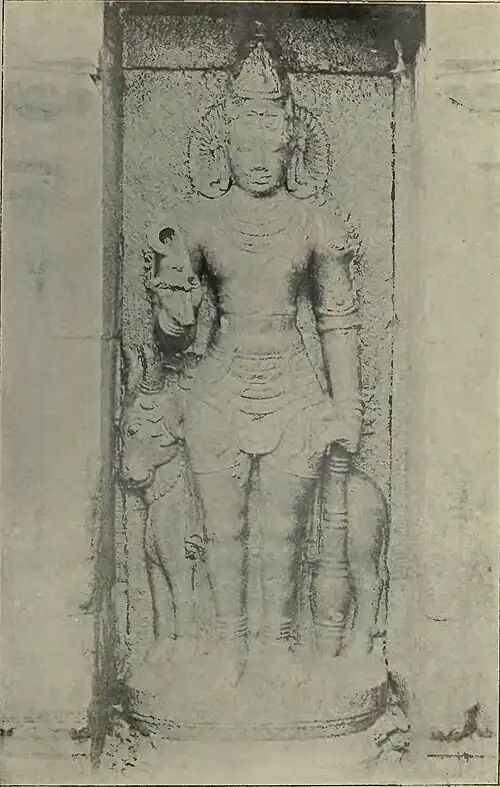
Fig. 148.—Yama; Chidambaram.

Fig. 149.—Nairrita Ahōbalam.

Fig. 150.—Varuna; Lēpākshi.
and Yamuna, holding chauns in their hands, stand on either side of him, the former riding on the crocodile and the latter on the tortoise.
Vayu, the lord of the north-west, is blue in colour. In his hands are seen a fan, flag, varada and abhaya. He rides on a deer (fig. 151). An image of Vayu at Chidambaram shows him only with two hands of which the right holds the flag and the left rests on the waist.
Kubera, the lord of the north and the god of treasures, is a fat, ugly person as his name implies, but serene or self-satisfied and rides on a horse (fig. 152). Hemadri describes him as riding on a man with his wife Riddhi l seated on his left thigh. He is the chief of the demi-gods called Yakshas and Kinnaras. Two treasures personified, viz., Sankhanidhi and Padmanidhi, are supposed to attend upon him on either side. He is the friend of Siva the lord of the adjoining north-east quarter.
V
The worship of the "serpents" (Nagas) 2 is prevalent all over India and particularly so in the west coast of the Madras Presidency, where a corner of a house or of a field is exclu- sively dedicated to the living cobra so that it may dwell there with its family group. In other parts of the Presidency on a particular day of the year sacred to the Nagas, milk, fruit and coconut are placed near a snake-hole with the object of feeding the cobra. Naga-images cut on stones as plain serpents with one, three, five, seven or nine hoods, are also worshipped. Sometimes these have a human body above the navel and a serpent's coils below. Female snakes are said to have one hood only.
Snake-stones are installed in temples and other places, on specially prepared platforms under the shade of the pipal and the margosa trees. A ceremony called " the marriage of the pipal-tree " is performed both by Brahmans and non- Brahmans, when Naga stones are also fixed under these trees amidst great rejoicing. The connexion of the Nagas with the pipal and the margosa trees is evidently a relic of the ancient tree and serpent worship. Serpents have been worshipped in India from very early times, earlier even, perhaps, than the
1 The Bhattabkaskartya calls her Chitrini.
2 It is mentioned in the Buddhist NiJdesa among the various systems of belief and superstition that prevailed in the fourth century B.C. (Dr. R. (j
Bhandarkar's Vaishnavisw , Saivism, etc., p. 3). 
Fig. 151.—Vāyu; Lēpākshi.

Fig. 152.—Kubēra; Lēpākshi.
pitiation of the Nagas conduces towards the production of children. This belief may be traced in other countries also, where there are signs of the once widely prevalent serpent worship. Eight lords of Nagas are mentioned in the Agamas. The chief of these is Ananta, Sesha or Adisesha, on whose folds Vishnu is supposed to sleep. Fig. 153 represents him in a semi-human form. In an inscription of the twelfth century A.D. the eight Nagas, Sesha, Vasuki, Takshaka, Karkotaka, Abja (Padma), Mahambuja (Maha-Padma), Sankhadhara and Kulika are invoked to decide about the auspicious or inaus- picious nature of the grant. 1
Besides the Nagas mentioned in the previous paragraph, there are other groups of demi-gods and demons largely depicted in Hindu temples, such as the Yakshas, Vidyadharas, y a kshas, Gandharvas, Apsarasas, Kinnaras and Rakshasas. 2 These are idyadharas made to serve, generally, as chauri-bearers to the gods and are elc ' represented with a light body flying in the air. They have generally two hands, two eyes and the kamndamakiita crown. The Manasara describes the Kinnaras as having the legs of a cock the middle part of their body being human and the face beaked like Garuda with spreading wings. They wear a crown on their heads and hold a vina in their arms. A sketch from Ramesvaram illustrates a female Kinnarl (fig. 154). The origin and description of these groups of demi- gods are given by W. J. Wilkins in Chapter XI of his Hindu Mythology. Also, the figures of these in their various postures are beautifully illustrated in the rock sculptures known as "Arjuna's Penance" at Mahabalipuram.
The Dvarapalas seen at the entrance into almost every Dvarapalas. Hindu shrine are also demi-gods and bear different names being sometimes called Chanda and Prachanda, sometimes Jaya and Vijaya, or Harabhadra and Subhadra according as they occupy the second, third or fifth door-way opening into the shrine. In the standing figures of Dvarapalas the right leg is placed straight on the pedestal (svastika) and the left is slightly bent (kiuichita). The posture of their body may be : (l) with legs and back partly turned to front ; (2) hands resting on the thigh which then is bent in the shape of a plough ; or (3) with both hands supporting the gdpnra. The Silpasangraha states that in form the Dvarapalas are like bhutas with two big hands in one of which they hold a club- They
1 .Madras Epigraphical Report for 1910, p. 117, para. 60.
2 See V'isvakanna, Part V, plate 66.
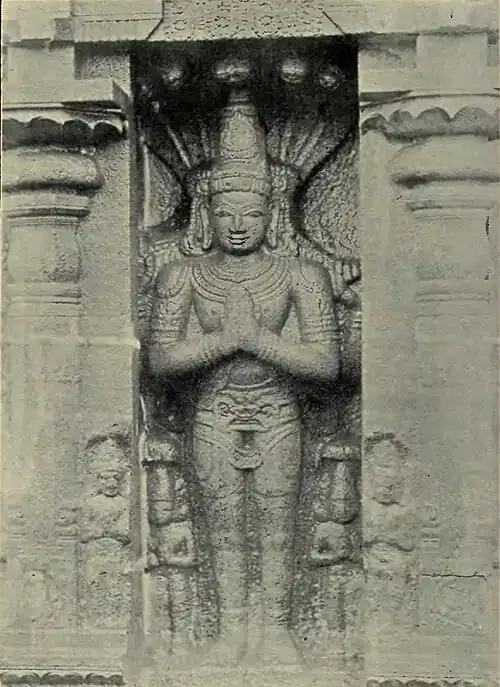
Fig. 153.—Ādisēsha; Chidambaram.
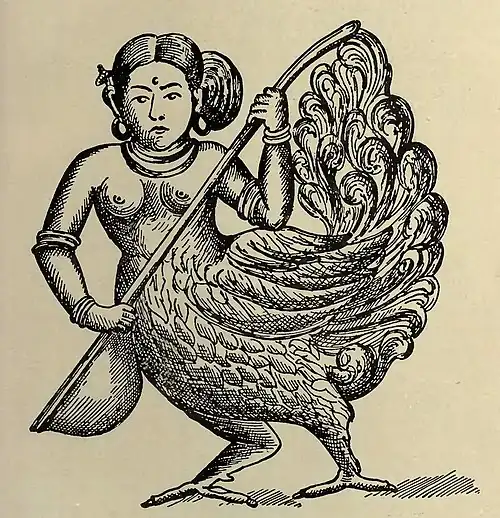
Fig. 154.—Kinnarī; Rāmēsvaram.
are beautiful in form, but disfigured in the face (fig. I55). 1 Figures of Dvarapalas are sometimes also found to have four arms and to hold the Saiva or the Vaishnava symbols according as they are placed in Siva or Vishnu temples. The fine image (fig. 156) of a Dvarapala from Dharasuram, Tanjore district, which has four arms and is probably Saiva, is stated to have been brought as a trophy from Kalyanapura (i.e., Kalyana in the Nizam's Dominions), by the Chola king Rajadhiraja I, in the middle of the eleventh century A.D. Entrances into the shrines of goddesses are attended by Dvarapalikas just as those of the gods are guarded by Dvarapalas.
VI
Saints and Sages are also not infrequently figured in temples. The latter include the Vedic rishis and the authors of the early sacred literature of the Hindus, represented as old men, serene and unmindful of mundane affairs. The sacred thread, braided hair, flowing beards and moustaches form the special features cf rishi images. They are seated in a meditative posture with the rosary or book and the water- pot or staff in their hands. The seven famous sages Gautama, Bharadvaja, Visvamitra, Kasyapa, Jamadagni, Vasishtha and Atri are occasionally also represented with their wives, while Narada, Agastya, Bhrigu, Angiras, etc., are surrounded by their disciples- Narada (fig. 157) is distinguished from other sages by the vina which he holds in his hands, being always engaged in singing the praises of Vishnu. In Purdnas he is described as fond of setting up one against the other and creating quarrels. Hence in common parlance Narada represents a tale-bearer. Agastya (fig. 158) is dwarfish in stature and pot-bellied. 2 He is supposed to have migrated from north to south and to have dwelt there permanently and developed the Tamil language of which he is said to be the first grammarian. Kapila, the founder of the Sankhya system of Hindu philosophy, holds a water-pot on his lap and has in his two hands the conch and the discus. 3 Dhanvantari,
1 In the Silpasara the Dvarapalas of Siva temples are stated to be Nandi and Mahakala at the eastern entrance ; Bhringi and Vinayaka at the southern entrance ; the sacred Bull a ; id Skanda at the western entrance and Chandi at the northern.
2 A bron/.e illustration from Nallur is given in the Madras Archaeological Survey Report for 19*1-12, Plate A, fig. 2.
3 In Visvakarma, Part I, Plate 52, a totally different form of Kapila, from
Ceylon, is given. Perhaps he is not identical with the sage described here. 
Fig. 155.—Dvārapāla; Tiruvottiyūr.

Fig. 156.—Dvārapāla; Dhārāsuram.

Fig. 157.—Narada; Chidambaram.
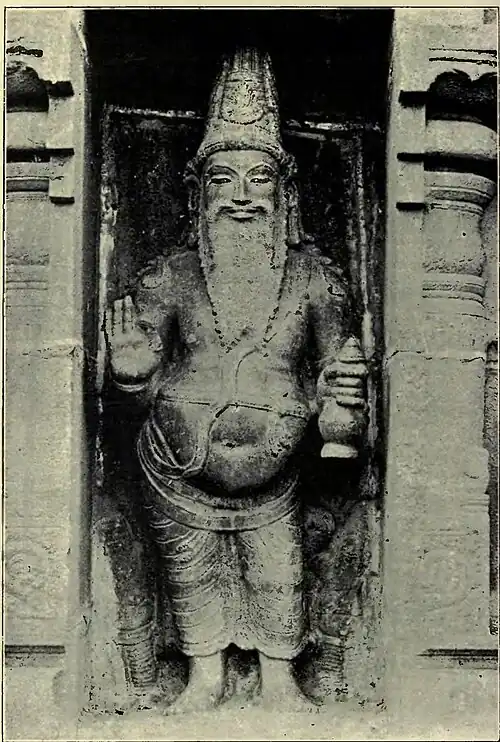
Fig. 158.—Agastya; Chidambaram.
supposed to be a form of Vishnu and is found generally figured in company of the Asvins, 1 who are the physicians of the gods. He holds a pot of nectar in his hands.
Among the human beings who have attained sainthood may be included the great religious reformers such as Sankaracharya, Ramanujacharya, Madhvacharya and others. SANI-.ARA- The first is represented as a sannyasin (mendicant) with a CHARYA - bald head and a body besmeared with ashes. He holds a book in his left hand and shows the chinmudrd, the teaching pose of fingers, in the other. The staff and the water-pot (kundika) which are the symbols of the sannydsins, are found placed by his side. Seated on the tiger's skin in the padmasana posture he is surrounded by attendant pupils. Sankaracharya may also be found decorated with a necklace of rudraksha-beads which are sacred to Siva. The illus- tration from Tiruvottiyur (fig. 159) shows GaulTsvara (Gauda- pada ?), the teacher's teacher of Sankaracharya, with four arms, occupying the highest seat. Below him to the right is Sankaracharya and below him on the pedestal are depicted the latter's four pupils. Ramanujacharya has the sanjali- RAMANUJA- mudra, i.e., hands folded together over the breast in a CHARYA and worshipping posture, the triple staff (tridanda) and a head- D^SIKA! dress. He wears the Vaishnava caste marks urdhvapundra (or ndmani) made of white clay and red pigment (fig. 160 (d) Vedanta-Desika (fig. 160 (b)) is also a Sri- Vaishnava teacher of great fame. Madhvacharya, like Sankara, is a bald-headed MADHVA- sannydsin with the chinmudrd, the book, the staff and the CHARYA kundika. He wears the caste mark urdhvapundra and the Vaishnava symbols of conch, discus, etc., made on his body either of sandal-paste or of the yellow clay called gopichandana.
Saiva and Vaishnava saints (called Ndyandrs and Alvdrs), saivaand the former of whom are sixty-three in number and the latter Vaishnava twelve are also occasionally installed in temples, their images Saints - being made either of metal or of stone. The most famous of the former are Appar, Sundarar and Tirujnanasambandar, 2
1 These are the two gods Nasatya and Basra mentioned in the Vedas. They are of the form of a horse except in their faces and are found together, seated on the same lion-pedestal. In two of their arms they exhibit the abhaya and the book. On their right are represented the medical herbs Mritasamj'wani and l?isalydkarani and on their left, the sages Dhanvantari and Atreya (?).
2 In the Madras Archaeological Survey Report for 1911-12, Plate II, rigs. 1-4, are given illustrations of four bronze images which represent Appar, Manik- kavasagar, Jnanasambandar and Sundarar (?). Visvakarma, Part IV, Plates 62 and 63, illustrate figures of Manikkavasagar and Sundaramurti (Sundarar) from Ceylon.
Havell gives a picture of Appar (Ideals oj Indian Art, Plate XIV), In the 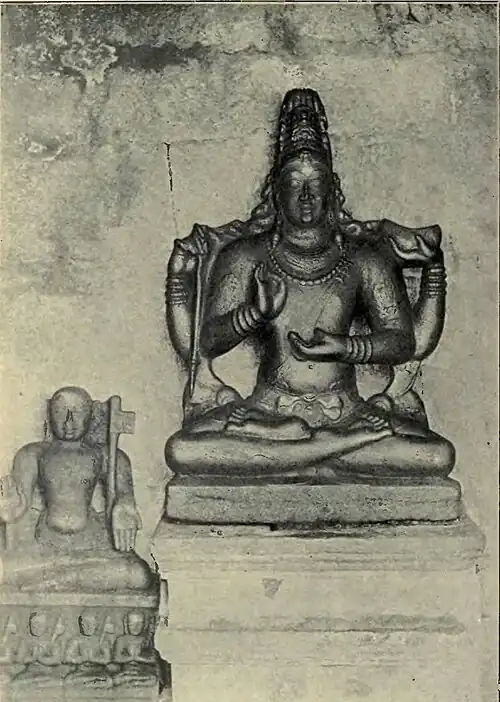
Fig. 159.—Gaulīsvara (Gaudapāda ?) and Sankarāchārya; Tiruvottiyūr.

Fig. 160 (metal).—(a) Garuda; (b) Vēdanta-Dēsika; (c) Vishva ksēna; (d) Rāmānujāchārya; (e) Tirumangai-Ālvār; Nāmakkal.
of the South are collected together under the name Devdram and are regarded as scriptures by the devout section of the Saivas. Stories relating to the pious lives of the sixty-three Saiva devotees are recorded in the book called Periyapuranam, which was written about the end of the thirteenth century of the Christian era. Manikkavasagar, the author of the Tiru- vdsagam, is also a saint of great reputation. A beautiful image of his (fig. 161) comes from Tiruvarangulam in the Pudukkottai State. An illustration from Madura (fig. 162) of Karaikkal-Ammai, one of the female Saiva saints counted among the sixty-three, gives a true picture of how devotion and severe penance are expected to reduce the physical body to a skeleton. Likejhe Saiva scriptures, the hymns of the Vaishnava saints (Alvars) (see Tirumangai-Alvar, fig. 160 (e) above), are also collected under the name Ndldyiraprabandham and form the accredited scriptures of the Tengalai section of Sr!-Vaishnavas. The lives of the Alvars are given in the book entitled Guruparampardprabhdva.
Numerous other images are mentioned in the Agamas, Purdnas and similar other works. These are rarely, if at all, depicted in temples. The nine Prajapatis, the eight Vasus, the seven (or sometimes forty-nine) Maruts, the ten Visvedevas, the fourteen Manus, the nine Chiranjivins, are all personified and described with their weapons and vehicles. Even the sixty-four sciences, the sixty years of the cycle, the months, fortnights, days, constellations, signs of the zodiac, seasons, solstices, oceans, quarters, mountains, rivers, etc., are similarly personified and described. It is not necessary to consider them in any detail.
VII
A brief description may now be given of the Digambara J a ^ na images, of which we have a good number in the districts of Chingleput, South Arcot, South Canara and other parts of the Madras Presidency. It is not possible to enter here into a detailed enquiry of Jaina ritual, symbolism, idology, etc. We
Tanjore temple built by Rajaraja I at the beginning of the eleventh century A.U., were installed images of Nambi-Aruranar (i.e., Sundaramurti), Tirujnanasarr.- banclar, Nangai-Paravaiyar (wife of Sundaramurti), Tirunavukkaraiyar, Periya- Perumal and his queen Lokamahadeviyar, Meypporul-Nayanar and Siruttonda- Nayanar. The set of images illustrating the story of the last-mentioned, included Kshetrapala, Bhairava, Siruttonda-Nambi, Tiruvenkattu-Nangai (his wife) and Siraladevar (his son); see S.I.I., Vol. II. Introduction, p. 39 f. In the temple at Dharasuram near Kumbakonam are pictured scenes from the lives of most of these sixty-three Saiva devotees vith labels cut on their pedestals. These
belong to the thirteenth century A.D. 
Fig. 161.—Mānikkavāsagar (metal); Tiruvarangulam.

Fig. 162.—Kāraikkāl-Ammai; Madura.
VIII
In concluding this small treatise on South Indian gods and goddesses, it will not be out of place to dwell briefly upon the pedestals, postures, symbols, weapons and jewellery of images, although most of these have been noticed where they occur incidentally, in the above pages.
The Mayamata, speaking of pedestals in general, says that they are triangular, half-moon-shaped, square or circular (P). 1 Nine pedestals (plthas) are mentioned by name, viz., bhadra- pitha, vajrapitha, padmapitha, mdhdmbuja (the big lotus), srikara, pithapadma, mahdvajra, saumyaka, and sriMmya. Of these, the first and the third are pictured on the accompany- ing Plate I, as Nos. 13 and 12. No. 16 on the same Plate, perhaps, represents mahdmbuja.
The postures, symbols and weapons of images differ according as the image is conceived to be either in a fighting attitude or as bestowing bliss and knowledge on its worship- pers. Sometimes, even though the weapons of war are exhibited in the hands of an image, it may yet be considered peaceful if it only shows the positions of the hands known as abhaya and varada. The posture, sukhdsana, in a seated image (Plate I, No. 14) and the posture samapddasthdnaka in a standing image (Plate II, No. 4) are generally adopted in conferring bliss, just as the position of the hands abhaya (Plate IV, No. 7) and varada (Plate III, No. 23) indicate the same. The dlidha '* (Plate II, Nos. 5 and 6) and the utkatika 3 postures (Plate I, No. 15) denote respectively the heroic attitude in actual fighting and the angry mood that imme- diately follows it. The padmdsana (Plate I, No. 16) and the ydgdsana (Plate II, No. l) postures show either the medi- tative or the teaching attitude. The position of the legs (Plate II, Nos. 2 and 3) adopted in the case of the standing images of Gopala and Nataraja show not only a graceful and artistic attitude but, evidently, also indicate the ecstasy of joy. It may be noted that in all figures of gods and god- desses standing in any position, the ideal beauty is recog- nized to consist in the three bhangas (bends) which according to the Silpasangraha are dbhanga (slight bend), samabhanga (medium bend) and atibhanga (great bend). Each of these three bends may be found separately or together in one and the same image. 4
1 According to the Prayogaratna the nine Planets are to be seated on circular, quadrilateral, triangular, arrow-shaped, rectangular, pentagonal, bow- shaped, winnow-shaped and flag-shaped pedestals.
2 The alldha posture is assumed generally in drawing the bow and dis- charging the arrow.
3 There is reason to suppose that the posture known as virasana wherein one leg has to be placed on the other so as to rest on that thigh, is sometimes substi- tuted for utkatika. Perhaps they are synonymous.
4 See South Indian Bronzes by O. C. Gangoly, p. 401 f. The .Silpasangraha describing a particular torm of Kama states that it consists of three bhangas or bends, the face slightly leaning to the right, the middle of the body to the left and the portion below the waist, again, to the right. The symbols of the gods and goddesses apart from the Symbols and weapons which they wield, such as the goad (Plate IV, No. 8), wea P ns - noose (No. 9), disc (Nos. 10 and I0a), shield (No. 12), sword (No. 13), pestle (No. 14), axe (No. 15), trident (Nos. 16 and l6a), thunderbolt (Nos. 20 and 20a), club (Plate III, No. l), sakti or vel (No. 2), tanka (No._3|, arrow (No. 4), bow (No. 5), fire (No. 6) and khatvdnga (No. ll), are very few. Goddesses, perhaps as a sig_n_of__beauty, hold in their hands aJotus r JDU_d (Plate IV, No. 18 and Plate I, No. 3), a mirror (PlatelnTNo. 8) or a parrot perching on the back of the palm (Plate IV, No. 19). The rosary (Plate IV, Nos. I and 2), the water-pot (Nos. 3 and 4), the book (No. 5), the position of the fingers known as chinmudrd (Plate III, No. 16) and jnanamudrd (No. 14) denote meditation, purity and knowledge. The conch of Vishnu (Plate IV, No. II and Plate I, No. 4#), the kettle-drum dhakka of Siva (Plate III, No. 12 and Plate IV, No. 24) and the bell in the hands of some gods and goddesses (Plate III, No. 7) may be taken as equipments for fight, though not as actual weapons, offensive or defensive. The deer held by Siva as a trophy on the occasion when he destroyed the sacrifice of his father-in-law Daksha (Plate IV, No. 17), the serpent (Plate I, No. 46) and the kapala (Plate III, No. 21 and Plate IV, No. 23^) may be considered only as symbols specially^disj tinguishing him from the other gods. The same has to be said of the kukkuta "cock" (Plate III, No. 30) of Skanda, of the broken tusk 1 (Plate IV, No. 2l) of Vinayaka and of the flag (No. 22) of Vayu, " the god of winds."
Some of the purely artistic positions of the hand are : the Positions of simhakarna (Plate I, No. l), the kataka (Plate IV, No. 40), the the hand - katiga "hand resting on the waist" (Plate IV, No. 6), the position in which the hand hangs down freely "like the tail of a cow " (Plate I, No. 2), the placing of the kurpara by Siva on the head of the bull (Plate III, No. 9), the gajahasta of Nataraja (No. 19) and the position in which Siva as Bhiksha- tana touches the mouth of the antelope (Plate III, No. I7). 2 Some other significant positions of the hand are those known as siichi " the pointing finger " (Plate III, No. 13 and Plate IV, No. 23), tarjani "the threatening finger" (Plate III, Nos. 18 and 26) and the vismaya "wonder" (Plate III, Nos. 15 and 22 and Plate I, No. 4). The three latter are generally found in the figures of Siva and of guardian deities.
1 For the story of the broken tusk with which Vinayaka (Ganapati) is stated to have written the Mahabharata, see above, p. 176.
2 This last position is called si>nkakarna. In images of Tripurantakamurti,
the arrow is held by one r-f the right hands which is, again, stated to be in the
simhcikarna pose. Jewellery,
crowns, etc.
The jewellery of images corresponds in most cases to the jewels of the present day worn by men as well as by women. Most of these have been mentioned in the above pages in the general descriptions of gods and goddesses. It has only to be noted that a very large number of them, such as necklaces, breast-plates, girdles, armlets, bracelets, wristlets, anklets, arm-rings, finger-rings, and toe-rings, made of gold and set with various gems,[3] are mentioned in the Tanjore inscriptions as having been presented to the images in the Brihadīsvara temple, by the great Chōla king Rājarāja I, in the first quarter of the eleventh century A.D. The different fashions of making up the hair seem to have also occupied the attention of Indian artists. The jatās (matted hair) of Siva, arranged generally in the form known as jatāmakuta (Plate I, No. 8), show other varieties such as jatāmandala (Plate II, No. 6), jatābhāra (No. 9) and jatābandha (No. 7). The terrible form of Siva, known as Pāsupatamūrti, has the jatāmakuta with flames of fire surrounding it (Plate I, No. ll). Natarāja's jatās, whether flying in the air or tied up in a knot have a bunch of peacock's feathers decorating them (Plate I, No. 5). Vishnu has generally a kiritamakuta, i.e., a crown (Plate I, No. 7). The goddesses either wear the crown called karandamakuta (Plate II, No. 8)[4] or have their hair parted in the middle like the Indian women of to-day. In figures of Jyēshthā, is seen a peculiar fashion of dressing the hair known as vāsikābandha (Plate I, No. 10). Other peculiar head-dresses, whose names are not known, also occur occasionally (see, e.g., Plate I, No. 9).

Gandabherunda.

Plate 1.—Pedestals, postures, etc

Plate ii.— Pedestals, postures, etc.
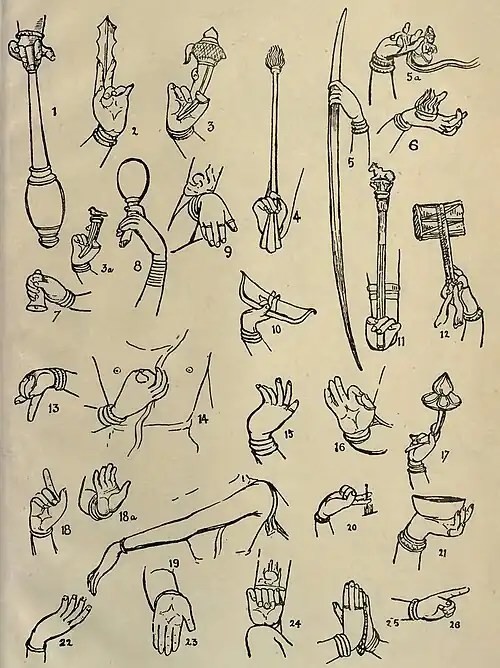
Plate iii. Pedestals, postures, etc.
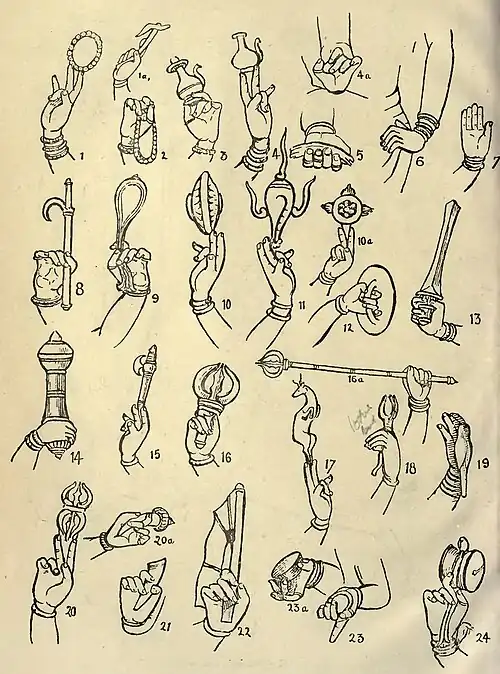
Plate iv. Pedestals, postures, etc.
- ↑ Vaisnavism, Saivism, etc., pp. 151 to 155.
- ↑ Madras Epigraphical Report for 1908, Part II, paragraph 60.
- ↑ See above p. 8, fig. 4. One of the peculiar jewels worn by images of Siva such as Natarāja, Dakshināmūrti, Bhikshātana, Kankāla, etc., is the bhringipāda (Plate II, Nos. 3 and 4). It may be noted that the priestly class among Lingayatas, called Jangams, wear such a jewel when they go out for receiving doles.
- ↑ When represented independently and in a fighting or otherwise terrible attitude, they may wear the jatāmakuta like male deities.