Pran of Albania/Chapter 1
PRAN OF ALBANIA
CHAPTER I
GUESTS BY THE FIRE
The firelight shone a soft glow in the dim room. The mountain people of these far Albanian highlands, men and women, were crouched around the low central hearth. There was silence save for the rushing noise of the tiny brook that crossed the yard outside.
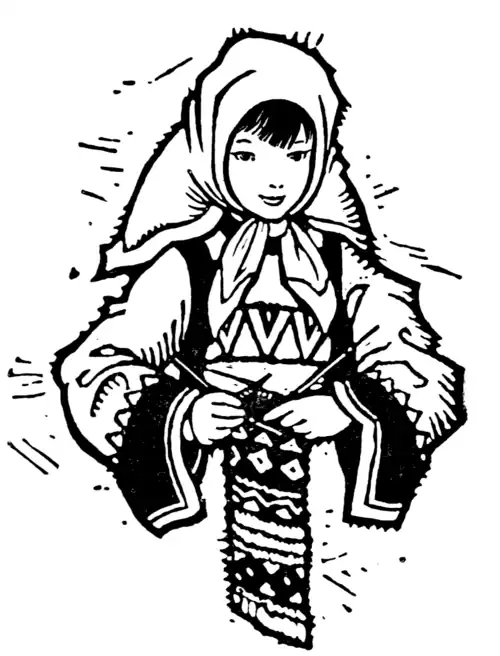
Pran, who was only fourteen and not entitled to a place by the fire when there were so many guests, sat on the rough floor planks in a dark corner, knitting. Her fingers, used to the work since she was a very little girl, needed no light nor watching even; so, as her slim needles flew she let her eyes wander about the shadowy room and rest at last on the group of six people sitting so quietly by her father’s hearth. They would speak soon and she could listen, but now she would look at them and study out each face and what might lie behind it.
The square raised hearth was in the center of the room, and the four men and two women were in a circle round it. There was her father Ndrek. His back was toward her. No need to study him. She knew him. He was fine looking, tall, aquiline featured, and his gray mustache swept out either side over his firm mouth, and under his heavy brows glowed the deep blue eyes—cold eyes, some thought them. But she knew the warmth of them since, a baby girl clad only in a dingy cotton shift, she had sat near him playing with the great silver chain he wore over his shoulder or hunting in the folds of his wound colored girdle for sweet nuts and berries hidden there for her. Now he sat, his legs in their tight white woolen trousers crossed Turk fashion, and in his hand the massive silver holder that had at one end his smoking cigarette.
Across from him and farther from the warmth, as courtesy demanded, crouched her mother, Lukja—“Nona” Pran called her—“nona iamia,” my mother. She was dressed in heavy wool like Pran herself, but all her clothing black where Pran’s was white. “That’s because she is married and I’m not,” thought Pran, “I’ll wear that color too when I am wedded, and that broad leather belt all studded over with small glittering nail heads.” Pran looked long into her mother’s face that, turned a bit from the fire, was lost half in blackness and half lit white with the fire’s glow.
“She is sad to-night,” Pran told herself, letting her needles rest quiet a minute. “Why is she sad?” There was calm beauty in her mother’s face, a loveliness of line that Pran could hardly see, she knew the face so well. To her it was so loved and so familiar she could not have told what there was in it beautiful, but she could see the meaning in it always. To-night she knew something had made her mother sad. She puzzled, wondering.
What had the guests said? What news had they brought? When first they came Pran had been absent from the upper room, for she had been below, penning in the goats and sheep and chickens for the night. What had the news been? Guests always brought news. Only through passing friends and strangers could a mountain household learn what happened anywhere. Thethi, with its scattered village houses lay so far off, so near the dangerous edge of enemy country, that all news came slowly. Pran studied the four visitors while her fingers flew. Three men there were—tall like her father, all of them. One had fair eyes and hair and was quite young. His mouth was set a little firmly under his light mustache, but his eyes were frank eyes, friendly. The man beside him was older and dark eyed, with a long black mustache, and he sat looking at the red coals of the fire, not moving. Thought held him—thoughts of important things, and Pran knew by the drooped corners of his mouth and the hard lines beside it that these thoughts were not all pleasant. The oldest man was stooped a bit with age, for his hair was nearly white and his faded gray eyes were set deep under white brows. He watched Ndrek’s face sharply, though his glance slid now and then to where her mother sat, or rested on the glowing end of his own cigarette. He puffed slowly at it. “I trust him,” thought Pran. “He comes on some friendly business here to us. He holds himself, in spite of stooping, as a chief should. Perhaps he is a chief.”
The three rifles that the men had carried, as all men did in the mountain country, she could see hanging by her father’s own, on the wall, close to the room’s entrance. Where had they all come from? They were dressed much as Ndrek was, only the broad black braid that seamed the trousers and the short tight jackets was set differently on the cloth, and just below the brilliant wound girdles and the belts of cartridges the design worked was different from that her mother always made on Ndrek’s clothes. It was more intricately curved and turned, and here and there were bright scarlet insets. Pretty the color was, but Pran could not remember, if she had ever known, what mountain tribe it was that wore that special ornament. Yes, they came from far off, certainly.
The woman with them was her mother’s age and seemed to know Lukja well. They sat close by each other, drawn back a bit, and now Pran saw they spoke softly together, and intimately as old friends might speak, “Perhaps,” thought Pran, “before either married they were sisters of the same tribe, born in the self-same village.” Now she heard snatches of their talk and heard Lukja ask news of this one and of that. Yes, that was it, they had been girls together.
“And now your son is grown,” her mother said. “Indeed, Gjyl, there is no time at all between a boy’s cradle and his manhood. One day he cries strapped to the cradle board; the next he slings his rifle on his back.”
“Asht e vertet,” replied the woman. “It is true”; and in her voice Pran heard a sorrow speak. Now why was that?
Lukja smiled gently, as if comforting, and said, pointing to the farthest dark corner, “There sleep my twin sons, Gjon and Nikola. They came to me eight harvests back—the two at once. Good luck indeed, after our having had only a girl for years.” Her mother looked over to where Pran sat. “But you must see my girl, Gjyl. Pran, come here.” And now the sadness in her mother’s face was gone, and her brown eyes that matched Pran’s own, looked gladly at Pran, who rose and came shyly forward to the light and answered softly the strange woman’s greeting. She bent over Gjyl, and taking her hand in hers she pressed it to her forehead, then to her heart. She murmured, “T’y ngiat tieta! A long life!” And “Blessed be your feet that they have found the trail that led to our house door.” She stood then silently, fixing her eyes on her own rawhide sandals, for there was a custom that young girls should show a shamed and modest face before strange eyes.
Her mother laid a hand on Pran’s arm. “This woman, Gjyl, was raised next door to me in Gjoanni. We herded our sheep together at your age, Pran. She married a Merturi man and went far off to live with him as I did when I married Ndrek and came out here to Thethi. Years we have not met, and now at last she comes into our house. But sorrow comes with her, for her man, the father to her son, is dead—suddenly last week. He was in blood.”
Pran understood what those last words meant, for in the wildness of the mountain land was only mountain law, and that law rested on a man’s rifle. Pran knew that men avenged blood with blood, as honor bound them to do.
Her mother’s voice went on, “Long has Gjyl journeyed, and her feet are weary with the way.” Pran knew now what was in her mother’s mind. “Go then, daughter of the house, and get water ready that you may bathe her feet and wash her weariness away. For though her heart must go uncomforted I would her body should find comfort here in my man’s house.”
Pran left the room and took her way down the dark stone stairway at the side that led under the house floor where the animals were penned and chickens squawked, and where a second fire burned dimly in a high chimney place set against the wall. As she went down her feet shod in their rawhide moccasins made a soft brushing noise against the stone. She could hear the voices of the men talking again together, and then the fierce flaring crackle of a faggot bundle someone had set to burn over the coals.
Pran moved softly about the lower room. First she found wood and blew on the live coals until they blazed. And then she took from a great iron hook above the flame the heavy black iron pot and set it on the earth floor. Then she filled it from the wooden keg of spring water—not too full, for Gjyl must not have too long to wait upstairs. She lifted the pot with strong arms and swung it to the hook and laid more wood. Then she got from a wooden peg on the wall two bits of cloth—one dingy and one white and edged with red, a towel bought in Skodra market and meant for use at times like this when honor must be done to any guest. Then she sat down cross-legged on the floor to wait until the water should be warm.
She thought about the people up above. No one of those three men, then, was Gjyl’s husband, for Gjyl’s man had been killed, her mother said. The old man—he was Gjyl’s husband’s father, certainly. And the other two? Brothers, most likely, to the man who had died. Then they “owed blood.” Pran understood all this. The brothers of a man avenged his death. They had to—that was law. Until they did, the honor of their house was smirched, and this dishonor descended on the children. So these feuds, backbone of mountain law and mountain justice, lasted for generations, or until a “bessa,” or a truce, was made between the families or tribes that were involved. This all seemed right to Pran. This was the way good was secured, and evil men in a wild lawless land were kept from doing wrong.
But there was sadness in a good man’s death. Was that the reason why her mother’s face had saddened so a while ago? Perhaps. Pran wondered.
Now a goat bleated. Pran knew the voice. It was her favorite, the little one, brown and shaggy like all the other goats, yet having on its nose a round white spot, so that she called it “Hâna” or “the moon.” She got up and ran over to the pen wall that, made of woven branches, did not shut the animals from sight; and looking through the bars she saw Hâna’s white spotted nose pressed to an opening between. She reached her fingers through and scratched the kid’s nose while the little thing stamped a bit and moved its body knowingly as if to say, “I knew my Pran was here. I knew she’d come and say good-night.”
“You rascal,” Pran laughed softly back, “I know what you are after.” She stripped a green-leaved branch from a bundle of branches hung out of the goat’s reach and stuck it inside the pen. The kid nibbled happily. “Hâna, the moon,” Pran thought. “She is well named, for, like the moon, she never rests content but must be seeking always.”
To her ears there came a purring noise. The pot was on the boil. Hot enough now. Too hot. “Careless I’ve been, and stayed too long.” She took the pot off and poured the hot water into a tin can; then spilled a bit of cold water from the keg to temper it. “Blood warm.” She laid the two cloths over one arm and took a firm grasp of the thin wire handle of the can.
She mounted the stone steps again. The men were drinking coffee now. She saw the little brass saucepan bubble on the coals, and Ndrek poured out the thick liquid into the two tiny china bowls and handed them with the courteous words for coffee drinking to the two older men. He set the little pot to boil again. They talked in quiet voices. The dark eyed man was speaking to Ndrek of payment to be made in goats and sheep and sacks of meal. Payment for what? Pran wondered.
Then she saw where Gjyl waited for her. Pran set her burden on the floor and got a wooden bowl and set it before Gjyl, and near it the water can, and her two cloths. Gjyl, as custom prompted, turned herself from the hearth, while Lukja brought a low three-legged stool and Gjyl drew herself up on it.
Meanwhile Pran knelt down at Gjyl’s feet. First she undid the buckle holding the rawhide “opanga,” then drew them gently off. After that the heavy knitted “shputa”—slipperlike, they were, and gayly decorated with gold thread and brilliant colors on the dark red ground. Pran admired them, and even as she laid them by she studied the design to make it later on the pair she knitted now. The stiff socks, knitted in the design of Gjyl’s tribe, came next; and now, while Gjyl and Lukja talked, Pran began her work of foot washing. She filled the wooden bowl with water and with the small cloth gently bathed Gjyl’s feet, first one, and dried it with the soft towel, and then the other. She felt a pride in doing this, for it was not long that she had been entrusted with this service of hospitality. She did it well too, splashing no water and using deft, gentle hands. Someone had told her that not the warm water only but the touch of skillful hands gave comfort to a guest’s weary feet.
Pran did not put on again the rain-wet footwear. The three men were barefoot by the fire now. Bare feet were not unusual at the hearth after long miles of walking on the rough stony trails and through the snow of high passes. So Pran stood and reached above her head and hung Gjyl’s socks and shoes on one of the loose woven branches that made the low ceiling. Here were the men’s socks too. Here the rising heat would dry them all.
“Glory to your hands, Pran,” Gjyl said to thank her when she had done.
Pran smiled back at her and sat down beside her mother, listening again to the men’s talk. They made a bargain, so it seemed to her. They talked of autumn, too, the marriage season. Was this betrothal talk? Her heart fluttered a little. She was not betrothed, though many girls were promised so soon as they were born. That was the custom here.
Her mother broke hurriedly into the men’s talk. “’Tis enough, Ndrek. Time does not press us.”
Ndrek shot at her a good-humored look. “Women are like that,” he told the men, and all three smiled while Lukja gave them back a little laugh. But Pran, watching her mother’s face, saw over it that little cloud of sadness pass and disappear.
Gjyl said, ‘“My son next year will bear his father’s gun. He is a boy, but boys grow to be men overnight.” She paused. “I wish it were not so.”
“So women always talk,” Ndrek said banteringly, and the old white-haired man looked sharply where Pran and the two women sat. He said, “Mothers would keep a son, or daughter either, tied in the cradle always. And they never fail to cry out with wonder when the grown child bursts through the cradle bands of his own strength.”
“He that is born a cat must catch the mice,” the youngest man said teasingly.
“True enough,” answered Lukja, “but remember, it is the spoon that knows what’s in the dish.”
Now what did all that mean? Pran wondered. Sometimes the grown-ups talked over her head, and proverbs answered each other too quickly for her ears.
Lukja turned to her now. “Go underneath, daughter, and catch and cut a hen that we may give a fitting feast to-night for all our friends.”
“Supper time,” thought Pran. “The evening bread,” she called it to herself. As she went out she thought, “Good food to-night, and after we shall hear good singing.” She hummed a little as she went below, while Lukja rose to mix the cornbread in a wooden bowl.