Photoplay/Volume 36/Issue 6/Miscellaneous
Herr Lubitsch, Der Old Master from Germany, Directs Two Talkie Scenes At Once
 |
 |
The most striking photograph, friends, to be smuggled from the sound stages since the silent drama found its larynx. It shows Ernst Lubitsch, the great German director, doing something unheard of in the history of pictures—staging two scenes at one and the same time, and without the aid of a plug hat full of rabbits. Herr Lubitsch sits on the milking stool between the two camera booths. In the secluded garden nook on the left are Lupino Lane and Lillian Roth. Before the screen on the right, and seated on a sofa, are Maurice Chevalier and Jeanette MacDonald, star and leading lady of the new Paramount singie-talkie, "The Love Parade." The script and score of the production called for a double duet by these four principals, and Herr Lubitsch was forced to devise ways and means for directing two sets of actors with one wave of the wand. So he had his hirelings erect the two sets cheek to cheek, arranged his people, and went at it. In the foreground are the two camera booths, each with its crew of camera and sound geniuses. At the left, out of the picture except for one bold fiddler, is the orchestra which accompanies the singers. Over the heads of the actors you can see the malicious microphones, suspended on cords. And this gives you a good idea of the enormous number of lights necessary to shine up a talking picture scene. Our hardworking directors may soon be expected to direct three scenes, juggle four pool balls, eat a bacon and tomato sandwich and sing "Mammy" simultaneously. Just out of camera range old Cal York, Photoplay's studio nuisance, is being strangled by four assistant directors.

Abbe
JUST how do you think these mellow curves will register? And if so, what? The silver-haired gent listening to the do-re-mi is none other than Mr. Mack Sennett, who was making comedies when Hollywood Boulevard was a cow-path. The nameless young lady, who has passed the eye-test with honor, is now hurling her high C into the microphone, in the hope of making a comedy that is not only funnier, but louder. Of course, with Mack's bathing girls a historic institution, Mr. Sennett couldn't think of running a voice test if the young lady wore galoshes and a raccoon coat. He just couldn't hear a thing!
Full Face & Profile

If you don't think the camera is trickier than a boarding house card shark, look at these! At the left is a hard-boiled, smart alecky master of ceremonies. At the right, a soft-eyed, wistful college boy. Believe it or not, they're both Buddy Rogers!
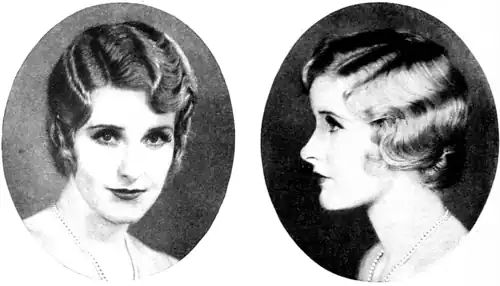
See this beautiful but wise woman of the world, looking very much like Elsie Ferguson, with her chiselled loveliness and her perfect poise
This shy young sorority sister is the same girl, tricked by the camera―Catherine Dale Owen, Jack Gilbert's leading woman in his new film!
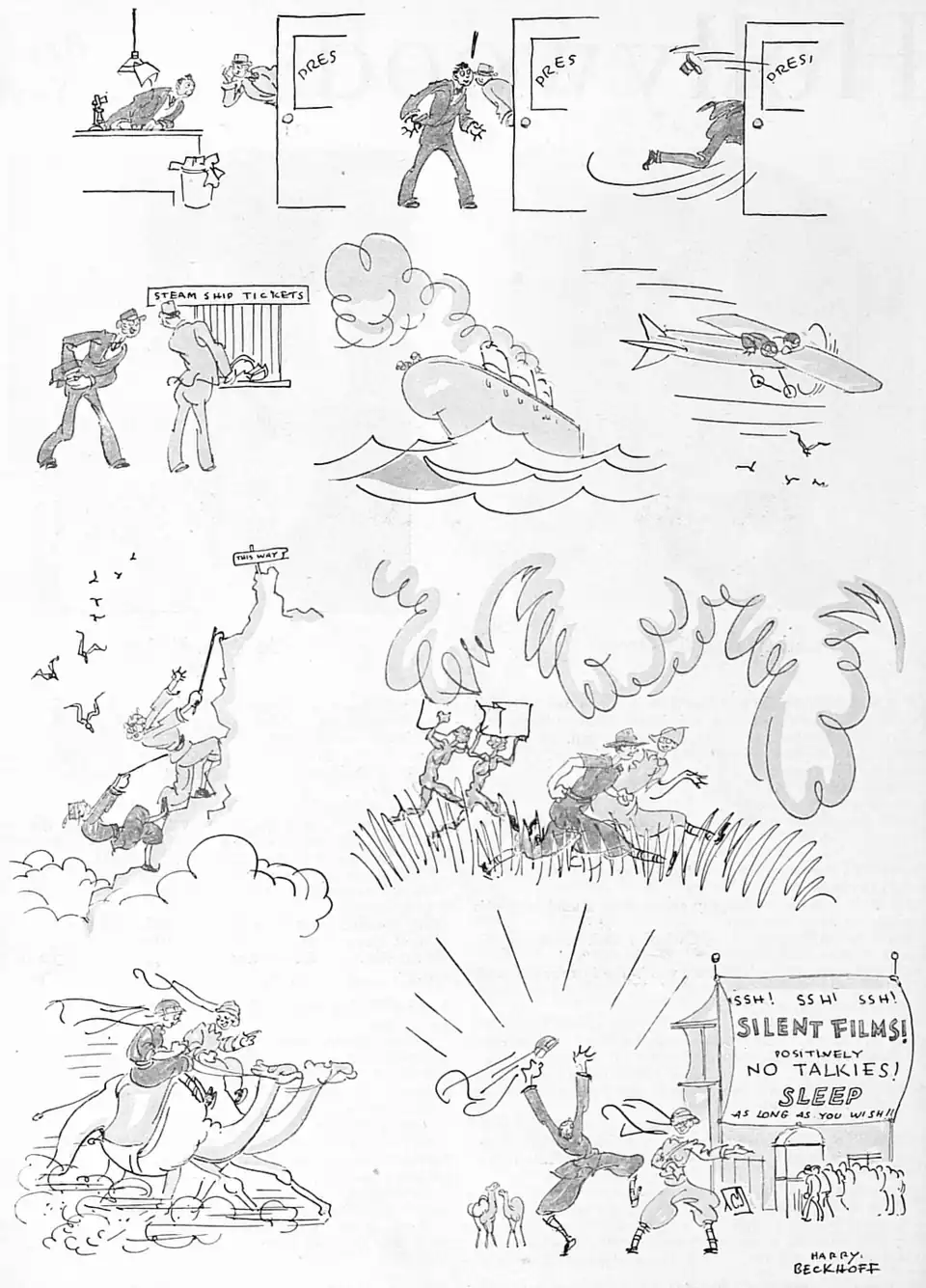
The Quest for Silence: Or an Old-Fashioned
"Fan" Goes to the Movies
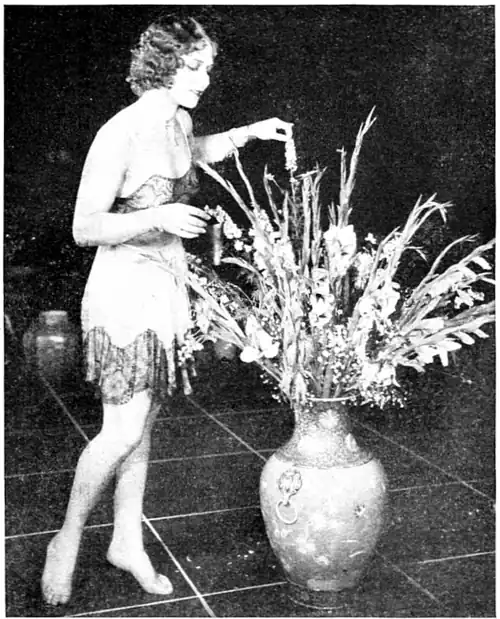
Just a little informal—but charming, none the less. Pretty lady plus pretty teddy plus pretty flowers equals pretty picture. The scantily clad damsel is Mona Rico, one of the supporting cast of "Shanghai Lady," Universal's picture starring Mary Nolan

When Jeanette MacDonald appears in "The Love Parade" in a gorgeous court gown with a sweeping train of white satin, audiences will gasp at the effectiveness of the costume as a whole, but they will not notice the detail. Yet ten bead workers labored with infinite patience for two weeks, taking the millions of tiny stitches necessary to snare the sequins, rhinestone brilliants and pearls to this costly fabric. The workers here are shown at their frame in the wardrobe department of the Paramount studios in Hollywood

Blondes will never go out of style as long as they continue to look like Mary Nolan. Mary will next appear in the stellar rôle of "Shanghai Lady," a Universal all talking special from a play by that eminent Chinese student, John Colton
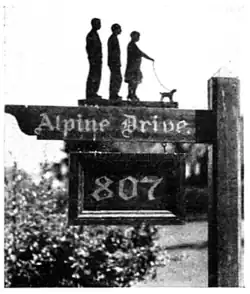
Leave it to the home-loving Gleasons for the latest stunts to trick out their magnificent Beverly hovel. Here are the outlines of Russell, Jimmy, the missus and the purp to direct the weary traveler, as he approaches the house

International
When better prints are worn, Mary Nolan will wear 'em! Mary is shown here wearing one of the very smartest models in printed ensembles. The print is made with a border which is used to finish both the bottom of the jacket and the bottom of the charming wrap-around skirt. Note the rakish velvet béret
[[ File:Photoplay - 1929.11 - 118 - Lenore Ulric.png|center|450px]]
These are Alan Dwan's Four Esquimaux―no relation to Joe Cook's Four Hawaiians. They appear in Lenore Ulric's first talking picture, "Frozen Justice." Reading from right to left―Ulgid Abced, Mary Abced and Joe Abced. And the other one? Oh, that's only Lenore Ulric
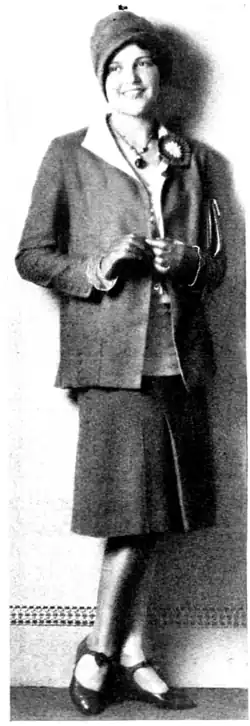
Sue Carol goes to old Mother Nature for her Fall color scheme. Sue is wearing a fetching street ensemble of light brown camel's hair cloth. The lining, of yellow crepe, is contrasted with a deeper yellow in the vestee of the finger tip length jacket. The hat of light brown soleil is trimmed in a two tone brown band. Gloves, shoes and hose are soft brown

"See?" says Ramon Novarro to Dorothy Jordan. "High C," comes back Miss Jordan snappily. Ramon is illustrating to Miss Jordan a high note of one of the several songs they will sing in "The Battle of the Ladies," the star's newest M-G-M picture. Miss Jordan, dainty musical comedy star, plays opposite Novarro in the production

What a break! Tough luck follows Beverly Bayne, the erstwhile Mrs. Francis X. Bushman and an old time picture favorite. With the advent of talking pictures the stage was set for a comeback for Beverly. She looks like a million, has a fine voice and stage training. Three of the big studios offered her leading roles, but due to her long membership in Equity she was unable to accept any picture offers. She returns to Broadway to play in "Escapade," a stage play