Photoplay/Volume 36/Issue 5/The New Broadway
The New Broadway
By Cal York
Hollywood Boulevard is doing its best to be a Big Time Street during the latest Gold Rush

Nowadays the list of celebrities at a Hollywood first-night reads like the program for an Equity benefit. The Celluloid City has become more like New York than New York itself
BROADWAY? Oh, yes, it was a grand old street, and really it was quite gay before it packed its tooth brush and pajamas and trekked to Hollywood.
They used to write songs about that street. It must be desolate now. A sort of cross between "The Deserted Village" and the Sargasso Sea.
There must be cobwebs at Broadway and 42nd Street, and the Lambs and Friars clubs probably take in non-theatrical boarders to meet expenses.
The bellhops at the Algonquin surely are dejected, and the waiters at the Ritz are crying into the soup.
Wonder what the New Amsterdam Theater is doing now? Quite likely it is offering a revival of "The Perils of Pauline," or an Indian medicine show. And Sardi's restaurant. Quaint place. Sardi is probably serving tea and lettuce sandwiches to women who spend the morning shopping at Wanamaker's.
In just such a manner would the average Hollywoodian describe Broadway today. The film capital doesn't see how anyone can be left on New York's main stem, despite the fact a prominent producer said that the people who had deserted Manhattan for the West left no more impression than a drop of iodine in the Atlantic. But maybe that remark could be classified as sour grapes.
Broadway can scarcely help missing Lenore Ulric, Marilyn Miller, Irene Bordoni, Basil Rathbone, Charles King, Fanny Brice, Al Jolson, Dennis King, and Laura Hope Crews―to mention a very few.
With every train pulling into Los Angeles, several carloads of New York stage people, actors, playwrights, directors, song writers, or what can you offer, shake the dust of the Mojave from Fifth Avenue habiliments, hop into a taxi and start for Hollywood.
There are more than two thousand Broadwayites here now, and every day brings a new invasion. Now Hollywood, after all, isn't a big town, and two thousand people cannot fail to make a marked impression. It is still a bit bewildered with its streets swarming with new faces, new automobiles, and with broad a's dropping into your coffee at the cafes.
The new gold rush is on. Not since the days of '49 has there been such a rush to the Coast. The precious metal does not come out of them thar hills, however.
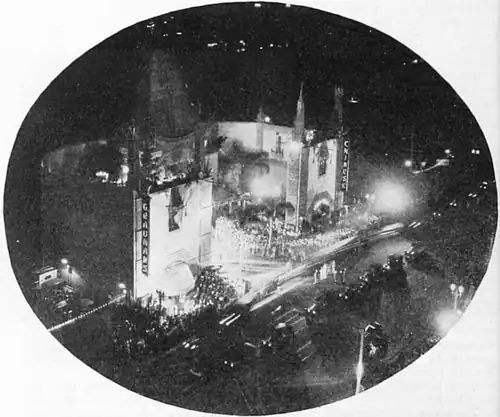
Just another Hollywood opening, sun-arcs, radio, and all. Hollywood Boulevard is the new Broadway―whether it will or no. The placid street, accustomed to dozing in the summer sun, and going shut-eye long before midnight, is doing its best to be big time
Pioneer days are with us again. Hollywood Boulevard is the new Broadway. The placid street, accustomed to dozing in the summer sun, is doing its best to be big time. Of course it felt a bit hurt, that's all, when some actor said that the only thing it lacked to become Surf Avenue in Coney Island was a roller coaster and a "hot dog" stand.
The Boulevard isn't at all sure that it wants to be the new Broadway. Hollywood today is a bit like the mother hen with a brood of ducklings. She is doing her best to raise her ducklings into good, little motion picture chickens―and more than likely she will succeed. The Broadway invaders are faced with the necessity of doing in Hollywood as the Hollywoodians do. New York habits of life are completely out of focus in these more or less wide open spaces of real estate subdivisions.

This is how the Hollywoodians picture Broadway now―a cross between the Deserted Village and the Sargasso Sea. In their eyes old Bagdad-on-the-Subway has become an empty shell. Well, a few of us old timers stick to the ghosts of yesterday
Hollywood goes to bed at night and gets up early in the morning. The New Yorker is now getting his first introduction to 8a.m. Hollywood, for the most part. lives in homes. New Yorkers usually have apartments. Hollywood makes whoopee in its homes. The New Yorker goes to night clubs and speakies.
They do tell some priceless stories about the New York stage people, having their first experience at bona fide home life. Helen Kane, the baby talk girl from the revues, leased a house in Hollywood for no other reason than a fig tree in the back yard. Helen had never seen a fig tree. In fact she had a vague idea that figs grew like potatoes, beneath the ground. But to have a house with a real live tree. She couldn't resist it. Her little nephew eyed the tree with speculative interest.
"Auntie Helen," he queried, "do Fig Newtons grow on it?"
After eighteen years on the road, Hal Skelly, now under contract to Paramount, has a house. He's all for the idea. When he runs out of ginger ale he can just drop out in the back yard and pluck a few oranges. Charles Mack, the Black Crow with the tired voice, has purchased a swanky mansion in Beverly Hills―the only typically modern art structure in Southern California. Whereas he used to buy the missus "jools" on events like anniversaries he now buys her peacocks, live ones. Just little ornaments for the garden.
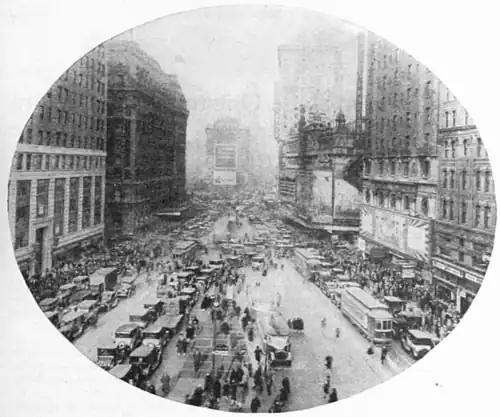
The little white arrow points westward, and dozens of Broadwayites have taken the hint. But New York has not yet become the Lost City. Two or three taxis ply their trade as of old, and white men may still be seen in the wastelands of Times Square
Eddie Buzzell, star of many musical shows, wanted to buy a house and have a garden. First
National has kept him so busy that he hasn't even had time to change apartments. The Jap gardener there has been quite tolerant with him, however.
"He told me I might water the lawn," Eddie explained, "but he didn't trust me to hoe the flowers. It's just as well. I didn't have any time. I've learned that a summer sun rising over the eastern rim of the world looks different when you've just gotten up from seven hours on your ear. You see, I used to see it, just before deciding it was time to go to bed. What time do I hit the hay, now? About ten. Doesn't seem strange at all. I'm as sleepy by that time now as I ever was in New York early in the morning. The only strange thing about it is having to undress by artificial light."
THE Roosevelt Hotel, on Hollywood Boulevard, has been the neck of the bottle for the stage people. Wait a minute. Don't get ahead of the story. After registering at this hostelry they later spread out into Los Angeles, Beverly Hills and Santa Monica, into homes and apartments. The Roosevelt is the Claridge, the Algonquin and the Ritz of the West.
Home life appeals to these people of the stage, accustomed to apartments in New York, and rooms and baths in hotels on the road.
Ann Harding, the star of the stage production of "Mary Dugan," has a house, and wonder of wonders, there is grass in the front yard. Ann's baby doesn't have to have a sun bath on the fire escape.
Irene Bordoni and Lenore Ulric, both arriving in the West with huge staffs of servants, have taken big houses in Beverly Hills. Miss Bordoni has leased Marie Prevost's residence. Ina Claire, of course, the moment she became Mrs. John Gilbert moved her trunks out of the smart Beverly-Wilshire into John's house on Tower Road, overlooking the mountains, the sea and the Los Angeles plain.
Others among the Broadway personalities who lost no time in finding houses are Charles Bickford, Cliff Edwards (Ukulele Ike), Charles King, Robert Montgomery, George Arliss, Walter Woolf, Chester <orris, Fannie Brice, Lillian Roth, Frederick March, Florence Eldridge, Mary Eaton, Kay Francis, and Paul Muni. Ruth Chatterton, Carlotta King, Pauline Frederick and Raymond Hackett are living at the seashore. Hackett says Hollywood is the cleanest place he knows. Everyone goes to the beach from May to October.
Some of the footlight stars couldn't sleep unless they had apartments. Someone snoring on the floor below, a wild party on the floor above, and a domestic squabble in the suite adjoining.
The Beverly-Wilshire, built with the intention of attracting Los Angeles society folk, has become a very fashionable hotel for theatrical top-notchers. The Beverly Hills hotel, until a short time ago, a resort for over-upholstered Eastern dowagers, is filled with the big names of the stage. Apartment and hotel life, New York or Hollywood, appeals to Jack Buchanen, Pert Kelton, Marilyn Miller, Beatrice Lillie, Charlotte Greenwood, Al Jolson, Bernice Claire, Zita Johann, Catherine Dale Owen, and most of the song writers.
Things are still a bit chaotic along the new Broadway, but then life's like that. The stage people are trying to become accustomed to Hollywood, and Hollywood is trying to become accustomed to the New Yorkers. At first the arrivals from the legitimate and variety stages rather kept to themselves. Now, gradually, the two groups are beginning to merge. Particularly is this true of Ann Harding, Ina Claire, Marilyn Miller, the Gleasons, and Basil Rathbone.
VAUDEVILLE people are slower to venture out of their own circle of fellow performers and song writers. But then there is the picture of Fannie Brice, the proud possessor of a house with a swimming pool in the back yard, entertaining hordes of film people on Sundays. Fannie, however, has long been popular with the colony during her many visits to the Los Angeles Orpheum. Sophie Tucker was quite exclusive while she was here. Tex Guinan didn't pal around much, either, but then she couldn't find anyone to pal with.
At times there have been some hard feelings between the old line motion picture stars and the newcomers to flickerland. There is, of course, the famous motion picture star who attended a party where most of the guests were from the stage. He was introduced to them all and the questions directed to him included: "What is the name again, please?" and "Are you in pictures?" The film people retaliate by asking politely―"How long are you going to stay?" Just as politely the stage people answer―"As long as we can."
THE Hollywood method of doing things has been puzzling to most of the footlighters. For instance, Carlotta King objected to singing her most difficult arias in "The Desert Song' before 9 a.m. A singer doesn't get going that early. Irene Bordoni makes her best recordings after midnight. Charlotte Greenwood can't imagine what is happening to the filmization of "So Long Letty," her perennial stage success. It's turning into a sort of passion play. Walter Catlett, after spending ten years of his career in "So Long Letty," "Sally" and "Rio Rita" isn't in any of the picture versions. But this is all as Hollywoodian as the eighteen day diet. And since we've brought that up, Helen Kane heard about the diet the first day she arrived and started on it immediately.
The real acid test and final initiation will come when they start giving parties for twenty, with sixty guests arriving. Hollywood is used to that sort of thing. Phyllis Haver always prepared for about double her guest list. In New York small parties are the vogue. A Manhattan apartment is not designed for wholesale entertaining.
Basil Rathbone and his wife, Ouida Bergere, the scenarist, are among the first of the stage people to take up lavish entertainment. Their recent fancy dress ball was fancy. Apparently no one appeared that wasn't invited, but then Hollywood is thoughtful about that sort of thing.
Rathbone will be lulled into the secure feeling that he can actually give parties with none but invited guests. Then, like a bolt from the blue, he will have a party and everybody will come, including fans from Oshkosh, and a lady whose cousin's brother-in-law went to school with the host in England.
The Gleasons, James and Lucille, are already well entrenched in Hollywood. They, also, have a house and swimming pool, and lots of guests. You'd be surprised to know what a swimming pool can accomplish in the film colony. It carries as much distinction as having a house at Newport. Cliff Edwards is very proud of his swimming pool.
"I can't afford to fill it with water," he said, "but it's a great place to throw the tin cans and the empties."
Edwards, at his beach house, entertains many of the melody makers. Ruth Chatterton and Carlotta King have many stage guests at their Malibu Beach cottages, and Pauline Frederick mixes her crowds, stage and screen. Pauline, for years, has maintained a stately house in Beverly Hills. Strictly speaking, she is not a Hollywood newcomer. She is instead one of the Hollywood comebackers.
THE bitterest pill to swallow for the Broadwayites is the fact that they have to go to bed at a reasonable hour. There's no actual law about staying up late, and the curfew does not ring tonight. Just no place to go.
Joan Bennett moaned at first about the lack of night life and took an apartment on a busy street so she could hear the street cars and automobiles. Now she has moved to the top floor where noises do not penetrate. That's Hollywood getting in its work.
Few of the stage people are habitues at the Montmartre Cafe, for many years the holy of holies of the film colony. They go once but they do not like the crowds, the curious tourists. The stars who were wont to visit Sardi's restaurant in New York, with its collection of caricatures of the theatrically famous, go a great deal in Hollywood to Wilson Mizner's Brown Derby. The other night, by actual count, there were thirty-five glittering person- alities from the "other" Broadway dining there.
The Russian Eagle, with its superb music and caviar, is another favorite dining place. Farther on downtown is the Victor Hugo, famed for its filet mignons and chicken under glass. Arthur Caesar, king wit, says that if the Victor Hugo went out of business in Los Angeles he'd be compelled to eat at a lunch wagon. The song writers have adopted the College Inn as official rendezvous. The other night one of the boys asked the waitress for a sturgeon sandwich.
"What is it?" she asked. "Is it anything like tripe?"
MOST of the footlight favorites like living in Hollywood. Certain things they naturally miss from their old lives, but there are compensations. Charles King went to New York expecting to stay six weeks. He hurried back in three. Marilyn Miller is most enthusiastic about it. Ruth Chatterton says she never wants to go back. On the other hand Lillian Roth finds it a bit too quiet for her taste.
Margaret Wycherly isn't too happy here, but she says it is more like New York than New York itself. Now what can you do in a case like that?
BUT, hot or cold, Hollywood Boulevard is the new Broadway, even if it lacks the stimulus of the other street. It can't avoid being the king-pin of thoroughfares with all the new personalities. In addition to the recent contract players at the various studios, there is an impressive list of summer visitors. Ethel Barrymore, Helen Menken, Katherine Cornell, Helen Hayes, Fay Bainter and Sylvia Field arc all here. Maude Adams has been living quietly here, in the strictest seclusion, for some time. And a year ago Hollywood, the dear, old innocent, was impressed when Ethel Barrymore, Mary Nash, Basil Rathbone, Nora Bayes, Elsie Janis and Beatrice Lillie were guests at a Mayfair ball. Now these presences create scarcely a ripple of excitement.
Still, there must be some crumbs of comfort for the first Broadway in the words of Robert Benchley: "You can bring polar bears and icebergs to Broadway and, even then, it won't be the North Pole."