Photoplay/Volume 36/Issue 4/Tragic Mansions
Tragic Mansions
The strange story of heartbreak houses of heartbreak town
By Cal York
Special Photographs for Photoplay by STAGG
Some fine dwellings that stand as monuments of shattered careers

Falcon's Lair, the home of Rudolph Valentino, has never been occupied since his death. Superstitious and foolish stories are told about this house, all typical of the countless legends that have grown up around the memory of Valentino
HAUNTED houses, to look the part, should be gray, grim castles with a surrounding moat, and at least a somber bat or two circling about the turrets. Houses which shelter poignant memories should be vine-covered cottages with old rose gardens. Tragedy houses can be anything from hovels to mansions, for tragedy is as old as the world and as new as next season's hat―and no respecter of persons.
Hollywood has its dwellings of tragedy. There they stand, the heartbreak houses of heartbreak town.
High up on the ledge of a mountain is Falcon's Lair, the home left by Valentino when he went to New York, never to return. There is Fred Thomson's beautiful hillside home, and Joseph Schenck's great mansion on Hollywood Boulevard. Then there are the houses of Barbara La Marr, William Desmond Taylor, Roscoe Arbuckle, Charles Ray, Mary Miles Minter and Harry Langdon. Sheltering their memories, outliving the fame and sometimes the lives of those who passed through their rooms, those who have laughed and loved and have gone from the screen.
They do not look like the harboring places of tragedy, these Hollywood houses of sorrow. They stand back in well-kept gardens. Their walls gleam in the bright sunshine of Southern California. Red tile roofs are a blaze of color. People pass by unthinking and forgetful. But the walls could tell stories of romances ended, careers shattered and death.
A ROMANTIC but foolish legend says that Falcon's Lair is haunted. Irresponsible stories have been told of a caretaker who fled screaming down the hill, never to return.
This is the house that Valentino bought and rebuilt for Natacha Rambova. It was furnished magnificently with treasures gathered from all over the world. At Valentino's death household and personal effects were sold at public auction. Shop girls bought his scarf pins, struggling clerks purchased articles from his wardrobe. At last Falcon's Lair stood barren of its furnishings. Then the weird stories of the place began, just as they circulate about any house that isn't occupied.
There's a road that wanders about a hill in Hollywood, and along this strange little road are picturesque cottages. Among these cottages is a small brown house, nestling in the shade of giant eucalyptus trees. You have to climb down from the road to get in the upstairs of the house. It is a different sort of a dwelling and it is cursed with beauty. Barbara La Marr built it, and here she lived during the last tragic year of her life.
IT was here that she undertook one of the strictest of diet regimes. She lost her health and was dying when she made her last picture. She died before it was completed. And now, strangely enough, the house that once belonged to the too beautiful girl is occupied by the too beautiful boy, Philippe de Lacy, the war orphan who so many times was close to death during his babyhood in shell-torn France.
Farther down-town, on Alvarado Street in Los Angeles, there is the house that could tell a tale of the strangest murder mystery in the annals of crime. S. S. Van Dine has never evolved a more baffling plot, and this plot has never had a solution. Perhaps it never will.

This placid bungalow court apartment saw the murder of William Desmond Taylor, one of the most baffling mysteries in the annals of crime. The murderer was never caught but innocent persons suffered an unjust stigma
In 1922 William Desmond Taylor was murdered in this imposing building, and his death signified the writing on the wall for Mabel Normand and Mary Miles Minter.
Both stars, the greatest of that day, were brought into the case. There was an avalanche of publicity from which they never quite escaped.
Curiously enough, Miss Normand and Miss Minter were living within two blocks of each other at the time. Mabel's house has been transformed into a flat building, with business structures creeping upon it. Mary Miles Minter's beautiful residence, in which she never found the semblance of happiness, is a club. Now Mabel is very ill and Mary Miles Minter is living in Paris.

Here, in the hillside home of Frances Mariou and Fred Thomson, dwelt youth and wealth and romance. After Thomson's death it was sold to an Eastern capitalist
The year 1922 is one Hollywood will never forget. For the first time the actor realized that he could not dance without paying the piper's price. Fame before had seemed a safe, assured thing.
Never again could it be "the public be damned." At the same time as the William Desmond Taylor murder, Roscoe Arbuckle was on trial for his life in San Francisco, the aftermath of a gay holiday party.
The fat fellow who had made millions laugh would never be a favorite on the screen again. He, too, was paying the piper. The trial cost him his place among the stars, and his wealth. His big cars, specially made, were sold. He lost his great house, and since that time not many people have cared to live in it.

In the heart of the most conservative section of Los Angeles lived Roscoe Arbuckle. The sedate English home was sold to foot the expenses of his trial
Just this year there have been the inevitable stories that the place is haunted. That there have been lights and sounds of revelry when such things did not exist in reality.
Arbuckle's formal English house stands on West Adams Street, Los Angeles' most aristocratic residence boulevard. From the back of the place the windows overlook Chester Place, the holy of holies of the city's smart set. Across the street is the Huntington Minor home, in days gone by the mansion that ruled the destiny of Southern California society.
The Arbuckle gardens join the wide lawns of E. L. Doheny in Chester Place. On the other side is a parish house. A strange environment for the dwelling place of the film comedian who loved reckless parties.
There were many stories of these parties long before Arbuckle had to sell his house on 400 row to pay lawyer's fees.
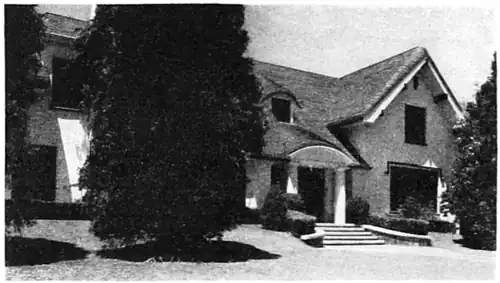
Charles Ray sank a small fortune in his Beverly Hills residence, one of the first of the luxurious homes of the movie stars
It didn't seem that tragedy could ever find shelter in the beautiful hillside hacienda of Fred Thomson. Here was youth and romance and wealth. Thomson, the athletic star, was the idol of Young America. His wife, Frances Marion, was one of the most successful of scenarists. Their romance read like a story book.
Frances Marion had been introduced to Fred Thomson during the war, when the tall, curly-haired boy was a chaplain of the Fortieth Division. She had journeyed down to San Diego with Mary Pickford, the honorary colonel of the regiment, to see a service football game. Fred had made a forty-yard run, and then was tackled by four husky sailors. His leg was broken in three places.

Five families knew tragedy in this handsome residence. Douglas Fairbanks, Norma Talmadge and Emil Jannings lived here at unhappy moments in their careers
MARY and Frances visited him in the hospital. That was the beginning of the romance. They were later married in France. When he returned from the war he became Mary Pickford's leading man. Fame came easily to him.
Fred seemed the last person to die in youth. He had such a splendid physique and lived such an exemplary life. Yet he did not survive an operation.
The Thomson hacienda has since been sold, at a sacrifice, to an Eastern capitalist. The place held too many poignant associations for any member of the motion picture colony to desire it. Fred and Frances were a marvelous host and hostess.
Now Frances Marion is living in Charles Ray's former residence in Beverly Hills―from one house of sorrow to another. Charles put a fortune in the building of this graceful mansion. It was to this place that he brought his bride, a cultured society girl.
When Charlie lost his fortune, the house in Beverly Hills was sold, but the bride and groom rented it from mouth to month, loath to leave the house where they had been happy.
At last they had to give it up. But it may be that Frances Marion will here find happiness again.

Domestic worries and business tribulations disturbed Harry Langdon when he lived in this Spanish castle. It was here that his high hopes of a brilliant career went glimmering
THEN there is Harry Langdon's towering Spanish castle on the Argyle hilltop, in which he spent so many unhappy days, beset with domestic trouble and the worries of a career which had promised so much and yet did not last. He signed over the house to his wife and went back to vaudeville. Now he is back in Hollywood, beginning again, but he is not living in the Spanish home.
One of Hollywood's most imposing mansions, known to everyone in the film colony, has had its two decades of sorrows. Five families, at different times, have failed to find happiness back of its white stucco walls and have left for new surroundings.
Douglas Fairbanks lived there, so did Norma Talmadge, and most recently Emil Jannings. Now it stands vacant again as it has from time to time in the past.
The big dwelling on one of the world's most publicized thoroughfares, Hollywood Boulevard, was built by the late Albert Ralphs, a Los Angeles grocer. He had started business humbly, waiting on all customers from the first families to Mexican day laborers.
Thrift and faith in the future of the city built the great Ralphs fortune. The mansion was a monument to his success, but it did not bring the happiness expected. Soon after taking possession of the place he was struck by a falling boulder and never recovered from the accident.
The family did not live long in the house after his death.
Douglas Fairbanks lived there during his early picture carcer in Hollywood. The film colony in 1918 and 1919 was agog over the fact that he paid $500 a month rent. That is quite a figure for rental now. In those days of wartime frugality it was considered enormous. It was a trying period for Fairbanks. He had just been divorced by the first Mrs. Fairbanks, the mother of Douglas, Jr., then a youngster of nine.
Later, when Mary Pickford became Mrs. Douglas Fairbanks, "Pickfair," the beautiful home in Beverly Hills, was purchased. Doug was glad to leave the expensive showplace in Hollywood.
John P. Cudahy, a son of the late Michael Cudahy, one of the great packer barons of the nation, next took possession of the residence. His tenancy was one of the gayest, and yet the most tragic. There were many parties at the Cudahy house, music and dancing, plenty to eat and drink. Restraint was not one of Jack Cudahy's virtues. His name had been blazoned in headlines many times. His life was one continuous law suit. There was talk at the time that his wife was about to divorce him.
Although the Cudahy fortune was of many millions the estate could not be divided for seven years. Payments came at stated intervals.
When there was money there was gayety, when there was not, there were bills and threats from tradesmen. At one of the critical periods of penury Cudahy tried to negotiate a loan for $10,000, his only security the golden flood of money in the future. No one would take the risk.
ONE spring morning in 1921, in one of the beautiful upstairs bedrooms, Jack Cudahy took the suicide's way out of life, Mrs. Cudahy, in an adjoining dressing room, heard the shot. Their two children were playing downstairs.
During the past few years, Michael Cudahy. Jack's son, has figured often in newspaper stories. Recently he married a film player. Muriel Evans. He was once a suitor of Joan Crawford.
Now Douglas Fairbanks, Jr., has wedded Joan, so by a strange twist of fate there is a link between the two families who occupied this house of sorrows.
Joseph Schenck, multimillionaire executive of United Artists studios, and husband of Norma Talmadge, purchased the mansion for her. For a time it seemed that the tragic spell exerted by this apparently cheerful house had lifted. Outwardly the producer and his wife were the happiest of couples. Through the spacious, luxurious rooms moved the most famous people of the screen world. Norma was at the very peak of her popularity.
Then the old spell came back to the house. Rumors began to circulate that Norma was not happy.
In time the house was closed again. Joseph Schenck moved to a Hollywood hotel, and Norma went abroad.
When Emil Jannings came to America, fresh from triumphs in the studios of Germany, he leased the mansion from Schenck. Fairbanks had paid $500 a month rental. With the passing years values had increased. Jannings paid $1,250.
HERE was an all-conquering star, and surely the old spell could not influence his career. His first American pictures were hailed as triumphs by the critics. He was the screen's greatest actor.
There were many parties for the foreign colony in the rooms which had seen so many parties and so many social sets.
Then came talking pictures. Jannings, in spite of his God-given ability to play upon the emotions, could not learn to speak even fair English during his years in the United States. The conquering hero returned this year to his homeland, defeated. He cried when he left.
Now the place is vacant again. It is as beautiful as ever with its fresh, white walls, beautiful lawns and great trees.
Who will be the next to live in the house of sorrows?
They say that Joseph Schenck intends to live there alone. The bride's bower will become bachelor quarters.
Perhaps the now rather old-fashioned mansion has run through its cycle of tragedies. It may bring good luck to future tenants. The coming years will tell the rest of the story.