Photoplay/Volume 36/Issue 3/Excess Baggage
Excess Baggage
Our film girls check their non-professional spouses with the Judge
By Katherine Albert
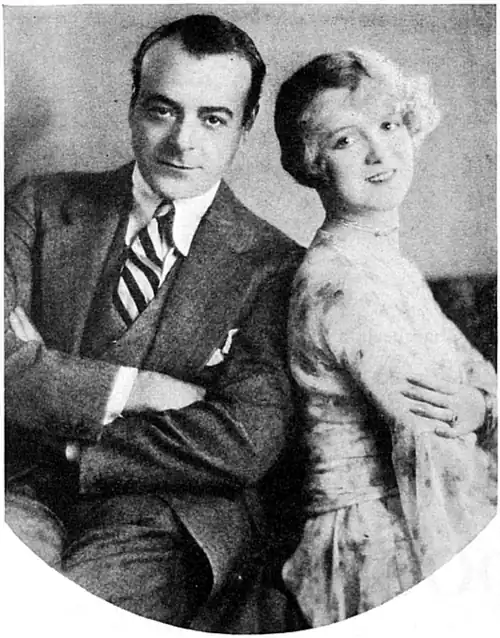
A picture of Lowell Sherman and Pauline Garon taken in the joyous days when the love-birds still twittered. Both were players there might have been happiness. But soon Polly packed up and departed
THE play, "Excess Baggage," ended happily.
It doesn't work out so nicely in real life.
And this poignant little drama, set down by the thousands who saw it as fiction merely, is, with the exception of the final fadeout, gospel truth. Its three acts are played out almost daily behind the motion picture cameras in Hollywood.
Every time you cross a studio lot you find yourself knee deep in excess baggage. You see the non-professional husbands of the younger players. Their eyes are bewildered as they, baffled at the state they have found themselves in, realize the fame and glory of their wives.
On these pages you see four smiling brides and four grinning grooms. Renee Adoree and Bill Gill, Helene Costello and Jack Regan, Pauline Garon and Lowell Sherman, Dorothy Mackaill and Lothar Mendes—all happy enough until the grins turned to glowers and the husbands became ecxess baggage—checked at the station.
John Regan, Allan Keefer, Harry Rosebloom, Julian Ancker, Logan Metcalf—unfamiliar names, aren't they? Yet they are the excess baggage of Hollywood. They were, at one time, the husbands of Helene Costello, Sue Carol, Jeanette Loff, Jean Arthur and Madge Bellamy, respectively.
You remember the stage and film story of "Excess Baggage"? It concerned a tight rope walker whose wife—and also his inspiration—was singled out for a film career. She had been excess baggage to him, her sole raison d'etre being to hand him parasols. But when Hollywood bore down upon them, he found himself the second rate member of the family.
These non-professional husbands who do not speak the easy, unconventional language of the screen or, as in the case of Marian Nixon and Joe Benjamin, speak it too fluently, hamper the professional growth of their wives. There is a strange barrier between them. It concerns money. The men can't hope to compete with their wives' salaries, yet can they, without losing prestige, dig ditches? And even if the husbands have money of their own the fame and attractiveness of their wives give them a second-hand position.

Actress Renee Adoree and Businessman William Gill caught in the act of worshipping each other at the time of their marriage. But soon the royal road to the studio and the dusty path of trade diverged, and Mr. Gill was marked excess baggage in the world of screen art
JEANETTE LOFF'S case is fairly typical. Three years or so ago she married Harry Rosebloom in Portland. He was a salesman, she was an organist at one of the theaters. They were young and contented. They were ordinary. Their lives took on the color of every other young married couple in America. His men friends. Her girl friends. Bridge parties. Sunday night suppers. Laughter. Hopes. Ambition. The savings account at the bank going nicely enough, thank you, for Jeanette to have a fur coat next year. Or maybe the first payment on the house.
A spoiled dessert. A shopping tour with one of the girls. Christmas presents much too expensive and therefore much more precious. Little sacrifices. Little hopes. Little ambitions.
An ordinary life, if you will. But there is something so secure about being ordinary. There is something that touches glory in being young and contented.
And then the little hopes and the little ambitions grew into large ones. All day long as Jeanette played the organ at the theater she watched girls no prettier than she (hadn't Harry told her how beautiful she was?) go through their screen tricks. So she came to Holly wood to go into the movies.
Being young and contented had meant something in Portland. But in Hollywood it was being young and unattached that counted. Suddenly her life was changed. She found herself achieving fame and a fair amount of fortune. A fame and fortune with which Harry, her husband, had nothing to do. It was not being a wife, but being an actress that counted. Harry had no place in her new life.
He came on from Portland, of course. He found it hard to get any sort of job in the new city, but much more difficult to find a position that was worthy of the name he bore, the name of Jeanette Loff's husband.
Jeanette Loff's husband. And, like the heroine in "Excess Baggage," she told no one that she was married. It was not that she was ashamed of him. Gracious, no! But there is something psychological about being unattached. It concerns not so much the fans, as you might imagine, but the directors and producers. Not that any of them wanted to marry her, but they, subconsciously, wanted the knowledge that they could if they chose. A subtle intangible thing that assumed important proportions. Important to a film career.

A handsome pair if ever one stood up—Helene Costello and young John Regan. But Jack was a non-professional, and didn't understand things, and a divorce separated two kid sweethearts forever

Dorothy Mackaill smiles happily as the judge hands her the fateful paper that makes her one with Lothar Mendes, the director. It wasn't long, however, until she grinned when another one handed her a note that made them two again
HARRY went to a couple of parties with Jeanette and they both realized that it was all quite impossible. It was a mixed marriage and by that I mean a marriage between a professional and a non-professional, and it simply wouldn't work.
They talked it over quite calmly. They were both unreasonable, of course. They were both right. Jeanette, by this time, knew the demands of a film career. Harry couldn't (or wouldn't) understand. He was immensely proud of her, but not willing to accede to the dictates of this strange business. Not willing to be tolerant when her job (he couldn't realize how a mere job could be so all enveloping) made it necessary for her to be nice to and smile upon people who bored her. He couldn't understand why it was good business to be seen at various parties, to give her time to people who meant nothing to her.
And Jeanette knew that this was part of her job, as vital a part as putting on grease paint in the morning. It was nobody's fault. It was the situation itself.
So they separated, the happy, ordinary couple from Portland. Harry hopes for a reconciliation. But it won't work. It doesn't ever. Only the play had a happy ending.
Helen and Clarke Twelvetrees were reconciled when there was talk of a divorce. But how long will that last? How long can it last?
IN New York, Clarke, as an actor, was better known than his actress wife. Even that name, that splendid, unforgettable, box office name belongs to him. He had played leads on Broadway. "An American Tragedy." "Elmer Gantry" and others. Perhaps he had contributed a meed of beauty to the pattern of existence, while she had done only secondary roles. But during the beginning of the hectic talkie era one of the Fox officials saw Helen on the stage, noted her amazing resemblance to Lillian Gish and sent her to Hollywood with a nice, fat contract bulging from her hand bag.
Clarke came along, too. They always do. It's the last gesture of husbandry.
Helen achieved immediate notice. She was made a Wampas baby star and given good parts. Clarke was left in the background, unable to cope with his wife's fame. He was a good actor, but he didn't have a photographic face. So he is trying to write and while Helen is at the studio, growing more and more famous and more and more popular, he stays at home and struggles with dialogue and manuscript.
Clarke Twelvetrees thinks he can write.
So did Jaimie del Rio when he found that Dolores was leaving him behind.
Shrouded in mystery is the marriage and annulment which occurred a few days after Christmas of Jean Arthur and Julian Ancker. The papers carried the story that their honeymoon was cut short by Jean's discovery of a clause in her Paramount contract that prohibited her marrying. She immediately packed up her trousseau and went back to the studio. According to Ancker efforts on his part to persuade her to recognize her marriage contract failed. He received the annulment.
WAS this another case of excess baggage? I wondered. But when Jean was questioned she fell into a violent case of weeping, left the studio before I got there, with instructions to one of the office boys to hand me the following note, "My career had nothing to do with the annulment. It was an extremely unhappy event which I wish to forget as quickly as possible."
But it was another case of excess baggage when Evelyn Lederer Keefer (Sue Carol) left her husband and came to California. She found a spot in pictures and didn't go back to Chicago. Allan was forgotten and she became engaged, after her divorce, to Nick Stuart, an actor. This gives them an even chance for happiness.
They are in the same business, with the same hopes and ideals, the same knowledge of the requirements of the motion picture profession. Hundreds of professional marriages have succeeded. The mixed ones fail. And the wise gals are those who, when they fall in love and prepare to marry a man outside the business, give up their own screen work.
MAY ALLISON gave it up when she married the editor of Photoplay and has become a regular contributor to Cosmopolitan Magazine. Marguerite Clark did it and is happy. Phyllis Haver has left the screen forever to become Mrs. William Seaman. The other day, when she refused to talk about her husband or her plans, she made a pertinent remark: "William doesn't understand the business. He doesn't know that we tell everything for publication. He would never understand why I should be discussing him and our affairs publicly. And I know that he would never be able to realize what our lives on the screen require. I have found a man I love. I have found someone who satisfies me completely and I'm not taking any chances on readjustments. I'm not going to try to teach him what the necessary gestures of a film star are. I'm just leaving the screen so that I can be happy with a non-professional husband."
Marian Nixon fell in love with a prize fighter, Joe Benjamin. Unlike Jack Dempsey, he had no patience with the film folk or their ways. Divorce was inevitable.
Á lengthy blurb in the newspapers recently told that Jacqueline Logan's love for Larry Winston, from whom she has been separated for over a year, is to undergo a super-test. He is to spend the summer in Europe, while she is to stay here. If they still love each other upon his return they are to be re-married. They may be married; they won't be happy. For Winston is the scion of the historic Bradbury family.
John Regan was also a scion of a wealthy family, but Helene Costello found him excess baggage and they were divorced after a few months together. Regan had been a childhood chum of Helene. There is nothing that brings on incompatibility more quickly. Helene finally grew tired of watching him sitting around the house all day, while she worked from eight to eighteen hours out the twenty-four. But it was not possible for him to take a position that might lower her professional prestige.
CONSTANCE BENNETT divorced her multi-millionaire husband, Phil Plant, not long ago. She is coming back to go into pictures.
Constance Talmadge recently married Townsend Netcher and will give up the screen. Netcher is a wealthy Chicago boy.
Janet Gaynor has been reported engaged to Lydell Peck, a lawyer. Shouldn't she pause to consider the example of Renee Adoree, who found that nothing but trouble followed after her marriage to William Gill, a business man?
Madge Bellamy's marriage to Logan Metcalf, a broker, was a failure. Ethlyne Clair soon got a divorce from Dale Hanshaw, a non-professional. And Josephine Dunn who, by the way, played the leading role in the screen version of "Excess Baggage," learned, to her sorrow, what it meant to have a non-professional husband and a career.
Those in the profession, writers, actors, directors, executives, editors, publicity men, understand.
The rest, the brokers, the shoe men, the salesmen, the millionaires, can only bring unhappiness to their wives.
They will always be excess baggage.