Photoplay/Volume 36/Issue 2/Brickbats and Bouquets
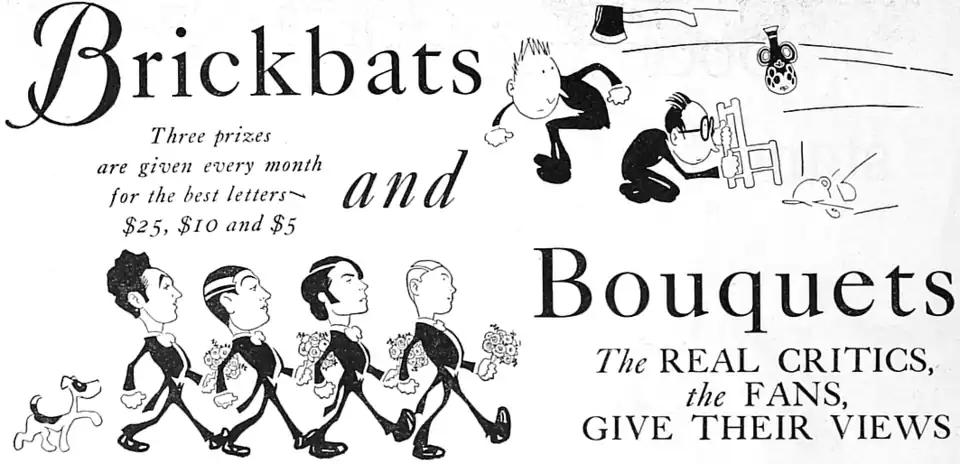
The readers of Photoplay are invited to write to this department—to register complaints or compliments—to tell just what they think of pictures and players. We suggest that you express your ideas as briefly as possible and refrain from severe personal criticism, remembering that the object of these columns is to exchange thoughts that may bring about better pictures and better acting. Be constructive. We may not agree with the sentiments expressed, but we'll publish them just the same! Letters must not exceed 200 words and should bear the writer's full name and address. Anonymous letters go to the waste basket immediately.
The Monthly Barometer
OUR mail has fairly exploded this month with letters from excited fans. Some demand that talkies be abolished; others say they are through with silent pictures forever.
Jannings and Garbo are causing a great deal of worry. Their loyal followers don't want to lose them. No one seems to care whether they talk or not—just as long as they continue to act on the American screen.
The heated arguments about voice doubling continue—both for speaking and singing. Some of the disillusioned fans are wailing because they can't be sure they are actually hearing their favorites. Others argue that voice doubling is no more to be frowned upon than doubling for stunts, a scheme to which the fans have long been accustomed.
From readers in foreign countries have come many letters expressing great interest in the talkies. Those who have not already heard them are awaiting their advent with eagerness.
Protests against talking pictures have come from the deaf—a situation that calls for serious thought.
Incidentally, Photoplay Magazine wants to say thank you for the lovely bouquets it has received in the past few months from readers all over the world—words of praise we are too modest to print, but which help by their encouragement.
$25.00 Letter
Omaha, Nebraska.
No one who has never lived outside the large cities can really appreciate what talking pictures mean to the American public. If the talkies brought only intelligent orchestral accompaniment—
God bless 'em!
If there is anyone who can enter into the forceful, moving spirit of "The King of Kings" while a correspondence school pianist plays "Why Should I Care?" in syncopated jazz rhythm, on a piano that hasn't been tuned in two years, during one of the most touching moments of the film—
There isn't!
Yet this not only actually happened but occurs regularly in every town in the United States, once you venture beyond cities large enough to support theater orchestras. Contrast it with the orchestral offerings in "The Broadway Melody" and like pictures.
Motion pictures laid entertainment at the feet of the world; talking pictures increase the world's enjoyment a hundred-fold.
And their present trend seems to insure us a still greater boon; the doom of the mere "pretty face" and weak plot and the advent of the genuine actor who has something worthwhile to offer and demands a worthwhile play in which to offer it.
E. C. Whelan.
$10.00 Letter
Toronto, Canada.
I am a clergyman's wife with one son ten years old, whom everyone, including my husband, says I spoil dreadfully. Although well on in years I had never been in a moving picture show, as I thought they were places where nothing but vice was depicted, and where no one could learn anything good.
A friend of mine (I know now she was a real friend) induced me to go with her and see "The Sins of the Fathers." No sermon ever affected me as that picture did, and I saw myself for the first time in my life, as I was—a mother, who, for my own gratification, was teaching my son to grow up in idleness; neglecting his education, pampering his every wish, and smoothing away every obstacle in his path instead of teaching him self-control, and helping him to prepare for the battle of life.
How thankful I am I was saved in time, by that wonderful picture of the devoted father, played by Emil Jannings, who showed how easily a child may be misdirected in his youth by parents' selfish love. Every mother should see this picture. No better sermon was ever preached.
L. Watkin.
$5.00 Letter
Santa Fe, N. M.
About the only thing I can find wrong with the average movie producer is that he has the modern boys and girls all wrong. We're not a pack of drinking, smoking and petting-party hounds that sneak home in the wee hours of the morning after a night of whoopee. The most of us are home, happily dreaming of Greta and John in a love scene.
In "Our Dancing Daughters" Joan Crawford got a big laugh from some of the younger generation I know. She was a hot toddy, I'll agree, but she wasn't carrying our banner. "The Godless Girl" wasn't a good likeness of us either. I take it that high school was supposed to be a replica of any school in the United States. Well, all I've got to say is that De Mille fell down on that picture.
Clara Bow is supposed to be the symbol of us. She is certainly a good actress, but she can't represent the modern girl. Of course, there are different types, but even at our wildest we don't resemble that red-headed child.
We're more on the Bronson-Moran type—chic, sophisticated, but with enough sense to come home while it's still dark and a few stars are left.
Mary Walsh.
It Does Sound Logical.
Alden, Pa.
I personally most emphatically prefer talkies because I find them more entertaining.
The comments of some of the objectors are quite amusing. One of your readers fears that the advent of talkies will prevent him from exercising his imagination! Another is quite wrought up over the introduction of dialogue and sound in movies because it will disturb his repose!
To the first objector I might advise cutting out movies entirely and confining himself to reading good books, where his imagination can have full scope. To the second objector I would suggest that if he wishes repose, why in the name of common sense does he not go to bed?
I really believe the objectors have had some ground for their stand as some of the talkies have been quite terrible. But in spite of all this, there has been very pronounced improvement in all directions since their introduction about a year ago, and this would indicate that still further advances will be made all around.
Donato A. Giangiulio.
Gentlemen, Make a Bow!
Honolulu, T. H.
Let's hand the newsreel camera man a nice big bouquet for his patience and courage. Stars come and go, but the newsreel goes on forever.
Gloria M. Wall.
A Flower for Bill Powell
Jamestown, N. D.
I heard my first talking picture a few days ago. It was "The Canary Murder Case." I thought it was great! William Powell had always been fixed in my mind as a villain of the screen until then. He will never seem the same to me again and I am glad of it, because I like him so much better this way. He has a really remarkable voice. It is so easily understood and contains such a soothing quality. Let's hear and see more of him!
Nancy Kimball.
And Now a New Problem
A few nights ago I went to see my favorite actor, Wallace Beery, playing in "Chinatown Nights." I had looked forward to seeing this picture as Mr. Beery was taking a somewhat different part than usual. Imagine my disappointment; I didn't enjoy the evening at all. To me it was a total mystery, because it is a talkie. I am deaf and dumb and I guess I will have to give up the movies (talkies) now. "Actions speak louder than words," but you can't guess it all.
Helen C. Clemons.
Movies Teach How to Write
University of Oregon,
Department of English,
Eugene, Oregon.
I have been trying to teach college juniors and seniors how to write the English language.
One day I asked them to review a current film. And I discovered this: They all did remarkably well, considering their past efforts.
They saw life through the medium of the pictures. It was not a perfect way for them to see it, but I found in time, the ideas that they gleaned from the screen broadened and deepened until they began to be interested in life itself, with its moral, and social, and economic problems. Finally I learned too, that these students as a whole were beginning to demand of life the things they demanded from their movie entertainment; honesty, and beauty, and at least a semblance of truth.
Margaret Clarke.
Maybe He's Also a Ventriloquist
Tulsa, Okla.
I personally am in favor of the Silent Drama. Although an actor is able to change his makeup, his dress and his mannerisms, he is never able to change his voice. Lon Chaney may be "The Man of a Thousand Faces," but with movietone he is merely the man of one voice.
L. J. N.
Short Story
Kansas City, Mo.
About seven months ago I met a boy who was ideal in every way but one. He was tall, with clean-cut features and appealing eyes and had a good character, but he just looked like a hick. He had a good position with a good salary, but was just naturally sloppy, the kind of young man that is so wrapt up in his work and unselfish that he doesn't know what color his hair is and that he is terribly good looking. The only thing that stood between us was his appearance and I could not go through life with him looking like a rag-picker's offspring.
One night we went to see Adolphe Menjou in the movies and for the following week I raved about Adolphe's smart clothes and wonderful appearance. Then the miracle happened. From a slouching, ill-clothed and dusty-shoed boy he turned into a shining, well-groomed, well-tailored young man. He is just as unselfish as ever and not a bit conceited since he found his real self. Success!
H. E.
Movies Her Style Center
Glendale, Calif.
As I am planning to be a dress-maker and it is very hard indeed to get all of the different styles, because I cannot afford to visit some of the style making cities, such as Paris, I am truly thankful to the movies in furnishing to my mind the different styles, different hem designs, different collars and cuffs.
I believe the movies are largely responsible for the simplicity of our American clothes.
A bouquet should also be handed to those who plan the settings.
Dolores L. Hudson.
Do We Get Too Much Romance?
San Diego, Calif.
A generation ago, it was the bright lights of the city which our parents feared. Now it is the glitter and glamour of the movies. The movies make love-making the summum bonum of life, and accentuate too strongly its importance. They cheapen love by making it too common. Romance has its place in life, but it is not the only important or the all-important thing. The movies sugar-coat life to such an extent that young people are unprepared and shocked when they marry and face life as it is.
Lee Hamilton.

Columbus, Ohio.
Photoplays—and prisoners. I wonder how many fans in the outside world really know what a moving picture means to a prisoner, and the effect?
Well, I can tell you, because I happen to be one of the prisoners in the Ohio penitentiary who recently saw "Weary River." It probably impressed the general public as just another picture with a prison theme, but to us it carried a moral—and a convincing one! To us men behind the gray walls it demonstrated the truth we have been told and eventually must learn—"It doesn't pay at any price."
I'm not saying this picture made converts of hundreds of convicts, for it didn't.
But—had you seen the faces and noted the actions of many of my fellow prisoners before and after we saw that picture, you would be more than mildly surprised.
Such pictures, to my way of thinking, can do more toward sending completely rehabilitated men back into the world than all the feeble tactics employed by modern prison reformers.
This isn't a plea for more pictures for prisoners—but rather an expression of sincere appreciation for what we have seen, which has made us think—constructively.
W. R. G.