Pet Birds of Bengal/Additional Aviary Notes
APPENDIX
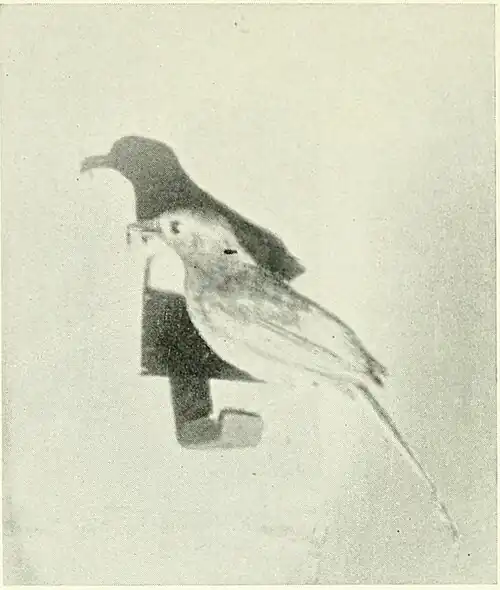

Shama and nest
Additional aviary Notes
1. THE SHAMA
A male and a female Shama were inmates of adjacent aviaries. They were kept separate because I found that in the non-breeding season the male refused to keep company with the female. In March 1923, noticing an amorous change in their attitude, I brought them together in the hope of raising a brood of young Shamas. The hen showed no fear of the male; on the contrary, in a few days she seemed to order the cock about. The latter had evidently lost all his imperiousness. But, however gentle he was to his mate, he was most overbearing towards strong-charactered and sturdy birds like the Dhayal. Chats also and even the gentle Dāmā—Orange-headed Ground Thrush—seemed to irritate him and had to be removed elsewhere. But smaller birds like the Finches were never molested. The male was a very jealous husband, and if he heard, or fancied he heard, the voice of another male Shama close by, he worked himself up into a great fury. A friend of mine took it into his head to whistle the Shama's love-notes when he came to my aviary. Whenever he did this, the cock Shama would at once stand up alert and give out his peculiar notes of anger—t'chat t'chat. As my friend continued, the anger of the bird increased. It puffed out all its feathers, furiously worked its tail up and down and peered around for the supposed rival. The first day my friend began the game, he was outside the aviary and noticed that the bird became very restless and flew about the aviary occasionally going to the female, as if, to protect her from the advances of the invisible lover. The next day he went into the aviary and the Shama was not long in finding out whence the notes proceeded. But the bird's uneasiness was not removed. It probably thought that my friend had a male Shama concealed somewhere on his person and flew up to very near him and stood in an attitude of defiance, calling as loudly as it could in order to outdo my friend. Not satisfied with wordy combats, it began to sweep down on my friend trying to peck at his head as it flew past. My friend had to throw up his hands to save himself from being scratched by the bird. At times he would extend his hand towards the bird which spent its fury on the fingers of my friend by pecking them with all its might.
But to return. When the hen was introduced into the aviary, the cock began to court her favour in right earnest. His song became loud and insistent. Besides the usual call-notes, he used to utter a very loud tremolo whistle with a sharp and sudden ending. This evidently used to excite sexual inclinations in the female; for these calls generally excited the latter very much. At the time of pairing, the male used to shoot down like an arrow from a high perch with such a call, and then uttering a short, sudden whistle, he sprang upon the hen. Among his coquetish displays, one of the attitudes was to drop suddenly down in front of the female (if she were on the ground) with a loud whistle. Then he would stretch out his head and gradually bend it till the chin and bill rested on the ground while the hinder parts went up, the tail being held straight uplifted. The hen would remain still all the while.
To afford them a suitable nesting site I nailed up in the wall a long piece of very fat bamboo with three holes in it, one above each joint. The male bird, after inspection, fixed upon the middle hole and invited the female to have a look at it. In a short time I noticed the latter carrying nest materials which consisted of fine cocoanut fibres. The upholstering of the cavity began on the 25th March and continued till the 30th. The hen Shama became so bold as to accept cocoanut fibres from my hand. If I gave a rough one, she would smooth and clean it by beating it on the ground. She would carry to the nest four or five fibres at a time and, after arranging them in the hole, invariably came back with one in her bill.
On the 31st the hen laid the first egg and on the 4th April she completed a clutch of five. I removed removed one and left her four to hatch. She alone incubated. The first egg was hatched out on the 14th and the rest by the 16th April. After this the behaviour of the female was most unmotherly. She beat one nestling to death and killed the others by dropping them from a height.
On April 22nd the hen began nest-building again. Strangely enough, she carried materials to three different holes in none of which a nest was completed. On the 27th I found two eggs in two different holes and another lying broken on the floor. I placed the eggs together but the next day, they were thrown out by the bird!
I gave the bird one more chance to raise a brood, as, even after the above two abortive attempts, the hen still seemed to possess a strong inclination for nesting. But, this time again, the eggs were destroyed as on the previous occasion. Thereupon I locked the female bird up in a cage. I had another hen which had come to me as a nestling. I introduced her to the cock bird's aviary on the 9th May.
This bird was able to rear up two young ones sucessfully. It was a better-behaved bird, sat on the eggs more closely and took greater care of its children. It laid twice,—the first clutch consisting of four and the second of three eggs. The first clutch began on the 13th May. One egg was destroyed. On the 27th the first young came out and two more followed the next day. One of these died and was removed from the nest by the mother. On the 8th June, the two surviving nestlings were completely feathered and the next day they left their nest. I confined them in a large cage with the mother-bird. On June 12th, the youngsters began to feed themselves, and I observed that thenceforth their mother occasionally fed them on egg-food and satoo. Before this date no artificial food was given. The hen used to show great care and discrimination in feeding the young. For the first two or three days after birth, the mother fed them only with ants' eggs. Then for a few days beetles, ants' grubs and a few grasshoppers were given. As the chicks grew older, ants' eggs were discarded and grasshoppers and beetles only composed their diet. Not until a fortnight after their birth did the mother give them prepared food.
From the 14th June, the youngsters began to emit t'chat t'chat sounds. At this time the cock began to court the hen again and the latter responded from within the cage. So, I let her loose with the children. On the 15th she began nest-building. The youngsters fed themselves but were still importunate. So, the cock used to feed them at times. The youngsters used to sit on a high perch crying for food. The cock used to fly up with a grasshopper and as there was no 
Shama feeding young

Shama nestlingPhoto by S. C. Law. room beside the young birds for him to sit, he thrust insects into the baby's mouth as he flew past. How deftly he did this!
On June 19th the hen began her second clutch. On July 3rd, one young appeared and two more on the next day. Unfortunately all the nestlings died for some unaccountable reason. This catastrophe marked a distinct change in the conduct of the female. Up till then she was bold and fearless, taking food from my hand. Now she suddenly became morose, retiring and shy, shunning human proximity. She also ignored all the amorous advances of the male and soon after began to moult.
Elsewhere I have noted that according to Mr. Reginald Phillips the incubation period of the Shama was twelve days. But I find that with my birds the period was fourteen days each time, neither more nor less.
2. THE DHAYAL
Two pairs of Dhayals in my aviary raised a brood each. The nestlings, unfortunately, did not live long. One of the pairs was lodged in the same room with the Shama and another in an adjoining room. The hen of the first pair was rather shy and, though the breeding season was on, showed no sign of taking advantage of the cock's restlessness to become a mother. But I noticed that the hen of the second pair in the adjoining room frequently flew up to the wire-netting separating the two compartments; and her behaviour clearly showed that she wanted the company of the first cock-bird more than that of the one with which she was lodged. Thinking they might pair up, I let this flirt into the first cock's room. It seems that a female bird occasionally declares her love to a cock and persists in it even though beaten and insulted. The cock seemed in no mood to respond to the advances made by the forward female and became more irascible. Fights with the Shama became very frequent, and so I moved the three Dhayals into the second compartment which now contained two pairs of these birds. This arrangement led to more unpleasantness. The two cocks frequently indulged in free fights with serious consequences to the original occupant of the room—the second cock. The first and sturdier cock, furious with jealousy, began also to chase both the hens. The second cock was therefore removed to a third compartment which adjoins the second one. The first cock showed his favour to the shy hen by displaying before her and singing at his loudest. But the hen held him in dread and always fled in terror whenever he approached. She was in evident danger of losing her life from extreme exhaustion. Therefore, I shut her up in a cage.
Her rival being thus confined, the other bolder hen now had the cock all to herself. The cock tried to handle her also roughly. But this wily bird stood the cock's browbeating admirably, eluded all attacks and even freely indulged in coquetry, whistling persistently all the while. As the cock evidently paid no head to her overtures I re-introduced the shy hen to see if she could shake off her fear. As soon as she was let loose, the cock flew towards her with a joyful whistle; but the hen fled in sheer funk and, after being pursued around the aviary, fell panting to the ground. I had no alternative now but to take her out of the room and try if she could pair with the other cock.
After her removal the first cock would frequently cling to the wire-netting separating him from the shy hen and burst into rapturous melody. This naturally provoked the wrath of the second cock which also would fly up to the wire-netting and sing defiantly; and the two spent their time in hurling loud abuses at each other. Whenever the first cock bird flew to the wire-netting, the bolder female would fly up to its side and whistle, as if to attract it away from its rival hen. At last the persistent attentions of the bolder female overcame the cock's dislike for her. The shy hen in the adjacent compartment responded, in the meantime, to the second cock's wooing and made up a good match. In a short while both pairs began to build nurseries for their coming offspring.
The first cock chose an aperture in the wall and began to enter it frequently on the 22nd April 1923. On the 3rd May the hen was noticed to follow suit. On the 14th she began to carry cocoanut fibres. A semi-circular wall of these fibres was built up around a corner of the selected aperture, leaving some space in the middle. The eggs were laid here on bare floor, no padding being used.
The cock used to indulge in frequent displays about this time. He would crane his neck forward and sing with all his might after swelling himself out. On the 13th June the hen laid the first egg. In the next two days she completed a clutch of three. I left her two eggs to hatch. On the 27th the first young came out and the other on the following day. The period of incubation was 14 days. Two days later one youngster disappeared and on the 2nd July the other was found in a decapitated condition on the floor.
The second pair chose a cavity in a bamboo pole similar to the one used by the Shamas. They merely padded the floor of the cavity with grass and a few cocoanut fibres and thereon laid the eggs. This pair began to build their nest on the 17th May. I used to look in occasionally for the eggs; but none were laid during the month. In June I could not inspect the nest in the first week and on the 8th I discovered three eggs. I removed one from this clutch also. The eggs of this clutch differed from those of the other in that the speckles were not sprinkled all over the surface but were concentrated in a zone at the thick end. The eggs were hatched out on the 16th and 17th June. But on the 19th I missed the young ones. I strongly suspect, though I have no actual ocular proof, that in both cases the male parents were responsible for the death and disappearance of the nestlings. On p. 32, I have already stated that cock Dhayals kill their own young. That the cock has carnivorous tastes was apparent from his conduct in my own aviary. A pair of Bulbuls (Molpastes leucotis) nested and raised two nestlings in the aviary in which the first pair of Dhayals was breeding. One day I noticed the cock Dhayal on the floor beating to death a Bulbul's nestling. The Dhayals are, therefore, not fit to be in a mixed aviary containing inoffensive birds; and, as the cock is an unnatural father, he should be segregated as soon as the young ones come out of the shells.
3. HAREWA
On p. 100 I have quoted a passage from the new edition of the Avi-fauna of British India (edited by Mr. Stuart Baker) in which it is stated that Gold-fronted Chloropsis (C. aurifrons aurifrons) becomes gregarious in the non-breeding season. But the male Harewa has been known to be a very sturdy little creature with an autocratic temper and never associates with others of his ilk (vide p. 104). According to Legge we find that females of C. Jerdoni collect in small flocks. Since the habits of closely related species are generally the same, I made bold to suggest the possibility of Mr. Baker having seen parties of female Harewas only. Since writing the chapter six months ago, I got half a dozen of these birds for my aviary and had ample opportunities to observe their habits on this point. I find that the males assume a stand-offiish attitude towards each other not only in the breeding season but in the off seasons for breeding as well. They are impatient of each other's company and can not be lodged together. But my four female Harewas associate together and live in the same aviary in admirable harmony. It is very likely that regarding gregariousness the habits of Jerdon's Chloropsis and the Gold-fronted one are similar viz., that the females only collect in small parties in the non-breeding season.
4. THE DĀMĀ
In describing the coloration of the female Orange-headed Ground Thrush in the Fauna of British India (Birds, Vol. II., p. 140), Oates writes, "the back and scapulars greenish brown with yellowish margins". I possess two pairs of Damas and I notice that the yellow to the margins of the back and scapulars is put on during the breeding season, and is not retained all through the year. The yellow splash, therefore, indicates breeding plumage.
In distinguishing males and females, the colour of the lower body does not seem to be the criterion, for I have found that the female of one pair has the chestnut colour deeper than the male. So, when buying these birds or choosing pairs reliance should not be placed on this point.
5. TICKELL'S OUZEL
I have two specimens of Merula unicolor. Up till last spring they were kept separately in different aviaries. But in June last I heard one of them attempting to sing. The attempt resulted in short and frequently-uttered whistles which were a mixture of guttural and sibilant sounds. Hoping that the season might not pass in vain, I brought the above two birds together. For the first few days, I noticed the male chasing the female about. The hen was evidently dallying with the male. In a short while there was no more pursuit and dodging; the birds lived together quite peacefully in evident harmony. For a long time I did not see them making any attempt at nesting. Late in July, on the 27th, I saw the female perched on the top of a long bamboo-pole. Entering the aviary, I went up to the pole but the bird did not move. Curious to to see what made the erstwhile shy bird so indifferent to my proximity, I brought a ladder and placing it against the pole, climbed up to discover the bird sitting in a beautiful nest. The top of the fat pole had a slight depression in the middle. Around this depression the bird had created a wall of soft grass and the cavity had been upholstered with very fine coir-fibres. That very day the two birds mated in my presence. The restless male was in evident heat. It was following the female everywhere. They were first on the ground. The hen suddenly flew up to the nest. The male came up to her with a loud note and perched on the edge of the nest. The female moved off and flew on to the top of a hanging cage. The male followed her there with a strange guttural sound and, with mouth agape, attempted to pair. The female however, slipped down to the ground. The cock followed and, alighting at a little distance, made a quick run towards the hen. When close up to her side the cock opened his mouth again and I heard a distinctly audible sound, such as that mentioned above, issuing from his throat. In a second they mated. Next day I found an egg in their nest. The hen laid three eggs consecutively and sat very close. During this period I noticed a change in the conduct of these extremely shy birds. They became quite bold and fearless. If I climbed up to inspect the nest, the female bird would not stir till I was actually upon it. On its leaving the nest, the cock would fly up and sit in front of my nose and make a noise. Though not actually aggressive towards other birds they jealously guarded their nest at this time from intrusion. For over a fortnight the hen sat on the eggs but unfortunately these proved to be clear.
As in the case of the Shama, the female Ouzel alone built the nest and took part in incubation. The cock, though not obsequiously attentive, kept watch over the nursery and, whenever the hen was away, he went up close to the nest and sometimes perched on its edge. But I never found him brooding on the eggs.