Page:The music of Bohemia.djvu/43
This page has been validated.
THE MUSIC OF BOHEMIA
29
![\new PianoStaff << \override Score.TimeSignature #'stencil = ##f
\new Staff {
\key e \major
\relative c' {
<< {
\autoBeamOff
<gis gis'>8[ <b' b'>8^^] <a a'>8^^[ <fisis fisis'>8^^] |
\tuplet 3/2 { <eis eis'>8^>[ <dis dis'>^> <cis cis'>^>] }
<b b'>8.^>[ <a a'>16^>] | <a a'>2
} \\ {
r16 <cis e>16 s4. | s2 | r16\( <bis dis fis>16\)[ <bis dis fis>16]
} >>
} }
\new Staff {
\clef bass \key e \major \time 2/4
\relative c' { gis,,8_> r8^\f <gis'' e'>8^^ r8 | r4 r8. gis,,16_. | gis8 r8 s4} }
>>](../_assets_/2c19452f88484be4af947dcfe5b2d338/jfll6hq9.png)
As a composer for the piano Smetana left a considerable number of works, especially Polkas, which he idealized in a very poetic form. His Polka No. 1, op. 7, was one of Liszt's favorites; the subject of this dance will not be thought devoid of interest in this place:
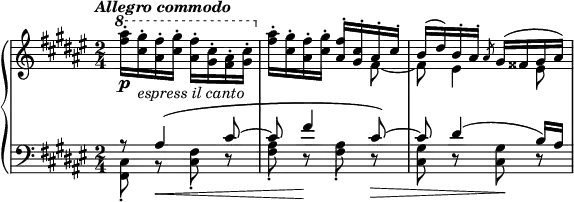
Two cycles of piano compositions, of which the first bears the title Rêves, and the other The Bohemian Dances, especially deserve the attention of the pianist. In this later work the