Page:The Strand Magazine (Volume 6).djvu/90
table and examined the little statuette more closely. Edmund Yates looked up.
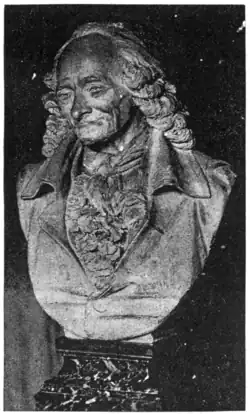
Voltaire.
From a Bust by Carrier Belleuse.
"The finest of all novelists," he said, earnestly. "I am an immense worshipper of him, and read him over and over again, and yet again. A wit—an epigrammatist of the first water. I was talking to him once about a matter, and the name of a gentleman cropped up—very well known in his day, but now dead. 'I never saw him,' I said; 'I believe he wrote a book called "Biscuits and Grog."' 'Oh yes,' he replied; he did. Clever fellow—remarkably clever fellow! Pity he's so fond of—biscuits!'
"How well he sang—I can hear him now. How he delighted to listen to Morgan John O'Connell, a nephew of the Liberator, giving 'The Shannon Shore.'"
We were talking of William Makepeace Thackeray.
Mr. Edmund Yates has given in his biography a very complete account of the following remarkable incident, which was unquestionably a crisis in his career, but, as he crossed to the table and opening a drawer brought forth a small six-sheet paper, yellow with age, he quietly turned to page 64 and asked me to read what appeared under the heading of "Literary Talk." This is the article which appeared in Town Talk, Vol. I., No. 6, June 12, 1858:—
Literary Talk.
Finding that our pen-and-ink portrait of Mr. Charles Dickens has been much talked about and extensively quoted, we purpose giving, each week, a sketch of some literary celebrity. This week our subject is
Mr. W. M. Thackaray.
HIS APPEARANCE.
Mr. Thackeray is forty-six years old, though from the silvery whiteness of his hair he appears somewhat older. He is very tall, standing upwards of six feet two inches, and as he walks erect his height makes him conspicuous in every assembly. His face is bloodless, and not particularly expressive, but remarkable for the fracture of the bridge of the nose, the result of an accident in youth. He wears a small grey whisker, but otherwise is clean shaven. No one meeting him could fail to recognise in him a gentleman; his bearing is cold and uninviting, his style of conversation either openly cynical, or affectedly good-natured and benevolent; his bonhomie is forced, his wit biting, his pride easily touched—but his appearance is invariably that of the cool, suave, well-bred gentleman, who, whatever may be rankling within, suffers no surface display of his emotion.
HIS CAREER.
For many years Mr. Thackeray, though a prolific writer, and holding constant literary employment, was unknown by name to the great bulk of the public. To Fraser's Magazine he was a regular contributor, and very shortly after the commencement of Punch, he joined Mr. Mark Lemon's staff. In the Punch pages appeared many of his wisest, most thoughtful and wittiest essays; "Mr. Brown's Letters to His Nephew" on love, marriage, friendship, choice of a club, etc., contain an amount of worldly wisdom which, independently of the amusement to be obtained from them, render them really valuable reading to young men beginning life. The "Book of Snobs," equally perfect in its way, also originally appeared in Punch. Here, too, were published his buffooneries, his "Ballads of Policeman X," his "Jeames's Diary," and some other scraps, the mere form of which consisted in outrages on orthography, and of which he is now deservedly ashamed. It was with the publication of the third or fourth number of Vanity Fair that Mr. Thackeray began to dawn upon the reading public as a great genius. The greatest work, which, with perhaps the exception of "The Newcomes," is the most perfect literary dissection of the human heart, done with the cleverest and most unsparing hand, had been offered to and rejected by several of the first publishers in London. But the public saw and recognised its value; the great guns of literature, the Quarterly and the Edinburgh, boomed forth their praises, the light tirailleurs in the monthly and weekly Press re-echoed the feux-de-joie, and the novelist's success was made. "Pendennis" followed, and was equally valued by the literary world, but scarcely so popular with the public. Then came "Esmond," which fell almost still-born from the Press; and then "The Newcomes," perhaps the best of all. "The Virginians," now publishing, though admirably written, lacks interest of plot, and is proportionately unsuccessful.
HIS SUCCESS,