Page:The Strand Magazine (Volume 6).djvu/619
mand can be heard; punctually they are obeyed; the sealer steers quietly his way out into the sea. He is accustomed to such a turmoil, and he knows that the world will still last a while.
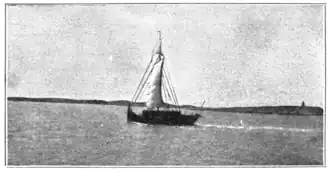
A MODERN VIKING-SHIP OF NORWAY PASSING THE "FRAM."
But there is not only storm in the Polar Sea; indeed, it can be just as mild and peaceful there as a day in spring at home, with bright sunshine and glittering snow. When you come some distance into the ice it is so as a rule, and that which most often comes before my memory when I think of the Polar regions is not the storms, not the hardships, but this strange peace, so far from the vortex of the world, when from the bright blue sky the sun is pouring its flood of light over the white, snow-covered ice, outward and outward to the horizon. It glitters in the snow and sparkles in the deep blue water; it gleams and glitters every where around, while cold blue tints are reflected from the sides of the floes, and border them with all tints of blue and green, clear as the clearest crystal, far down into the cold, transparent water. And in the sunshine the seals are lying in thousands and thousands on the floes, enjoying life. Some of them sleep, others are busy with their toilette, and prune and scratch themselves; others again are playing, whilst some are in the water and dive up and down, and the sun is shining on their wet heads. The whole is a picture of the most perfect, charming peace, and the memory never wearies of recalling it to view.
But when you penetrate further into ice, and further northward, the open water gradually disappears, and the sea is totally covered by immense drifting ice-floes; the whole world becomes one field of white, snow-covered ice; only now and then between the floes a narrow strip of dark water can be seen. Soon all life also disappears; no seals any longer, such as those keep near open water, neither any birds: the only animal which you may perhaps meet is a single, lonely Polar bear, but soon he also disappears, and there is nothing left except yourself and the endless ice in constant drift across the sea towards the south, towards warmth and sun, where it is soon destroyed. So extends the Polar Sea northward and northward to the Pole.
In the summer the sun is shining all day and night, and circulates round and round in the sky, and never disappears until the autumn comes; but then begins the long, dark winter night, which at the Pole itself lasts six months. Then the stars are constantly shining over the desolate snow-fields. When the moon comes it circulates round the sky and shines day and night until it disappears again. But sometimes the Northern Lights begin their play, this great mystery of the north; then there comes life; it scintillates and burns; sparkling lights and rays are running to and fro over the whole sky, until they disappear again, leaving the scene quiet and desolate as before.
In this dead, frozen world is it that the Polar explorer has to live. There he roams with sledge and dogs in summer, and from thence he sends longing thoughts in the dark winter night southward to the dear ones at home, over whom the same stars are twinkling in their cold peace.
