Page:The Strand Magazine (Volume 6).djvu/618
kinds, perhaps more than we wish for; but it is to explore that we go out, and there is no exploration to be made without sufferings, as well as no victory without a risk.
On the 24th of June we started on our expedition from Christiania, and sailed northward along the beautiful Norwegian coast. Everywhere people came from the most distant places in order to see the strange ship and her crew. Whenever we stopped in some little place the deck was at once crowded with people who wanted to see everything. On the 21st of July we left Vardö, our last harbour in Norway, and now we are sailing eastward across the Barents Sea.
Within a few days we shall enter the ice and shall get the first cold embrace of the ice-world which is going to be our home for years hence, and from which no tidings will reach the dear ones at home, when first entered. To give those who have not seen this world of ice an idea of what it looks like is not easy, as it is so different from anything else. It is a strange thing with this region, that when you are there, you think it sometimes monotonous perhaps; but when you are away from it, you long to get back again to its white, vast solitude.
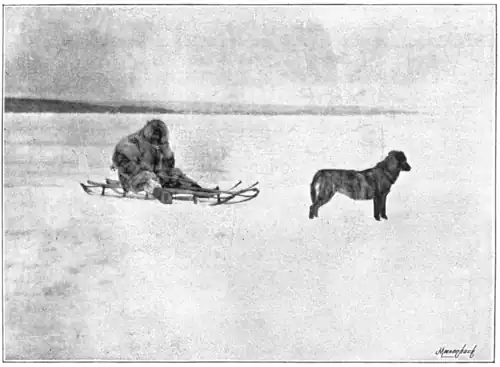
DR. NANSEN PREPARING FOR DRIVE IN DOG SLEDGE.
(Eight or ten dogs have to be harnessed to this sledge.)
When you approach the ice-fields of the Polar Sea you hear them far off by the noise of the breakers against the floes; it sounds like the strange roar of a distant earthquake or thunderstorm. Over the horizon to the north you will also see a strange light: this is the white reflection which the ice throws on the sky above. When you sail on you will after a while begin to meet the white floes riding on the dark water. It is along the margin of this ice that the sealer hunts for the seal; between these tremendous floes he forces his way with his strong ship to his prey. But many a hard struggle he has to fight here when the elements are in tumult. Nothing more foaming wild than a tempest in the winter-night in the north can easily be imagined. When the storm whistles over sea and ice, lashes snow and foam in your face, and seizes you so that you cannot stand on deck; when the waves rise into huge water-mountains, between which the ship disappears, and is all in foam; when sea and ice meet, and the waves rise like towers and break in over the floes like greenish-yellow waterfalls, and the huge floes are thrown against each other and crushed into dust, while the water foams and ice-blocks are thrown high against the dark sky—then it may happen that you will feel the wild horror of the Polar Sea. No stars, no Northern Lights, no light of any kind over this furious uproar. Heavy storm-charged clouds fly across the sky; all around you is blackness and darkness, noise and tumult. It is the wild demons of Nature in fight. It thunders and roars, it hisses and whistles in every direction—it is Ragnarök which is coming; the world is shaking to its foundations.
But in the middle of this wild fight of the sea and the demons, between these tower-like waves, a small, frail work of man is riding, a ship with living men on board. Woe to them if they now make a single mistake; woe to them if they come too near one of these floes or put the ship's bow between them at the moment they strike together: in the next instant they will be crushed and disappear! But through the noise words of com-