Page:The Strand Magazine (Volume 6).djvu/610
shores of Spitzbergen and Greenland; it comes in such abundance, and with such regularity, that it is quite impossible that it should be carried to these shores, so far from the original home, by occasional winds or currents. There must be a regular communication between the coasts of Siberia and those of Spitzbergen and Greenland. By this same communication were several objects from the unfortunate Jeannette carried to the Greenland coast. The Jeannette sank in June, 1881, to the north of the New Siberian Islands, and three years afterwards, in June, 1884, a great many objects belonging to her or her crew were found on an ice-floe on the south-west coast of Greenland. This floe can only have been brought there by the same current which carries the driftwood. By this same current an Eskimo implement, a throwing-stick or harpoon-thrower, was also carried the long way from Alaska to the west coast of Greenland. There can, in my opinion, be no doubt of the existence of such a communication or current across the North Polar region from the Siberian side to the Greenland side.
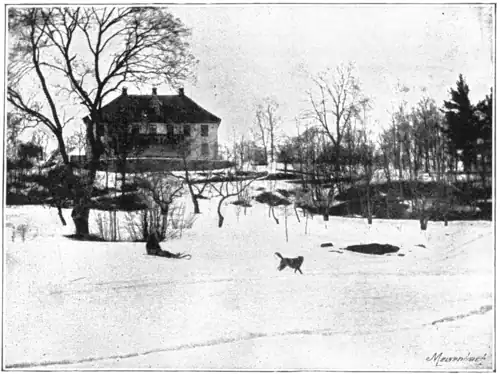
Dr. Nansen's House.
My intention is now to make use of this communication, which Nature herself has established. I shall try to find the place where the heart of this current has its origin, and shall go north there until I am beset in the Polar ice, and then simply let the current have its way, and let it carry us across the unknown region and out into the open sea again on this side of the Pole.
This is the basis upon which I am acting. In order to be able to lead a relatively comfortable life during the ice-drift, the first thing of importance is to get a good and strong ship especially adapted to withstand the pressure of the ice-floes when they are pressed together by the currents and the heavy gales of the Arctic Sea. Such a ship cannot be had ready-made, and I had to build the Fram, in which we are now steering into the unknown North. It took me two years to get her ready, but I believe the result is good. She is an unusually strong ship; the frame timbers are made of hard Italian oak, are 10in. to 12in. thick, and are placed close together. Inside them is the ceiling, consisting of pitch-pine planks, alternately 4in. and 8in. in thickness. Outside the frame timbers is the planking, consisting of three skins; first a 3in. oak skin, over which is another of 4in., and finally an outer planking, or "ice-sheeting," of greenheart, which increases in thickness from the keel towards the water-line from 3in. to 6in. Greenheart is a very hard, strong, and slippery wood, but also very heavy, as it sinks in water. The whole thickness of the sides of the Fram is thus 28in. to 32in.: a solid mass of pitch-pine, oak, and greenheart, with a little pitch in between to make it watertight.
A ship's side of these dimensions and material will alone have a great power of resistance to the pressure of the ice. But this power is to a very essential degree increased by the many beams, stays, and strengthenings of every kind placed inside the vessel. These are so carefully arranged and united to each other that the whole is like one coherent mass, and the ship may almost be considered as if built of solid wood. But even if this had been the case, she would not be strong enough to resist the ice if she had not got a suitable shape, as the ice is able to crush anything which it gets a firm hold of with its cold, irresistible grasp.