Page:The Strand Magazine (Volume 6).djvu/207
rooms find themselves as pleasantly and as sumptuously housed as they would be in the best hotels of either continent.
The Majestic and the Teutonic belong to the Naval Reserve of Great Britain, and in the event of war both these magnificent vessels would undoubtedly render inestimable services to the Government. The circumstances under which these twin steamships became included in the British Navy are simple enough.
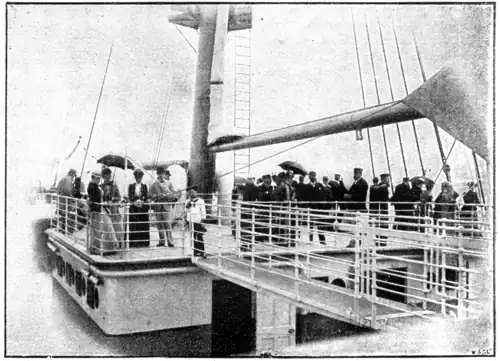
Deck View—Forward.
From a Photograph.
Mr. Ismay, founder and chairman of the White Star Line, having been long convinced of the necessity of applying Napoleon's theory of army supplies to our diffusive commerce, eventually submitted his views to the Government, offering to realize the practical demonstration of the idea with two ocean steamers to be constructed nearly on the same lines as the Teutonic and Majestic. Though the offer was at first declined, the Admiralty was induced some years later to reconsider it, and ultimately Mr. Ismay's proposition was accepted. The Teutonic was then constructed without delay, and the Majestic, her sister ship, similar in every respect, was built a few months later.
The value of these vessels as troopships will be readily understood from the following facts. The Teutonic or the Majestic could provide accommodation for one thousand cavalry or two thousand infantry, and could, if required, reach Canada in five days, or Cape Town in twelve and a half days. Through the Suez Canal, they could land troops at Bombay in fourteen days, at Calcutta in seventeen and a half days, at Hong Kong in twenty-one and a half days, and at Sydney in twenty-two days.
The coal supply of either ship is sufficient for seventeen days' steaming at full speed, or for three months' cruising at half speed. The immense amount of attention which the Teutonic received from all classes of experts during the Naval Inspection in 1889 sufficiently establishes her great importance. The German Emperor, well informed as to what deserved examination, devoted himself principally to the Teutonic, of all the powerful war vessels then assembled in the Solent. She was at that time commanded by Captain Henry Parsell, himself an officer of the Royal Navy on the reserve list, and now in command of the Majestic, the flag-ship of the White Star Line. Captain Parsell is as good a specimen of the British sailor as one would wish to meet. That his ship is managed with an eye to the strict performance of his duty to his owners, and at the same time with every regard to the comfort and enjoyment of all who intrust themselves to his care, many hundreds who have had the good fortune to cross the Atlantic under his vigilant charge and agreeable companionship will eagerly testify.
In fact, Captain Parsell is one of the most popular sea officers afloat, and whether on the bridge of his ship, or amongst the passengers in the saloon, he is distinctly the right man in the right place. I should not, however, advise anyone taking passage in the Majestic to ask Captain Parsell superfluous questions, a sample list of which was thoughtfully supplied to me, probably with the benevolent view of maintaining cordial relations between the worthy captain and myself during the voyage. I quote a few of these doubtful queries, with a view to placing such of my readers as intend to cross