Page:The Strand Magazine (Volume 6).djvu/201
"Un faux pas! He has rather led you into one. But, silence, miss! I am not going to receive lessons, above all lessons in memory, from a silly girl who forgets her purse."
M. Chapoulot has taken his hat, and looks even more enraged than ever.
The old servant comes back. "A cabman is at the door, but he will only agree to a single journey."
"Oh! that will do. I can easily find another to return."
And M. Chapoulot goes out in furious haste, while Charlotte timidly confides to the sympathizing servant that she knows even more of the young man than she has dared to say. For a month past he has regularly travelled in the same omnibus, and she has noticed that he has noticed, etc., etc.
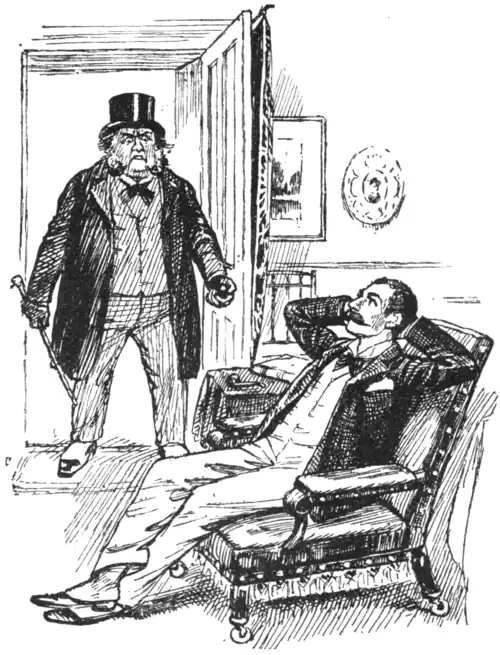
"Monsieur! Your conduct is scandalous."
Agénor, in his bachelor apartment, sits thinking over his experience of the evening, and vowing he will not wash until the morning the hand that had been touched by the dainty fingers of Charlotte when she received the card.
Suddenly a sharp rap at the door, a violent opening, and a stout gentleman, out of breath, his hat upon his ears and cane in hand, breaks in upon his dreaming.
"Monsieur!" exclaims the invader, "your conduct is scandalous. You are not worthy the name of a French gentleman. An honest man would never take advantage of the embarrassment and inexperience of a young lady. To profit by the absence of a father and a purse, to offer your money—and your card into the bargain—to an unprotected girl, it may be a good investment, but it is a bad action. I have brought you your six sous again, and would have you to know, sir, that, as for my daughter and myself, we wish to have nothing to do with you."
And the stout gentleman, trembling with his vehemence, puts his hand into his pocket to get the money, when, before Agénor has time even to recover from his bewilderment, a new actor enters upon the scene. It is the cabman, all furious, with an oath upon his lips, and brandishing his whip in a threatening manner.
"Eh! you! What do you mean? You engage me for a single journey. I tell you I cannot stay. You even order me to hurry. And then you jump from my cab like a madman, and rush in here without a word. None of that for me. I have only one thing to ask. Pay me my money quickly, or ———" And the whip goes round again or more emphatically than before.
Agénor understands nothing of it. But the stout gentleman, who has searched vigorously in all his pockets, becomes suddenly pale, then red, then redder still, then a crimson, then violet. He is silent in stupefaction a minute, and then, in answer to a more vigorous demand from the cabman, he manages to falter:—
"I have—forgotten—my—purse!"
"Oh, yes! I know," cries the enraged cocher. "I have seen that dodge before. You needn't try it on with me. Come along! you shall tell your tale at the police-office." And he begins to drag away by the shoulders the unfortunate Chapoulot, who is ready to fall into an apoplectic fit. But Agénor, a true providence for the family, draws from his pocket the necessary sum, and dismisses the driver.
"You will allow me, sir," he says to M. Chapoulot, who, all at once understanding that it is possible to forgets one's purse, and that of all friends a friend in need is one indeed, can only reply with a smile:—
"Monsieur—M. Baluchet, I believe—thirty centimes for the omnibus and one