Page:The Strand Magazine (Volume 6).djvu/19
being arranged round three sides of the room; these being fully set before the guests come in. Very beautiful is the effect; the costly and matchless plate, the glass, flowers, and china having an appearance simply indescribable. In the midst of all is the beautiful fountain designed by H.R.H. the Prince Consort; a piece of plate of such magnificence and artistic beauty, that it is worth a special journey to the Palace to see it.
I may here say that every dish that is put on is prepared in the Royal kitchens—fine apartments these, which I shall not be able to describe to you for want of space. There are two sets of doors into the room, each opening from the Promenade Gallery, and enter by which you may, you are confronted by the most magnificent display of plate in Europe. This is kept at Windsor, and brought here for special occasions; then mounted on three immense buffets, facing the doors, one in the centre and one at each corner. When I say that its beauty dazzles and bewilders, I only very faintly convey to your minds the real effect. To-day, being a "Drawing Room," it is not en évidence, so I cannot do more than point out to you its location when present, and give the faintest description of it as I have seen it on the occasion of a "State Concert."
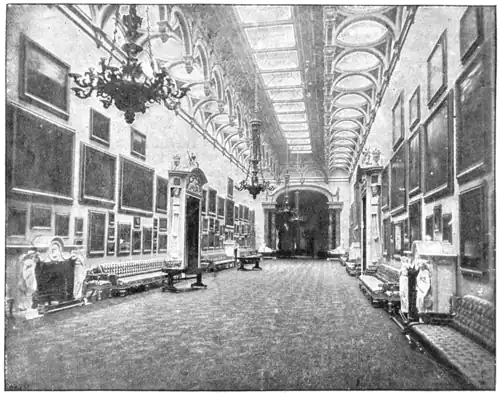
The Picture Gallery.
From a Photo. by H. W. King.
Now we will recross the Promenade, and so enter the "Wilkie" Room: so named from the number of works of that master hung there. From here we can walk direct into the "Picture Gallery." You have already crossed the top of this, but had not time for other than a brief glance. Here a lover of art could very easily spend an entire day, so beauteous and so varied are the studies. Suffice it to say that there are some of the finest examples of Flemish and Dutch, Italian and English masters. George IV really founded the collection, purchasing a large number from Sir J. Baring, and Queen Victoria has increased the number to a considerable extent. Some good examples of Titian, 1477-1576, must be mentioned; of Teniers, 1610-1690; of Rembrandt, 1607-1669 (the "Adoration of the Magi" needs no words); of Peter Paul Rubens, 1577-1640; of Sir Joshua Reynolds, 1723-1792; of Van Dyck, 1599-1641; of Cornelis Janssens, 1590-1665, and many others which cannot now be noticed.
In order to secure a good light, the roof has a treble range of skylights, having a