Page:The Strand Magazine (Volume 6).djvu/18
tions of trophies emblematical of the Army; the fire-dogs are ormolu dragons. On the mantels you will see some Sèvres in turquoise blue, and other specimens of a variety of painting in colours.
Opposite notice a fine clock, by Pinchbeck; it is of tortoiseshell, having columns surmounted by a dome. It has four dials—time, day and date, wind and tide, and an astronomical dial.
The curtains are of crimson silk, edged with gold lace, the furniture to match; but as people do not go to the Throne Room to sit as a general rule, the furniture is a small item. The floor is carpeted with Brussels. I believe Her Majesty prefers this make, as, though Axminster and velvet-pile look uncommonly effective and rich, yet there is a sort of rotary motion when walking upon them that is a deal more tiring than when it is of a firm texture. Chandeliers and candelabra diffuse electric and candle light, throwing a brilliant radiance around, bringing the rich colours into relief, and lighting up the painted portraiture consisting of Queen Charlotte and George III., both by Ramsay; Charlotte Princess Royal, and William Duke of Clarence. George Prince of Wales, and Frederick Duke of York, both by Zoffany.
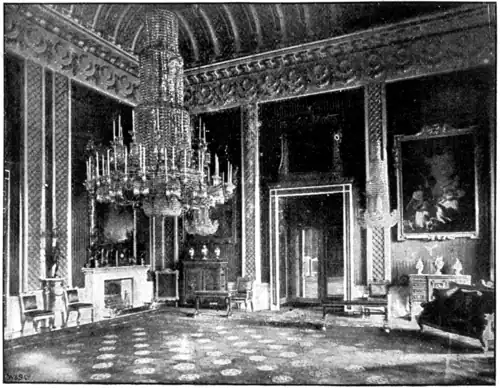
The Green Drawing-Room.
From a Photo. by H. W. King.
Passing through the handsome doors facing the Throne, we enter the "Green Drawing Room," not quite so large a room as the former, but only a little decrease in the length. Here you see every shade of the colour from which the room takes its name, the whole relieved with borders of burnish and gilt, together with mounts of ormolu. This room is used on ball and concert nights for light refreshments, such as tea and coffee, fruit and champagne. The roof is decorated in white and gold, the walls panelled in striped green silk in frames of gold. This apartment is carpeted in Axminster with a parquetry border of satin and rose wood, the furniture green and gold to match.
There are several good portraits of members of the Royal Families of former reigns, also of the children of Philip II. of Spain; the artists being Gainsborough, Ramsay, Wright, Copley, and Dance. Now pass through these handsome doors, and you are in the "Guard Chamber." Before looking at anything here, though, turn round for one moment, and you will find that from here you have a clear view of the Throne; consequently, those immediately near the Throne have a clear view of you: not only that, but you can be seen when you first come in, for as you mount the staircase, which you can view now by crossing the room, you find plate glass reflects a back view of each of you—so, as a matter of fact, Her Majesty can watch you, if she chooses to do so, long before you are in the presence.
There are two or three other rooms of interest, but in order to see them we had better descend to the landing where the "double exit" terminates; then turn round, and go up the same staircase as when we first commenced the "Upper State Rooms." By this means, if you remember, we arrived first in the Promenade Gallery.
We now take a door on the left of that, and are at once in the "Supper Room." This is of splendid proportions, very lofty, and sixty feet square. There are immense sideboards of mahogany and ormolu, the supper-tables