Page:The Strand Magazine (Volume 6).djvu/11
too, the exquisite light and shade, and I think you will agree with me that nothing more perfect of its kind could be seen.
The wells of the staircase contain bronzes, replete with iced glass fittings for electric light; while for concert and ball occasions the recesses you see on either side of the hand-rails are filled with zinc fittings, to carry palms, ferns, and choice exotics.
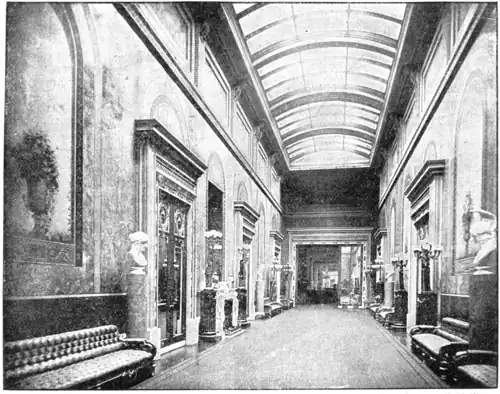
The Promenade Gallery.
From a Photo. by H. W. King.
The photo. here introduced was taken on the occasion of a State ball, and is particularly happy in effect. When we have proceeded up the first broad flight, we find ourselves on a landing, from which stairs diverge in exactly opposite directions, with a flight facing us. We take this one, and mounting upwards, find ourselves in the "East" or "Promenade Gallery." A splendid place for promenade this—about 105ft. in length, lighted by electricity, richly carpeted in crimson, and provided with luxurious settees and chairs. The ceiling is beautifully painted, the walls are imitation marble, having painted panels of baskets of flowers. Costly marble chimney-pieces have medallions of the masters in the centre (in one I noticed Rubens) and a continuation of figures, flowers, etc.
On the mantels is some priceless porcelain, most of it Sèvres. Ancient cabinets of tortoiseshell, buhl, and inlaid ivory—one of them, at any rate, a "Boule" (whose best work was executed about 1700). Pedestals and busts, mythological and French, all call for prolonged examination. Here hangs Frith's famous picture of the marriage of the Prince of Wales. Sometimes you may miss it, though, for this is one the public like the loan of, and not long ago it journeyed to Melbourne and back, for the benefit of our Australian friends.
Sir F. Leighton is also represented by his "Cimabue's Madonna Carried Through the Streets of Florence," and Sir M. A. Shee with his portrait of the first Marquis of Wellesley. The doors leading from this gallery are worthy of notice. They are a pair of three-fold folding doors, each one inclosed within revolving doors, so that they really open nearly the width of the promenade. They have massive plate-glass panels, with Spanish mahogany frames and metal mounts. Through these doors, then, we enter the State ball-room—also doing duty as a concert-room. This was only finished in 1856, and cost £300,000. Most of the decoration was by Gruner. It is a truly noble apartment, measuring 109ft. by 58ft.