Page:The Strand Magazine (Volume 5).djvu/639
"Ah, that sort of mark's no use—unless you make it in Company," said the Genius.
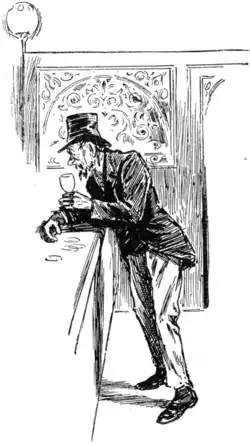
"Haven't got your head above water, I see?"
One day, as young Bansted Downs sat in his cistern-cupboard biting his nails, a step was heard on the stair, and his late instructor entered.
"I've been all wrong," he said, sitting down on the cistern. "I put you all wrong—I've put all my pupils all wrong. I fell down stairs lately and knocked my head, and when I got up I saw everything—the light broke in upon me!"
"Why, you've cut your hair, and you're dressed quite neatly—I should hardly have known you for a Master Genius at all!" exclaimed young Bansted Downs.
"I am no longer a Genius—I am now the M.W.K.A.A.I.—the Man Who Knows All About It. I now know why genius fails to get the Ear of the Public, and is not appreciated"
"Fault of the public—everybody knew that before," growled young Bansted Downs.
"Pardon me, it is not the fault of the poor public, but the fault of the system. We—the entertainers—have made the have made the mistake of being geniuses; whereas we had no business to meddle with genius at all.
"It is the public who ought to have the genius; they should have the lively appreciation, the keen sense of humour, the afflatus, and all that; and then those who cater for them would not need to trouble about those things—they would only have to cater, and leave the public to perceive, by means of their genius, the excellences of the fare provided. If a plain person does something, and geniuses perceive greatness in it, that's a right state of affairs; but if a genius does something great, and plain persons fail to appreciate it, that's a wrong state of things, and a waste of material—see?"
"And what do you propose to do?" asked young Bansted Downs.
"That's very simple—just make geniuses of the public. Of course the public, having their own affairs to attend to, will not wish to turn caterers and originate—their province is to appreciate, perceive, applaud, and pay at the doors—see? By this system any dullard is enabled, without effort, fatigue, or preliminary study, to Make his Mark and get his F.I., his E.P., and his H.A.W. A child could use it."
"But," objected young Bansted Downs, "under your system, dullardism paying so well, everybody would want to cater for the public, and there wouldn't be any audience—any public."
"Pooh! The system at present in vogue is all I require is all I require—compulsory education. Everybody will have to be educated as a genius, except a few who will be specially exempted from attendance at the Board schools to enable them to lie fallow and fit themselves for originators.
"Of course, you may say that it would not be necessary for the entertainer to be dull. Of course it would not; but, as it is not necessary for him to be a genius either, there would be a waste of public money in educating him as one. In fact, it might be a disadvantage for both originator and appreciator to be geniuses, and their conceptions might clash and create confusion. It's better for a conception to be lighted from one side only, as you get more contrast."
"But would not the genius of the spectator simply perceive the dulness of the originator?
"Not in the least. It's just the sphere of genius to perceive, in a given production, excellences which the ordinary observer fails to detect; and it's only a question of degree of genius. I take it that perfect genius can de-