Page:The Strand Magazine (Volume 5).djvu/547
By W. Cade Gall.
 N elderly gentleman of our acquaintance, whose reading has been rather desultory than profound, and tending rather to the quaint and speculative, was astonished recently at coming across a volume in his library of whose very existence he had been completely unaware. This volume was oblong in shape, was bound in mauve morocco, and was called "Past Dictates of Fashion; by Cromwell Q. Snyder, Vestamentorum Doctor."
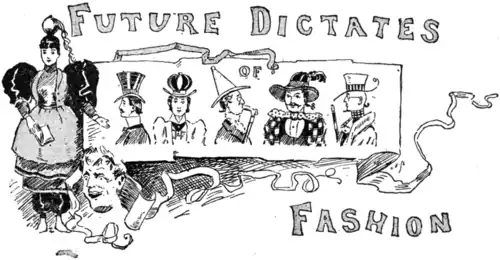
Glancing his eye downwards past a somewhat flippant sub-title, the elderly gentleman came, with intense amazement, to understand that the date of this singular performance was 1993. Other persons at a similar juncture would have pinched themselves to see if they were awake, or have tossed the book into the street as an uncanny thing. But our elderly gentleman being of an inquisitive and acquisitive turn of mind, despite his quaintness, recognised the fact that if he was not of the twentieth century the volume obviously was; seized pen and paper, and began to make notes with the speed of lightning. Being also something of a draughtsman he was able to embellish his notes with sketches from the engravings with which "Past Dictates of Fashion" was copiously furnished. These sketches appear with the present article.
Fashion in dress, according according to the twentieth century author, notwithstanding its apparent caprice, has always been governed by immutable laws. But these laws were not recognised in the benighted epoch in which we happen to live at present. On the contrary, Fashion is thought a whim, a sort of shuttlecock for the weak-minded of both sexes to make rise and fall, bound and rebound with the battledore called—social influence. But it will interest a great many people to learn that Fashion assumed the dignity of a science in 1940. Ten years later it was taken up by the University of Dublin. By the science as taught by the various Universities later on were explained those points in the history, manners, and literature of our own ancestors which were formerly obscure and, in fact, unknown. They were also, by certain strict rules, enabled to foretell the attire of posterity. Here is a curious passage from the introductory chapter to the book:—
"Cigars went out of fashion twenty years ago. Men and women consumed so much tobacco that their healths were endangered. The laws of Nature were powerless to cope with the evil. Not so the laws of Fashion, which at once abated it. It will, however, return in thirty-one years. In 1790 Nature commanded men to bathe. They laughed at Nature. In 1810 Fashion did the same thing. Men complied, and daily cold baths became established. In 1900 it was pushed to extremes. The ultra-sect cut holes in the ice and plunged into the water. The fashion changed. For forty years only cads bathed."
The following table is also interesting, and should be borne in mind in considering the