Page:The Strand Magazine (Volume 5).djvu/515
of such Japanese handicraft in miniature in the kingdom. There is everything in ivory, from a beggar with his rosary to a beauty with painted cheeks and almond-shaped eyes. You may handle the quaintest of ideas carried out in ivory; a skeleton carrying a baboon—calculated to beat Holbein's "Dance of Death" all to pieces; skulls with cobras intertwined—indeed, the serpent is everywhere; and all with some mystic meaning.
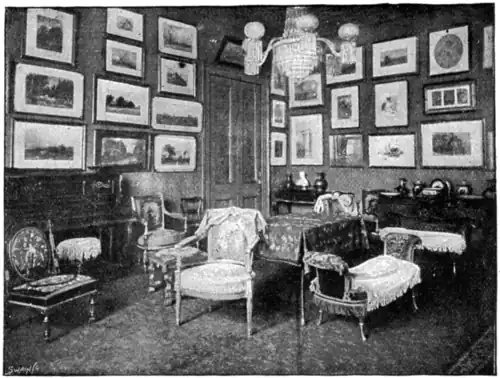
The Drawing-Room.
From a Photo. by Elliott & Fry.
"The date of the workmanship of these,' said Sir Robert, "must go back for centuries."
"I should think to the very beginning!" Lady Rawlinson remarked. And amongst these curios are rare jade bowls of white and green, and shining in the midst of all—as big and almost as brilliant as the noonday sun—is the largest ball of pure rock crystal in Europe. An exquisitely carved rhinoceros horn in the shape of a goblet might possibly come in useful, for the legend associated with it runs that should poison be put in it, and some unkind friend request you to drink, the deadly liquor would disappear of its own accord.

The Drawing-Room.
From a Photo. by Elliott & Fry.
We looked in at the small library, and then went into the dining room. As in the drawing-room, the walls are hidden from view by artistic works—Landseer, Frith, Phil Morris, Müller, Ansdell, Ansdell and Phillip, Hefner, Weiser, Creswick, Sant, John Wilson, Junr., Solomon, and Henry O'Neil—the latter artist's "Return of the Wanderer" being in a conspicuous position. As Sir Robert points them out, he seems to see an unwritten story on every canvas. He singles out the Müller as his greatest treasure, for it was the last and possibly the best work the artist ever chronicled with his brush, and he died eight days after its completion.
Pointing to the first study of Frith's "Dolly