Page:The Strand Magazine (Volume 5).djvu/511
The holly-bushes look delightfully green from the study windows. Here is a fine bust of Her Majesty, by Noble, and a statuette of Miss Florence Nightingale, with whom Sir Robert frequently came in contact during the Crimean War. There are several family portraits; and a couple of strikingly clever sketches of Paganini, by Landseer, draw from their present possessor the remark that he never heard the famous violinist, because the prices charged for admission were beyond his means, but he caught sight of him by waiting at the door of the theatre until he came out. Marshall, the painter, is represented by an old lady picking a goose.
"I like that picture," said Sir Robert, "because the face is the nearest resemblance to my old mother I ever saw. There's a couple of curious sea pieces," pointing to a pair of pictures done on two pieces of rough deal board—"Storm" and "Calm." "They were painted by Richard Dadd, the mad artist. He had an illusion that his father was the devil. He was pronounced mad, and was confined in Broadmoor Lunatic Asylum. But come up-stairs."

Paganini.
By Sir Edwin Landseer.
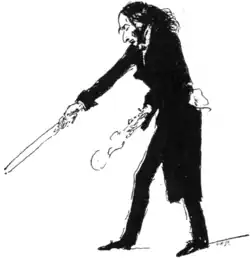
Paganini.
By Sir Edwin Landseer.
On the upper landing hang several remarkable examples of Dadd's work. One is a canvas executed before he went out of his mind; two depict his efforts afterwards. One of the latter is an Eastern market place, the other "The Crooked Path"—an incident from the "Pilgrim's Progress"—done on a sheet of brown paper, and dated Broadmoor, September, 1866. Every face painted bears the sign of insanity! The staircase, which is flooded with light from the beautiful stained-glass window, has many fine canvases, notably Landseer's original study for the companion to "Bolton Abbey in the Olden Time," a genuine Holbein of Harry the Eighth, a Linnell, small but precious, for it cost three hundred guineas, and the sketch for Sir Joshua Reynolds's "Holy Family."
In a small ante-room near here hangs a portrait of Miss Florence Nightingale as she appeared when engaged in her noble duties in the Crimean War. We pause for a moment before a moonlight scene—a picture of the graveyard in the Crimea, and Sir Robert crosses to a table and takes from it a forty-two pound shot, which he places in my hand—a shot of steel, forged and not cast.
"I keep that picture to remind me how very near I was being put to rest there myself," he said, thoughtfully; then, pointing to the cannon ball, he added, "Yes, and that very nearly did it. The story goes a long way to prove that nothing is ever lost by being polite."
Sir Robert Rawlinson is probably the only man living who has been knocked off his horse by a cannon ball. It was Sunday morning, the 18th of June, 1854, in the Crimea, that Sir Robert—then Mr. Rawlinson—was riding out with some young artillery officers down a ravine called "The Valley of the Shadow of Death." A great crowd of our soldiers were assembled on Cathcart's Hill, and the Russians began firing. Mr. Rawlinson called out to a captain:—
"I'm not going any farther; good morning," and raised his hat to salute him. As he did so the shot came whizzing along in front of him, cutting the reins, the pommel of the saddle, and driving a steel purse against the crest of the hip-bone,