Page:The Strand Magazine (Volume 5).djvu/504
He had little sympathy for a nature such as Verschoyle's; and, unconsciously perhaps to himself, the few words he uttered conveyed what was in his mind to the other, who was quick to resent it.
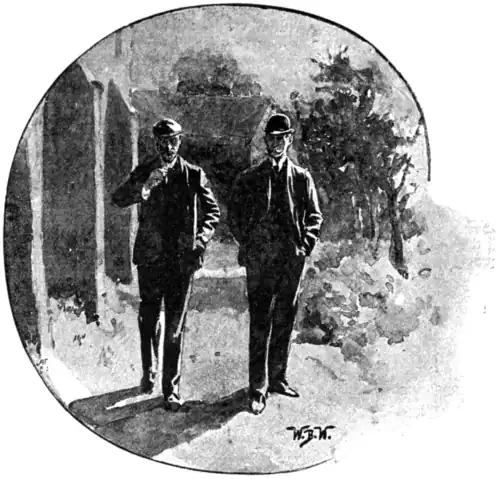
"To and fro in the moonlight."
"Put me in the way of earning money, indeed! No use asking him for a loan; he would be putting all sorts of awkward questions," thought Verschoyle, with the uneasy consciousness that he would find it difficult to explain without incriminating himself. "No, I won't try it! It must be the other way—there's no help for it now. Once out of this hole, I'll put my shoulder to the wheel, and pay him back with the first money I earn. He isn't likely to want the money if I took all instead of a quarter, and I won't take a penny more than that. It will only be a loan after all, which, if he were like anyone else, I could openly ask him for. Yes, I'll do it! If he sees through the trick, it will be easy to say it was only a jest done to try him. But I think I can manage it so quietly that he won't wake, and then I am safe."
On re-entering the room they had quitted—the only habitable sitting-room the Priory could now boast—they found it untenanted, the mother and daughter having retired for the night. The two men sat in desultory conversation, maintained with some effort, until, in reply to a question from Laurence, Meredith admitted that he had had a long day and was inclined for bed. They went up together, and Laurence showed the other into a large, barely-furnished, and somewhat desolate-looking room, with two doors and one high, narrow, iron-barred window.
"Sorry we have no better quarters to offer you, Meredith."
"I am no sybarite, Verschoyle. You'll say that when you see my room at home. My housekeeper is always bewailing my lack of appreciation of what she calls comfort"—taking out his pocket-book as he spoke, and putting it on to the dressing-table before removing his coat.
Laurence took quick note of the position of the book upon the table. "Well, good-night, old fellow"; adding, with an elaborate assumption of carelessness: "Oh, by the way, I'd nearly forgotten there's a key in that door—the one belonging to this must be lost, I fancy; but it seems hermetically sealed. You can't open it, you see," turning and pulling at the handle; "and you are safely barred in at the window," with a little laugh.
"All right, Verschoyle. A barred window and a locked door ought to be enough. Good-night," telling himself they must talk over things in the morning. Too late to enter upon what he wanted to say, just then. In the morning Verschoyle should be made to see that here was a friend who was not to be put off; they must go into matters together.